
Updated October 2026 · Reviewed by Billy Forte
The Texas teen driving cell phone law says a driver under 18 may not use a wireless communication device while driving, and that includes hands-free devices, except in an emergency. It covers teens with a learner license and teens with a provisional license. This guide explains what counts as use, the fines, how the rule is enforced and how it compares with the texting rule for every driver.
Key Facts
- Who: every driver under 18, learner or provisional. See who it covers.
- What: any wireless device, handheld or hands-free. See what counts.
- Exception: an emergency. See the exception.
- Fines: $25 to $99, or $100 to $200 with a prior conviction. See fines.
- All drivers: Texas bans reading, writing or sending a text while driving. See the all-driver rule.
What the Texas Teen Driving Cell Phone Law Says
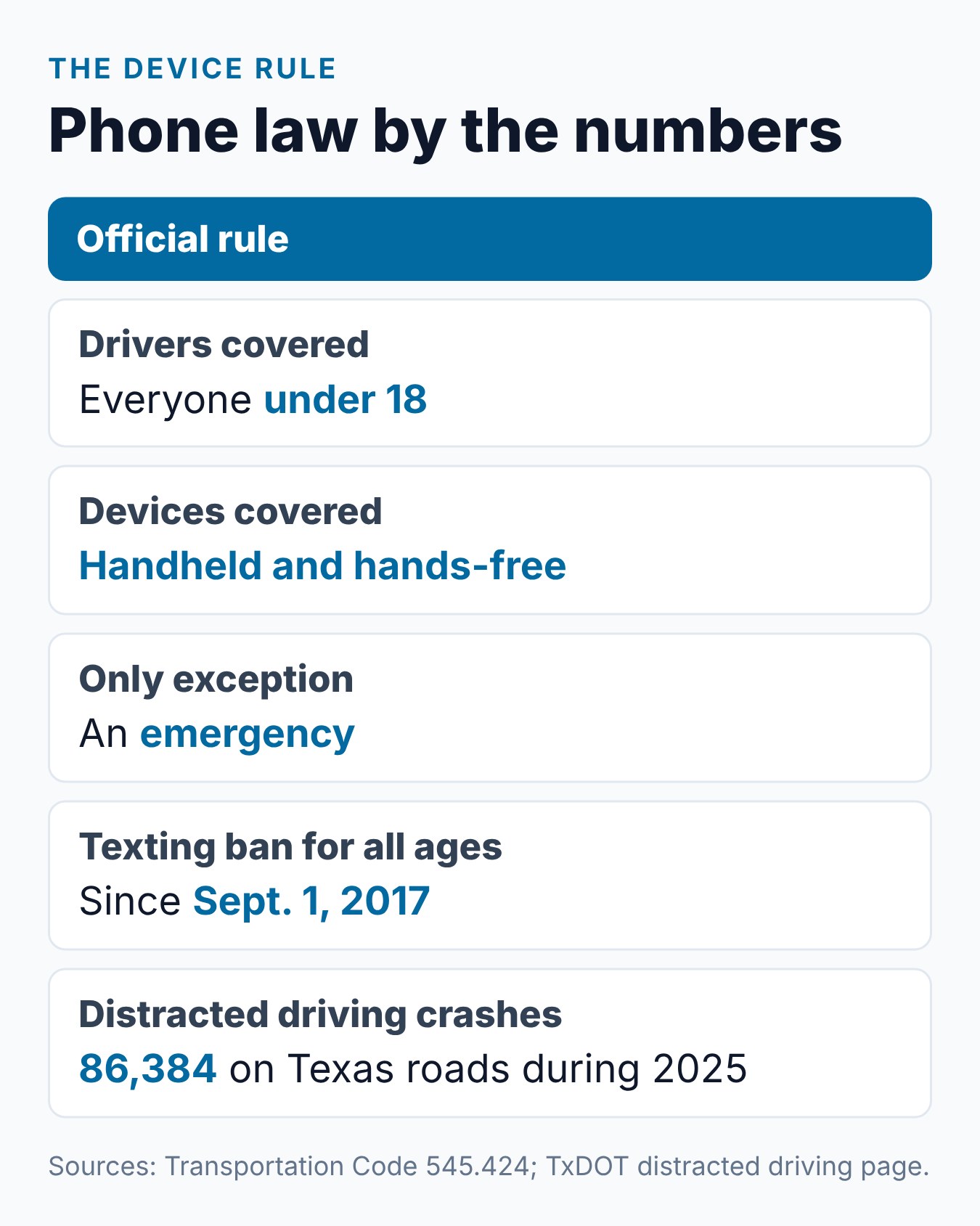
The rule is in Transportation Code 545.424. A person under 18 may not drive while using a wireless communication device, except in case of emergency.
The same section defines the device. It says a “wireless communication device” includes handheld and hands-free devices.
The DPS provisional license page says it in plain words: “All cell phone use is prohibited, including hands-free devices unless it’s an emergency.”
Who the Phone Rule Covers
The statute is about age. It covers any “person under 18 years of age” who is driving.
That means it reaches both teen license stages:
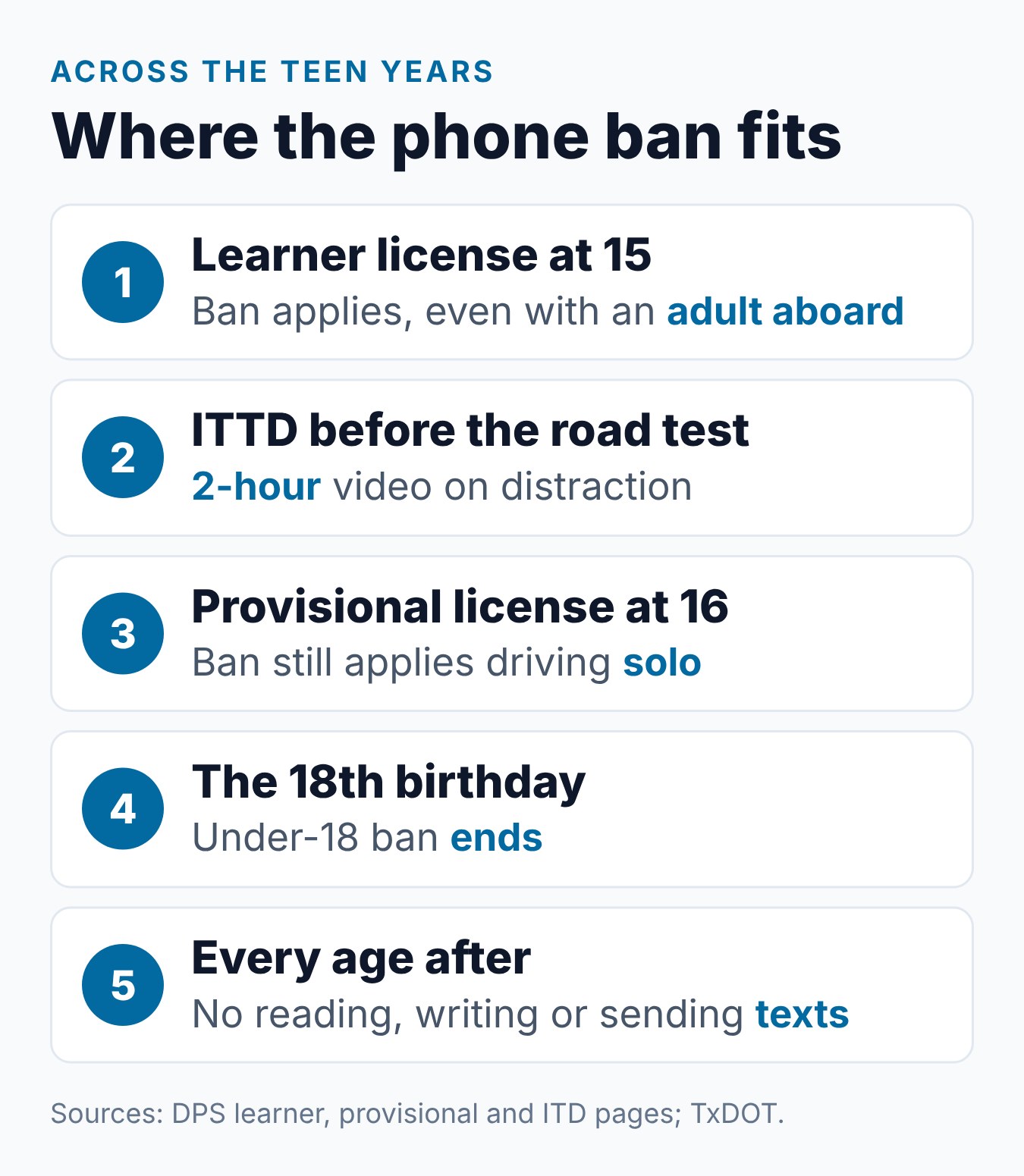
- Learner license holders. The DPS learner license page lists the same ban, including hands-free use.
- Provisional license holders. DPS lists the ban among the provisional limits.
A supervising adult does not change this. The statute’s carve-out for learner-level supervision applies to the late-night and passenger limits, not to the phone rule.
So a 15-year-old learner with a parent in the front seat and a 17-year-old driving alone face the same ban. Age is the only test.
Our guide to learner license restrictions covers the other learner rules.
Handheld and Hands-Free Both Count
The definition is what makes the teen rule strict. A teen cannot get around it with a speaker, a headset or a car system that links to the phone.
| Phone use while driving | Allowed for a driver under 18? |
|---|---|
| Holding the phone for a call | No, except in an emergency |
| A hands-free call through the car or a headset | No, except in an emergency |
| Reading, writing or sending a text | No, except in an emergency |
| Any use in an emergency | Yes, the statute allows it |
The rule is about use while driving. It does not ban a teen from owning a phone or having one in the car.
The table shows why the hands-free part matters. A call through the car’s speakers is still a call, and the statute treats it the same as holding the phone.
The Emergency Exception
The statute allows device use “in case of emergency.” DPS words it as “unless it’s an emergency.”
The statute does not list examples of an emergency. We do not add a list here.
When someone needs urgent help, call 911. Pull over first when it is safe to do so.
Planning cuts down on calls. Share trip plans before the teen leaves, so family members do not need to call while the teen is driving.
Fines and How the Rule Is Enforced
Section 545.424 sets the fine:
- First conviction: $25 to $99.
- With a prior conviction: $100 to $200.
The section also limits traffic stops. A peace officer may not stop a vehicle or detain a driver solely to check for a violation of this section.
That limit does not make phone use legal. The ban applies on every drive, and the fine still applies to a violation.
The amounts add up with repeat tickets. Two convictions could cost between $125 and $299 combined, using the low and high ends of each range.
The Texting Rule for Every Texas Driver
Texas also has a rule for drivers of all ages. TxDOT’s distracted driving page says it has been illegal to read, write or send a text while driving in Texas since Sept. 1, 2017.
TxDOT says violators can face a fine of up to $200. That rule keeps applying after the teen turns 18.
The teen rule is wider. The texting rule is about messages. The under-18 rule covers any use of a wireless device, including hands-free calls.
The Two Phone Rules Side by Side
Here is how the under-18 rule and the all-driver texting rule compare:
| Point | Under-18 rule | Texting rule for all drivers |
|---|---|---|
| Who it covers | Drivers under 18 | Every driver |
| What it bans | Any wireless device use, hands-free included | Reading, writing or sending a text |
| Fine | $25 to $99; $100 to $200 with a prior conviction | Up to $200, per TxDOT |
| When it ends | At 18 | It does not end with age |
| Source | Transportation Code 545.424 | TxDOT distracted driving page |
A teen follows both rules until 18. After that, only the texting rule is left from this pair.
What Texas Crash Data Shows
TxDOT tracks distracted driving crashes. Its distracted driving page reports these figures for the year 2025:
- 86,384 crashes on Texas roads caused by distracted driving
- 299 people killed
- More than 2,437 people seriously injured
The page also says the number of crashes was highest among young drivers. Drivers under 18 are part of that young group.
How ITTD Connects to the Phone Rule
Every teen takes Impact Texas Teen Drivers (ITTD) before the driving test. DPS says it is for drivers 15 to 17 who take a parent-taught or minor driver education course. TDLR describes it as “a free, two-hour informational video about distracted driving.”
The DPS ITD page says the certificate is valid for 90 days. The teen prints it and brings it to the driving test. The course is on the official Impact Texas Drivers site.
Our ITTD guide explains the program.
When the Phone Rule Ends
The under-18 ban is tied to age. It stops when the driver turns 18.
TDLR says the provisional license expires on the 18th birthday. The TDLR step-by-step guide says the driver must renew “to receive a regular driver license without restrictions.”
The texting ban for every driver does not end. It keeps applying at 18 and after.
How the Phone Rule Fits With the Other Teen Limits
Section 545.424 has two more limits for drivers under 18. One bars driving from midnight to 5 a.m. without a listed reason. The other caps riders under 21 who are not family at one.
Those two limits lift with learner-level supervision. The phone rule does not. That makes it the one teen limit that applies on every drive, alone or with an adult.
See our midnight driving rule guide and our passenger limit guide for the details.
What the Law Does Not Spell Out
Some phone questions have no clear answer in the sources we checked. We leave them alone rather than guess.
- Emergencies. The statute allows use in an emergency but gives no list of examples.
- Map and music apps. The DPS pages and the statute summary we used do not address them by name. The device definition still covers hands-free use.
- Owning a phone. The rule is about use while driving. Nothing in it bans a teen from carrying a phone.
If a question is not settled by the text, the careful choice is to leave the device alone while driving.
Questions to Ask Before the First Drive
A short talk can head off problems. These questions come straight from the rule:
- Where will the phone ride, and can the driver reach it?
- Will calls go through the car? If so, how will the teen avoid answering?
- Who will handle directions or messages if a passenger is along?
- What counts as an emergency in your family plan, and when should the teen pull over first?
Setting Phone Rules at Home
The law sets the floor. A family plan can make it easy to follow:
- Put the phone away before the car moves. A phone out of reach is harder to grab.
- Silence alerts before the trip. Fewer alerts mean less pull to look.
- Let messages wait. A reply can be sent after the car is parked.
- Know the one exception. An emergency is the only time the law allows use.
- Model it. Adults in the car can follow the same habits.
Our Review of the Official Pages
On the DPS learner and provisional license pages we checked on October 26, 2026, both listed the phone ban with hands-free use included. The fine amounts come from the statute itself.
TxDOT’s distracted driving page, checked the same day, covered the texting rule for every driver. It did not cover the under-18 rule. For that, read Section 545.424.
Common Mistakes With the Phone Law
Each one goes against the statute or the DPS pages:
- Using a hands-free call. The statute counts hands-free devices.
- Thinking an adult in the car lifts the ban. Supervision does not lift the phone rule.
- Thinking the rule is only for provisional drivers. Learners follow it too.
- Mixing it up with the texting rule. The teen rule covers all device use, not just texts.
- Assuming it ends at 17. It applies to every driver under 18.
- Thinking 18 means anything goes. The texting ban for every driver still applies.
For all three under-18 limits in one table, see Texas provisional license restrictions. For the full licensing path, see our teen driver license guide.
How Requirements Can Vary
Texas driver education rules come from TDLR, and driver license rules come from Texas DPS. They apply statewide, but what you need depends on the student’s age, the course method, and whether the classroom part comes from a parent-taught course, a driving school, or a public school.
Fees, forms, and office procedures can change. Check the TDLR parent-taught pages and the DPS driver license pages before each step, and follow the instructions from your course provider.
Frequently Asked Questions
Can a Texas teen use a hands-free phone while driving?
No. The statute says a wireless communication device includes hands-free devices. A driver under 18 may use one only in an emergency.
Does the phone ban apply to a learner license?
Yes. The DPS learner license page lists the ban, including hands-free use. A supervising adult does not lift it.
What is the fine for a teen using a phone while driving?
Section 545.424 sets a fine of $25 to $99. With a prior conviction, the fine is $100 to $200.
Can police pull my teen over just for phone use?
The statute says a peace officer may not stop a vehicle or detain a driver solely to check for a violation of Section 545.424.
When can my teen use a hands-free device?
After turning 18, the under-18 ban no longer applies. The texting ban for every Texas driver still applies.
Is it legal for my teen to have a phone in the car?
Yes. The rule bans using a wireless device while driving. It does not ban having one in the car.
Is ITTD about phone use?
ITTD is a free, two-hour video about distracted driving. Teens finish it after behind-the-wheel training and within 90 days before the driving test.
Is there an exception for emergencies?
Yes. The statute allows use in case of emergency. It does not list examples.
Conclusion
The Texas teen driving cell phone law bans any phone use by drivers under 18, hands-free included, except in an emergency. It covers learners and provisional drivers, carries a $25 to $99 fine, and gives way at 18 to the texting ban for every driver. Driving Logic’s Texas Parent Taught Drivers Ed course is coming soon, and the DPS teen license pages state the phone rule now.
Related Articles
- How to Get a Texas Driver’s License at 16: The Complete Teen Guide
- Texas Provisional License Restrictions: Complete Rules for 16-Year-Old Drivers
- Texas Learner’s Permit Restrictions: What Your Teen Can and Can’t Do
- What Is Impact Texas Teen Drivers (ITTD)? The Complete Guide
Sources
- Texas Transportation Code § 545.424 — Operation of vehicle by person under 18
- Texas DPS — Texas Provisional License as a Teen
- Texas DPS — Texas Learner License as a Teen
- Texas DPS — Impact Texas Drivers (ITD) Program
- Impact Texas Drivers (official DPS course site)
- TDLR — Parent-Taught Provisional License
- TDLR — Parent-Taught Step-by-Step Guide (PDF)
Billy Forte is the owner of Driving Logic, a state-approved driver improvement course provider serving Texas and other U.S. states.
This article is general information, not legal advice. Texas driver education and licensing rules are set by TDLR, Texas DPS, and Texas law, and can change. Check the official TDLR and DPS websites for current requirements.