
Updated October 2026 · Reviewed by Billy Forte
The Texas teen driving passenger limit says a driver under 18 may carry no more than one passenger under 21 who is not a family member. The rule is in Transportation Code 545.424, and DPS lists it for provisional license holders. This guide shows who counts, who does not, and how the rule works with an adult in the car.
Key Facts
- The limit: one passenger under 21 who is not a family member. See how it works.
- Who is left out of the count: riders 21 or older and family members. See who counts.
- Family member: the statute does not define the term. See the missing definition.
- Adult supervision: the limit does not apply with learner-level supervision. See the carve-out.
- End: the limit stops at 18. See when it ends.
How the Texas Teen Driving Passenger Limit Works
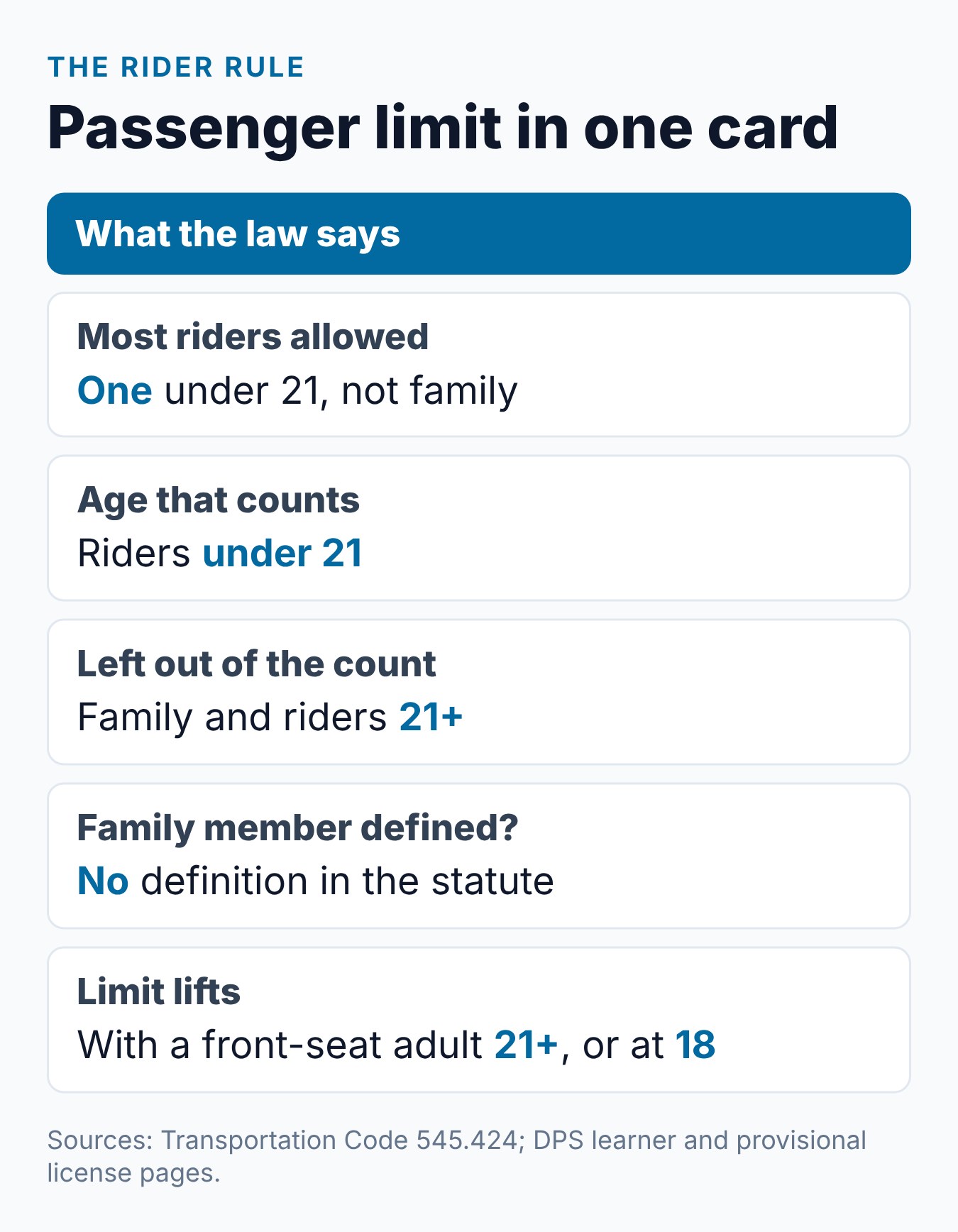
The rule comes from Transportation Code 545.424. A person under 18 may not drive with more than one passenger in the vehicle under 21 who is not a family member.
The DPS provisional license page gives the same rule. It says, “You may not drive with more than one passenger in the vehicle under 21 who is not a family member.”
So the limit is about one group of riders. Those are young riders who are not family. Everyone else is left out of the count.
Who Counts Toward the Limit
A rider counts only if two things are true. The rider is under 21, and the rider is not a family member.
| Rider | Counts toward the limit? | Why |
|---|---|---|
| Friend age 16 | Yes | Under 21 and not family |
| Classmate age 20 | Yes | Under 21 and not family |
| Coworker age 21 | No | 21 or older |
| Neighbor age 35 | No | 21 or older |
| A family member of any age | No | The statute leaves family members out |
The driver is not a passenger. Only the people riding along are counted. A rider who is 21 or older can ride along with any other riders, and the count does not change.
Two Ages to Keep Straight
The rule uses two different ages. Mixing them up is the fastest way to get the count wrong.
- Under 18 is the driver’s age. It decides whether the rule applies at all.
- Under 21 is the rider’s age. It decides whether a rider counts.
So an 18-year-old friend counts as a rider, even though that friend is no longer covered as a driver. A 21-year-old coworker never counts.
The Missing Definition of Family Member
Section 545.424 uses the words “family member” but does not define them. DPS repeats the phrase without a list.
That leaves a gap. This guide does not list which relatives count as family, because the law does not.
If a rider’s status is unclear, the safe choice is to treat that rider as counting. Then plan the trip as if the limit applies.
Worked Examples
Simple counting settles these cases. Here are five trips with the math:
- One friend, age 17. Count: 1. Within the limit.
- Two friends, ages 16 and 19. Count: 2. Over the limit, since both are under 21.
- One friend age 17 and one coworker age 22. Count: 1. The 22-year-old does not count.
- Three friends, ages 21, 23 and 25. Count: 0. Every rider is 21 or older.
- One friend age 18 and one friend age 20. Count: 2. Over the limit.
The age that matters for each rider is under 21, checked on the day of the trip. The driver’s age matters too, because the rule covers drivers under 18.
When the Limit Does Not Apply
The statute has a carve-out. The passenger limit does not apply when the teen drives with the supervision a learner license requires.
The DPS learner license page explains that supervision. A licensed adult 21 or older sits in the front passenger seat.
So a teen with a qualified adult in the front seat is outside the passenger limit. That adult does not count toward the limit either, since the adult is 21 or older.
Who Qualifies as the Supervising Adult
Not every adult in the car lifts the limit. DPS says the learner supervisor is a licensed adult 21 or older in the front passenger seat.
For the 30 practice hours, the TDLR behind-the-wheel page adds a second detail. The practice adult must be licensed for at least one year.
An adult in the back seat does not meet the front-seat rule. Neither does a 20-year-old in the front seat.
Who the Passenger Limit Covers
The statute applies to a “person under 18 years of age.” DPS lists the rule among the provisional license limits.
A learner always drives with a supervising adult. So in practice, the limit shapes trips a teen takes alone with a provisional license.
The rule follows the driver. A teen under 18 who drives a parent’s car, a friend’s car or a work vehicle follows the same limit.
The rule also draws no line between new and seasoned drivers. A teen who just turned 16 and a teen one week short of 18 follow the same limit.
Enforcement and Fines
Section 545.424 sets a fine of $25 to $99. With a prior conviction, the fine is $100 to $200.
The statute also says a peace officer may not stop a vehicle or detain a driver solely to check for a violation of this section. That limits why an officer can make a stop. The passenger rule still applies on every trip.
What Official Sources Say About Risk
We looked for an official Texas source on teen crash risk with young passengers. On the DPS, TDLR and TxDOT pages we reviewed, we did not find a figure on peer passengers.
So we give no number here. We will not repeat a statistic we cannot trace to an official source.
The rule itself is the official guidance. Texas set the limit in statute, and DPS repeats it for every provisional driver.
TxDOT does report on one related risk. Its distracted driving page says the number of distracted driving crashes was highest among young drivers. That page is about distraction in general, not passengers.
How the Limit Works With the Other Rules
The passenger limit is one of three under-18 rules. The other two apply on the same trips.
A teen with one friend in the car still may not use a phone, even hands-free, except in an emergency. The same teen may not drive from midnight to 5 a.m. without a listed reason.
See our midnight driving rule guide and our cell phone law guide. For all three in one table, read Texas provisional license restrictions.
When the Passenger Limit Ends
The limit is tied to the driver’s age. It stops when the driver turns 18.
TDLR says the provisional license expires on the 18th birthday. The TDLR step-by-step guide says the driver must renew “to receive a regular driver license without restrictions.”
Two quick examples: a teen licensed at 16 years and 6 months follows the limit for 18 months. A teen licensed on the 16th birthday follows it for two full years. Our guide on when the restrictions end covers the renewal.
Carpool Math
Carpools are a good place to practice the count. Here are three setups, worked out with the rule:
- School carpool with three classmates, ages 15, 16 and 17. Count: 3. Over the limit. Two of them need another ride.
- Work carpool with one coworker age 25 and one friend age 17. Count: 1. Within the limit.
- Sports practice with two teammates, ages 16 and 16, and a coach age 30 in front. The coach does not count. If the coach is licensed and meets the learner supervision rule, the limit does not apply. If not, the count is 2, which is over.
When in doubt, count again with the two ages in mind. A rider under 21 who is not family is the only kind that counts.
Planning Rides With Friends
A little planning keeps group trips inside the law. These steps follow the statute:
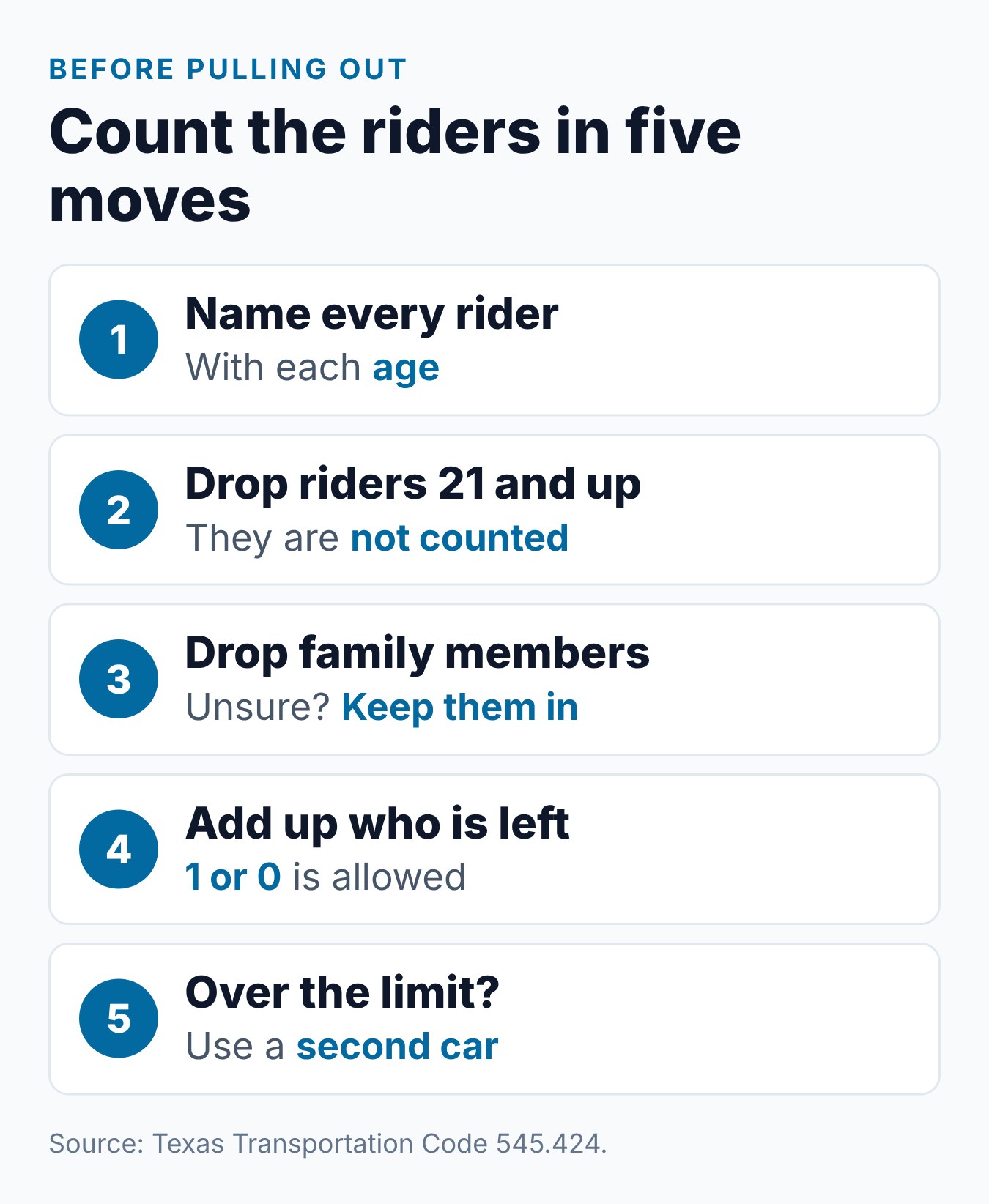
- List the riders. Write down who is coming and how old each one is.
- Take out riders 21 or older. They do not count.
- Take out family members. If you are not sure someone is family, keep them in the count.
- Check the total. One or zero is within the limit.
- Split the group if needed. A second car with another driver can carry the rest.
Our Review of the Rule Text
On the DPS provisional license page we checked on October 26, 2026, the passenger rule matched the statute in substance. Both said one passenger under 21 who is not a family member.
Neither source listed which relatives count as family. That is why our examples use friends, classmates and coworkers. Each example can be checked with simple math and the two ages in the rule.
Common Mistakes With the Passenger Limit
Each of these misreads the statute or the DPS page:
- Counting riders 21 or older. Only riders under 21 count.
- Thinking 18-year-old friends are fine. An 18-year-old is still under 21.
- Assuming the limit is zero. One rider under 21 who is not family is allowed.
- Guessing about family. The law does not define family member.
- Thinking it ends at 17. It applies to every driver under 18.
- Forgetting the other rules. The phone and late-night limits apply on the same trip.
For the full licensing path, see our teen driver license guide.
How Requirements Can Vary
Texas driver education rules come from TDLR, and driver license rules come from Texas DPS. They apply statewide, but what you need depends on the student’s age, the course method, and whether the classroom part comes from a parent-taught course, a driving school, or a public school.
Fees, forms, and office procedures can change. Check the TDLR parent-taught pages and the DPS driver license pages before each step, and follow the instructions from your course provider.
Frequently Asked Questions
How many passengers can a Texas teen driver have?
A driver under 18 may carry no more than one passenger under 21 who is not a family member. Riders 21 or older and family members are not counted.
Does an 18-year-old friend count?
Yes. The limit counts every rider under 21 who is not a family member, so an 18-year-old friend counts.
Who counts as a family member?
The statute does not define the term, and DPS does not list relatives. If you are unsure, count the rider toward the limit.
Do riders in the back seat count?
Yes. The statute and DPS speak of passengers “in the vehicle.” Where a rider sits does not change the count.
Does a learner follow the passenger limit?
A learner always drives with a licensed adult 21 or older in the front seat. With that supervision, the statute says the passenger limit does not apply. The phone ban still applies to learners.
Does the limit apply with a parent in the car?
Not when the teen drives with learner-level supervision, meaning a licensed adult 21 or older in the front passenger seat.
What is the fine for too many passengers?
Section 545.424 sets a fine of $25 to $99. With a prior conviction, the fine is $100 to $200.
When does the passenger limit end?
At 18. The provisional license expires on the 18th birthday, and the renewed license has no under-18 limits.
Conclusion
The Texas teen driving passenger limit allows one rider under 21 who is not a family member, and it leaves out riders 21 or older. Count before each trip, treat unclear cases as counting, and remember the rule ends at 18. Driving Logic’s Texas Parent Taught Drivers Ed course is coming soon, and the DPS provisional license page states the rule in full.
Related Articles
- How to Get a Texas Driver’s License at 16: The Complete Teen Guide
- Texas Provisional License Restrictions: Complete Rules for 16-Year-Old Drivers
- Texas Teen Midnight Driving Rule: What It Is and the Exceptions
- Texas Teen Driving Cell Phone Law: What Parents Should Know
Sources
- Texas Transportation Code § 545.424 — Operation of vehicle by person under 18
- Texas DPS — Texas Provisional License as a Teen
- Texas DPS — Texas Learner License as a Teen
- TDLR — Parent-Taught Behind-the-Wheel Instruction
- TDLR — Parent-Taught Provisional License
- TDLR — Parent-Taught Step-by-Step Guide (PDF)
Billy Forte is the owner of Driving Logic, a state-approved driver improvement course provider serving Texas and other U.S. states.
This article is general information, not legal advice. Texas driver education and licensing rules are set by TDLR, Texas DPS, and Texas law, and can change. Check the official TDLR and DPS websites for current requirements.