
Updated October 2026 · Reviewed by Billy Forte
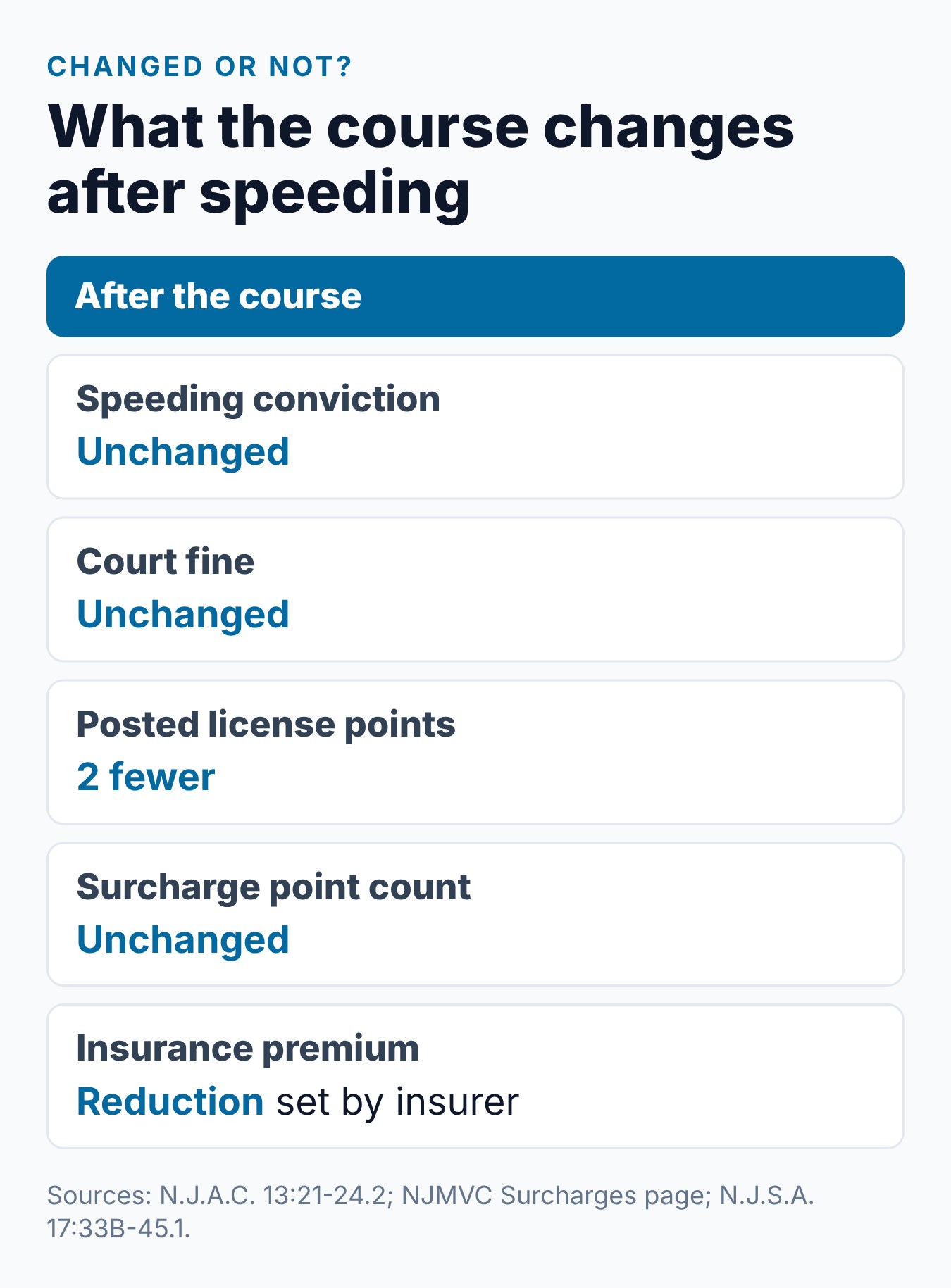
NJ speeding ticket points are 2, 4 or 5, and the defensive driving course cannot stop them from posting or dismiss the ticket. What it can do is take 2 points off your total once they are on your record. It can also earn an insurance premium reduction, with the amount set by your insurer.
Key Facts
- The ticket stays: the course does not dismiss a speeding ticket or change the fine. See what the course does.
- Points first: the 2-point credit applies only to points posted when you finish. See timing.
- Once in five years: the point credit cannot repeat sooner. See the math.
- Insurance: the course reduction ends early if you reach four or more points during its three years. See insurance.
- Surcharge: course credit does not reduce the surcharge point total. See surcharges.
What the Course Can and Cannot Do
A New Jersey defensive driving course is a voluntary class. N.J.A.C. 13:21-24.10 says entry into an approved course is voluntary, and providers may charge an attendance fee.
After a speeding ticket, the course has two benefits and several limits.
What it can do:
- Remove 2 points. N.J.A.C. 13:21-24.2 reduces your points by two after you finish an approved course.
- Earn a premium reduction. State law requires insurers to lower your premium after an approved course.
What it cannot do:
- Dismiss the ticket. The course has no effect on the court case.
- Change the fine. Fines and court costs come from the municipal court that hears your ticket.
- Stop points from posting. The speeding points still go on your record after a conviction.
- Lower your surcharge points. The NJMVC says course credit does not reduce a surcharge point total.
NJ Speeding Ticket Points in Brief
The NJMVC Points Schedule sets speeding points under 39:4-98 by how far over the limit you were: 2 points for 1 to 14 mph over, 4 points for 15 to 29 mph over and 5 points for 30 mph or more over. Our NJ speeding ticket points and fines guide covers speeding in full.
Those points count toward the same totals as every other violation. The NJMVC Point System page sets two levels: 6 or more points within three years brings a surcharge, and 12 or more brings a suspension.
How Speeding Points Reach Your Record
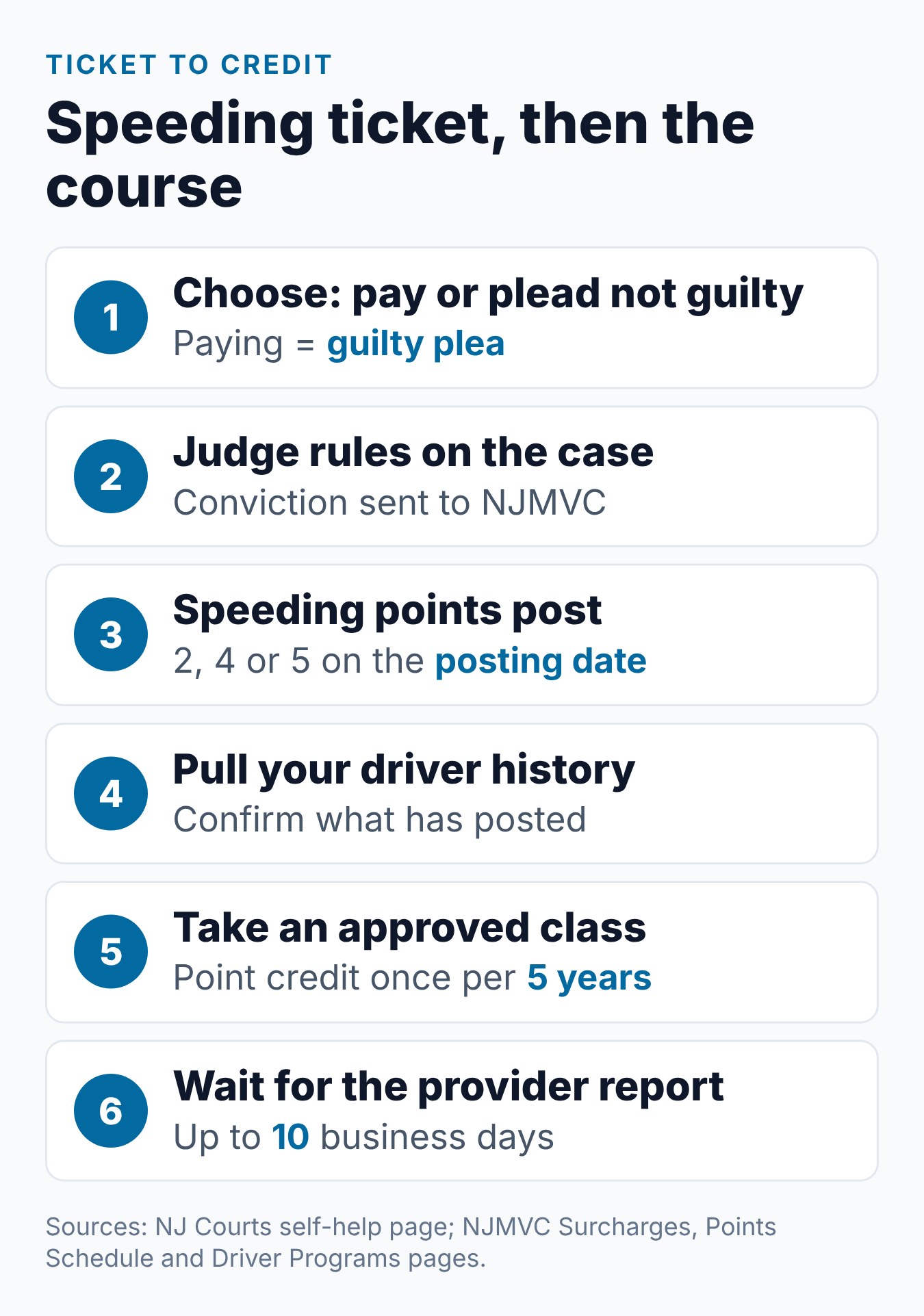
The points are not added at the roadside. They follow the court case.
The NJ Courts municipal court self-help page explains your choices. You can pay the ticket if it does not need a court appearance, but paying the fine means you are pleading guilty. You can also plead not guilty, and the judge hears the case on your court date.
Once there is a conviction, the court sends it to the NJMVC. The NJMVC Surcharges page calls the day the NJMVC enters it on your record the posting date.
If you need time to pay, the self-help page says you are entitled to an installment plan if you cannot pay in full on the day of sentencing. The guide to paying, contesting or taking a course compares your options.
Timing the Course After a Speeding Ticket
Timing decides whether the course helps your point total. The NJMVC Driver Programs page says you get the two-point reduction only if there are points on your record when you complete the course.
That leads to a simple rule of thumb:
- No other points, ticket still in court: a course finished now has no points to reduce.
- Speeding points already posted: a course finished now takes 2 of them off.
- Other points already posted: a course finished now reduces those, and the speeding points add on when they post.
To see what has posted, order your driver history abstract. The NJMVC Driver History page lists online, mail and in-person options for $15.
After you finish, the provider sends proof to the NJMVC within 7-10 business days. The NJMVC does not accept certificates from license holders, so there is nothing for you to mail.
The Math After a Speeding Ticket
The course credit is 2 points, and the total cannot go below zero. Here is how that works with speeding points:
- A 2-point ticket, no other points: 2 minus 2 leaves 0.
- A 4-point ticket, no other points: 4 minus 2 leaves 2.
- A 5-point ticket plus 2 earlier points: 7 minus 2 leaves 5.
- Two 4-point tickets: 8 minus 2 leaves 6.
N.J.A.C. 13:21-24.2 allows the credit no more than once in any five-year period. So if a second speeding ticket comes two years after your course, there is no second course credit for it.
The clean-year credit is separate. The Point System page says one year with no violations or suspensions removes 3 points, and that year begins on the date of the violation. Our 2-point reduction guide explains how the course credit works with it.
Speeding Tickets and the Insurance Reduction
N.J.S.A. 17:33B-45.1 requires insurers to reduce the premium after the named insured or principal operator finishes an approved course. The amount is based on the insurer’s own data, and no state percentage is set.
The reduction lasts three years, starting with the next policy period. The law ends it early if your license is suspended or you build up four or more motor vehicle points.
That rule matters with speeding. One ticket for 15 to 29 mph over carries 4 points by itself. Ask your insurer how it counts points for this rule before you plan around the reduction.
The course reduction is a separate item from any rate change a ticket may cause. Your insurer sets your rate, and the NJMVC Point System page says your insurance company might not factor point deductions into your rate.
Speeding and the 6-Point Surcharge
The NJMVC Surcharges page says 6 or more points within three years from your last posted violation brings a $150 surcharge, plus $25 for each point over six. It can be billed every year for three years.
The same page says the course reduction does not reduce a surcharge point total. Here is what that means:
- A 5-point speeding ticket plus a 2-point ticket: 7 surcharge points, or $175 a year.
- After a course: your license total drops to 5, but the surcharge count stays at 7.
The NJ MVC surcharge points guide covers how surcharges are billed and paid.
Out-of-State Speeding Tickets
A speeding ticket from another state is scored differently. The NJMVC Point System page says a moving violation committed outside New Jersey is assessed 2 points under 39:5D-4.
The speed tiers on the NJMVC schedule are for violations of New Jersey’s speed law, 39:4-98. The out-of-state line is its own entry at 2 points.
Those 2 points count like any others. Once they are on your New Jersey record, a course finished afterward can take them off, within the five-year limit.
Speeding on a Probationary License
Newer drivers have an extra rule. The NJMVC remedial programs page says the Probationary Driver Program is required for probationary license holders with more than two points, or with certain violations.
A single speeding ticket for 15 to 29 mph over is 4 points, which is more than two. So for a probationary driver, one ticket can bring a PDP order.
The PDP removes 3 points and has 120 days to complete. It costs a $75 NJMVC fee plus a class fee of no more than $75. A defensive driving course cannot stand in for it.
Should You Take the Course After This Ticket?
The answer depends on your record and your goals. Here is how the rules sort it out:
- You have points posted and no course credit in five years: the course takes 2 off. That can matter if you are near 12.
- Your only points are from a ticket still in court: wait until they post if you want the point credit.
- You used course credit in the last five years: no point credit is available, though you can ask your insurer about the premium reduction.
- You have a clean record and just want a lower premium: the course can still help, since the insurance rule does not require points.
- You got a PDP or DIP notice: follow the notice first, because a course cannot replace either program.
When a Speeding Stop Becomes More Serious
A speeding stop can lead to other charges too. If it does, look up each one on the NJMVC schedule.
Reckless driving under 39:4-96 is 5 points, and tailgating is 5 points. Those are the same as the top speeding tier.
At 12 or more points, the NJMVC suspends your license and mails a notice of scheduled suspension. N.J.A.C. 13:21-24.2 says course credit does not invalidate a suspension the NJMVC has already proposed. If your total is climbing toward 12, the course works best before that notice.
Common Mistakes After a Speeding Ticket
These come from the NJMVC, the courts and state law:
- Expecting the course to dismiss the ticket. It does not touch the court case or the fine.
- Finishing before any points post. The credit needs points on your record when you finish.
- Paying without knowing it is a guilty plea. The NJ Courts page says paying means pleading guilty.
- Counting on the course to stop a surcharge. It does not reduce the surcharge point total.
- Assuming the insurance reduction lasts no matter what. Four or more points can end it early.
- Taking a second course for a second ticket within five years. No new point credit applies.
How Requirements Can Vary
New Jersey’s point system and defensive driving rules are set by state law and NJMVC rules, and they apply statewide. Fines and court costs come from the municipal court that handles your ticket, so the amount you owe depends on the court and the violation.
Insurance discounts also differ. State law requires insurers to reduce your premium after an approved course, but each insurer sets the amount.
Check the NJMVC Driver Programs page, your driver history abstract, and your insurer for current rules before you sign up for a course.
Frequently Asked Questions
How many points is a speeding ticket in NJ?
It depends on your speed. The NJMVC schedule lists 2 points for 1 to 14 mph over, 4 for 15 to 29 mph over and 5 for 30 mph or more over.
Will the defensive driving course dismiss my NJ speeding ticket?
No. The New Jersey course does not dismiss tickets. It can take 2 points off your total and earn an insurance premium reduction.
Should I take the course before my speeding ticket court date?
Only if you already have other points on your record. The NJMVC gives the 2-point credit only for points on your record when you finish, and speeding points post after a conviction.
Can the course remove all the points from a speeding ticket?
Only from a 2-point ticket with no other points, since 2 minus 2 is 0. A 4-point or 5-point ticket still leaves points after the credit.
Does the course stop my insurance from going up after a speeding ticket?
The law does not say that. It requires a premium reduction after an approved course, set by your insurer, and that reduction can end early at four or more points.
Does an out-of-state speeding ticket add points in NJ?
Yes. The NJMVC assesses 2 points for a moving violation committed outside New Jersey. A course finished after those points post can take them off.
Can I take the course online after a speeding ticket?
Yes. The NJMVC lists State-approved online and classroom courses. Each must give at least six hours of instruction.
Conclusion
After a speeding ticket, the New Jersey course cannot dismiss the ticket or change the fine. It can take 2 points off once the points post, and it can earn an insurance premium reduction set by your insurer. Driving Logic’s New Jersey Defensive Driving Course is coming soon, and State-approved providers are listed on the NJMVC Driver Programs page.
Related Articles
- How to Check Points on License NJ: Your Record Guide
- How Much Is a Speeding Ticket in NJ? Points and Fines
- NJ Defensive Driving 2 Point Reduction: How It Works
- NJ Traffic Ticket Options: Pay, Contest, or Defensive Driving
Sources
- NJMVC — Driver Programs (defensive driving course, DIP, PDP, approved providers)
- NJMVC — Points Schedule
- NJMVC — Point System and Suspensions
- NJMVC — Surcharges
- N.J.A.C. 13:21-24.2 — Point reduction for a defensive driving course
- N.J.A.C. 13:21-24.10 — Voluntary course; fees
- N.J.A.C. 13:21-24.5 — Course length and content
- N.J.S.A. 17:33B-45.1 — Insurance premium reduction after a defensive driving course
- New Jersey Courts — Municipal Court Self-Help
- NJMVC — Driver History Abstract
- NJMVC — Driver Improvement and Probationary Driver Programs
- NJMVC — Probationary Driver Program FAQ
Billy Forte is the owner of Driving Logic, a state-approved driver improvement course provider serving Florida and other U.S. states.
This article is general information, not legal advice. New Jersey point rules, surcharges, and insurance discounts are set by New Jersey law, the Motor Vehicle Commission, and your insurer, and can change. Check the NJMVC website, the court on your ticket, and your insurer for current requirements.