
Updated October 2026 · Reviewed by Billy Forte
The answer to how to check points on license NJ records is to order your driver history abstract from the New Jersey Motor Vehicle Commission (NJMVC) for $15. You can order it online, by mail or in person, and it lists your New Jersey moving violations, points, accidents and suspensions from the last five years. Once you have it, you can add up your points and see how close you are to the levels that bring a surcharge or a suspension.
Key Facts
- Where to look: your NJMVC driver history abstract. See how to check.
- Cost: $15, online, by mail with Form DO-21, or in person. See the three ways.
- What it covers: five years of moving violations, points, accidents and suspensions. See what it shows.
- Levels to watch: 6 or more points in three years brings a surcharge, and 12 or more brings a suspension. See why your total matters.
- Ways points come off: a clean year, the defensive driving course and NJMVC programs. See how points come off.
How to Check Points on License NJ Records
The NJMVC Point System and Suspensions page points you to one place for your point count. That place is your driver history, which the NJMVC calls a driver history abstract.
A traffic ticket does not tell you your total. The ticket shows one charge, and points are tied to the violation on your record. The abstract shows what the NJMVC has on file.
You may hear people say “NJ DMV points.” In New Jersey, the agency is the Motor Vehicle Commission, so search for your record on the NJMVC site.
Three Ways to Get Your Abstract
The NJMVC Driver History Abstract page lists three ways to order. Each one costs $15.
| Way to order | What you need | How you pay |
|---|---|---|
| Online | A User ID, your NJ driver license or ID, and a card | Credit or debit card |
| By mail | Form DO-21 and a photocopy of your NJ license or ID | Check or money order payable to NJMVC |
| In person | Your NJ license or ID and Form DO-21 | Card, cash, check or money order at the counter |
Mail requests go to the NJMVC Abstract Unit, PO Box 142, Trenton, NJ 08666-0142. You can get Form DO-21 from the NJMVC site.
The online route needs a User ID before you start, so set that up first. Our NJ driving record guide walks through each route one step at a time.
What Your Abstract Shows
The NJMVC says the abstract covers the last five years. It lists four kinds of entries:
- Moving violations that posted to your New Jersey record.
- Points tied to those violations.
- Accidents on your record.
- Suspensions of your driving privilege.
The NJMVC also keeps a permanent record of every point, even after points are taken off. So you may see older points listed next to reductions. Your current total is what remains after those reductions.
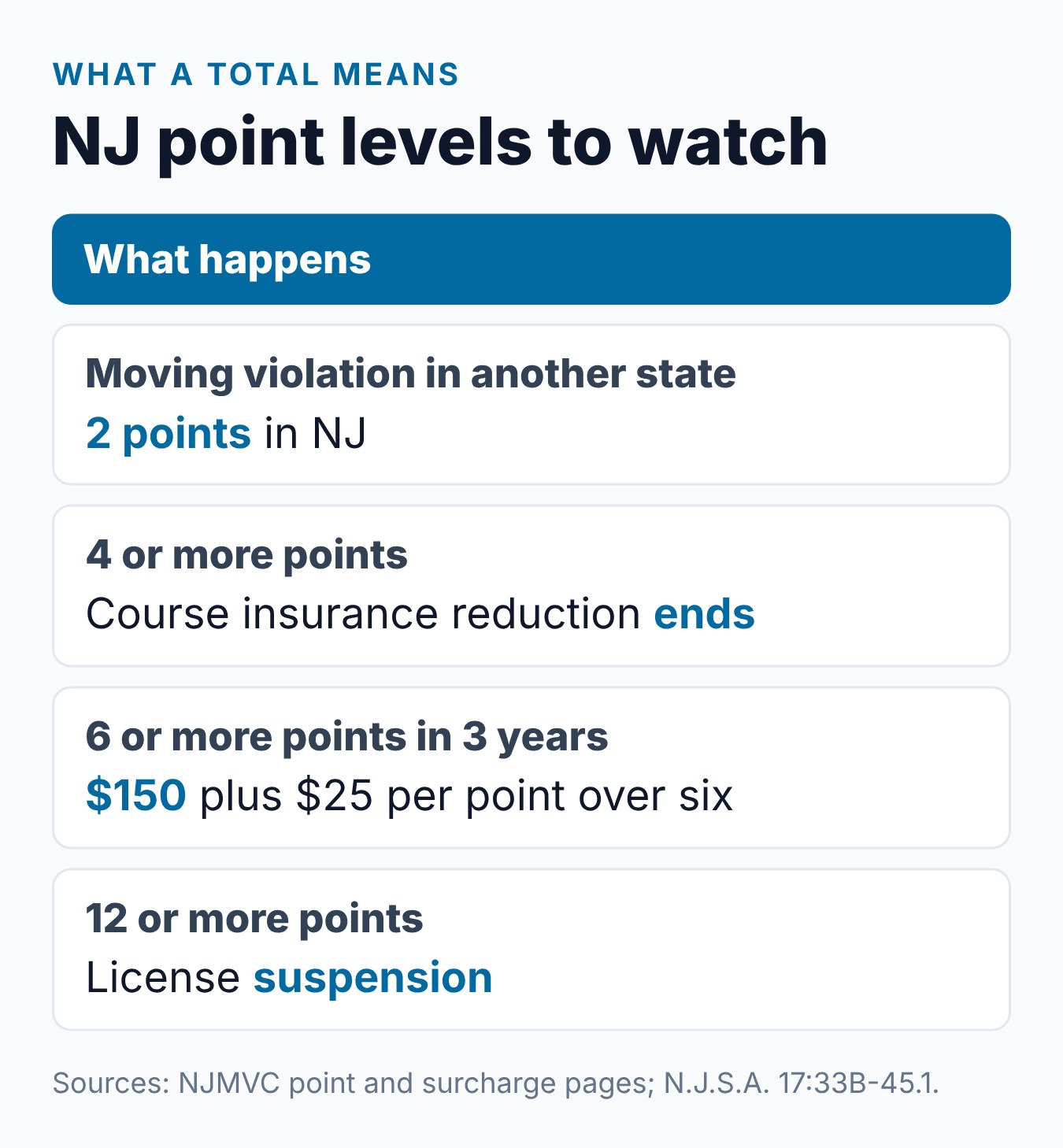
Violations from other states count too. The NJMVC assesses 2 points for a moving violation committed outside New Jersey.
How to Count Your Points From the Abstract
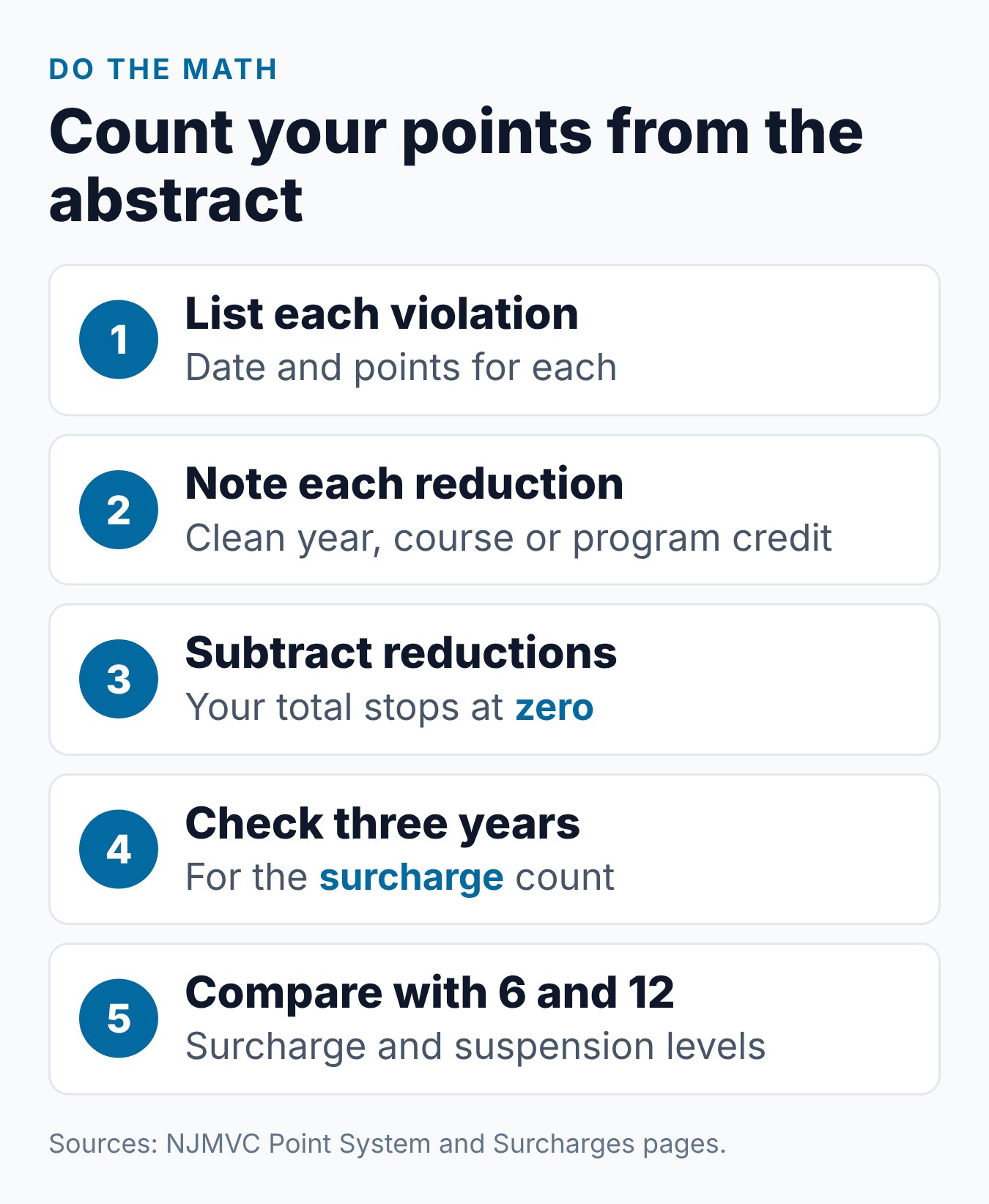
Once your abstract arrives, you can do the math yourself. Work through it in this order:
- List each violation. Write down the date and the points for each one.
- Note each reduction. Look for safe-driving credits, a defensive driving credit or a program credit.
- Subtract the reductions. Your total cannot go below zero.
- Check the three-year window. For the surcharge level, add the points posted within three years of your last violation.
- Compare with 6 and 12. Those are the two levels the NJMVC uses.
Here is a simple example. Say you have a 4-point violation and a 2-point violation, and you finished an approved course after both. That is 6 points, minus 2, which leaves 4 on your current total.
The surcharge count works in a different way. The NJMVC Surcharges page says course and safe-driving credits do not lower a surcharge point total. Our surcharge guide explains that rule.
How New Jersey Points Work
New Jersey adds points for moving violations. The number depends on the violation, and the NJMVC Points Schedule lists each one.
A few values from that schedule show the range:
- Careless driving: 2 points.
- Improper turns: 3 points.
- Speeding 15 to 29 mph over the limit: 4 points.
- Reckless driving: 5 points.
- Leaving the scene of a crash with personal injury: 8 points.
Some violations carry no points. The schedule lists a red light camera violation at 0 points.
Our guide to NJ license points by violation has the full table. If a ticket put you at a total of four, see 4 points on an NJ license.
Why Your Point Total Matters
Your total is more than a number. It decides when the NJMVC acts.
Six Points and the Surcharge
The NJMVC Point System page says 6 or more points within three years brings a surcharge. The NJMVC Surcharges page sets it at $150, plus $25 for each point over six.
That amount is billed each year for three years. It is separate from any court fine. The surcharge guide covers the full amounts and how to pay.
Twelve Points and Suspension
The NJMVC says 12 or more points leads to a license suspension. You get a notice of scheduled suspension by mail.
The length depends on how many points you have and how fast you got them. Those terms come from N.J.A.C. 13:19-10.2. Our guide to NJ license suspension points has the full breakdown.
Points and Your Insurance
The NJMVC says points may raise your insurance rates, and it tells drivers to check with their insurer. It also says your insurer may not apply point reductions to your rate.
Points also matter for the defensive driving insurance reduction. Under N.J.S.A. 17:33B-45.1, that reduction ends early if you build up four or more points. Read the insurance discount guide for the details.
How Points Come Off
Points do not stay on your current total forever. The NJMVC lists four ways your total goes down:
- A clean year: 3 points off for a year with no violations or suspensions.
- The defensive driving course: 2 points off, once every five years.
- The Driver Improvement Program: 3 points off, in response to an NJMVC proposed action.
- The Probationary Driver Program: 3 points off, one time, when ordered.
Our guide to automatic point reduction in NJ compares all four.
The defensive driving course is the one you can choose on your own. N.J.A.C. 13:21-24.2 says an approved course takes off two points. It works only on points already on your record, and your total cannot drop below zero.
The course does not dismiss a ticket. Its two benefits are the 2-point reduction and an insurance premium reduction. See how the 2-point reduction works for the full rule.
Good Times to Check Your Points
A few moments make a fresh abstract worth ordering. Each ties to an NJMVC rule:
- Before a defensive driving course. The NJMVC gives the 2-point credit only if you have points on your record when you finish.
- After a court case ends. A surcharge is based on the date the violation posts, so confirm it posted.
- When a notice arrives. A notice of scheduled suspension or a surcharge bill should match your abstract.
For more on timing the course, see when to take the NJ defensive driving course.
Our Review of the NJMVC Point Pages
On the NJMVC Point System and Surcharges pages we checked on October 25, 2026, three details stood out for anyone counting points:
- Two counts, not one. Clean-year and course credits lower your current total. The Surcharges page says they do not lower a surcharge point total.
- Posting date rules. The Surcharges page says a surcharge is based on the date a violation posts, not the ticket date.
- Out-of-state tickets. A moving violation in another state adds 2 points to your New Jersey record.
That is why a fresh abstract is worth the $15. It shows posting dates and reductions that a ticket cannot show.
Guides on NJ Points and the Course
Each guide below covers one part of the point system in depth:
- How the NJ defensive driving course can reduce 2 points: the rule, the reporting and the limits.
- How often you can take the NJ defensive driving course: the five-year rule and the three-year insurance period.
- NJ defensive driving insurance discount: what the law requires and what to ask your insurer.
- NJ MVC surcharge: amounts, payments and what happens if you do not pay.
- NJ license points by violation: the points for each common violation.
- 4 points on your NJ license: what a 4-point total means.
- Automatic point reduction in NJ: how points come off over time.
- When to take the NJ defensive driving course: timing the course.
- NJ defensive driving after a speeding ticket: what the course can do after a speeding conviction.
Common Mistakes When Checking Points
These mistakes come from the NJMVC rules above:
- Counting tickets, not convictions. Check what posted to your abstract, not what the ticket says.
- Reading the permanent history as your total. Old points stay listed even after reductions.
- Using one count for everything. Credits lower your current total, but not your surcharge point total.
- Forgetting out-of-state tickets. They add 2 points to your New Jersey record.
- Sending your own course certificate. The NJMVC Driver Programs page says certificates from license holders are not accepted.
How Requirements Can Vary
New Jersey’s point system and defensive driving rules are set by state law and NJMVC rules, and they apply statewide. Fines and court costs come from the municipal court that handles your ticket, so the amount you owe depends on the court and the violation.
Insurance discounts also differ. State law requires insurers to reduce your premium after an approved course, but each insurer sets the amount.
Check the NJMVC Driver Programs page, your driver history abstract, and your insurer for current rules before you sign up for a course.
Frequently Asked Questions
How do I check how many points are on my NJ license?
Order your driver history abstract from the NJMVC. It costs $15 online, by mail with Form DO-21, or in person. It lists your points, moving violations, accidents and suspensions from the last five years.
How much does an NJ driver history abstract cost?
The fee is $15 for each way you order it. Online orders take a credit or debit card. Mail orders take a check or money order payable to NJMVC.
How far back does the abstract go?
The NJMVC says it covers the last five years. It lists New Jersey moving violations, points, accidents and suspensions in that time.
How many points before NJ suspends my license?
Twelve or more points leads to a suspension. The NJMVC mails a notice of scheduled suspension. The length depends on your total and how fast you reached it.
Do out-of-state tickets add points in New Jersey?
Yes. The NJMVC assesses 2 points for a moving violation committed outside New Jersey.
Can a defensive driving course remove a ticket?
No. An approved course takes 2 points off your current total, once every five years, and can lower your insurance premium. It does not dismiss the ticket or the conviction.
Why does my abstract show points that were already reduced?
The NJMVC keeps a permanent record of all points, even after deductions. Your current total is the points left after reductions are subtracted.
Conclusion
The way to check points on your NJ license is a $15 driver history abstract from the NJMVC. Count the points, subtract reductions and compare your totals with the 6-point and 12-point levels.
The New Jersey Defensive Driving Course from Driving Logic is coming soon. Until then, find State-approved providers on the NJMVC Driver Programs page.
Related Articles
- NJ Defensive Driving 2 Point Reduction: How It Works
- How Often Can You Take NJ Defensive Driving Course?
- NJ Defensive Driving Insurance Discount: What to Ask Your Insurer
- NJ MVC Surcharge: What It Is and How Points Trigger It
- NJ Points on License: What Each Common Violation Is Worth
- 4 Points on Your NJ License: What It Means and How the DDC Helps
- How to Reduce Points on License NJ: Automatic Credits
- When Should You Take the NJ Defensive Driving Course? The Best Times
- NJ Speeding Ticket Points: Does Defensive Driving Help?
Sources
- NJMVC — Driver History Abstract
- NJMVC — Form DO-21, Application for Driver History Abstract
- NJMVC — Point System and Suspensions
- NJMVC — Points Schedule
- NJMVC — Surcharges
- NJMVC — Driver Programs (defensive driving course, DIP, PDP, approved providers)
- N.J.A.C. 13:21-24.2 — Point reduction for a defensive driving course
- N.J.A.C. 13:19-10.2 — Suspension for points
- N.J.S.A. 17:33B-45.1 — Insurance premium reduction after a defensive driving course
Billy Forte is the owner of Driving Logic, a state-approved driver improvement course provider serving Florida and other U.S. states.
This article is general information, not legal advice. New Jersey point rules, surcharges, and insurance discounts are set by New Jersey law, the Motor Vehicle Commission, and your insurer, and can change. Check the NJMVC website, the court on your ticket, and your insurer for current requirements.