
Updated October 2026 · Reviewed by Billy Forte
The best answer to when to take NJ defensive driving course credit is after your points have posted and before the New Jersey Motor Vehicle Commission (NJMVC) proposes a suspension. That timing lets the 2-point credit count. If you only want the insurance premium reduction, you can take the course at any time, even with no points.
Key Facts
- Points first: the 2-point credit applies only to points on your record when you finish. See after points post.
- Before 12 points: course credit does not cancel a suspension the NJMVC has already proposed. See before a suspension.
- Five-year gap: the point credit is allowed once in any five-year period. See the five-year limit.
- Insurance any time: the premium reduction does not depend on points. See insurance timing.
- Not for a surcharge: the course does not reduce your surcharge point total. See what timing cannot fix.
When to Take NJ Defensive Driving Course Credit for Points
The course is voluntary. N.J.A.C. 13:21-24.10 says entry into an approved course is voluntary, and providers may charge an attendance fee.
Since no one orders you to take it, timing is up to you. The best time depends on why you want it:
- To lower your point total: after the points are on your record.
- To stay away from a suspension: well before your total nears 12.
- To lower your insurance premium: any time, ideally with your policy renewal in mind.
The table below sums up the timing rules from the NJMVC and state law.
| Your situation | Good time for the course? | The rule behind it |
|---|---|---|
| Points are posted on your record | Yes | Credit applies to points on record at completion |
| Ticket is still in court, no other points | Wait | No posted points means no point credit yet |
| Course credit used less than five years ago | No point credit | Once in any five-year period |
| NJMVC has proposed a suspension | Too late to cancel it | Credits do not invalidate a proposed suspension |
| NJMVC offered you the DIP | Do the DIP | A course cannot be substituted |
| No points, want a lower premium | Yes | Insurance reduction does not require points |
Take It After Your Points Post
The NJMVC Driver Programs page is direct about this. You get the two-point reduction only if there are points on your driving record at the time you complete the course.
Points post after a conviction, not on the day of the stop. The NJMVC Surcharges page explains that the court sends the conviction to the NJMVC, which enters it on your record.
So if your only points would come from a ticket still in court, a course finished now has nothing to reduce. Check your record first.
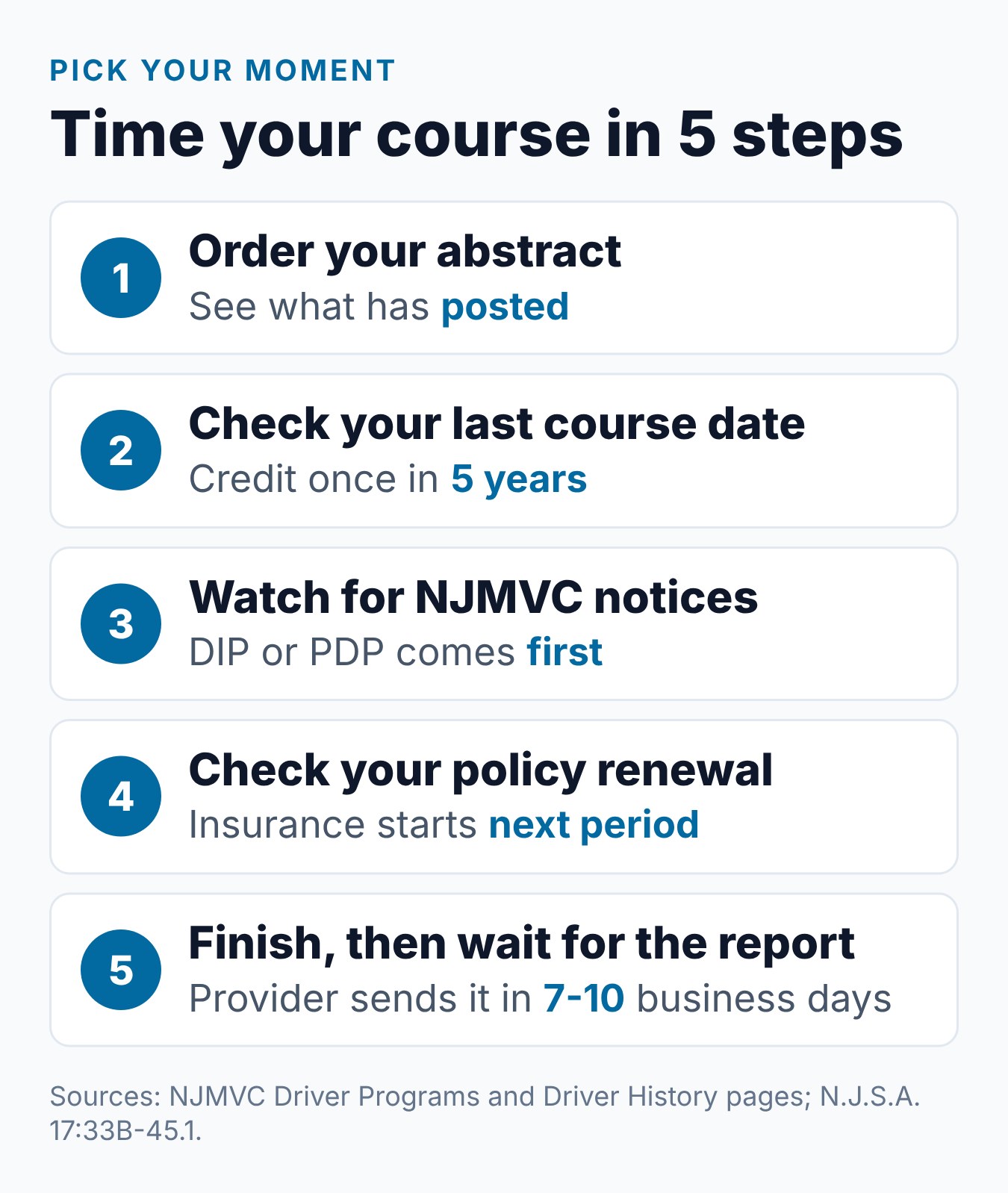
The NJMVC Driver History page lets you order an abstract for $15. It covers five years of moving violations, points, accidents and suspensions.
Simple math shows why this matters. With 5 points posted, a course leaves 3. With 0 posted, it leaves 0, because the total cannot go below zero.
Take It Before a Suspension Is Proposed
The NJMVC Point System page says a total of 12 or more points means your license will be suspended. You get a notice of scheduled suspension by mail.
N.J.A.C. 13:21-24.2 adds a timing rule. Credits from the course do not invalidate a suspension the NJMVC has already proposed for too many points.
That makes the window before a notice the useful one. Here is how it can play out:
- At 11 points, before any notice: a course takes the total to 9.
- At 11 points, then a 2-point ticket posts: the total is 13, and a suspension can be proposed.
- After the notice: a course credit does not cancel that proposed suspension.
The middle case shows the risk of waiting. If you are getting close to 12, the earlier window is the safer one.
Plan Around the Five-Year Limit
The credit is limited. N.J.A.C. 13:21-24.2 allows it no more than once in any five-year period, and the NJMVC page says the same.
The rule measures time from the dates of the offenses and the date you finish the course. So the date you complete the course becomes the start of your next five-year wait.
That makes your choice of moment matter. If you take the course for a 2-point total today, you cannot use it again for points for five years, even if a bigger ticket comes later.
There is no single right answer here. A driver close to 12 has a strong reason to act now. A driver with a small total may want to compare the credit with the insurance reduction and decide.
The how often you can take the course guide covers the five-year rule in detail.
Timing for the Insurance Reduction
The insurance side runs on its own clock. N.J.S.A. 17:33B-45.1 requires insurers to reduce the premium after the named insured or principal operator completes an approved course.
The law sets three timing rules:
- Start: the reduction begins with the next policy period after you finish.
- Length: it lasts three years.
- Early end: it stops if your license is suspended or you build up four or more points.
The law does not require points for this benefit. So a driver with a clean record can take the course just for the premium reduction.
The amount is up to your insurer, based on its own data, with no state percentage. The DOBI auto insurance guide says New Jersey law requires insurers to offer discounts for drivers who complete an NJMVC-approved course.
Because the reduction starts with the next policy period, check your renewal date before you sign up. Then ask your insurer what proof it needs. The NJ defensive driving insurance discount guide lists the questions.
Timing With Two Tickets
Two tickets close together make timing harder. The credit works on what is posted when you finish, and you only get it once in five years.
Say you have a 2-point ticket already posted and a 4-point speeding ticket still in court. If you finish the course now, the credit takes your total from 2 to 0. When the speeding ticket posts later, you are at 4, and the course credit is used up for five years.
If you wait until the second ticket posts, your total is 6. A course then takes it to 4.
The end number is the same in this example, 4 points. What changes is how long you sit at a higher total and when your five-year wait starts. Waiting also does not change the surcharge, since the course does not reduce the surcharge point total.
A Timing Guide by Point Total
Your current total is a good starting point. Here is how the rules apply at each level:
- 0 points: no point credit is possible. The course can still earn an insurance premium reduction.
- 1 to 5 points: a course lowers your total by 2, or to 0 if you have only 1. Weigh that against saving the credit for later.
- 6 to 11 points: a course still lowers your license total. It will not stop a surcharge, but it moves you further from 12.
- 12 or more points: if the NJMVC has already proposed a suspension, the course credit will not cancel it. Read your notice and follow it.
Leave Time for the Report
Finishing the course is not the last step. The provider has to tell the NJMVC.
The NJMVC Driver Programs page says the provider sends proof of completion within 7-10 business days. It also says certificates are not accepted from license holders.
The state rule, N.J.A.C. 13:21-24.8, says the sponsoring agency sends a certified list of students who completed within 10 days of each course. If you are timing the course around a point total, leave room for that step.
When a Different Program Comes First
Sometimes the NJMVC decides the timing for you. Two programs work that way.
The NJMVC remedial programs page says you can take the Driver Improvement Program only after the NJMVC sends a notice offering it. A defensive driving course cannot be used in its place.
The Probationary Driver Program is required for probationary license holders with more than two points or certain violations. The PDP FAQ gives 120 days to complete it.
If you get either notice, follow it first. The defensive driving course is a separate, voluntary choice.
What Good Timing Cannot Fix
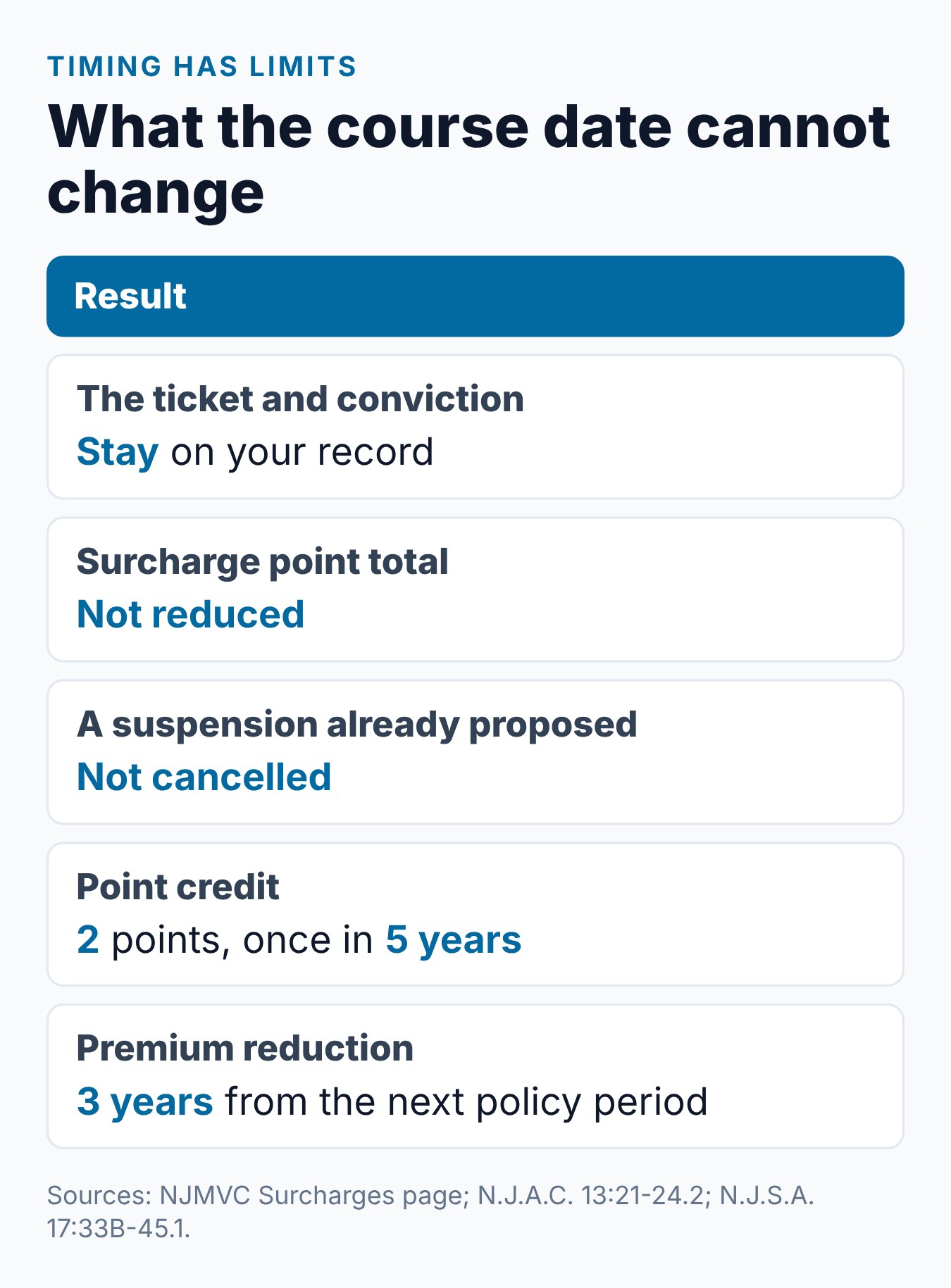
Some things stay the same no matter when you take the course:
- The ticket. The course does not dismiss it or change the conviction.
- The surcharge. The NJMVC Surcharges page says the course reduction does not reduce a surcharge point total. So 6 points within three years still brings a surcharge.
- A proposed suspension. Credit does not cancel one that is already proposed.
- Your record. The NJMVC keeps a permanent record of points.
Common Timing Mistakes
These mistakes come from the NJMVC and state rules:
- Finishing before the points post. No posted points means no point credit.
- Waiting for the suspension notice. Credits do not undo a proposed suspension.
- Using the credit on a small total, then needing it later. It is once in any five-year period.
- Mailing your certificate to the NJMVC. Only the provider can report completion.
- Taking the course instead of an offered DIP. A course cannot replace the DIP.
How Requirements Can Vary
New Jersey’s point system and defensive driving rules are set by state law and NJMVC rules, and they apply statewide. Fines and court costs come from the municipal court that handles your ticket, so the amount you owe depends on the court and the violation.
Insurance discounts also differ. State law requires insurers to reduce your premium after an approved course, but each insurer sets the amount.
Check the NJMVC Driver Programs page, your driver history abstract, and your insurer for current rules before you sign up for a course.
Frequently Asked Questions
Should I take the NJ defensive driving course before my court date?
For point credit, there is no gain if those are your only points. The NJMVC gives the credit only for points on your record when you finish, and a pending ticket’s points post after a conviction.
Should I take the NJ defensive driving course with no points?
You can, for the insurance premium reduction. State law requires insurers to reduce the premium after an approved course, but you will get no point credit with a zero total.
How soon after finishing do my points drop?
The provider notifies the NJMVC within 7-10 business days, according to the Driver Programs page. The NJMVC then applies the credit to your record.
Can I take the course after getting a suspension notice?
You can, but N.J.A.C. 13:21-24.2 says the credit does not invalidate a suspension the NJMVC has already proposed. It may still lower your total for the future.
Can I take the course again in three years?
You can attend, but you will not get the point credit again. The reduction is allowed once in any five-year period.
Can I take the course online?
Yes. The NJMVC lists State-approved classroom and online courses. Under N.J.A.C. 13:21-24.5, both formats need at least six hours of instruction.
Is there a course for older drivers?
Yes. The NJMVC Driver Programs page lists State-approved mature driver courses for drivers 55 and older, along with classroom and online courses.
Conclusion
The best time to take the NJ defensive driving course is after your points post and before any suspension is proposed. For insurance alone, any time works, but check your renewal date and remember the five-year limit on point credit. Driving Logic’s New Jersey Defensive Driving Course is coming soon, and State-approved providers are listed on the NJMVC Driver Programs page.
Related Articles
- How to Check Points on License NJ: Your Record Guide
- How Often Can You Take NJ Defensive Driving Course?
- NJ Defensive Driving Insurance Discount: What to Ask Your Insurer
- NJ Defensive Driving 2 Point Reduction: How It Works
Sources
- NJMVC — Driver Programs (defensive driving course, DIP, PDP, approved providers)
- N.J.A.C. 13:21-24.2 — Point reduction for a defensive driving course
- N.J.A.C. 13:21-24.10 — Voluntary course; fees
- N.J.A.C. 13:21-24.5 — Course length and content
- N.J.A.C. 13:21-24.8 — Certification of course completion
- N.J.S.A. 17:33B-45.1 — Insurance premium reduction after a defensive driving course
- NJ Department of Banking and Insurance — Everything Auto Insurance (2026)
- NJMVC — Point System and Suspensions
- NJMVC — Surcharges
- NJMVC — Driver History Abstract
- NJMVC — Driver Improvement and Probationary Driver Programs
- NJMVC — Probationary Driver Program FAQ
Billy Forte is the owner of Driving Logic, a state-approved driver improvement course provider serving Florida and other U.S. states.
This article is general information, not legal advice. New Jersey point rules, surcharges, and insurance discounts are set by New Jersey law, the Motor Vehicle Commission, and your insurer, and can change. Check the NJMVC website, the court on your ticket, and your insurer for current requirements.