
Updated October 2026 · Reviewed by Billy Forte
The simplest answer to how to reduce points on license NJ drivers can use is time: the New Jersey Motor Vehicle Commission (NJMVC) takes 3 points off after one year with no violations or suspensions. That happens without a class or a form. A defensive driving course, the Driver Improvement Program and the Probationary Driver Program can take off more, each under its own limits.
Key Facts
- Automatic credit: 3 points off for each clean 12 months. See the safe driving credit.
- When the clock starts: the date of your last violation or your most recent restoration. See the start date.
- Four official reductions: clean year, course, DIP and PDP. See the reductions table.
- Floor: no credit can take your total below zero. See limits.
- Record stays: the NJMVC keeps a permanent record of your points. See what does not go away.
How the Automatic 3-Point Credit Works
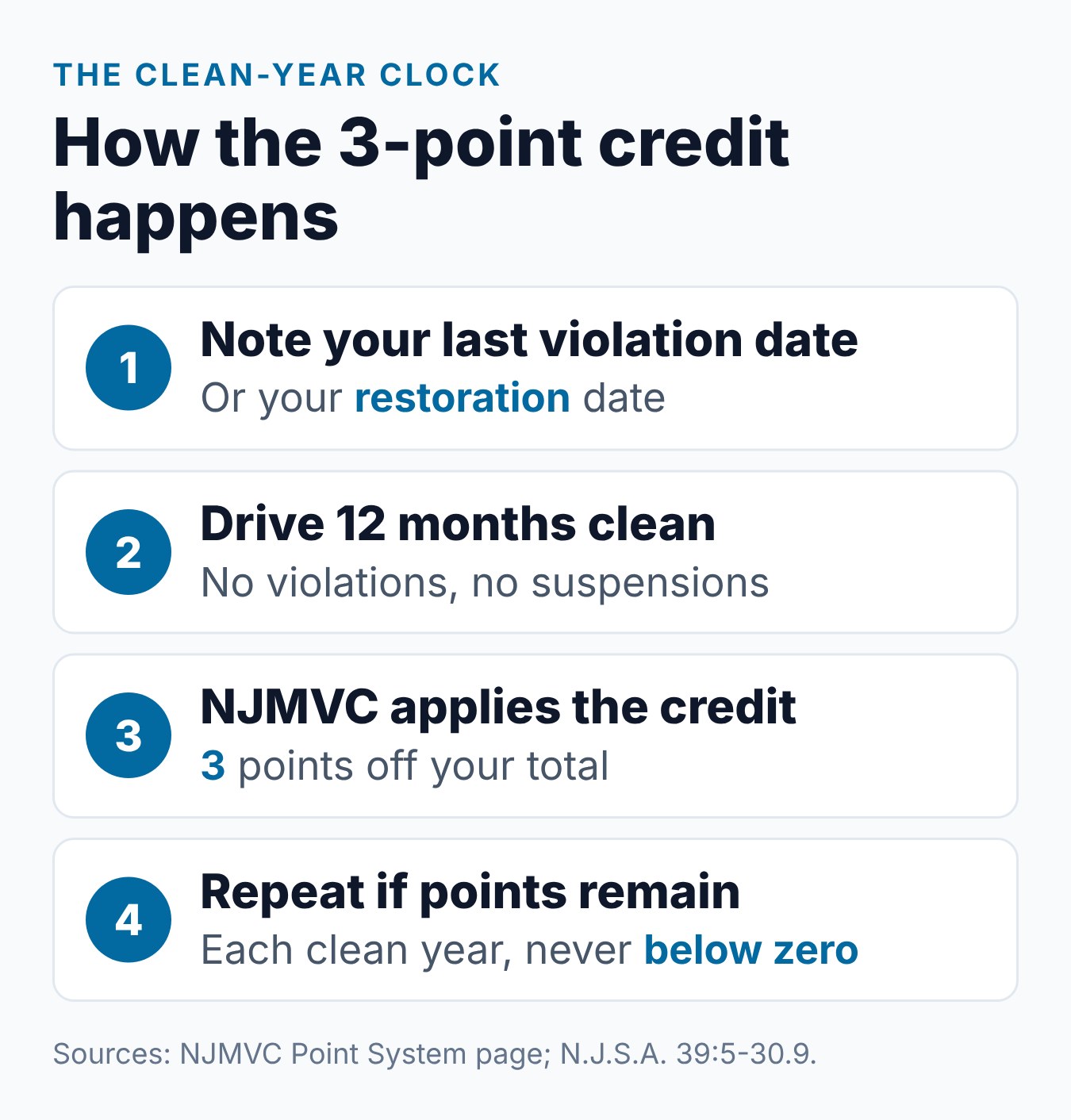
Yes, NJ points go down on their own. The NJMVC Point System page says you can earn point deductions by staying violation-free and suspension-free for one year. The value is 3 points.
State law backs this up. N.J.S.A. 39:5-30.9 reduces a point total at the rate of three points for each 12 consecutive months with no violation that leads to points or a suspension.
Because the law says “each” 12 months, the credit can repeat. Two clean years in a row can take off 6 points, as long as you have points to remove.
You do not have to apply. The NJMVC page lists this credit alongside the programs, with no form or fee named for it.
When the Clean Year Starts
The NJMVC page says the year begins on the date of the violation or the most recent restoration. That is the key date to track.
Here is how it plays out:
- After a ticket: the clock starts on the violation date printed on the ticket, not the court date.
- After a suspension: the clock starts on the date your license was restored.
- After a new ticket: a new violation starts the clock over.
A date example helps. Say your last violation was on May 10. If you have no new violation and no suspension through the next May 10, that year counts, and 3 points come off.
If you get a new ticket on April 1 instead, the clock starts over on April 1. That ticket also adds its own points.
How to Reduce Points on License NJ: Every Option
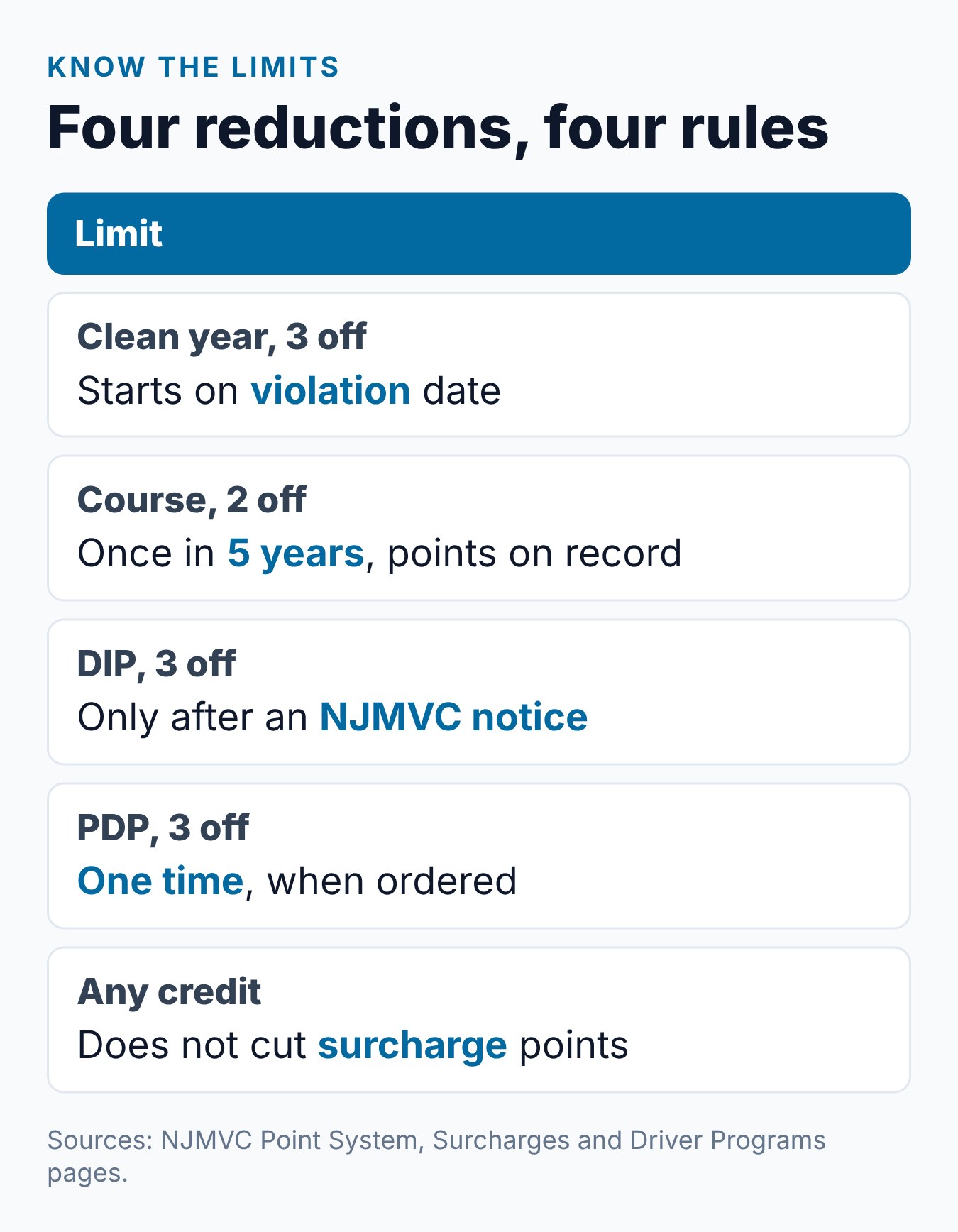
The Point System page lists four ways to lower your total. On the version we checked on October 25, 2026, they were:
| Reduction | Points removed | How often | Who can use it |
|---|---|---|---|
| One year with no violations or suspensions | 3 | Each clean year | Any licensed driver with points |
| Defensive driving course | 2 | Once every five years | Drivers who choose an approved course while points are on record |
| Driver Improvement Program (DIP) | 3 | Once every two years | Drivers the NJMVC offers it to, in response to proposed action |
| Probationary Driver Program (PDP) | 3 | One time | Probationary drivers the NJMVC orders to attend |
The page also says you can complete more than one of these to remove points. You must follow the timing limit for each one.
The table shows a clear split. The clean year and the course are open to you by choice. The DIP and the PDP start only when the NJMVC sends you a notice.
Using a Defensive Driving Course
The course is the only option that takes points off without a year of waiting or an NJMVC notice. N.J.A.C. 13:21-24.2 reduces your points by two after you finish an approved course.
The NJMVC Driver Programs page adds three rules:
- The credit applies only if there are points on your record when you finish.
- The provider sends proof of completion to the NJMVC within 7-10 business days.
- Certificates from drivers are not accepted.
The rule also bars credit for a course you taught. The course does not cancel any ticket. The 2-point reduction guide covers the steps.
The DIP and the PDP
These two programs are not something you sign up for on your own. Each one starts with the NJMVC.
Driver Improvement Program. The NJMVC remedial programs page describes a three-hour program for drivers facing a suspension. You can take it only after the NJMVC sends a notice offering it.
Finishing the DIP removes 3 points. The fees are a $75 NJMVC administrative fee plus a class fee of no more than $75.
A defensive driving course cannot be used in its place.
You must attend the whole DIP class. The DIP FAQ says arriving late or leaving early is reported as not completing, which results in a suspension. The NJ driver improvement program guide has more.
Probationary Driver Program. The PDP is required for probationary license holders with more than two points or certain violations. Finishing it removes 3 points, and it can be done one time when ordered.
The PDP also costs a $75 NJMVC fee plus a class fee of no more than $75. You have 120 days to finish. The NJ probationary driver program guide explains the rest.
Limits That Apply to Every Reduction
Every credit has limits. These come from the state rules:
- Not below zero. N.J.S.A. 39:5-30.9 says no point total can be reduced below zero.
- Dates come from the offenses. The same law and N.J.A.C. 13:21-24.2 measure time from the dates the offenses were committed.
- No effect on a proposed suspension. N.J.A.C. 13:21-24.2 says course credits do not invalidate a suspension the NJMVC has already proposed.
- No effect on surcharge points. The NJMVC Surcharges page says the safe driving credit and the course reduction do not reduce a surcharge point total.
That last point matters for planning. If you reach 6 points within three years, a surcharge can still apply after a credit lowers your license total.
The Year After a Restoration or Program
The first clean year after certain NJMVC actions carries extra weight. N.J.A.C. 13:19-10.6 covers drivers who were restored after a suspension, got an official warning, or finished the DIP or the PDP.
For those drivers, a new violation within one year leads to a suspension. For a first such case, the rule sets the length by timing:
- Within 6 months: 90 days.
- From 6 to 9 months: 60 days.
- From 9 to 12 months: 45 days.
So the same year that earns a 3-point credit is also a year when a new ticket costs more. Making it through clean helps on both counts.
Which Option Fits Your Situation
The right reduction depends on where you stand. Here is how the rules line up:
- You have points and no NJMVC notice. A clean year works on its own. A course adds 2 more points off if you have not had course credit in five years.
- You got an NJMVC notice offering the DIP. Follow the notice. The DIP removes 3 points, and a course cannot replace it.
- You hold a probationary license and got a PDP order. Complete the PDP within 120 days. It removes 3 points one time.
- You have no points. No credit applies yet. The course would give no point credit, though it can still earn an insurance premium reduction under state law.
What Does Not Go Away
Point credits change your active total. They do not wipe out your history.
The Point System page says the NJMVC keeps a permanent record of all the points you earn. So a violation stays on file even after its points are offset.
Your driver history abstract is a separate view. The NJMVC Driver History page says it covers five years of New Jersey moving violations, points, accidents and suspensions. It costs $15 online, by mail or in person.
Insurance is separate too. The NJMVC page notes that your insurance company might not factor these deductions into your rate.
A Worked Example
Simple math shows how the credits stack. Say you have 7 points on your record.
- You finish an approved course while the points are on your record. The total drops to 5.
- You go one full year from your last violation date with no new violation. The total drops to 2.
- Another clean year passes. The credit is 3, but the total cannot go below zero, so it lands at 0.
The course credit cannot be used again for five years. The clean-year credit keeps working as long as you keep a clean record.
Common Mistakes With Point Reductions
These mistakes come from the NJMVC pages and state rules:
- Counting from the court date. The clean year starts on the violation date or the restoration date.
- Taking the course with no points. The NJMVC gives the 2-point credit only if points are on your record when you finish.
- Signing up for the DIP on your own. The DIP is offered by NJMVC notice.
- Expecting a credit to stop a surcharge. The NJMVC says credits do not reduce the surcharge point total.
- Thinking the violation disappears. The NJMVC keeps a permanent record.
How Requirements Can Vary
New Jersey’s point system and defensive driving rules are set by state law and NJMVC rules, and they apply statewide. Fines and court costs come from the municipal court that handles your ticket, so the amount you owe depends on the court and the violation.
Insurance discounts also differ. State law requires insurers to reduce your premium after an approved course, but each insurer sets the amount.
Check the NJMVC Driver Programs page, your driver history abstract, and your insurer for current rules before you sign up for a course.
Frequently Asked Questions
Do NJ points go away automatically?
Your total goes down automatically. The NJMVC takes 3 points off for one year with no violations or suspensions. The violations themselves stay in the NJMVC’s permanent record.
How long does it take for 3 points to come off in NJ?
One year. The clock starts on the date of your last violation or your most recent restoration, and a new violation starts it over.
What is the fastest NJ points reduction?
An approved defensive driving course. It takes off 2 points, and the NJMVC says the provider reports your completion within 7-10 business days.
Can I combine a course and a clean year?
Yes. The NJMVC says you can complete more than one program to remove points, as long as you follow each one’s timing limit. Your total cannot go below zero.
Can I take the DIP to remove points?
Only if the NJMVC offers it. The DIP is taken in response to an NJMVC notice, and it removes 3 points once every two years.
Does a suspension stop the clean-year clock?
Yes. The credit needs one year with no violations or suspensions. After a suspension, the NJMVC says the year begins on the date of your most recent restoration.
Do point reductions lower my surcharge?
No. The NJMVC Surcharges page says the safe driving credit and the course reduction do not reduce a surcharge point total.
Does my abstract show points that were reduced?
The abstract covers five years of moving violations, points, accidents and suspensions. Order one for $15 to see how your record reads. The pillar guide on checking NJ points explains how.
Conclusion
New Jersey points do come down over time: 3 points for each clean year, starting on your last violation or restoration date. An approved course adds a 2-point credit once every five years, while the DIP and the PDP depend on an NJMVC notice. Driving Logic’s New Jersey Defensive Driving Course is coming soon, and State-approved providers are listed on the NJMVC Driver Programs page.
Related Articles
- How to Check Points on License NJ: Your Record Guide
- NJ Defensive Driving 2 Point Reduction: How It Works
- NJ Driver Improvement Program (DIP): What It Is and Who Has to Take It
- NJ Probationary Driver Program (PDP): What New Drivers Need to Know
Sources
- NJMVC — Point System and Suspensions
- NJMVC — Surcharges
- NJMVC — Driver Programs (defensive driving course, DIP, PDP, approved providers)
- N.J.A.C. 13:21-24.2 — Point reduction for a defensive driving course
- NJMVC — Driver Improvement and Probationary Driver Programs
- NJMVC — Driver Improvement Program FAQ
- NJMVC — Probationary Driver Program FAQ
- NJMVC — Driver History Abstract
- N.J.A.C. 13:19-10.6 — Violations after restoration, warning or a program
- N.J.S.A. 17:33B-45.1 — Insurance premium reduction after a defensive driving course
Billy Forte is the owner of Driving Logic, a state-approved driver improvement course provider serving Florida and other U.S. states.
This article is general information, not legal advice. New Jersey point rules, surcharges, and insurance discounts are set by New Jersey law, the Motor Vehicle Commission, and your insurer, and can change. Check the NJMVC website, the court on your ticket, and your insurer for current requirements.