
Updated October 2026 · Reviewed by Billy Forte
NJ points on license come from a fixed state schedule, and each moving violation is worth 0, 2, 3, 4, 5 or 8 points. The New Jersey Motor Vehicle Commission (NJMVC) adds them after a conviction posts to your record. Two totals matter most: 6 points within three years brings a surcharge, and 12 points brings a suspension.
Key Facts
- Range: one violation is worth from 0 to 8 points. See the full schedule.
- Speeding: 2, 4 or 5 points, based on how far over the limit you were. See speeding and careless driving.
- Repeat-only points: handheld phone and unsafe driving points start only on a third offense. See special rules.
- 6 points: 6 or more within three years brings a yearly surcharge. See what totals trigger.
- 12 points: 12 or more leads to a license suspension. See what totals trigger.
How NJ Points on License Are Assigned
Each point value is tied to a section of New Jersey traffic law. The NJMVC Points Schedule lists the statute number, a short name for the offense and its points.
Points do not land when an officer writes the ticket. The NJMVC Surcharges page explains the order of events. After a conviction, the court sends the violation to the NJMVC, which enters it on your driver record.
The day of that entry is called the posting date. It also sets the timing for any point surcharge.
Paying the ticket counts as a conviction too. The NJ Courts municipal court self-help page says paying the fine means you are pleading guilty.
Tickets from other states count as well. The NJMVC Point System page says a moving violation committed outside New Jersey is assessed 2 points under 39:5D-4.
The Full NJMVC Points Schedule
On the NJMVC Points Schedule we checked on October 25, 2026, every listed violation carried one of six values. Here is the schedule sorted from the highest value to the lowest. The offense names are short versions of the NJMVC wording, and related lines are grouped.
| Points | Violation | Statute (N.J.S.A.) |
|---|---|---|
| 8 | Leaving the scene of an accident, personal injury | 39:4-129 |
| 5 | Reckless driving | 39:4-96 |
| 5 | Tailgating | 39:4-89 |
| 5 | Improper passing of a school bus | 39:4-128.1 |
| 5 | Failure to pass to the right of an oncoming vehicle | 39:4-84 |
| 5 | Racing on a highway | 39:4-52; 39:5C-1 |
| 5 | Speeding, 30 mph or more over the limit | 39:4-98 |
| 4 | Speeding, 15 to 29 mph over the limit | 39:4-98 |
| 4 | Improper passing on the right or off the roadway | 39:4-85 |
| 4 | Improper passing in a no-passing zone | 39:4-86 |
| 4 | Improper passing of a frozen dessert truck | 39:4-128.4 |
| 4 | Improper passing on the Turnpike, Parkway or Atlantic City Expressway | 27:23-29 |
| 4 | Driving in an unsafe manner, third or later offense in five years | 39:4-97.2 |
| 3 | Handheld phone or device, third offense within 10 years of the second, and later | 39:4-97.3 |
| 3 | Improper turn at a traffic light | 39:4-115 |
| 3 | Improper right or left turn | 39:4-123 |
| 3 | Improper turn from an approved turning course | 39:4-124 |
| 3 | Improper U-turn | 39:4-125 |
| 3 | Construction vehicle driven over 45 mph | 39:3-20 |
| 2 | Speeding, 1 to 14 mph over the limit | 39:4-98 |
| 2 | Careless driving | 39:4-97 |
| 2 | Failure to observe stop or yield signs | 39:4-144 |
| 2 | Failure to observe traffic signals | 39:4-81 |
| 2 | Failure to stop for a traffic light | 39:4-105 |
| 2 | Failure to stop at a flashing red signal | 39:4-119 |
| 2 | Failure to yield to a pedestrian in a crosswalk | 39:4-35; 39:4-36 |
| 2 | Failure to yield at an intersection | 39:4-90 |
| 2 | Failure to yield to emergency vehicles | 39:4-91, 92 |
| 2 | Failure to yield when entering or leaving a highway | 39:4-66.1 |
| 2 | Failure to yield to an overtaking vehicle | 39:4-87 |
| 2 | Failure to keep right, including at an intersection | 39:4-82; 39:4-83 |
| 2 | Failure to observe traffic lanes | 39:4-88 |
| 2 | Improper operation on a divided highway or divider | 39:4-82.1 |
| 2 | Wrong way on a one-way street | 39:4-85.1 |
| 2 | Leaving the scene of an accident, no personal injury | 39:4-129 |
| 2 | Failure to give a proper signal | 39:4-126 |
| 2 | Improper backing or turning in the street | 39:4-127 |
| 2 | Improper railroad grade crossing or bridge crossing | 39:4-127.1; 39:4-127.2; 39:4-128 |
| 2 | Slow speed blocking traffic | 39:4-97.1 |
| 2 | Failure to obey an officer, an officer’s direction or a police whistle | 39:4-57; 39:4-80; 39:4-122 |
| 2 | Improper action on grades and curves | 39:4-55 |
| 2 | Failure to stop before crossing a sidewalk, or driving on a sidewalk | 39:4-66; 39:4-71 |
| 2 | Driving on property to avoid a traffic sign or signal | 39:4-66.2 |
| 2 | Driving through a safety zone | 39:4-41 |
| 2 | Destruction of agricultural or recreational property | 39:4-97a |
| 2 | Improper use of limited access highway entrances | 39:4-90.1 |
| 2 | Motorized bicycle on a restricted highway, or more than one rider | 39:4-14.3; 39:4-14.3d |
| 2 | Moving against traffic or using the median, Turnpike, Parkway or Atlantic City Expressway | 27:23-29 |
| 2 | Moving violation committed out of state | 39:5D-4 |
| 0 | Red light camera violation | 39:4-81 |
Only one line reaches 8 points. Speeding is the only offense that shows up at three values, because its points rise with your speed.
The Highest-Point Violations
Leaving the scene of an accident has the widest gap on the schedule. With no injury, it carries 2 points. When someone is hurt, it carries 8, which is two-thirds of the way to a suspension in one step.
Six offenses sit at 5 points. Reckless driving is one of them. Under N.J.S.A. 39:4-96, it means driving with “willful or wanton disregard” for the safety of others.
Tailgating, passing a school bus the wrong way and racing are also 5-point offenses. So is speeding 30 mph or more over the limit.
Here is the simple math on high values:
- One 8-point and one 4-point violation: 12 points, the suspension level.
- Two 5-point violations: 10 points, past the surcharge level.
- One 5-point and one 2-point violation: 7 points.
The careless vs reckless driving guide compares those two charges side by side.
Speeding and Careless Driving Points
Speeding under 39:4-98 has three tiers: 2 points for 1 to 14 mph over, 4 points for 15 to 29 mph over and 5 points for 30 mph or more over. Our NJ speeding ticket points guide covers speeding in more depth.
Careless driving is worth 2 points. N.J.S.A. 39:4-97 describes it as driving “carelessly, or without due caution and circumspection.” The careless driving points guide explains the charge.
Violations With Special Point Rules
A few lines on the schedule come with conditions. These are the ones to read closely:
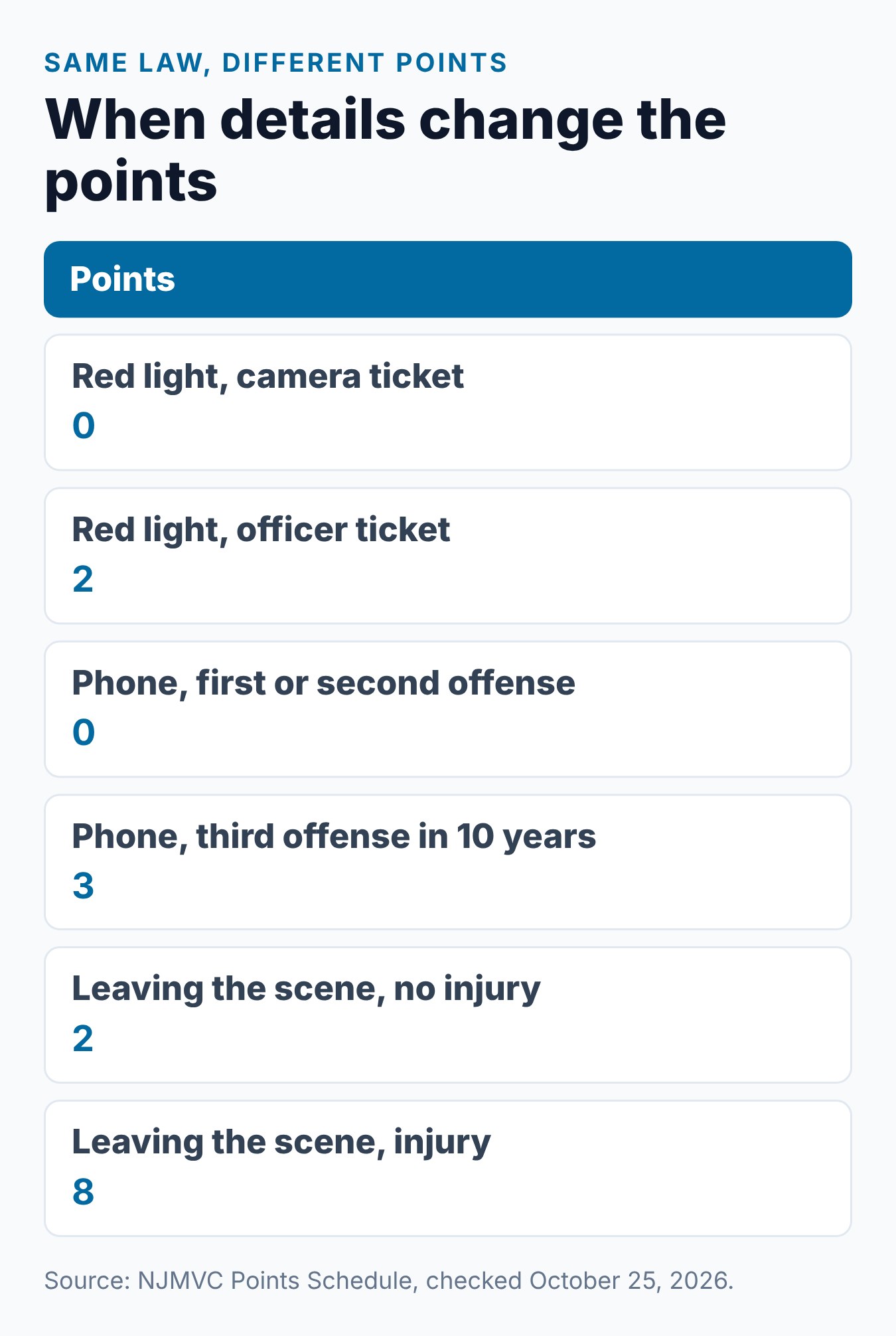
- Handheld phone or device (39:4-97.3): 3 points apply on a third offense within 10 years of a second offense, and on every later one. The first two offenses carry no points.
- Driving in an unsafe manner (39:4-97.2): 4 points apply only on a third or later offense within five years of the most recent conviction.
- Traffic signals (39:4-81): a ticket for failing to obey a signal is 2 points. A red light camera violation is 0 points.
- Leaving the scene (39:4-129): 2 points with no personal injury, 8 points with personal injury.
- Toll roads (27:23-29): the Turnpike, Garden State Parkway and Atlantic City Expressway have their own lines. Improper passing there is 4 points, and moving against traffic is 2.
- Out of state (39:5D-4): a moving violation in another state adds 2 points.
What Your Point Total Triggers
Single tickets matter, but your total is what the NJMVC acts on. Two levels stand out.
6 points within three years. The Surcharges page says 6 or more points within three years from your last posted violation brings a $150 surcharge. You also pay $25 for each point over six, and the bill can come every year for three years.
Here is the math. With 8 points in that window, the yearly bill is $150 plus 2 times $25, or $200. The NJ MVC surcharge points guide covers payment and what happens if you do not pay.
12 points. The Point System page says a total of 12 or more points means your license will be suspended. You get a notice of scheduled suspension by mail.
The length of a suspension depends on your total and how fast you built it. The license suspension points guide has those details.
How Points Come Off
The NJMVC keeps a permanent record of the points you earn. Still, your active total can go down.
The Point System page lists four ways. A year with no violations or suspensions removes 3 points. A defensive driving course removes 2, once every five years.
The Driver Improvement Program and the Probationary Driver Program each remove 3. Both are for drivers the NJMVC sends a notice to, not drivers who sign up on their own.
For the course, N.J.A.C. 13:21-24.2 adds that your total cannot drop below zero. The course does not remove the conviction or cancel the ticket.
One limit catches drivers off guard. The Surcharges page says the safe driving credit and the course reduction do not reduce a surcharge point total. Our guide to automatic point reduction in NJ compares all four options.
How to Look Up a Ticket on the Schedule
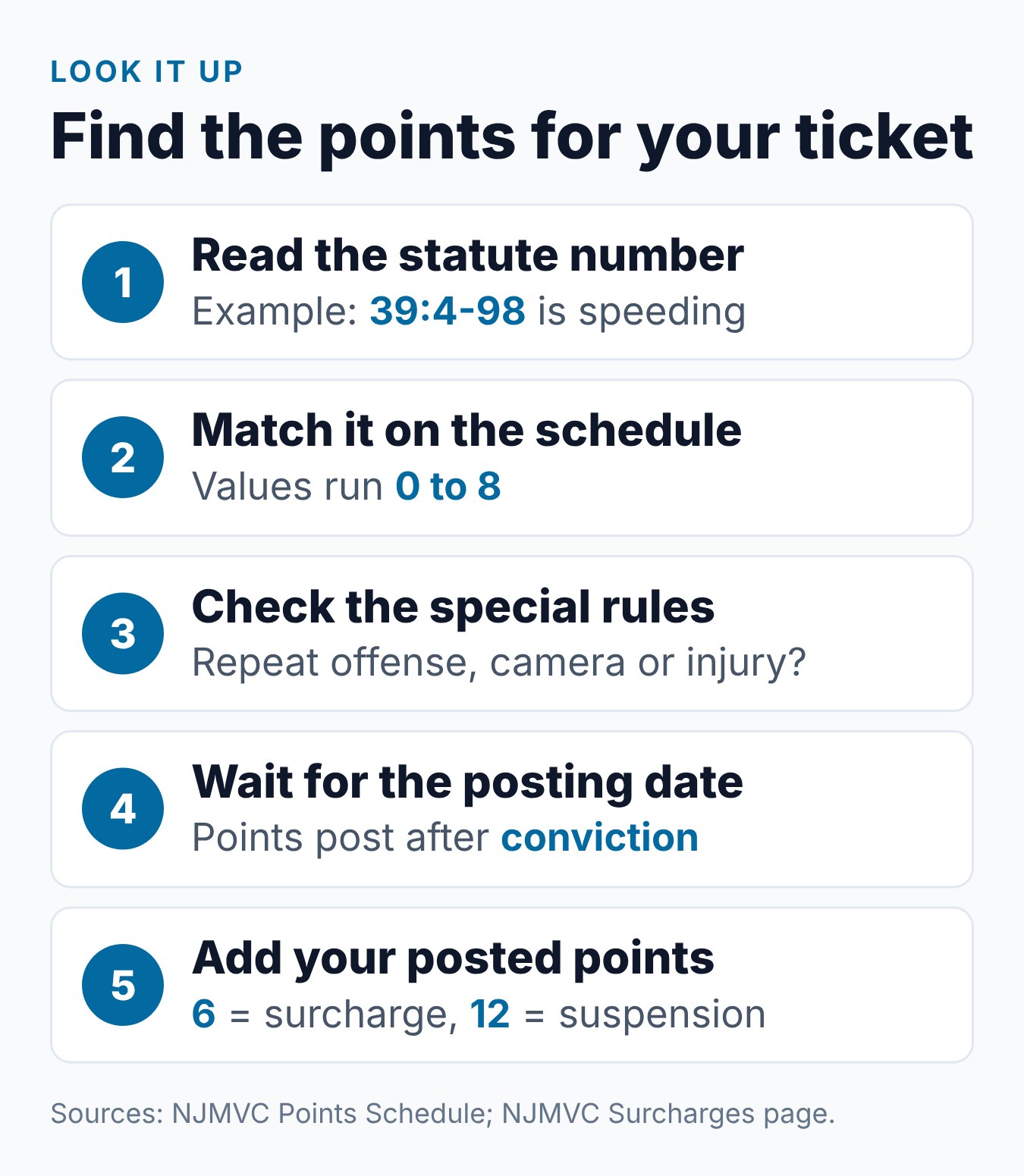
You can find the points for a ticket in a few minutes:
- Find the statute number printed on your ticket, such as 39:4-98 for speeding.
- Find that number in the table above or on the NJMVC Points Schedule.
- Check the special rules for repeat offenses, cameras and injuries.
- Add the points to the ones already posted on your record.
- Compare the total with 6 and 12.
To see what is already posted, request your driver history abstract. The pillar guide on checking NJ points walks through it.
Common Mistakes With NJ Points
These mistakes come from reading the official rules too fast:
- Using the ticket date as the points date. Points post after the conviction reaches the NJMVC.
- Assuming every red light ticket adds points. A camera violation is 0 points. An officer’s ticket for the signal is 2.
- Assuming phone tickets never add points. The third offense within 10 years of the second carries 3.
- Ignoring a ticket from another state. It adds 2 points in New Jersey.
- Expecting a course to cancel the ticket. It removes 2 points from your total. The conviction stays.
- Counting the course against a surcharge. The NJMVC says it does not reduce a surcharge point total.
How Requirements Can Vary
New Jersey’s point system and defensive driving rules are set by state law and NJMVC rules, and they apply statewide. Fines and court costs come from the municipal court that handles your ticket, so the amount you owe depends on the court and the violation.
Insurance discounts also differ. State law requires insurers to reduce your premium after an approved course, but each insurer sets the amount.
Check the NJMVC Driver Programs page, your driver history abstract, and your insurer for current rules before you sign up for a course.
Frequently Asked Questions
How many points is a speeding ticket in NJ?
It depends on your speed. The NJMVC schedule lists 2 points for 1 to 14 mph over, 4 points for 15 to 29 mph over and 5 points for 30 mph or more over.
How many points is careless driving in NJ?
Careless driving under 39:4-97 is worth 2 points. That is the same value as failing to stop at a stop sign.
Does a red light camera ticket add points in NJ?
No. The NJMVC schedule lists red light camera violations at 0 points. A traffic signal ticket written by an officer is 2 points.
Do NJ traffic ticket points come from other states?
Yes. The NJMVC assesses 2 points for a moving violation committed outside New Jersey under 39:5D-4.
What violation has the most points in NJ?
Leaving the scene of an accident with personal injury, at 8 points. It is the only 8-point line on the schedule.
When do points show up on my record?
After a conviction. The court sends the violation to the NJMVC, and the day it is entered on your record is the posting date.
Does the defensive driving course remove a violation?
No. An approved course can take 2 points off your total once every five years, but the conviction stays on your record. The 2-point reduction guide explains how the credit works.
Conclusion
Each New Jersey violation has a set point value, from 0 for a camera ticket to 8 for leaving an injury crash. Check the statute on your ticket, add it to what is already posted, and watch the 6-point and 12-point levels. Driving Logic’s New Jersey Defensive Driving Course is coming soon, and State-approved providers are listed on the NJMVC Driver Programs page.
Related Articles
- How to Check Points on License NJ: Your Record Guide
- NJ MVC Surcharge: What It Is and How Points Trigger It
- How to Reduce Points on License NJ: Automatic Credits
- NJ License Suspension Points: How Many Is Too Many?
Sources
- NJMVC — Points Schedule
- NJMVC — Point System and Suspensions
- NJMVC — Surcharges
- NJMVC — Driver Programs (defensive driving course, DIP, PDP, approved providers)
- N.J.A.C. 13:21-24.2 — Point reduction for a defensive driving course
- N.J.S.A. 39:4-96 — Reckless driving
- N.J.S.A. 39:4-97 — Careless driving
- New Jersey Courts — Municipal Court Self-Help
Billy Forte is the owner of Driving Logic, a state-approved driver improvement course provider serving Florida and other U.S. states.
This article is general information, not legal advice. New Jersey point rules, surcharges, and insurance discounts are set by New Jersey law, the Motor Vehicle Commission, and your insurer, and can change. Check the NJMVC website, the court on your ticket, and your insurer for current requirements.