
Updated October 2026 · Reviewed by Billy Forte
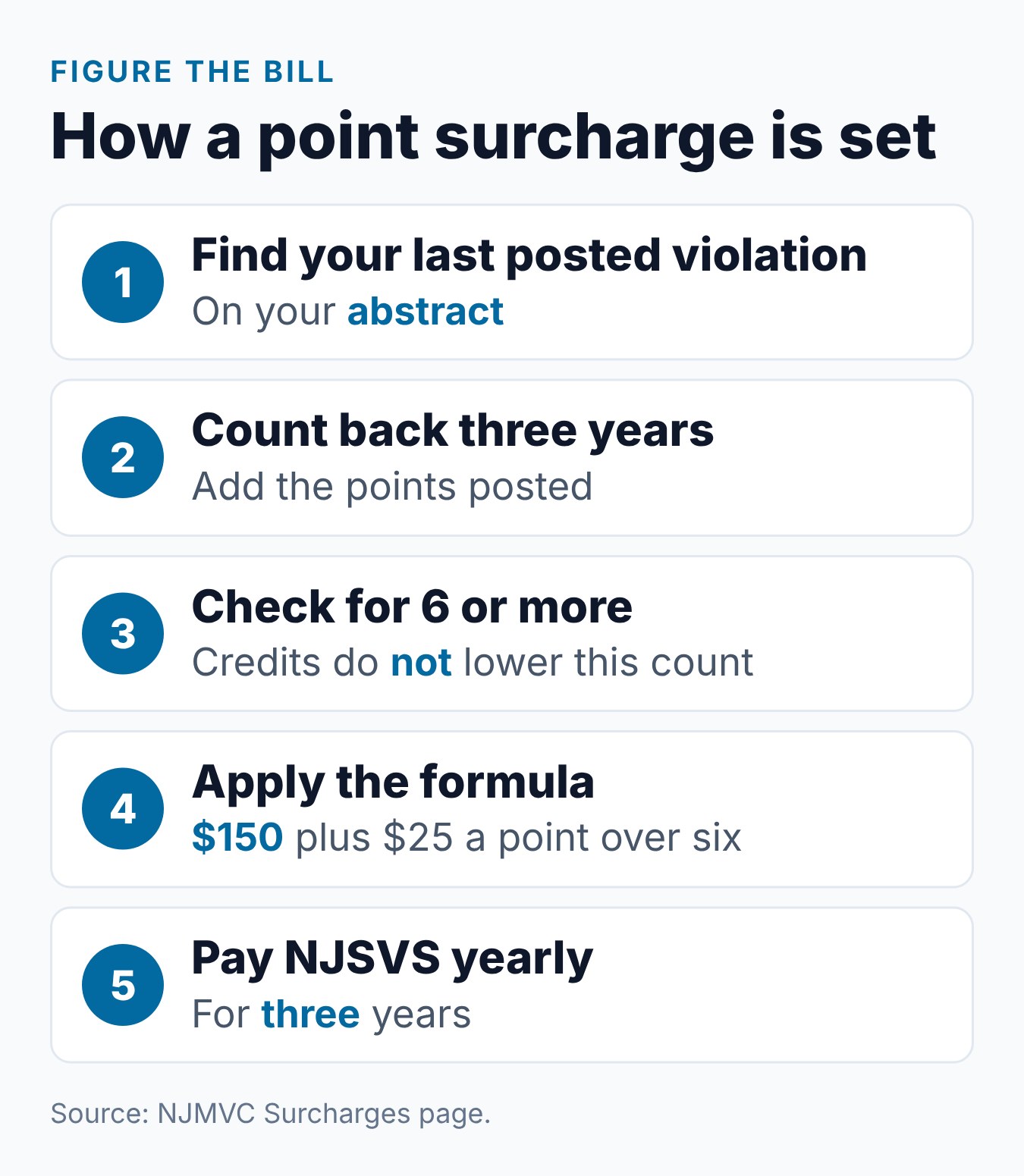
The NJ MVC surcharge is a yearly charge the New Jersey Motor Vehicle Commission (NJMVC) bills when you reach 6 or more points within three years of your last posted violation, or when you are convicted of certain offenses. For points, it is $150 plus $25 for each point over six, billed each year for three years. It is separate from any court fine, and you pay it to the New Jersey Surcharge Violation System (NJSVS), not to the MVC.
Key Facts
- Point trigger: 6 or more points within three years of the last posted violation. See point surcharges.
- Point amount: $150, plus $25 for each point over six, for three years. See the amounts.
- Offense surcharges: set amounts for DWI, refusal, suspended driving and more. See offense surcharges.
- Credits do not count: the course and safe-driving credits do not lower a surcharge point total. See why.
- Payment: to NJSVS, with a payment plan option. See how to pay.
What the Surcharge Is
The NJMVC Surcharges page says surcharges are assessed under New Jersey law. They apply when a driver builds up too many points or is convicted of certain offenses.
A surcharge is not a court fine. The municipal court handles the ticket. The surcharge comes later, from the NJMVC, based on what posts to your record.
The NJMVC cannot waive a surcharge. The page says only a court can remove one, by overturning or reversing the conviction behind it.
Three Separate Costs
One ticket can lead to three different bills. Each comes from a different place:
- The court fine comes from the municipal court that handles the ticket.
- The surcharge comes from the NJMVC and is paid to NJSVS.
- A higher premium may come from your insurer. The NJMVC says points may raise your rates.
Paying one does not cover the others. A paid court fine does not stop a surcharge bill.
The Point-Based NJ MVC Surcharge
The NJMVC Point System page says 6 or more points within three years brings a surcharge. The Surcharges page counts that window from the last posted violation.
Points come from the NJMVC Points Schedule. Two violations can reach 6. A 4-point violation plus a 2-point violation is 6.
Point Surcharge Amounts by Total
The base is $150. Each point over six adds $25. The NJMVC bills that amount each year for up to three years.
Here is the math for a few totals, if the same total stays in place all three years:
| Points in the three-year window | Yearly surcharge | Three-year total |
|---|---|---|
| 5 | $0 | $0 |
| 6 | $150 | $450 |
| 7 | $175 | $525 |
| 8 | $200 | $600 |
| 10 | $250 | $750 |
| 12 | $300 | $900 |
At 12 points, a surcharge is not the only issue. The NJMVC says 12 or more points also leads to a license suspension.
Offense-Based Surcharges
Some convictions bring a surcharge on their own, with no point count. The Surcharges page lists these, each billed yearly for three years:
| Offense | Each year | Three-year total |
|---|---|---|
| Unlicensed driver or expired license | $100 | $300 |
| Failure to insure a moped | $100 | $300 |
| Driving while suspended | $250 | $750 |
| Operating an uninsured vehicle | $250 | $750 |
| First or second DWI | $1,000 | $3,000 |
| Third DWI within three years of the last offense | $1,500 | $4,500 |
| Refusing a blood alcohol test | $1,000 | $3,000 |
The DWI rules reach beyond New Jersey. The page says New Jersey licensees can be surcharged for a substantially similar DWI in another state. Drivers licensed elsewhere are surcharged for a DWI conviction in New Jersey.
When the Surcharge Is Assessed
Timing is set by the posting date. The Surcharges page says the posting date decides when a surcharge is assessed, not the date of the ticket or the date the court processed the conviction.
So a bill can arrive well after your court case ends. Your driver history abstract shows what has posted. The NJMVC Driver History Abstract page explains how to order one for $15.
Surcharges Can Continue
A point surcharge can last past one three-year bill. The NJMVC gives an example, which we show here in our own words:
- Year one: a 4-point violation posts. That is 4 points, so no surcharge.
- Year two: a 2-point violation posts. That is 6 points, so a $150 surcharge.
- Year three: both violations are still within three years. Still 6 points, so another $150.
- Year four: the 4-point violation is now over three years old. Only 2 points count, so no surcharge.
The page adds that 4 new points in year four would bring the total back to 6. That would mean another $150 surcharge.
Do Point Credits Lower a Surcharge?
No. The Surcharges page says the three-point credit for safe driving and the two-point reduction for a defensive driving class do not reduce a surcharge point total.
That means the course cannot keep you under the 6-point surcharge level. The surcharge counts points from violations posted in the three-year window.
The course still lowers your current total under N.J.A.C. 13:21-24.2. That total is the one tied to the 12-point suspension level. Our pillar guide on how to check points on your NJ license explains both counts.
A Worked Example
Here is how the two counts split. Say a 4-point violation and a 2-point violation post within three years. Then you finish an approved defensive driving course.
Your current total drops from 6 to 4 under the course rule. But the surcharge point total stays at 6, so the $150 surcharge still applies.
For how points come off over time, see automatic point reduction in NJ.
How to Pay NJ MVC Surcharge Payments
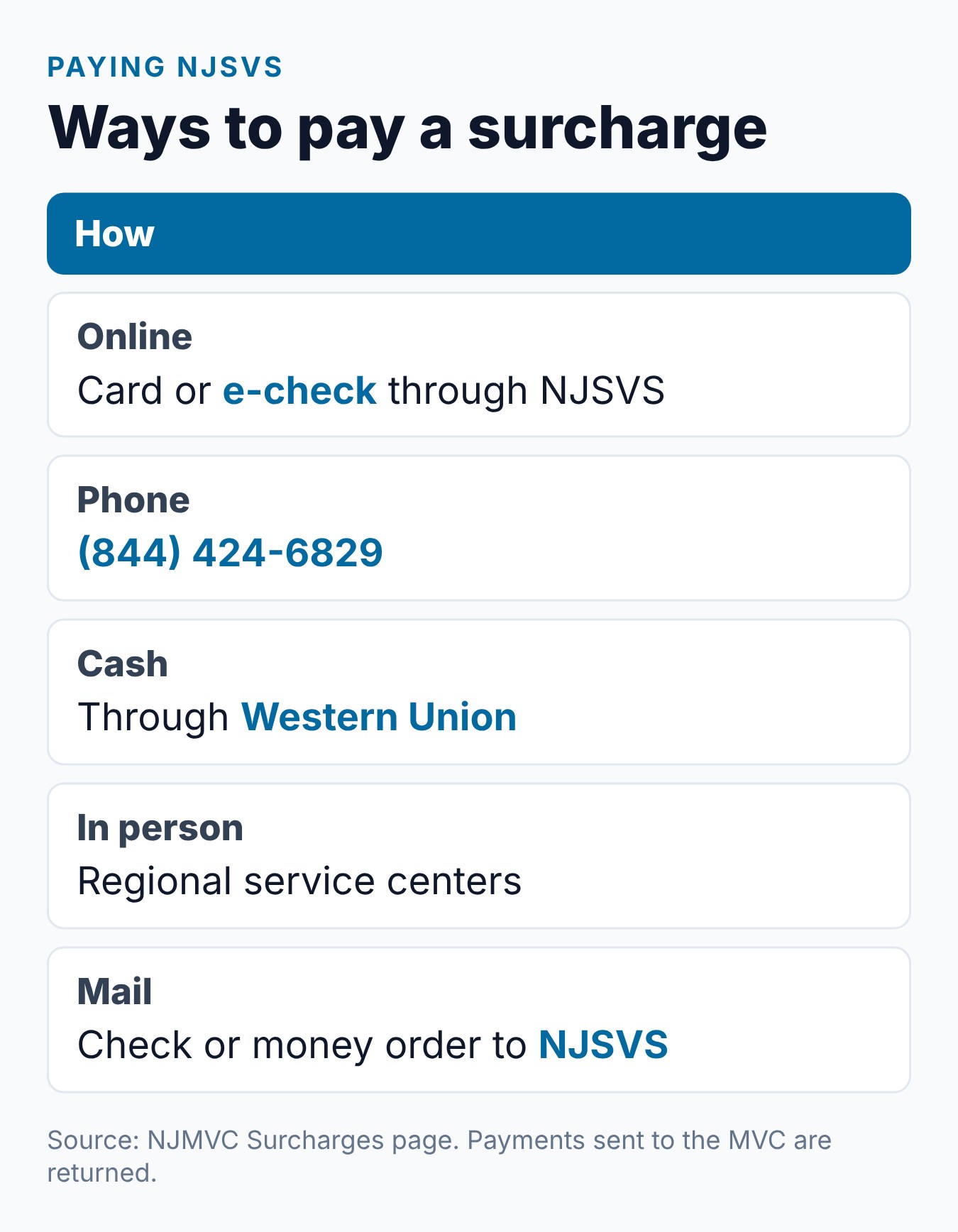
You pay the surcharge to NJSVS, not to the MVC. The Surcharges page says payments sent to the MVC are returned.
The page lists five ways to pay:
- Online by debit or credit card, or e-check, through NJSVS.
- By phone with a debit or credit card at (844) 424-6829.
- Cash through Western Union.
- In person at New Jersey regional service centers.
- By mail with a check or money order payable to NJSVS, P.O. Box 1502, Moorestown, NJ 08057-9704.
Do not mail cash. The page says to use Western Union for cash payments.
Payment Plans
The NJMVC encourages full payment, but it offers an installment payment plan. To start one, pay the installment amount on your billing notice by its due date.
After that, the remaining balance is billed monthly. If you cannot afford the listed amount, the page says to call (844) 424-6829 to talk about other arrangements.
One warning from the page: interest on judgments keeps adding up during a plan. A judgment stays in place until it is paid in full.
What Happens If You Do Not Pay
Unpaid surcharges move to collection. The Surcharges page says the NJMVC can file a Certificate of Debt with the New Jersey Superior Court, which acts as a judgment.
A judgment lets the state collect the unpaid amount plus collection costs and interest. The page lists several results:
- Property: a judgment can block the transfer or sale of property.
- Wages: it may lead to wage garnishment.
- State payments: tax refunds, property tax rebates and lottery winnings can be redirected to the debt.
Judgments must be paid in certified funds. The page says other payments delay the release of the judgment by two months.
What to Do When a Bill Arrives
A surcharge notice has a due date, so act on it soon. These steps follow the Surcharges page:
- Check your abstract. Confirm the violations and posting dates behind the bill.
- Choose how to pay. Pay in full, or pay the installment amount by the due date to start a plan.
- Call if you cannot pay. NJSVS takes calls at (844) 424-6829 about other arrangements.
- Keep your address current. Report changes to the MVC within seven days.
If you think the conviction was wrong, that is a matter for the court. The NJMVC cannot waive the surcharge itself.
Other Surcharge Rules Worth Knowing
The Surcharges page covers a few more situations:
- Moving away: surcharges still apply if you move out of New Jersey and surrender your license.
- Address changes: report a new address to the MVC within seven days, so bills reach you.
- Bankruptcy: a hold is placed once the petition is received. Only surcharge assessments can be discharged, not judgments.
- Incarceration: billing continues.
Our Review of the Surcharges Page
On the NJMVC Surcharges page we checked on October 25, 2026, the point formula matched the Point System page: 6 or more points in three years, $150 plus $25 a point. The page listed seven offense surcharges, from $100 to $1,500 a year.
The detail that matters most for course takers was in the questions section. It said point credits do not reduce a surcharge point total.
Common Mistakes With Surcharges
Each of these comes from the Surcharges page:
- Paying the MVC. Payments go to NJSVS. Payments sent to the MVC come back.
- Counting on the course. The 2-point course credit does not lower a surcharge point total.
- Using the ticket date. The posting date decides when a surcharge is assessed.
- Ignoring the bill. Unpaid surcharges can become a judgment with interest.
- Moving away to escape it. Surcharges apply even after you leave New Jersey.
For the points each violation carries, see NJ license points by violation. If you are at four points, read 4 points on an NJ license.
How Requirements Can Vary
New Jersey’s point system and defensive driving rules are set by state law and NJMVC rules, and they apply statewide. Fines and court costs come from the municipal court that handles your ticket, so the amount you owe depends on the court and the violation.
Insurance discounts also differ. State law requires insurers to reduce your premium after an approved course, but each insurer sets the amount.
Check the NJMVC Driver Programs page, your driver history abstract, and your insurer for current rules before you sign up for a course.
Frequently Asked Questions
What is the NJ MVC surcharge?
It is a yearly charge the NJMVC assesses under state law for too many points or certain convictions. It is separate from court fines and is paid to NJSVS.
How many points trigger a surcharge in NJ?
Six or more points within three years of your last posted violation. The surcharge is $150, plus $25 for each point over six.
How long do I pay a surcharge?
Each surcharge is billed yearly for three years. A point surcharge can continue past that if new violations keep 6 or more points in the three-year window.
Does the defensive driving course lower my surcharge?
No. The NJMVC Surcharges page says the two-point course reduction does not reduce a surcharge point total. It still lowers your current total for the 12-point suspension level.
Where do I pay an NJ surcharge?
Pay NJSVS online, by phone at (844) 424-6829, by Western Union, in person at a regional service center, or by mail to P.O. Box 1502, Moorestown, NJ 08057-9704.
Can I set up a payment plan?
Yes. Pay the installment amount on your billing notice by its due date, and the rest is billed monthly. Call (844) 424-6829 if you cannot afford the listed amount.
What happens if I do not pay a surcharge?
The NJMVC can file a Certificate of Debt with the Superior Court. That judgment can block property sales, lead to wage garnishment and take state payments such as tax refunds.
Can the MVC waive my surcharge?
No. The NJMVC page says it cannot waive a surcharge. Only a court can remove one, by overturning or reversing the conviction.
Conclusion
The NJ MVC surcharge starts at 6 or more points within three years, at $150 plus $25 a point, billed yearly for three years. Pay NJSVS on time or use a payment plan, and remember that point credits do not lower the surcharge count. The New Jersey Defensive Driving Course from Driving Logic is coming soon, and the NJMVC lists State-approved providers now.
Related Articles
- How to Check Points on License NJ: Your Record Guide
- NJ Points on License: What Each Common Violation Is Worth
- How to Reduce Points on License NJ: Automatic Credits
- 4 Points on Your NJ License: What It Means and How the DDC Helps
Sources
- NJMVC — Surcharges
- NJMVC — Point System and Suspensions
- NJMVC — Points Schedule
- NJMVC — Driver History Abstract
- N.J.A.C. 13:21-24.2 — Point reduction for a defensive driving course
Billy Forte is the owner of Driving Logic, a state-approved driver improvement course provider serving Florida and other U.S. states.
This article is general information, not legal advice. New Jersey point rules, surcharges, and insurance discounts are set by New Jersey law, the Motor Vehicle Commission, and your insurer, and can change. Check the NJMVC website, the court on your ticket, and your insurer for current requirements.