
Updated October 2026 · Reviewed by Billy Forte
A defensive driving course NJ insurance discount is required by state law, but the law does not set the amount, so your insurer decides how much your premium drops. Under N.J.S.A. 17:33B-45.1, the reduction lasts three years from your next policy period and ends early with a license suspension or four or more points. The way to learn your amount is to ask your insurer a few direct questions before and after the course.
Key Facts
- The law: insurers must reduce premiums after an approved course. See what the law requires.
- The amount: set by each insurer from its own data, with no state figure. See how much.
- Coverages: the law names four parts of a policy. See which coverages.
- How long: three years from the next policy period. See the timeline.
- What to ask: five questions for your insurer. See the questions.
How a Defensive Driving Course NJ Insurance Discount Works
Three groups each play a part. Knowing who does what tells you who to call:
- State law requires the reduction and sets how long it lasts.
- The NJMVC lists approved courses and records your completion for the point credit.
- Your insurer sets the amount and applies it to your policy.
So the NJMVC can confirm the course on your record, but it cannot tell you your premium. Only your insurer can.
What the Law Requires
The rule comes from N.J.S.A. 17:33B-45.1. It says private passenger auto rate filings must include a premium reduction for finishing an approved defensive driving course.
The state insurance agency says the same thing for consumers. The Department of Banking and Insurance guide, Everything Auto Insurance, says New Jersey law requires insurers to offer discounts for drivers who complete a defensive driving course approved by the NJMVC.
The NJMVC Driver Programs page adds one line. It says you may qualify for an insurance rate reduction and tells you to contact your insurance agent.
Who Qualifies
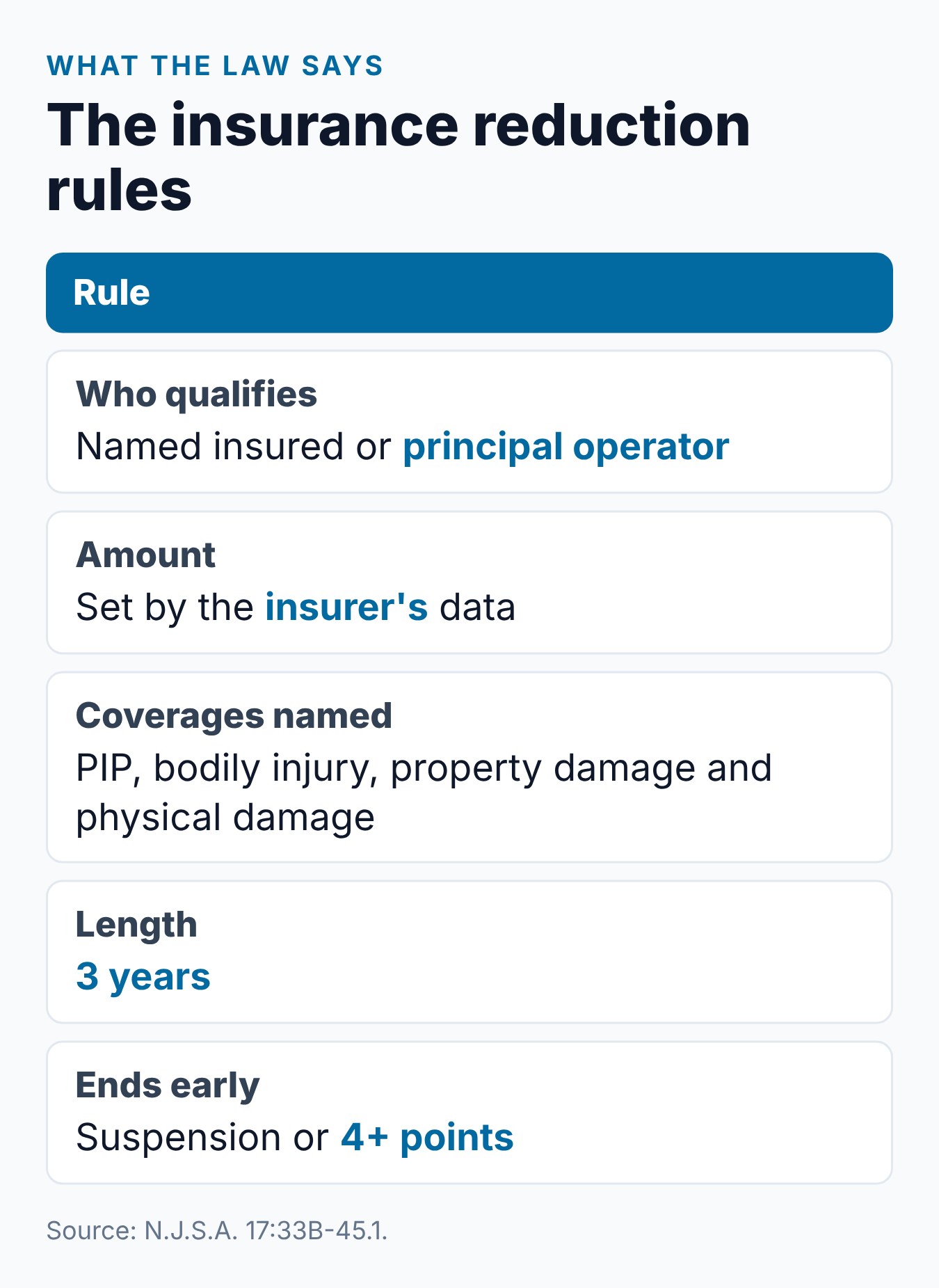
The law covers two people on a policy:
- The named insured, the person whose name is on the policy.
- The principal operator of the insured vehicle, if that is a different person.
So if someone else on your policy takes the course, ask your insurer how it applies. The law names only these two roles.
What Counts as Approved
The course must be approved under N.J.S.A. 17:33B-45. That law says the director must approve any course that meets or exceeds the National Safety Council’s defensive driving course standards.
The NJMVC lists State-approved classroom and online courses on its Driver Programs page. Check that list before you pay.
How Much the Reduction Is
There is no state number. The law says the reduction must be justified by the insurer’s actuarial experience.
That means each insurer uses its own data to set the amount. Two insurers can give two different amounts for the same course.
So be careful with any page that promises a set amount for every New Jersey driver. The law does not set one, and the only way to know yours is to ask your insurer.
Which Coverages the Law Names
N.J.S.A. 17:33B-45.1 names four coverages for the premium reduction:
- Personal injury protection (PIP).
- Bodily injury liability.
- Property damage.
- Physical damage coverage.
Your policy may not carry all four. Ask your insurer which parts of your bill change, and by how much for each.
When It Starts and When It Ends
The reduction does not start the day you finish. It starts with the next policy period after you complete the course.
It then lasts three years. Here is how each policy event affects it, based on the law:
| Event | What it means for the reduction |
|---|---|
| You finish an approved course | Nothing changes yet |
| Your next policy period begins | The reduction starts |
| Three years pass | The reduction ends |
| Your license is suspended | The reduction ends early |
| You build up four or more points | The reduction ends early |
The early endings matter. A new ticket that brings your points to four or more can end the reduction before three years pass.
To see where you stand, check your points first. Our pillar guide on how to check points on your NJ license shows how to order your abstract.
Before You Pay for a Course
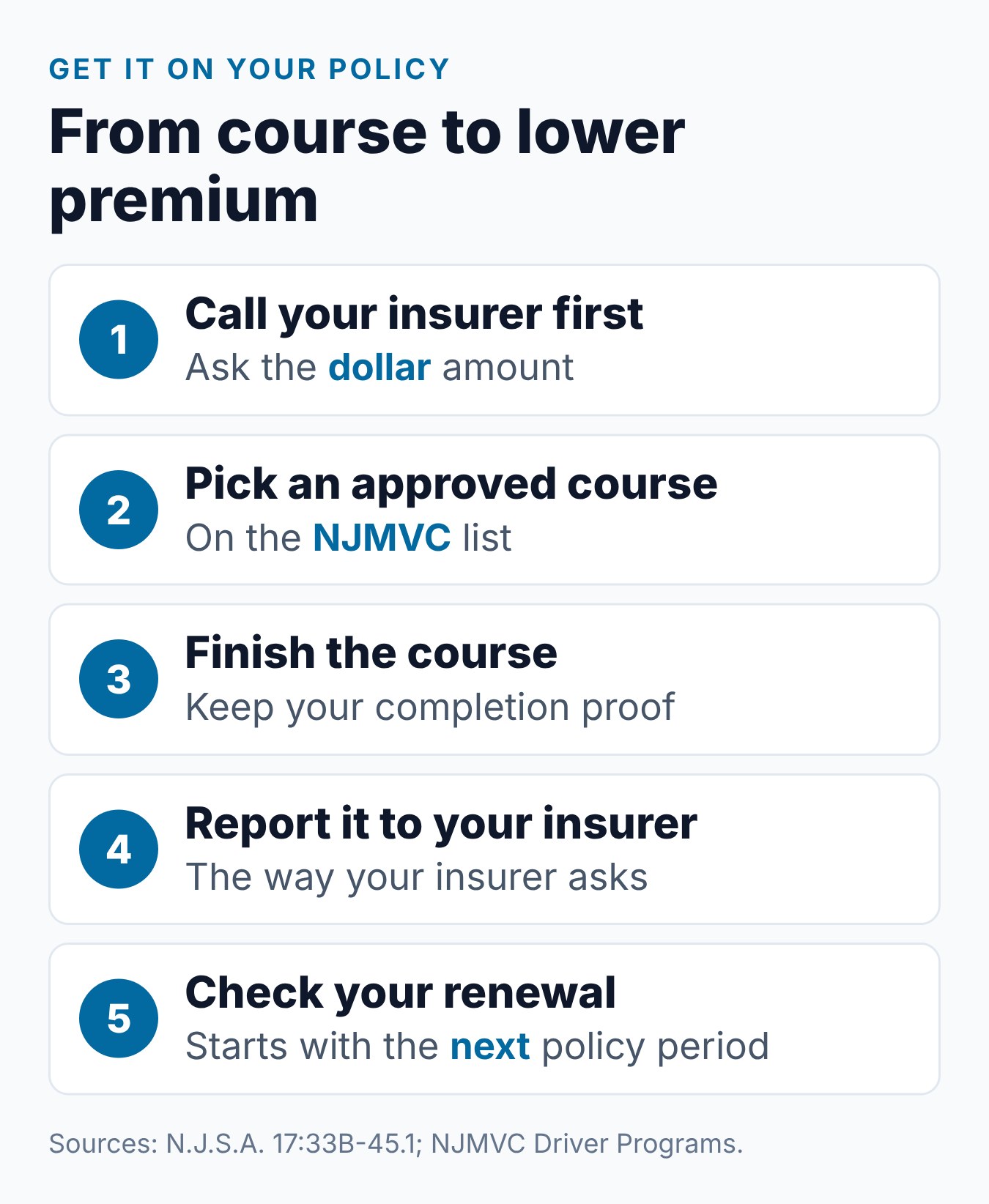
A few checks before you sign up can save time and money. Each one ties to the rules above:
- Check the NJMVC list. Only an approved course qualifies.
- Get a dollar figure. Your insurer can tell you what the reduction is worth on your policy.
- Check your points. The law ends the reduction at four or more points. If you are already at four or more, ask your insurer whether it will apply at all.
- Check your renewal date. The reduction starts with the next policy period.
Questions to Ask Your Insurer
Since the amount is up to your insurer, the questions you ask matter. Call before the course, then again after you finish:
- How much will my premium drop? Ask for a dollar amount on your current policy.
- Which coverages does it apply to? The law names PIP, bodily injury, property damage and physical damage.
- How do I report my completion? Ask what proof the insurer wants and where to send it.
- When will the reduction start? It should start with your next policy period.
- Will a new course start a new reduction? The law does not say, so get your insurer’s answer.
Write down the date, the name of the person you spoke with and each answer. That record helps if your renewal bill does not match.
Who Tells Your Insurer
The NJMVC page says the provider notifies the NJMVC of your completion within 7 to 10 business days. That report is for your driving record.
The NJMVC page does not say the provider tells your insurer. It tells you to contact your insurance agent, so plan to do that yourself.
Points, Your Record and Your Rate
The course has a second benefit on your driving record. Under N.J.A.C. 13:21-24.2, it takes 2 points off, once in any five-year period.
That credit and your premium are separate. The NJMVC Point System page says points may raise your insurance rates, and your insurer may not apply point reductions to your rate.
The DOBI guide adds another layer. It says insurers assign their own insurance eligibility points for driver inexperience, motor vehicle violations, suspensions and at-fault accidents. Those are not the same as NJMVC points.
The DOBI guide also says seven or more insurance eligibility points may make it hard to stay in the voluntary market. So ask your insurer how a ticket would affect your rate, apart from the course.
For the point side, see how the 2-point reduction works.
If Your Bill Does Not Show It
A missing reduction has a few possible causes under the law. Work through them in order:
- Timing. Check whether your next policy period has started yet.
- Proof. Confirm your insurer received your completion in the way it asked.
- Role. Confirm you are the named insured or the principal operator.
- Early endings. Check your abstract for a suspension or a total of four or more points.
Then call your insurer with your notes from the first call. Ask it to explain in writing how it applied the reduction.
A simple way to track it: once the reduction starts, it should show on each bill for the next three years. If it drops off sooner, ask whether a suspension or points ended it.
Taking the Course Again for Insurance
The point credit and the insurance reduction run on two clocks. The point credit is limited to once in any five-year period. The insurance reduction lasts three years from the next policy period.
The law does not say whether a second course starts a new three-year reduction. Ask your insurer before you sign up for a course for insurance alone.
Our guide on how often you can take the NJ defensive driving course lays out both clocks with dates.
What the Course Does Not Do
The course has two benefits: the 2-point credit and the premium reduction. It does not dismiss a ticket or remove a conviction.
It also does not replace the Driver Improvement Program or the Probationary Driver Program. The NJMVC says the defensive driving course is not a substitute for either one when the NJMVC requires it.
Our Review of the Insurance Rules
We read N.J.S.A. 17:33B-45.1, the DOBI Everything Auto Insurance guide and the NJMVC Driver Programs page on October 25, 2026. All three agreed that an approved course brings a premium reduction.
None of them set a dollar amount or a percentage. The statute was the only source that named the coverages, the three-year length and the two early endings.
That gap is why the questions above matter. The law sets the floor, and your insurer fills in the numbers.
Common Mistakes About the Discount
Each of these comes from the official sources above:
- Expecting a state amount. The law leaves the amount to each insurer’s data.
- Expecting it right away. It starts with the next policy period.
- Assuming the provider tells your insurer. The NJMVC tells drivers to contact their insurance agent.
- Forgetting the early endings. A suspension or four or more points ends it.
- Mixing up point systems. Insurance eligibility points are not NJMVC points.
- Using an unapproved course. Only an approved course qualifies under the law.
How Requirements Can Vary
New Jersey’s point system and defensive driving rules are set by state law and NJMVC rules, and they apply statewide. Fines and court costs come from the municipal court that handles your ticket, so the amount you owe depends on the court and the violation.
Insurance discounts also differ. State law requires insurers to reduce your premium after an approved course, but each insurer sets the amount.
Check the NJMVC Driver Programs page, your driver history abstract, and your insurer for current rules before you sign up for a course.
Frequently Asked Questions
How much does the NJ defensive driving course lower my insurance?
The law does not set an amount. N.J.S.A. 17:33B-45.1 says the reduction must be justified by each insurer’s actuarial experience. Ask your insurer for the dollar figure on your policy.
Is the insurance discount required in New Jersey?
Yes. State law requires insurers to include a premium reduction for completing an approved defensive driving course. The DOBI guide says New Jersey law requires insurers to offer the discount.
How long does the discount last?
Three years, starting with the next policy period after you finish. It ends early if your license is suspended or you build up four or more points.
Which parts of my policy get the reduction?
The law names personal injury protection, bodily injury liability, property damage and physical damage coverage. Ask your insurer which apply to your policy.
Do I need points on my record to get the insurance discount?
The insurance law ties the reduction to finishing an approved course, not to having points. The NJMVC point credit is the part that needs points on your record.
Will my insurer find out automatically?
Do not count on it. The provider reports to the NJMVC, and the NJMVC tells drivers to contact their insurance agent. Call your insurer and ask how to report completion.
Does the discount apply if I am not the policyholder?
The law covers the named insured and the principal operator of the insured vehicle, if that is a different person. If you are another driver on the policy, ask your insurer how it handles your course.
Can I get a new discount by taking the course again?
The law does not say. It sets a three-year reduction from the next policy period. Ask your insurer whether a new course starts a new reduction.
Conclusion
The defensive driving course NJ insurance discount is set by law, but the amount comes from your insurer. It starts with your next policy period, lasts three years and ends early with a suspension or four or more points. The New Jersey Defensive Driving Course from Driving Logic is coming soon, so check the NJMVC approved list and call your insurer first.
Related Articles
- How to Check Points on License NJ: Your Record Guide
- How Often Can You Take NJ Defensive Driving Course?
- NJ Defensive Driving 2 Point Reduction: How It Works
Sources
- N.J.S.A. 17:33B-45.1 — Insurance premium reduction after a defensive driving course
- N.J.S.A. 17:33B-45 — Approval of defensive driving courses
- NJ Department of Banking and Insurance — Everything Auto Insurance (2026)
- NJMVC — Driver Programs (defensive driving course, DIP, PDP, approved providers)
- NJMVC — Point System and Suspensions
- N.J.A.C. 13:21-24.2 — Point reduction for a defensive driving course
Billy Forte is the owner of Driving Logic, a state-approved driver improvement course provider serving Florida and other U.S. states.
This article is general information, not legal advice. New Jersey point rules, surcharges, and insurance discounts are set by New Jersey law, the Motor Vehicle Commission, and your insurer, and can change. Check the NJMVC website, the court on your ticket, and your insurer for current requirements.