
Updated October 2026 · Reviewed by Billy Forte
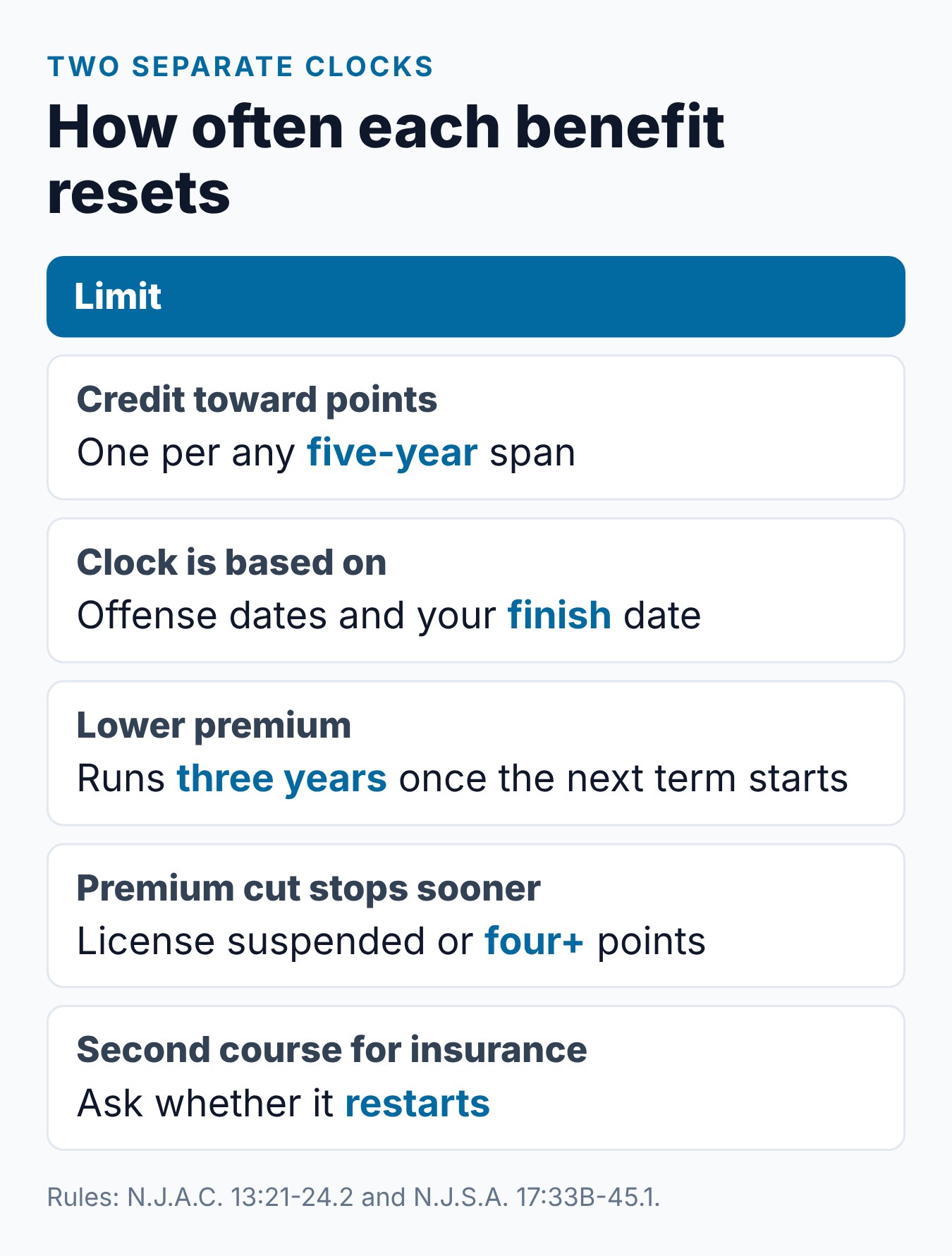
How often can you take NJ defensive driving course credit toward your points? The 2-point reduction is allowed once in any five-year period under N.J.A.C. 13:21-24.2, and the insurance premium reduction lasts three years from your next policy period. The two clocks are separate, so a course can still matter for insurance when it no longer counts for points.
Key Facts
- Points: one 2-point credit in any five-year period. See the five-year rule.
- How the window is set: by the dates of the offenses and the course completion. See the dates.
- Insurance: a reduction for three years from the next policy period. See the insurance clock.
- Ends early: a suspension or four or more points ends the insurance reduction. See what ends it.
- Other programs: DIP and PDP have their own limits. See the comparison.
The Five-Year Rule for Points
N.J.A.C. 13:21-24.2 gives a 2-point credit after you finish an approved defensive driving course. It also says the credit is available not more than once in any five-year period.
The NJMVC Driver Programs page says the same thing in shorter words. It limits the reduction to only once every 5 years.
The five-year limit is on the point credit. Taking the course is your choice, since N.J.A.C. 13:21-24.10 says entry into an approved course is voluntary.
How Often Can You Take NJ Defensive Driving Course Credit?
The short answer is one point credit per five years. Here is what that looks like with dates:
- First course: finished on March 1, 2024, with points on the record. The credit applies.
- Second course: finished on June 1, 2027. That is inside the same five-year period, so no new point credit.
- Third course: finished after the five-year period ends. A new credit can apply if points are on the record.
Because the window is “any” five-year period, two credits can never sit inside one five-year span. If you are close to the line, check your driver history abstract for the date of your last credit.
Which Dates Set the Window
N.J.A.C. 13:21-24.2 says the time periods are figured from the dates the offenses were committed and the date the course was completed. It does not use the date you signed up.
Two more rules affect timing:
- Points must be there. The NJMVC says the credit applies only if you have points on your record when you complete the course.
- The floor is zero. A credit cannot take your total below zero, so a credit used on 1 point uses up the full five years.
That last point is worth a pause. If you finish a course with 1 point, your total drops to 0. The five-year limit still starts, even though only one point came off.
The Three-Year Insurance Clock
The insurance benefit runs on a different law. N.J.S.A. 17:33B-45.1 requires insurers to reduce premiums after the named insured or principal operator finishes an approved course.
That reduction lasts three years. It starts with the next policy period after you complete the course, not on the day you finish.
The law does not set the amount. Each insurer sets it based on its own actuarial experience.
What Ends the Insurance Reduction Early
The same law lists two events that end the reduction before three years pass:
- A license suspension.
- Four or more motor vehicle points.
So a new ticket can cut the insurance benefit short. Our guide on the NJ defensive driving insurance discount covers the full insurance rules.
Does a New Course Start a New Reduction?
The law says the reduction lasts three years from the next policy period. It does not say what happens if you finish a second course later.
So ask your insurer before you take another course for insurance alone. Ask whether a new completion starts a new three-year reduction on your policy.
How Often for Each Program
New Jersey has more than one way to lower points, and each has its own limit. The NJMVC Point System page and the remedial program pages set them out:
| Benefit or program | How often | What starts it |
|---|---|---|
| Course point credit | Once in any five-year period | You finish an approved course with points on record |
| Course insurance reduction | Lasts three years | The next policy period after the course |
| Driver Improvement Program | Once every two years | An NJMVC notice of proposed action |
| Probationary Driver Program | One time | An NJMVC order |
| Clean-year credit | Each year with no violations or suspensions | The violation date or most recent restoration |
The course is the only one on this list you start on your own. DIP and PDP depend on an NJMVC notice, and the clean-year credit depends on time.
The clean-year credit works on time alone. The NJMVC takes off 3 points for a year with no violations or suspensions, and it lists no five-year cap for it.
The DIP and PDP Limits
The Driver Improvement Program (DIP) is a separate NJMVC program. The NJMVC DIP FAQ says you can take it only after the NJMVC sends a notice offering it.
Completing DIP removes three points. The NJMVC limits it to once every two years, in response to a proposed action.
The Probationary Driver Program (PDP) is for probationary license holders. The NJMVC PDP FAQ says it removes three points and may be completed one time when ordered.
A defensive driving course cannot stand in for either program. If you get a DIP or PDP notice, follow that notice.
How to Plan Around the Limits
Since the point credit comes once per five years, timing is the main choice you control. A few rule-based points can guide you:
- Points first. A course finished before points post has nothing to reduce.
- No proposed suspension. N.J.A.C. 13:21-24.2 says a credit does not cancel a suspension the NJMVC has already proposed.
- Insurance timing. The reduction starts with your next policy period, so your renewal date matters.
For a full look at timing, see when to take the NJ defensive driving course. To see what the credit does to a total, read how the 2-point reduction works.
A Ten-Year Timeline Example
Dates make the two clocks easier to see. Say a driver with 5 points finishes an approved course on March 1, 2024, and the auto policy renews each July 1:
| Date | Point side | Insurance side |
|---|---|---|
| March 1, 2024 | Course finished, 5 points drop to 3 | Course finished |
| July 1, 2024 | No change | Reduction starts with the new policy period |
| June 1, 2027 | A second course here earns no point credit | Ask the insurer about a new reduction |
| July 1, 2027 | No change | Three years have passed |
| After March 1, 2029 | A new course can earn a credit again, if points are on record | Ask the insurer again |
The table assumes no new tickets and no suspension. A suspension, or four or more points, would end the insurance reduction early under N.J.S.A. 17:33B-45.1.
What Happens Each Time You Finish
Each course follows the same reporting path. The NJMVC says the provider notifies it with proof of completion within 7 to 10 business days.
The NJMVC also says certificates are not acceptable from the driver license holder. So you do not mail anything to the NJMVC, even for a second course.
Once the credit posts, order a fresh driver history abstract. The completion shows up there, and it is the date you will need later to count five years.
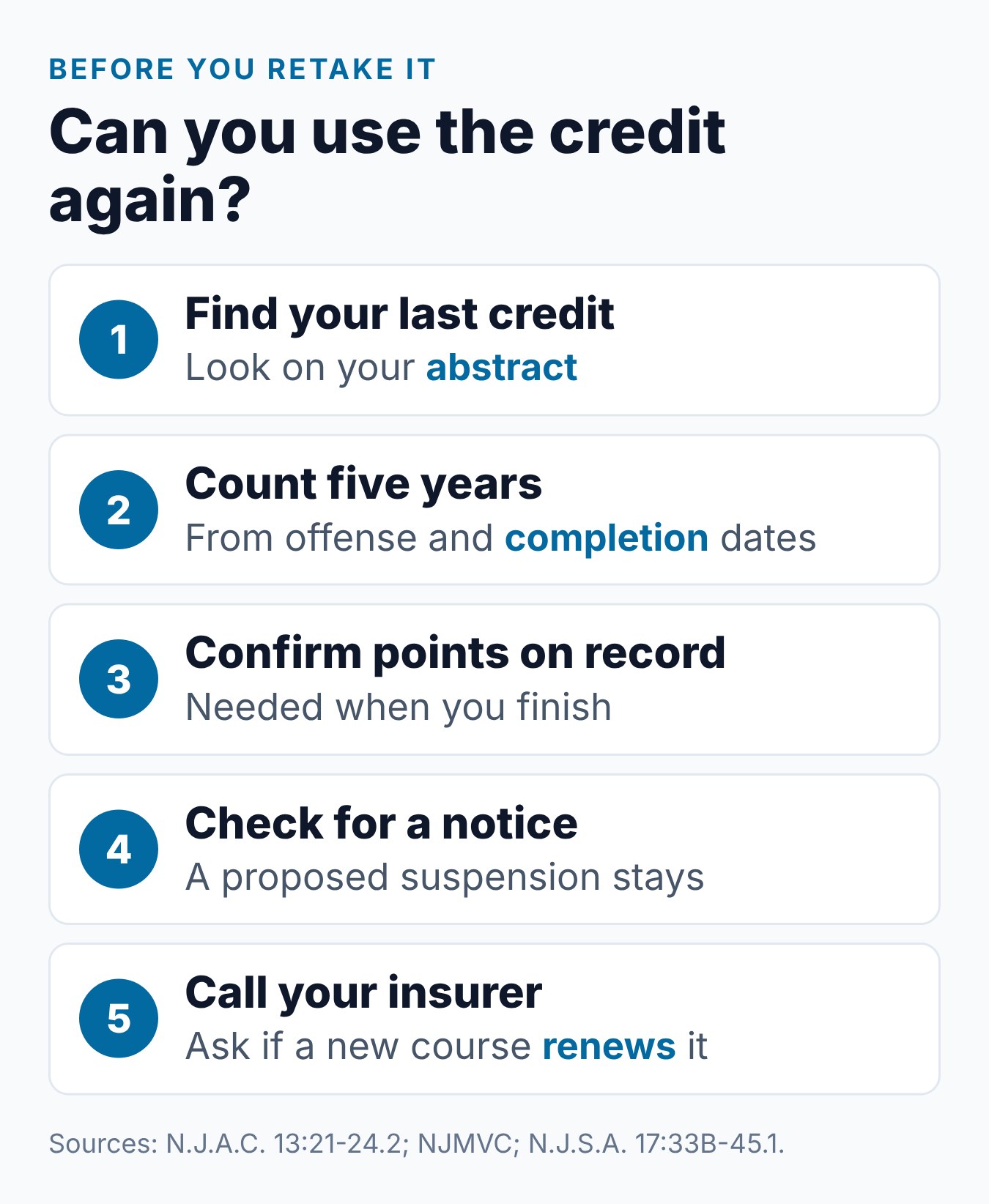
If You Are Near the Five-Year Line
A course finished one day too early earns no point credit. Before you pay a provider, take these steps:
- Find the date of your last credit on your abstract.
- Count five years from that course completion date.
- Plan to finish after that date, if points are on your record then.
The insurance side has no five-year line in the law. Your insurer can tell you how a second course affects your policy.
Our Review of the Timing Rules
We compared the NJMVC pages and the state rules on October 25, 2026. They agreed on the core limit, once every five years for the point credit.
N.J.A.C. 13:21-24.2 adds the detail that the NJMVC page leaves out. It names the offense dates and the completion date as the dates that set the window.
N.J.S.A. 17:33B-45.1 is the only source that sets the three-year insurance period. It does not say whether a second course renews it.
Common Mistakes About Course Timing
These mistakes come from the rules above:
- Mixing up the clocks. Five years is for points. Three years is for insurance.
- Counting from the sign-up date. The rule uses the offense dates and the completion date.
- Using the credit on 1 point. Only one point comes off, but the five-year limit still applies.
- Assuming a new course renews insurance. The law does not say so. Ask your insurer.
- Finishing a day early. A course finished before your five-year date earns no point credit.
- Treating DIP or PDP as the same course. They have their own limits and come from an NJMVC notice.
Before you plan a course, check your current total. Our pillar guide on how to check points on your NJ license shows how.
How Requirements Can Vary
New Jersey’s point system and defensive driving rules are set by state law and NJMVC rules, and they apply statewide. Fines and court costs come from the municipal court that handles your ticket, so the amount you owe depends on the court and the violation.
Insurance discounts also differ. State law requires insurers to reduce your premium after an approved course, but each insurer sets the amount.
Check the NJMVC Driver Programs page, your driver history abstract, and your insurer for current rules before you sign up for a course.
Frequently Asked Questions
How often can I take the NJ defensive driving course for points?
You can get the 2-point credit once in any five-year period. N.J.A.C. 13:21-24.2 sets that limit. The window is figured from the offense dates and the course completion date.
Can I take the course again before five years pass?
The five-year limit in N.J.A.C. 13:21-24.2 is on the point credit. A second course inside the same five-year period will not earn another 2-point credit. Ask your insurer whether it changes your premium.
How long does the insurance reduction last?
Three years, starting with the next policy period after you finish. N.J.S.A. 17:33B-45.1 says it ends early if your license is suspended or you build up four or more points.
Does the five-year clock start on the day I sign up?
No. N.J.A.C. 13:21-24.2 figures the period from the dates of the offenses and the date you completed the course.
How often can I take the Driver Improvement Program?
The NJMVC lists the DIP point reduction as once every two years, in response to an NJMVC proposed action. You can take DIP only after the NJMVC sends a notice offering it.
Do the point clock and the insurance clock line up?
No. They come from different rules. The point credit is limited to once in any five-year period, and the insurance reduction runs three years from the next policy period.
Do I send my certificate to the NJMVC after a second course?
No. The NJMVC says the provider sends proof of completion within 7 to 10 business days. It does not accept certificates from license holders, for a first course or a later one.
Does the five-year limit apply if I had only 1 point?
Yes. Your total drops to 0, and the credit counts as used. You cannot earn another point credit in the same five-year period.
Conclusion
The NJ defensive driving course earns a 2-point credit once in any five-year period, and the insurance reduction lasts three years from your next policy period. Track both clocks, check your abstract, and ask your insurer before a second course. The New Jersey Defensive Driving Course from Driving Logic is coming soon, and the NJMVC lists State-approved providers now.
Related Articles
- How to Check Points on License NJ: Your Record Guide
- NJ Defensive Driving 2 Point Reduction: How It Works
- NJ Defensive Driving Insurance Discount: What to Ask Your Insurer
- When Should You Take the NJ Defensive Driving Course? The Best Times
Sources
- N.J.A.C. 13:21-24.2 — Point reduction for a defensive driving course
- NJMVC — Driver Programs (defensive driving course, DIP, PDP, approved providers)
- NJMVC — Point System and Suspensions
- N.J.S.A. 17:33B-45.1 — Insurance premium reduction after a defensive driving course
- NJMVC — Driver Improvement and Probationary Driver Programs
- NJMVC — Driver Improvement Program FAQ
- NJMVC — Probationary Driver Program FAQ
- N.J.A.C. 13:21-24.10 — Voluntary course; fees
Billy Forte is the owner of Driving Logic, a state-approved driver improvement course provider serving Florida and other U.S. states.
This article is general information, not legal advice. New Jersey point rules, surcharges, and insurance discounts are set by New Jersey law, the Motor Vehicle Commission, and your insurer, and can change. Check the NJMVC website, the court on your ticket, and your insurer for current requirements.