
Updated October 2026 · Reviewed by Billy Forte
In the driver improvement program vs defensive driving question, the key difference is who starts it: you choose the defensive driving course, but you may attend the Driver Improvement Program (DIP) only after the New Jersey Motor Vehicle Commission (NJMVC) sends a notice offering it. The defensive driving course removes 2 points and leads to an insurance premium reduction. The DIP is a three-hour program that removes 3 points and can stand in for all or part of a suspension.
Key Facts
- Who starts it: you choose the course; NJMVC offers the DIP by notice. See what each program is.
- Points: the course removes 2, the DIP removes 3. See the side-by-side table.
- How often: the course once in any five years; the DIP once every two years. See the side-by-side table.
- No swaps: a defensive driving course cannot replace a DIP. See which one applies.
- Strict attendance: missing part of a DIP class leads to a suspension. See attendance rules.
What Each Program Is
The two programs share a goal. Both aim to make you a safer driver. But they come from different rules and serve different needs.
The Defensive Driving Course
The defensive driving course is voluntary. N.J.A.C. 13:21-24.10 says entry into an approved course is voluntary, and providers may charge an attendance fee.
NJMVC lists State-approved classroom and online courses on its Driver Programs page. There is also a separate mature driver course for drivers 55 and older.
You can take the course with no notice from NJMVC. It earns two benefits: a 2-point credit and an insurance premium reduction. For the full overview, see our NJ defensive driving course guide.
The Driver Improvement Program
The DIP is a remedial program run under NJMVC rules. NJMVC’s remedial programs page describes it as a three-hour program.
A license holder facing suspension may elect to attend the DIP in lieu of all or part of the suspension. But you can take it only after NJMVC sends a notice offering it.
Completing the DIP removes 3 points. For the full set of DIP rules, see our guide to the NJ Driver Improvement Program.
Driver Improvement Program vs Defensive Driving Side by Side
We compared the NJMVC pages and state rules on October 25, 2026. Here is how the two programs line up:
| Feature | Defensive driving course | Driver Improvement Program (DIP) |
|---|---|---|
| Who starts it | You, by choice | NJMVC, by a notice offering it |
| Length | At least six hours of instruction | Three hours |
| Ways to take it | State-approved classroom or online course | As set out in your NJMVC notice |
| Points removed | 2 | 3 |
| How often | Once in any five-year period | Once every two years, in response to an NJMVC proposed action |
| Effect on a suspension | Credits do not undo a suspension already proposed | May be taken in lieu of all or part of a suspension |
| Fees | Attendance fee set by the provider | $75 NJMVC fee plus a class fee of no more than $75 |
| Reporting | Provider tells NJMVC within 7-10 business days | Provider reports within 48 hours |
| Insurance | Insurers must reduce your premium | Ask your insurer |
The biggest differences are the first and the sixth rows. The course is your choice. The DIP is an NJMVC offer tied to a suspension.
What the Fees Look Like
The DIP fee has two parts. The $75 NJMVC administrative fee must be paid, or you get no credit for the class. The provider’s class fee can be no more than $75, so the total is no more than $150.
The course fee works differently. NJMVC’s Driver Programs page does not post a price. Each provider sets its own attendance fee.
Which One Applies to You
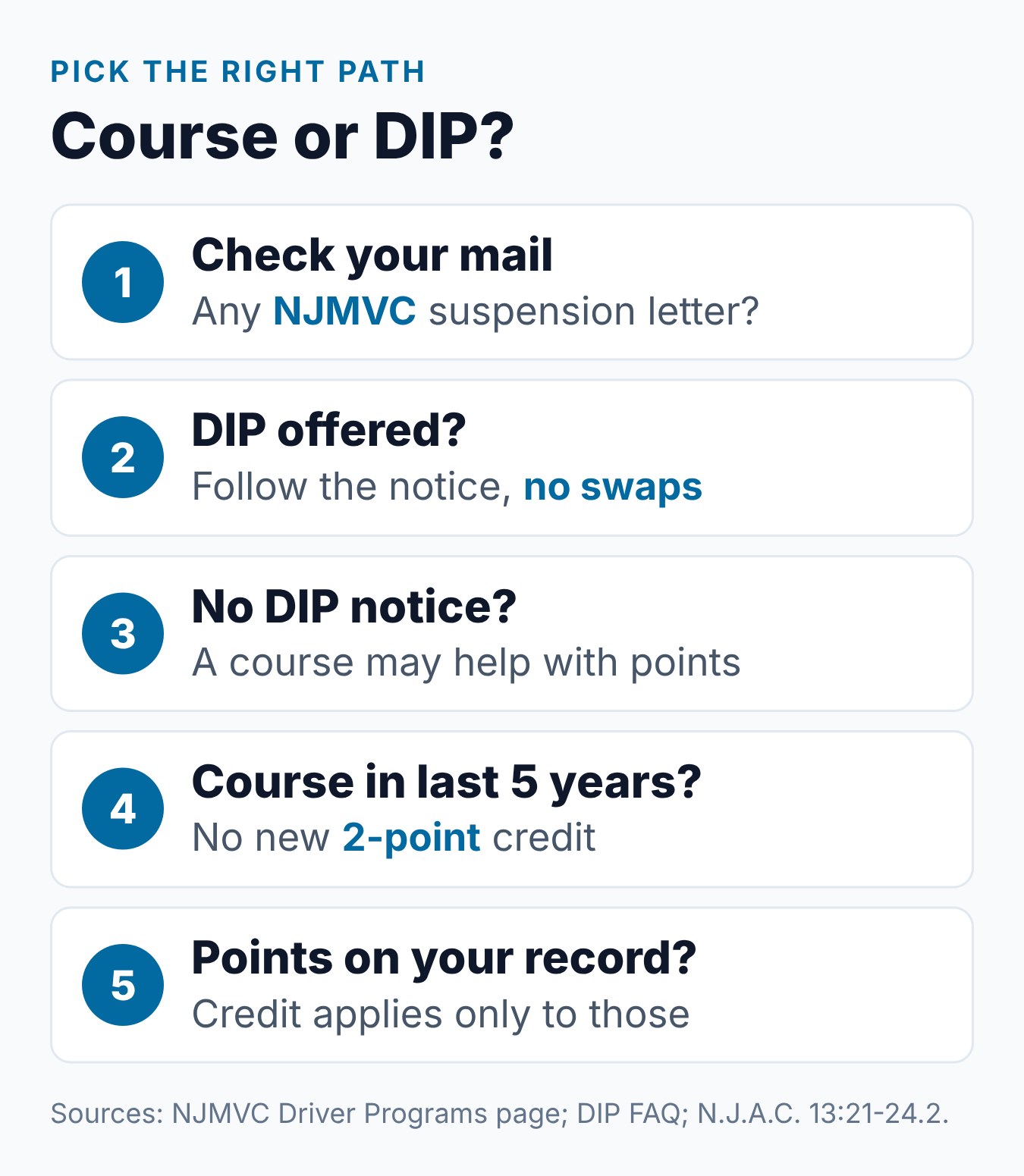
Start with your mail. Whether you got a notice from NJMVC decides which path you are on.
- Check for an NJMVC notice. Read any letter about a proposed suspension.
- If the notice offers the DIP, follow it. A defensive driving course cannot be substituted for it.
- If there is no DIP notice, look at the course. The DIP FAQ says a driver without a notice may take a defensive driving course for point reduction, if it applies.
- Check your course history. The course credit is limited to once in any five-year period.
- Check your points. The course credit applies only to points on your record when you finish.
Why a Course Cannot Replace a DIP Notice
NJMVC is clear on this point. The Driver Programs page says the defensive driving course is not a substitute for the DIP or the Probationary Driver Program.
So if your notice offers the DIP, taking a defensive driving course instead will not answer it. Read your notice and respond the way it says.
Where the Probationary Driver Program Fits
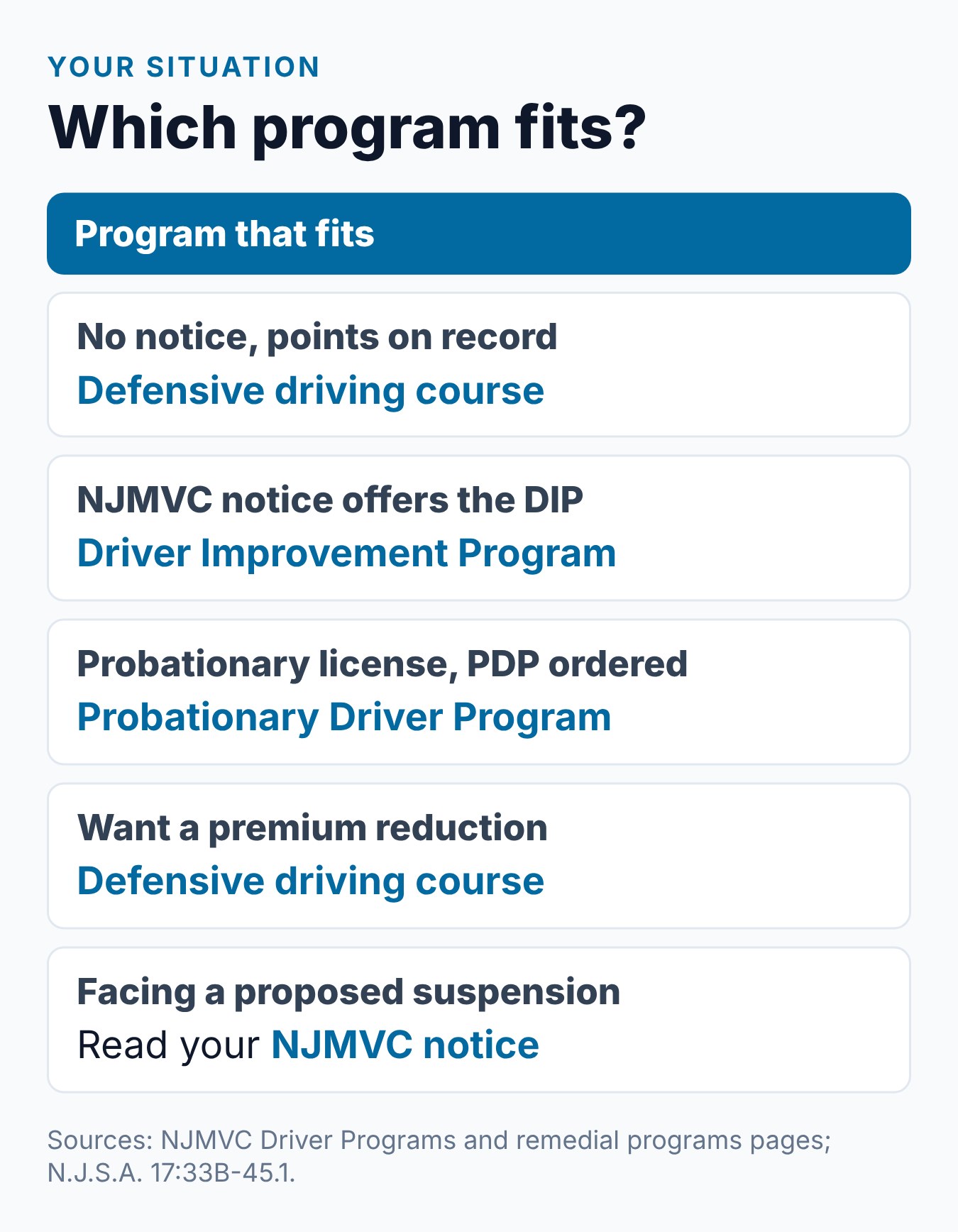
There is a third program. The Probationary Driver Program (PDP) is for probationary license holders.
NJMVC requires it for those who pick up more than two points or are convicted of certain violations. Completing it removes 3 points, and it may be completed one time when ordered.
Like the DIP, it costs a $75 NJMVC fee plus a class fee of no more than $75. You have 120 days to complete it. Our guide to the NJ Probationary Driver Program covers it in full.
How the Point Credits Compare
NJMVC lists four ways points can come off a record on its Point System and Suspensions page. The two programs here are two of them:
- One year with no violations or suspensions: minus 3 points.
- Defensive driving course: minus 2 points, once every five years.
- DIP: minus 3 points, once every two years, in response to an NJMVC proposed action.
- PDP: minus 3 points, one time when ordered.
The math is simple. With 7 points, a course credit of 2 leaves 5. Under N.J.A.C. 13:21-24.2, the course credit can never take your total below zero.
For how these reductions work together, see NJ license points automatic reduction.
Attendance and Reporting
The two programs treat attendance very differently.
DIP Attendance Is Strict
The DIP FAQ says you must attend the whole class. If you arrive late or leave early, the provider reports that you did not complete the program. That results in a suspension.
DIP providers report completions within 48 hours. If your class is cancelled and your suspension date is near, the FAQ says to call NJMVC at 609-292-7500, extension 5034.
Course Completion Is Reported by the Provider
For the defensive driving course, the NJMVC page says the provider notifies NJMVC within 7-10 business days. NJMVC does not accept certificates from drivers.
An online course must give no less than six hours of instruction, with quizzes you must pass to move on. A classroom course must give at least six hours too.
After the Program: The One-Year Warning
The DIP comes with a follow-up rule. N.J.A.C. 13:19-10.6 covers violations after a restoration, an official warning, or a DIP or PDP.
A further violation within one year leads to a suspension. For a first such violation, the rule sets these lengths:
- Within 6 months: 90 days.
- From 6 to 9 months: 60 days.
- From 9 to 12 months: 45 days.
This rule is tied to the DIP and PDP, not to the voluntary course. It is one more reason to drive with care after a DIP.
Suspension Context
The DIP is tied to suspensions. NJMVC says 12 or more points leads to a license suspension, with notice by mail.
Under N.J.A.C. 13:19-10.2, the Chief Administrator may, for good cause shown, allow a DIP in total or partial satisfaction of a suspension. For suspension lengths, see NJ license suspension points.
If You Got a DIP Notice
A DIP notice goes to a license holder facing a suspension. Read it as soon as it arrives.
- Read the whole notice. It tells you what NJMVC has proposed and what the DIP can replace.
- Pay the $75 NJMVC fee. The DIP FAQ says you get no credit for the class without it.
- Book a class with an approved provider. NJMVC lists DIP providers on its Driver Programs page.
- Plan to arrive early. Late arrival is reported as not completing.
- Keep your records. Save your receipt, class date and provider name.
If your class is cancelled and the suspension date is close, call NJMVC at the number in the DIP FAQ. Do not wait for the provider to call you.
If You Have No Notice and No Points
Some drivers have neither a notice nor points. The DIP is not open to them, since it needs an NJMVC notice.
The course point credit would not help either. It applies only to points on your record when you finish.
The course can still matter for insurance. N.J.S.A. 17:33B-45.1 requires insurers to reduce premiums after an approved course. Ask your insurer how much.
Common Mistakes to Avoid
These come from the NJMVC pages and state rules:
- Taking a course to answer a DIP notice. A defensive driving course cannot be substituted for the DIP.
- Signing up for the DIP on your own. You can take it only after NJMVC sends a notice offering it.
- Skipping the $75 NJMVC fee. Without it, you get no credit for the DIP class.
- Arriving late to a DIP class. Late arrival or leaving early is reported as not completing.
- Expecting a ticket dismissal. Neither program dismisses a ticket.
- Repeating the course too soon. The course credit is limited to once in any five-year period.
How Requirements Can Vary
New Jersey’s point system and defensive driving rules are set by state law and NJMVC rules, and they apply statewide. Fines and court costs come from the municipal court that handles your ticket, so the amount you owe depends on the court and the violation.
Insurance discounts also differ. State law requires insurers to reduce your premium after an approved course, but each insurer sets the amount.
Check the NJMVC Driver Programs page, your driver history abstract, and your insurer for current rules before you sign up for a course.
Frequently Asked Questions
What is the difference between the DIP and defensive driving in NJ?
The defensive driving course is voluntary and removes 2 points. The DIP is a three-hour program you may take only after an NJMVC notice offers it, and it removes 3 points.
Can I take the Driver Improvement Program without a notice?
No. NJMVC says you may take the DIP only after it sends a notice offering it. Without one, a defensive driving course may help with points if it applies.
Can a defensive driving course replace the DIP?
No. NJMVC says a defensive driving course cannot be substituted for the DIP.
How many points does each program remove?
The defensive driving course removes 2 points. The DIP removes 3 points, and so does the PDP.
How much does the DIP cost compared with the course?
The DIP costs a $75 NJMVC fee plus a class fee of no more than $75. Each defensive driving course provider sets its own fee.
How often can I use each program?
The course credit applies once in any five-year period. NJMVC lists the DIP credit as once every two years, in response to a proposed action.
Does the DIP lower my insurance like the course does?
State law requires an insurance premium reduction after an approved defensive driving course. For the DIP, ask your insurer how it treats the program.
Does Driving Logic offer the DIP or PDP?
No. Driving Logic does not offer the Driver Improvement Program or the Probationary Driver Program. NJMVC lists approved DIP and PDP providers on its Driver Programs page.
Conclusion
The defensive driving course is a voluntary choice for 2 points and an insurance premium reduction. The DIP is a three-hour NJMVC program you take only after a notice offers it, and a course cannot replace it.
Driving Logic’s New Jersey Defensive Driving Course is coming soon, with NJMVC approval pending. Until then, find a State-approved provider on the NJMVC Driver Programs page.
Related Articles
- NJ Defensive Driving Course: The Complete Guide to Point Reduction and Insurance Discounts
- NJ Driver Improvement Program (DIP): What It Is and Who Has to Take It
- NJ Probationary Driver Program (PDP): What New Drivers Need to Know
- How to Reduce Points on License NJ: Automatic Credits
Sources
- NJMVC — Driver Programs (defensive driving course, DIP, PDP, approved providers)
- NJMVC — Driver Improvement and Probationary Driver Programs
- NJMVC — Driver Improvement Program FAQ
- NJMVC — Probationary Driver Program FAQ
- NJMVC — Point System and Suspensions
- N.J.A.C. 13:21-24.2 — Point reduction for a defensive driving course
- N.J.A.C. 13:21-24.10 — Voluntary course; fees
- N.J.A.C. 13:19-10.2 — Suspension for points
- N.J.A.C. 13:19-10.6 — Violations after restoration, warning or a program
- N.J.S.A. 17:33B-45.1 — Insurance premium reduction after a defensive driving course
Billy Forte is the owner of Driving Logic, a state-approved driver improvement course provider serving Florida and other U.S. states.
This article is general information, not legal advice. New Jersey point rules, surcharges, and insurance discounts are set by New Jersey law, the Motor Vehicle Commission, and your insurer, and can change. Check the NJMVC website, the court on your ticket, and your insurer for current requirements.