
Updated October 2026 · Reviewed by Billy Forte
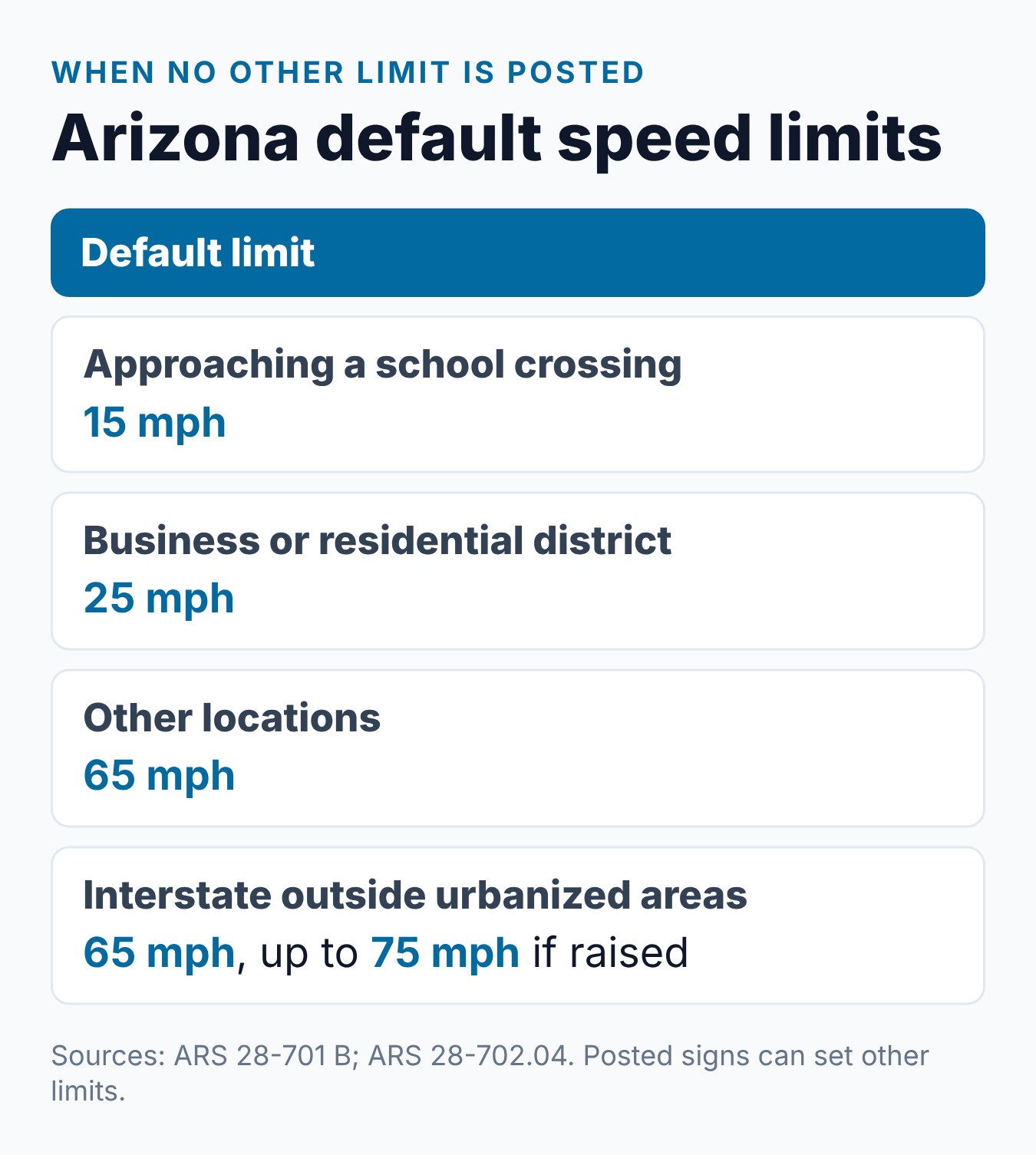
The basic Arizona speed limit rule is that you may never drive faster than is reasonable and prudent for the conditions, under ARS 28-701. Unless signs say otherwise, the default limits are 15 mph approaching a school crossing, 25 mph in a business or residential district and 65 mph in other places, and interstates outside urbanized areas start at 65 mph and can be raised to 75 mph. Going over a limit is a civil violation until you cross the criminal lines in ARS 28-701.02.
Key Facts
- First rule: drive no faster than is reasonable and prudent for the conditions. See the reasonable and prudent rule.
- Defaults: 15 mph at school crossings, 25 mph in districts and 65 mph elsewhere. See default limits.
- Interstates: 65 mph outside urbanized areas, and up to 75 mph if ADOT’s director raises it. See interstate limits.
- Signs: posted limits can change the defaults. See posted signs.
- Tickets: speeding is civil until it crosses a criminal line, such as more than 20 mph over a posted limit. See how limits connect to tickets.
The Reasonable and Prudent Rule
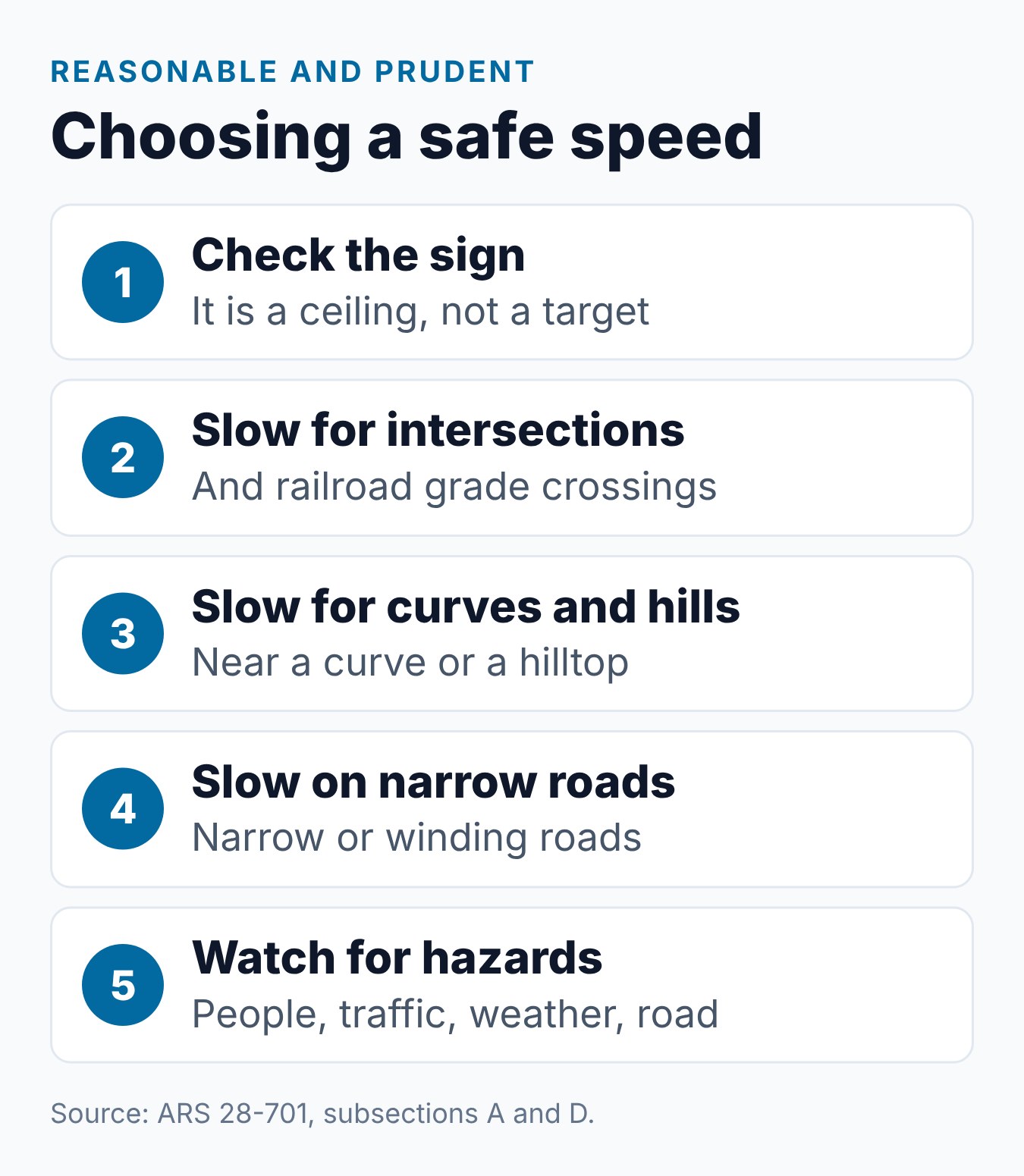
Arizona’s speed law starts with a rule, not a number. Subsection A of ARS 28-701 says you may not drive faster than is reasonable and prudent under the circumstances, conditions and hazards you face.
The same subsection asks for more. You must control your speed as needed to avoid hitting a person, a vehicle or anything else on or next to the road.
This means the number on the sign is a ceiling, not a target. On a clear day it may be safe. In heavy rain or dust, the law expects you to slow down.
When You Must Slow Down
Subsection D of ARS 28-701 lists places and conditions that call for a lower speed. You must drive at a reasonable speed when you are:
- Approaching an intersection or a railroad grade crossing.
- Going around a curve or nearing the top of a hill.
- Driving on a narrow or winding road.
- Facing special hazards from pedestrians, other traffic, weather or the road itself.
Driving Too Slowly
The law also works in the other direction. Subsection E says you may not drive slower than the speed that is reasonable and prudent under existing conditions.
There is one narrow exception. It covers a lawfully operated farm implement whose top safe speed is lower than that.
Default Arizona Speed Limit Rules
Subsection B of ARS 28-701 sets three default limits. A speed above them is prima facie evidence that you were going too fast.
“Prima facie” is a legal term. Here it means the speed itself is evidence that you were going too fast. The statute calls such a speed “too great and therefore unreasonable.”
Subsection C says these limits can be changed under ARS 28-702 and 28-703. That is how a road gets a posted limit that differs from the default.
Approaching a School Crossing
The default is 15 mph when you are approaching a school crossing. That is the lowest default limit in the statute.
A separate law sets a criminal line here. Going over 35 mph while approaching a school crossing is criminal speeding under ARS 28-701.02.
Business and Residential Districts
The default is 25 mph in a business or residential district. A posted sign can set a different limit.
If no limit is posted in a district, going over 45 mph is criminal speeding. Below that, the 25 mph default and the reasonable and prudent rule still apply.
Other Locations
Everywhere else, the default is 65 mph. That covers roads that are not school crossings or districts and have no other posted limit.
Interstate Speed Limits
Interstates have their own statute, ARS 28-702.04. It sets a base limit of 65 mph on interstates outside urbanized areas.
An urbanized area is one with 50,000 or more people. The statute uses the U.S. Census Bureau’s definition from the decennial census.
The ADOT director has two powers here. The director may set a lower limit under ARS 28-702. The director may also raise the limit to 75 mph on one interstate or on all of them.
Interstates in the Largest Counties
The statute adds a rule for counties with 3 million or more people. There, the interstate limit must be at least 65 mph.
A lower limit is allowed only if three things are true. An approved engineering study or road safety assessment must find it needed. The public must get a chance to comment, and overall capacity and mobility must not drop.
A violation of the interstate limit is a civil traffic violation. The penalty is capped by ARS 28-1598.
Who Sets Arizona Speed Limits
Posted limits do not appear at random. Two statutes say who can change the defaults and what they must do first.
State Highways
ARS 28-702 covers state highways. The director may set a different limit on any part of a state highway. First, an engineering and traffic investigation must show the current limit is more or less than is reasonable or safe.
The new limit can apply at all times or only at times shown on the signs. It can also vary by time of day, type of vehicle or weather. It takes effect only when signs giving notice are put up.
City and County Roads
ARS 28-703 covers local authorities, such as cities and counties. They also need an engineering and traffic investigation before they change a limit. Here is what they may do:
- Lower the limit at intersections.
- Raise the limit in a business or residence district, but to no more than 65 mph.
- Lower the limit outside business or residence districts.
- Raise or lower the limit on streets next to school grounds or public parks.
- Lower the limit on unpaved roads to as low as 15 mph to meet air quality standards.
The same law sets some guardrails. A street may have no more than six limit changes per mile, not counting lower limits at intersections. Limits next to each other may differ by no more than 10 mph, except at school crossings.
A change to a state highway inside a city also needs the state director’s approval. And like state limits, local limits apply only when signs are posted.
Posted Signs and Work Zones
The default limits apply unless a sign says otherwise. When a road has a posted limit, that sign is the number to follow.
Posted limits also matter for criminal speeding. Two of its tests count from the posted limit: more than 20 mph over it, in a district or anywhere else.
State highway work zones have their own rule. ARS 28-710 says you may not go faster than the speed allowed by the traffic control devices in the zone.
When workers are present, a speeding penalty there comes with an extra assessment equal to the penalty. Our guide to Arizona speeding ticket cost shows how that adds up.
How Speed Limits Connect to Tickets
Going over a limit can lead to one of three kinds of ticket. The type depends on how far over you were and where:
- Waste of a finite resource: under ARS 28-702.01, going no more than 10 mph over may get this label. It applies where the limit is at least 30 mph outside an urbanized area or at least 40 mph inside one.
- Civil speeding: going over a limit, or faster than is reasonable and prudent, without crossing a criminal line.
- Criminal speeding: more than 20 mph over a posted limit, over 35 mph near a school crossing, or over 45 mph in an unposted district.
For a full comparison, read criminal speeding vs civil speeding Arizona. For the exact criminal lines, see what is considered criminal speeding in Arizona.
Speed Limits and Defensive Driving
The type of ticket decides your options. ARS 28-3392 says a court shall allow defensive driving for an eligible civil moving violation. For criminal speeding, the court may allow it.
We checked the court’s List of Eligible Violations on October 25, 2026. It listed 28-701A and 28-701E, from the speed law, and 28-702.04B, the interstate code. Criminal speeding codes were marked CM, which means the judge must give express permission.
For how the class works on a speeding ticket, read can defensive driving dismiss an Arizona speeding ticket.
Points for Speeding
ADOT MVD’s points page lists 3 points for speeding. With 8 or more points in any 12-month period, MVD may order Traffic Survival School or suspend your license for up to 12 months.
Common Mistakes
These mistakes come from misreading Arizona’s speed laws. Each one can lead to a ticket:
- Treating the sign as a target. ARS 28-701 says your speed must be reasonable and prudent for the conditions.
- Thinking no sign means no limit. The default limits of 15, 25 and 65 mph apply where no other limit is posted.
- Assuming every interstate is 75 mph. The statute’s base is 65 mph outside urbanized areas, and the higher limit must be set.
- Ignoring work zone signs. In a state highway work zone, the posted devices set the limit.
- Driving slower than conditions call for. Subsection E bars driving below a reasonable and prudent speed.
- Forgetting the criminal lines. More than 20 mph over a posted limit is a class 3 misdemeanor.
For the full topic of criminal speeding, see the criminal speeding Arizona guide.
How Requirements Can Vary
Arizona’s defensive driving rules are set by state law and the Arizona Supreme Court, but each court handles its own cases. The total cost includes a court diversion fee that each court sets, so the price depends on the court on your ticket.
Extension allowances also differ by court, from 14 to 60 days on the Supreme Court’s list. If a judge orders in-person attendance, you must take a classroom course.
Court fees can change in April and October each year. Check the Arizona Supreme Court Defensive Driving Program and the court on your citation for current rules before you register.
Frequently Asked Questions
What is the speed limit in Arizona?
It depends on the road. Where no other limit is posted, ARS 28-701 sets 15 mph approaching a school crossing, 25 mph in a business or residential district and 65 mph elsewhere. You must also drive at a reasonable and prudent speed.
What is the residential speed limit in Arizona?
The default is 25 mph in a business or residential district, under ARS 28-701. A posted sign can set a different limit for that street.
What is the school crossing speed limit in Arizona?
The default is 15 mph when approaching a school crossing. Going over 35 mph there is criminal speeding under ARS 28-701.02.
What is the highest speed limit in Arizona?
ARS 28-702.04 lets the ADOT director raise interstate limits to 75 mph. The base limit on interstates outside urbanized areas is 65 mph.
Are there roads in Arizona with no speed limit?
No. Where no limit is posted, the default limits in ARS 28-701 apply. The reasonable and prudent rule applies on every road.
Can I get in trouble for driving under the speed limit?
The law can still apply. ARS 28-701 requires a reasonable and prudent speed for the conditions, even below the sign. It also bars driving slower than is reasonable and prudent for the conditions.
Is speeding a criminal offense in Arizona?
Only past certain lines. Going more than 20 mph over a posted limit, over 35 mph near a school crossing or over 45 mph in an unposted district is a class 3 misdemeanor. Other speeding is civil.
Conclusion
The Arizona speed limit on any road starts with one rule: drive at a reasonable and prudent speed, and never above the posted or default limit. Know the 15, 25 and 65 mph defaults, watch for interstate and work zone signs, and remember that more than 20 mph over a posted limit is a crime.
Driving Logic’s Arizona Defensive Driving Course is coming soon. For an eligible civil speeding ticket, the court’s list at azcourts.gov/drive shows every certified school.
Related Articles
- Criminal Speeding Arizona: What It Is and What to Know
- What Is Considered Criminal Speeding in Arizona? The Speed Thresholds
- Criminal Speeding vs Civil Speeding Arizona: Key Differences
Sources
- Arizona Revised Statutes — ARS 28-701 (reasonable and prudent speed)
- Arizona Revised Statutes — ARS 28-702.04 (interstate speed limits)
- Arizona Revised Statutes — ARS 28-701.02 (criminal speeding)
- Arizona Revised Statutes — ARS 28-702.01 (waste of a finite resource)
- Arizona Revised Statutes — ARS 28-1598 (civil traffic penalty)
- Arizona Supreme Court — List of Eligible Violations
- Arizona Revised Statutes — ARS 28-3392 (eligibility)
- ADOT MVD — Points Assessment
- Arizona Revised Statutes — ARS 28-702 (changing state highway speed limits)
- Arizona Revised Statutes — ARS 28-703 (local speed limit changes)
- Arizona Revised Statutes — ARS 28-710 (work zone speeding)
Billy Forte is the owner of Driving Logic, a state-approved driver improvement course provider serving Florida and other U.S. states.
This article is general information, not legal advice. Arizona defensive driving eligibility, deadlines, and fees are set by Arizona law, the Arizona Supreme Court, and each court, and can change. Check the Arizona Supreme Court Defensive Driving Program and the court on your citation for current requirements before you register for a course.