
Updated October 2026 · Reviewed by Billy Forte
The Texas teen driving curfew says a driver under 18 may not drive after midnight and before 5 a.m., unless the trip is for work, a school-related activity or a medical emergency. It is part of Transportation Code 545.424, and DPS lists it for provisional license holders. This guide covers the hours, each exception, the learner carve-out and when the rule ends.
Key Facts
- Hours: no driving after midnight and before 5 a.m. for drivers under 18. See the hours.
- Exceptions: work (including family farm work), school-related activities and medical emergencies. See the exceptions.
- Learner carve-out: the rule does not apply with learner-level supervision. See the carve-out.
- Fines: $25 to $99, or $100 to $200 with a prior conviction. See enforcement.
- End: the rule stops at 18. See when it ends.
What the Texas Teen Driving Curfew Says
The rule is in Transportation Code 545.424. It says a person under 18 may not drive after midnight and before 5 a.m. unless the trip is necessary for one of three reasons.
The DPS provisional license page puts it more simply. It says, “Driving is restricted between midnight and 5:00 a.m. unless for work, school activities, or emergencies.”
People call this a curfew. The statute does not use that word. It is a limit on driving hours, not on being out of the house.
The Hours the Rule Covers
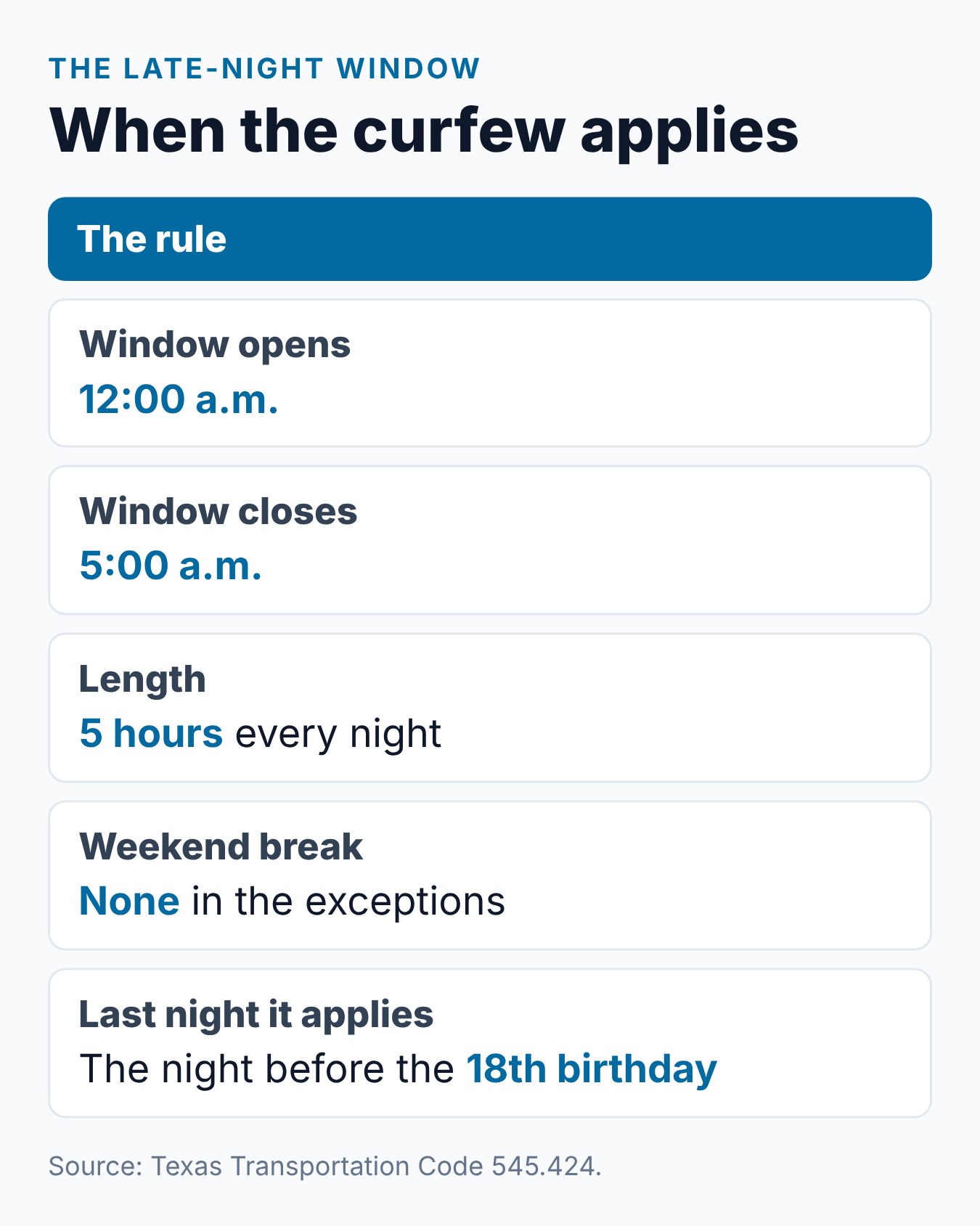
The window opens at 12:00 a.m. and closes at 5:00 a.m. That is five hours each night.
The rule applies on every day of the week. The exceptions in the statute do not mention weekends, holidays or summer break.
A little clock math helps:
- 11:50 p.m.: outside the window. The rule has not started yet.
- 12:01 a.m.: inside the window. A listed reason is needed.
- 4:59 a.m.: still inside the window.
- 5:00 a.m.: the window has closed.
A trip that starts before midnight can run into the window. If the drive home crosses 12:00 a.m., that part of the trip falls under the rule.
The Three Exceptions
The statute lists three reasons a teen may drive in the window. Here they are in the law’s own terms:
| Exception | What the statute says | Detail |
|---|---|---|
| Employment | Necessary to attend or participate in employment | Includes work on a family farm |
| School activity | Necessary to attend or participate in a school-related activity | Must be school-related |
| Medical emergency | Necessary because of a medical emergency | A true medical emergency |
No other reason appears in the statute. A party, a movie or a friend’s house is not on the list.
Each exception uses the word “necessary.” The drive has to be needed for the job, the school activity or the emergency. A stop that is not needed for one of the three reasons does not fit the list.
Work, Including Family Farm Work
The first exception covers employment. Subsection (d) of the statute adds that employment includes work on a family farm.
So a teen who works a late shift may drive for that job. The same goes for chores on a family farm before dawn.
School-Related Activities
The second exception covers a school-related activity. The teen may drive to attend or take part in it.
The word “school-related” matters. An event with no link to the school does not fit this exception, even if classmates are there.
The statute does not define “school-related activity.” If you are not sure an event fits, plan for a licensed adult to drive. That choice stays inside the law either way.
Medical Emergencies
The third exception covers a medical emergency. The statute does not list examples.
In a true emergency, safety comes first. Call 911 when someone needs urgent help.
Driving With Learner-Level Supervision
The rule has a carve-out. The statute says the limit does not apply when the teen drives with the supervision a learner license requires.
The DPS learner license page describes that supervision. A licensed adult 21 or older must sit in the front passenger seat.
This matters for practice. The TDLR behind-the-wheel page requires 30 hours of practice, with at least 10 at night. Those night hours are done with the supervising adult.
TDLR adds a rule for that adult. The practice partner must be 21 or older and licensed for at least one year. For a minor, a parent or legal guardian certifies the hours.
So the night hours teach the skill before the teen drives alone. Once the provisional license arrives, the late-night limit applies to solo trips.
A Note on Daily Limits
Night practice still follows the course rules. TDLR limits supervised practice to 2 hours per day. Under 16 TAC 84.50, in-car work can begin only after the learner license is issued.
Who the Curfew Covers
The statute applies to any “person under 18 years of age.” DPS lists the rule among the limits for provisional license holders.
In practice, the rule bites when a teen drives alone. A learner always has a supervising adult, and that supervision lifts the limit.
The rule follows the driver, not the car. A teen under 18 who drives a friend’s or a relative’s car follows the same limit.
The Curfew Across the Teen Years
The rule plays a different part at each stage. Here is how it lines up:
- Learner stage, age 15 and up: a licensed adult 21 or older rides in front, so the limit does not apply. Night practice can happen.
- Provisional stage, ages 16 and 17: the teen drives alone, and the limit applies every night.
- Age 18 and older: the limit no longer applies once the driver turns 18.
Some quick math shows the span. A teen who gets a provisional license on the 16th birthday drives under the rule for two years. A teen licensed at 17 and a half drives under it for six months.
Fines and Enforcement
Section 545.424 sets the fine for a violation. It is $25 to $99. With a prior conviction, it is $100 to $200.
Here is the math for two tickets. The first could cost $25 to $99.
A second, after a conviction for the first, could cost $100 to $200. Together, that is $125 to $299 in fines.
The statute also limits stops. A peace officer may not stop a vehicle or detain a driver solely to check for a violation of this section.
The rule still applies on every drive. The limit on stops only changes why an officer can pull a car over.
When the Curfew Ends
The limit is tied to age. Once the driver turns 18, it no longer applies.
TDLR says the provisional license expires on the 18th birthday. The TDLR step-by-step guide says the driver must then renew “to receive a regular driver license without restrictions.”
Our guide on when teen driving restrictions end walks through the renewal.
How the Curfew Works With the Other Two Rules
The late-night limit is one of three under-18 rules in Section 545.424. The other two apply at every hour, including late at night.
On a lawful late trip, such as a drive to work at 4:30 a.m., the teen still may not use a phone, even hands-free, except in an emergency. The teen also may carry no more than one passenger under 21 who is not a family member.
Our cell phone law guide covers the device rule.
What This Guide Does Not Add
Some rules about late-night driving get passed around without a source. We left them out. This guide does not list any letter, form or card a teen must carry for a late trip, because the statute text we reviewed does not set one.
If a family wants extra rules at home, that is a family choice. It is separate from what the law requires.
Planning Around the Late-Night Window
The window is easier to follow with a plan. These ideas keep each trip inside the law:
- Check the end time. Before a late event, find out when it ends.
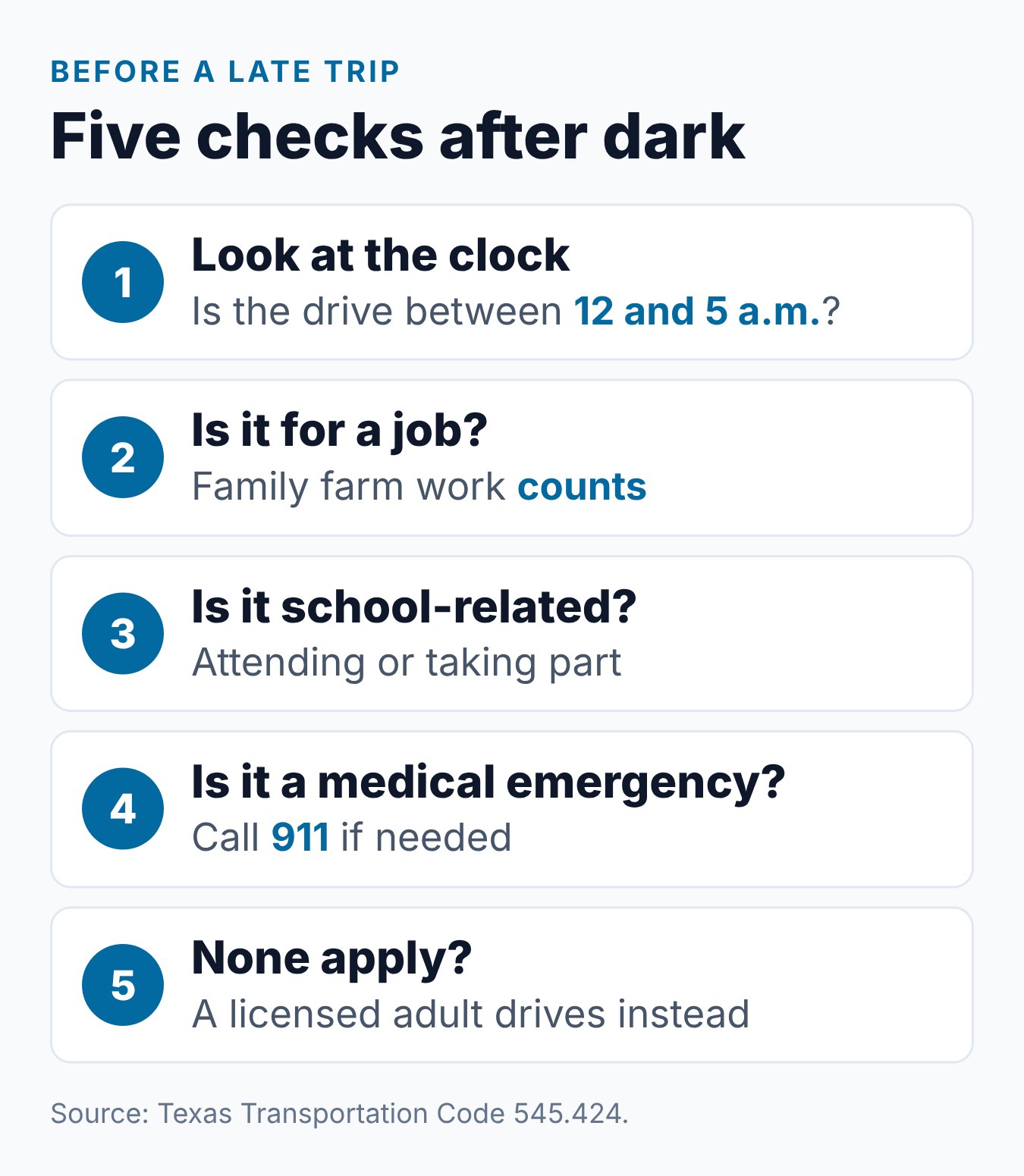
- Ask which reason applies. Work, a school-related activity or a medical emergency are the only three.
- Arrange another ride. If no reason applies, a licensed adult can drive.
- Leave early. Getting home before 12:00 a.m. avoids the window.
- Think about passengers too. The passenger limit applies on the same trip.
Our passenger limit guide covers that second rule.
Our Review of the Statute and DPS Page
On the DPS provisional license page we checked on October 26, 2026, the late-night rule appeared in one sentence. It named work, school activities and emergencies.
The statute uses longer wording. It says “school-related activity” and “medical emergency,” and it adds the family farm detail. When the two differ in detail, read the statute.
Common Mistakes With the Midnight Rule
Each mistake below breaks a rule in the statute:
- Treating weekends as free. The statute has no weekend exception.
- Counting any event as school-related. The activity must be school-related.
- Thinking 5 a.m. is inside the window. The window closes at 5:00 a.m.
- Forgetting the trip home. A drive that crosses midnight falls under the rule.
- Assuming the rule ends at 17. It applies to every driver under 18.
- Ignoring other limits. The phone and passenger rules apply at night too.
For all three limits in one table, see Texas provisional license restrictions. For the full licensing path, see our teen driver license guide.
How Requirements Can Vary
Texas driver education rules come from TDLR, and driver license rules come from Texas DPS. They apply statewide, but what you need depends on the student’s age, the course method, and whether the classroom part comes from a parent-taught course, a driving school, or a public school.
Fees, forms, and office procedures can change. Check the TDLR parent-taught pages and the DPS driver license pages before each step, and follow the instructions from your course provider.
Frequently Asked Questions
What is the Texas teen driving curfew?
It is a limit in Transportation Code 545.424. A driver under 18 may not drive after midnight and before 5 a.m. unless the trip is for work, a school-related activity or a medical emergency.
Can my teen drive to a late shift?
Yes, if the drive is necessary to attend or participate in employment. The statute says employment includes work on a family farm.
Does the rule apply on weekends?
Yes. The exceptions in the statute do not mention weekends, holidays or summer break.
Can a learner practice after midnight?
The late-night limit does not apply while a teen drives with learner-level supervision. That means a licensed adult 21 or older in the front passenger seat.
Is a school dance a school-related activity?
The statute does not define “school-related activity,” so we cannot say for sure. If you are unsure, have a licensed adult drive for any part of the trip between midnight and 5 a.m.
What is the fine for breaking the curfew?
The statute sets a fine of $25 to $99. With a prior conviction, the fine is $100 to $200.
Can police stop my teen just to check the time?
No. A peace officer may not stop a vehicle or detain a driver solely to check for a violation of Section 545.424.
When does the curfew end?
At 18. The provisional license expires on the 18th birthday, and the renewed license has no under-18 limits.
Conclusion
The Texas teen driving curfew keeps drivers under 18 off the road from midnight to 5 a.m., with exceptions for work, school-related activities and medical emergencies. It does not apply with learner-level supervision, and it ends at 18. Driving Logic’s Texas Parent Taught Drivers Ed course is coming soon; until then, the statute and the DPS provisional page spell out the rule.
Related Articles
- How to Get a Texas Driver’s License at 16: The Complete Teen Guide
- Texas Provisional License Restrictions: Complete Rules for 16-Year-Old Drivers
- Texas Teen Driving Passenger Restrictions: How Many Passengers Can a Teen Have?
- Texas Teen Driving Cell Phone Law: What Parents Should Know
- When Do Texas Teen Driving Restrictions End?
Sources
- Texas Transportation Code § 545.424 — Operation of vehicle by person under 18
- Texas DPS — Texas Provisional License as a Teen
- Texas DPS — Texas Learner License as a Teen
- TDLR — Parent-Taught Behind-the-Wheel Instruction
- 16 Tex. Admin. Code § 84.50 — Parent-taught program requirements
- TDLR — Parent-Taught Step-by-Step Guide (PDF)
Billy Forte is the owner of Driving Logic, a state-approved driver improvement course provider serving Texas and other U.S. states.
This article is general information, not legal advice. Texas driver education and licensing rules are set by TDLR, Texas DPS, and Texas law, and can change. Check the official TDLR and DPS websites for current requirements.