
Updated October 2026 · Reviewed by Billy Forte
Your Texas speeding ticket options come down to four paths: pay the ticket, contest it, ask for a driving safety course, or ask the judge for deferred disposition. Each one starts with a plea, and each leads to a different result on your record. The answer date on your citation shapes which paths stay open, so find it before you decide.
Key Facts
- Four paths: pay, contest, take the course, or ask for deferred disposition. See the comparison.
- Paying is a plea: it means guilty or no contest, and the court reports the conviction to Texas DPS. See paying.
- The course is a right only if you qualify: ask on or before the answer date. See the course option.
- Deferred disposition is the judge’s call: it can last up to 180 days. See deferred disposition.
- No set outcome at trial: a not guilty plea leads to a trial, not a promised result. See contesting.
Texas Speeding Ticket Options Compared
Code of Criminal Procedure Chapter 45A lists three pleas: guilty, not guilty and nolo contendere. Nolo contendere means no contest. The table shows how each path uses them.
| Path | Plea you enter | What you do next | How it ends | Who decides |
|---|---|---|---|---|
| Pay | Guilty or no contest | Pay the fine and costs | Conviction reported to DPS | You |
| Contest | Not guilty | Go to trial before a judge or jury | Depends on the trial | Judge or jury |
| Driving safety course | Guilty or no contest | Finish the course and file papers in 90 days | Charge dismissed | Right if you qualify |
| Deferred disposition | Guilty or no contest | Meet the judge’s conditions | Complaint dismissed | Judge |
This is general information, not legal advice. Only you can choose your plea. The court or a lawyer can help you see how each path fits your case.
Option 1: Pay the Ticket
Paying is the simplest path, but it is not neutral. It counts as a plea of guilty or no contest, and the case ends in a conviction.
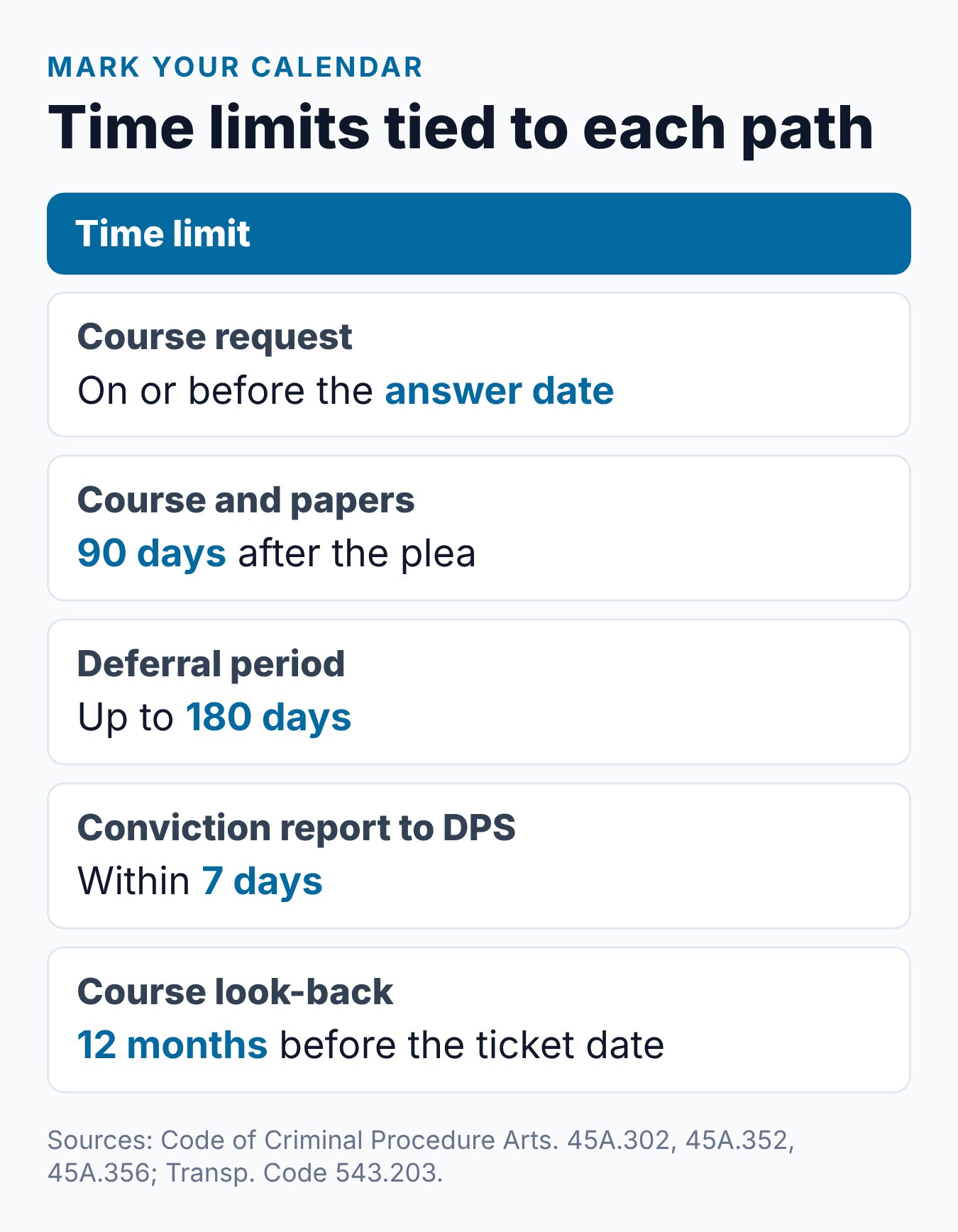
Transportation Code Chapter 543 says the court must send the conviction record to Texas DPS. It is due no later than the seventh day after the conviction.
A conviction can matter later in a few ways:
- Insurance: the Texas Department of Insurance says companies charge more for tickets.
- License: DPS must suspend a habitual violator, meaning 4 or more moving-violation convictions in 12 months, or 7 or more in 24 months.
- State fine: a guilty or no contest plea brings the $50 state traffic fine.
Option 2: Contest the Ticket
You can plead not guilty. The court then sets your case for trial.
You may waive a jury in writing, and the judge hears the case. If you do not waive it, a jury is called.
Chapter 45A gives you the right to appear through a lawyer. The result depends on the trial, so no one can promise how it ends.
The full process, including appeal deadlines, is in contesting a Texas speeding ticket in court.
Option 3: Ask for a Driving Safety Course
This path trades a plea for a dismissal. You plead guilty or no contest and ask for the course on or before the answer date.
You can ask in person, through a lawyer, or by certified mail, return receipt requested, postmarked by that date. Some courts also allow an e-mail address or online portal.
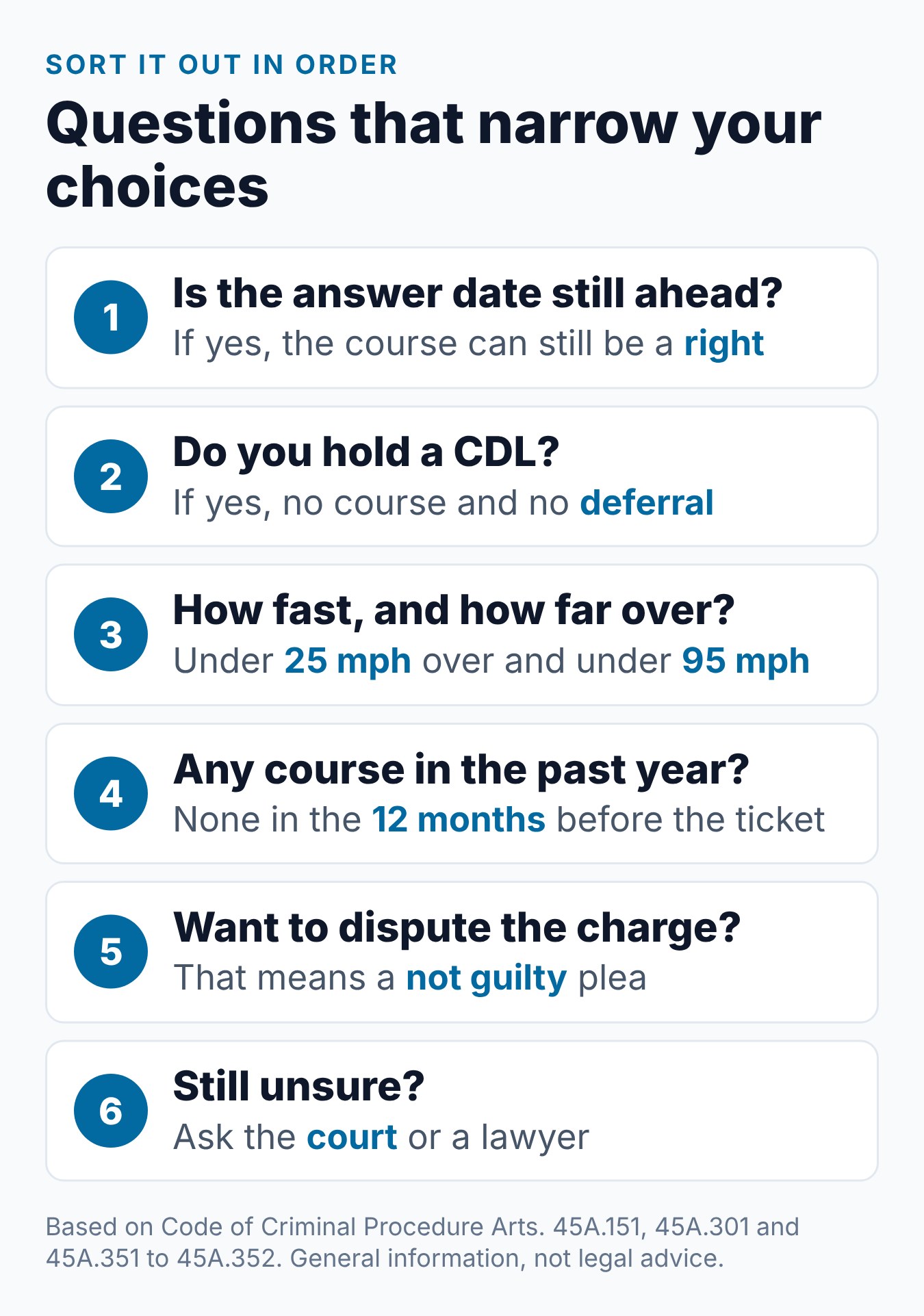
The judge must allow the course if all of these are true:
- You hold a Texas license or permit, or you are active-duty military, a spouse or a dependent child.
- You have not finished a course in the 12 months before this ticket’s date.
- You show proof of insurance.
- You do not hold a CDL and did not hold one on the ticket date.
- The charge is not 25 mph or more over, or 95 mph or more.
After the plea, you have 90 days. In that time you finish the course and turn in three things: the certificate, your driving record, and an affidavit. The course must run at least 360 minutes under 16 TAC 84.504.
When you comply, the court removes the judgment and dismisses each eligible charge. The dismissed charge may not be part of your driving record.
Several Tickets From One Stop
TDLR’s SB 296 notice explains a 2025 change. For requests made on or after Sept. 1, 2025, one course can dismiss each charge from the same criminal transaction.
Each charge must qualify on its own. The court may charge its fee of up to $10 for each one.
Option 4: Ask for Deferred Disposition
Deferred disposition is a separate process in Chapter 45A. You plead guilty or no contest and pay court costs. The judge may then put off the case for up to 180 days without a finding of guilt.
During that time, the judge may set conditions. One can be a driving safety course. For a driver under 25 with a moving violation, the judge must require one.
Since Dec. 4, 2025, the judge may also charge a “special expense fee.” It can be as high as the most the fine could be.
If you meet the conditions, the judge dismisses the complaint. The court may not report a conviction to DPS while the case is deferred. If guilt is found later, the record goes to DPS within 7 days.
Two groups cannot use it. Anyone who holds or held a CDL is barred for traffic offenses other than parking.
Work-zone offenses with workers present are also barred. Read what deferred disposition is for more.
Key Factors That Shape Your Choice
No path is best for every driver. These facts decide which ones are open to you:
- The answer date. The course is a right only if you ask by then. After it, the court may still allow it, but does not have to.
- Your license. The course right needs a Texas license or permit, or active-duty military family status.
- Your last course. A course finished in the 12 months before the ticket date ends the right.
- Your speed. At 25 mph or more over, or 95 mph or more, there is no course right.
- A CDL. Holding one bars both the course and deferred disposition.
- Insurance. An insurer may not raise your premium or cancel your policy because of a course dismissal. See speeding tickets and insurance.
When Each Path Might Fit
The law does not rank these paths. Still, the rules point to some plain matches. Think of these as questions to raise with the court or a lawyer, not as advice.
- Paying ends the case fast. It also leaves a conviction, which the course and deferral paths are built to avoid.
- Contesting fits a driver who disputes the charge and wants a judge or jury to decide. It takes a court date and has no set result.
- The course fits a driver who meets every condition and can finish within 90 days. It is a right in that case, so the judge must allow it.
- Deferred disposition may fit a driver who does not qualify for the course right. The judge still decides whether to grant it.
Drivers under 25 have two extra rules. The course rules cover any moving violation they get in a justice or municipal court. A judge who defers their moving violation must require a course.
If the Answer Date Has Passed
Missing the answer date ends the right to the course. It does not always end the chance.
Chapter 45A lets the court grant a course request before the case is finally decided. That choice belongs to the court.
There is one more rule to check. The citation must include a notice about the course.
If it did not, your right to the course continues until the notice is given or the case ends. For both course deadlines, see the Texas defensive driving deadline guide.
Questions to Ask the Court
A short call can clear up the basics. Ask the clerk:
- What is my fine, and what are the court costs?
- How does this court accept a course request?
- Does this court accept requests by e-mail or an online portal?
- Does this court offer deferred disposition for my charge?
- What record type does the court want with my course papers?
Write down each answer with the date you got it.
What We Found in Chapter 45A
On the Legislature’s compiled Chapter 45A text we checked on October 26, 2026, the course rules were Arts. 45A.351 to 45A.359. Deferred disposition was in Arts. 45A.301 to 45A.305.
Article 45A.302 showed the HB 16 change, in effect since Dec. 4, 2025. It replaced the deferral “fine” with a “special expense fee.” Article 45A.352 showed the SB 296 change on several charges.
Common Mistakes to Avoid
Each of these comes from a rule above:
- Paying first and asking about the course later. Paying is a plea that ends in a conviction.
- Mixing up the course and deferred disposition. One is a right when you qualify. The other is up to the judge.
- Asking after the answer date. The right to the course ends on that date.
- Sending a plain letter. A mailed request must go by certified mail, return receipt requested, postmarked by the answer date.
- Forgetting the affidavit. The court needs it with the certificate and driving record.
How Requirements Can Vary
The driving safety course rules come from Texas law and TDLR and apply statewide. Each justice or municipal court still sets its own fees, filing steps and contact methods, and the facts of your citation decide which options you have.
Laws, fees and court procedures can change. Check your citation, ask the court that handles your case, and use the TDLR and Texas DPS websites for current rules before you act.
Frequently Asked Questions
What are my options after a Texas speeding ticket?
You can pay, contest the ticket at trial, ask for a driving safety course if you qualify, or ask the judge about deferred disposition. Each path starts with a plea and ends differently.
Does paying a ticket count as pleading guilty?
Paying means a plea of guilty or no contest. Either way, the case ends in a conviction that the court reports to Texas DPS.
Which option keeps the ticket off my record?
A charge dismissed through the driving safety course may not be part of your driving record. Deferred disposition also ends in dismissal if you meet the judge’s conditions. Paying leads to a conviction.
Can I take the course and still contest the ticket?
No. The course requires a plea of guilty or no contest. Contesting starts with a plea of not guilty.
Is deferred disposition the same as the driving safety course?
No. They are separate processes in Chapter 45A. The course is a right when every condition is met, while deferred disposition is up to the judge.
What if I hold a CDL?
Texas law bars CDL holders from the course and from deferred disposition for traffic offenses, in any vehicle. That leaves paying or contesting as the main paths. Talk to a lawyer before you decide.
What happens if I ignore the ticket?
Ignoring it does not make it go away. When you sign a citation, you make a written promise to appear. Transportation Code Chapter 543 says breaking that promise on purpose is a separate misdemeanor.
Conclusion
Paying, contesting, the course and deferred disposition each start with a plea and end in a different place. The course is a right only when every condition is met and you ask by the answer date.
Check your citation, call the court, and talk to a lawyer if your case is complex. If the course is your path, Driving Logic’s online Texas driving safety course is one place to take it.
Related Articles
- Texas Speeding Ticket: Costs, Record Impact, and What to Know
- Texas Speeding Ticket Court: Can You Contest It?
- What Is Deferred Disposition in Texas? How It Compares to Defensive Driving
- Texas Speeding Ticket Insurance: What to Know
Sources
- Texas Code of Criminal Procedure Chapter 45A (PDF)
- Texas Transportation Code Chapter 543 — Arrest and Prosecution of Violators (PDF)
- TDLR — Taking a Driving Safety Course
- TDLR — SB 296: one driving safety course for multiple charges
- Texas Department of Insurance — Auto insurance guide
- 16 Tex. Admin. Code § 84.504 — Driving safety course length
Billy Forte is the owner of Driving Logic, a state-approved driver improvement course provider serving Texas and other U.S. states.
This article is general information, not legal advice. Texas traffic and driving safety course rules are set by Texas law, TDLR, Texas DPS and each court, and they can change. Check with the court on your citation and the official TDLR and DPS websites for current requirements, and talk to a Texas lawyer about your specific case.