
Updated October 2026 · Reviewed by Billy Forte
A missed Texas defensive driving deadline does not end your case on the spot: the court must first mail you a written notice and require you to appear and show cause. If you do not appear, or cannot show good cause, the court finds you guilty and imposes the sentence, and the ticket is not dismissed. If the 90 days have not run out yet, call the court right away, because the law gives you options while the clock is still running.
Key Facts
- The deadline: 90 days after the plea to finish the course and file three papers. See what the deadline requires.
- The notice: if you miss it, the court must mail you a written notice to appear. See what happens next.
- Show cause: at that appearance, you explain why the papers are late. See the hearing.
- Good cause: the court may allow more time to present the certificate. See good cause.
- The outcome: no appearance or no good cause means a finding of guilt and a sentence. See what a conviction means.
Which Deadline Did You Miss?
The driving safety course (DSC) process has two deadlines. The first is the answer date on your citation, the last day to plead and ask for the course as a right.
The second is the 90-day window after your plea. That window is the focus here.
If you missed the answer date instead, see our deadline guide, because the rules for a late request are different. In short, the court may still grant the course before the case is closed, but it does not have to.
What the 90-Day Deadline Requires
After you plead and ask for the course, the court enters judgment and defers it. Art. 45A.356 gives you 90 days to complete the course and present three items:
- The uniform certificate of course completion.
- Your Texas DPS driving record, unless the judge gets it from DPS under Art. 45A.359.
- An affidavit that you were not taking a course when you asked, and had not finished one in the prior 12 months that is missing from your record.
All three are part of the deadline. A finished course with no papers on file still counts as a missed deadline.
What Happens After a Missed Texas Defensive Driving Deadline
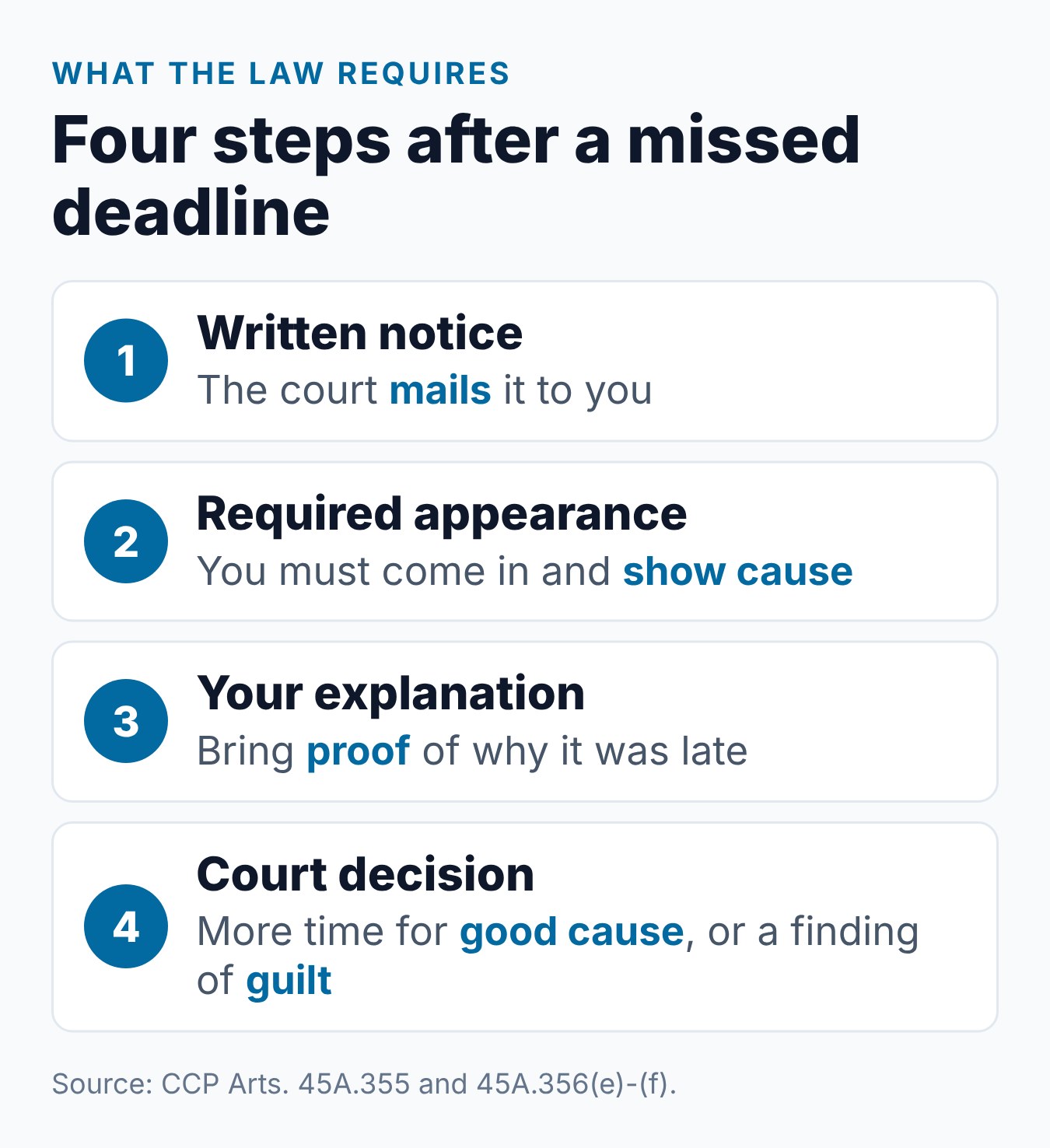
Art. 45A.356 sets out the steps in order. The court cannot skip to a conviction without them.
- Written notice. The court must mail you a written notice.
- A required appearance. The notice requires you to come before the court and show cause.
- Your explanation. You tell the court why you did not present the papers on time.
- The court’s decision. If you show good cause, the court may give you more time. If you do not appear, or have no good cause, the court must find you guilty and impose a sentence.
Once the court finds you guilty, the deferred judgment is no longer on hold. The case ends in a conviction rather than a dismissal.
The Show-Cause Appearance
“Show cause” means you explain to the court why you did not meet the deadline. It is your chance to keep the dismissal alive.
Come ready. A short, organized packet helps the court see what happened:
- Your notice from the court, and your citation.
- Proof of your reason, such as a provider e-mail, a record order receipt, or papers about an emergency.
- The papers you now have, such as the certificate, your driving record and a signed affidavit.
- A short timeline of what you did and when, written in plain words.
If something is still missing, say when you expect to have it.
Do not skip the appearance. Under Art. 45A.356, a failure to appear lets the court move straight to a finding of guilt.
Why the Course Alone Is Not Enough
The court cannot dismiss the charge just because you finished the course. Art. 45A.356 requires proof that you met the 12-month rule, too. The driving record and the affidavit supply that proof.
There is one twist. Under Art. 45A.359, a judge may get your record from DPS instead and charge you a fee equal to the certified record fee plus a state portal fee. If your court does this, ask whether you still need to send a record yourself.
Good Cause and More Time
Art. 45A.355 covers late papers. If you show good cause for not presenting the evidence on time, the court “may allow an additional period” to present the certificate.
Two things stand out. First, the word is “may,” so more time is up to the court.
Second, the law does not list what counts as good cause. The court decides based on what you show it.
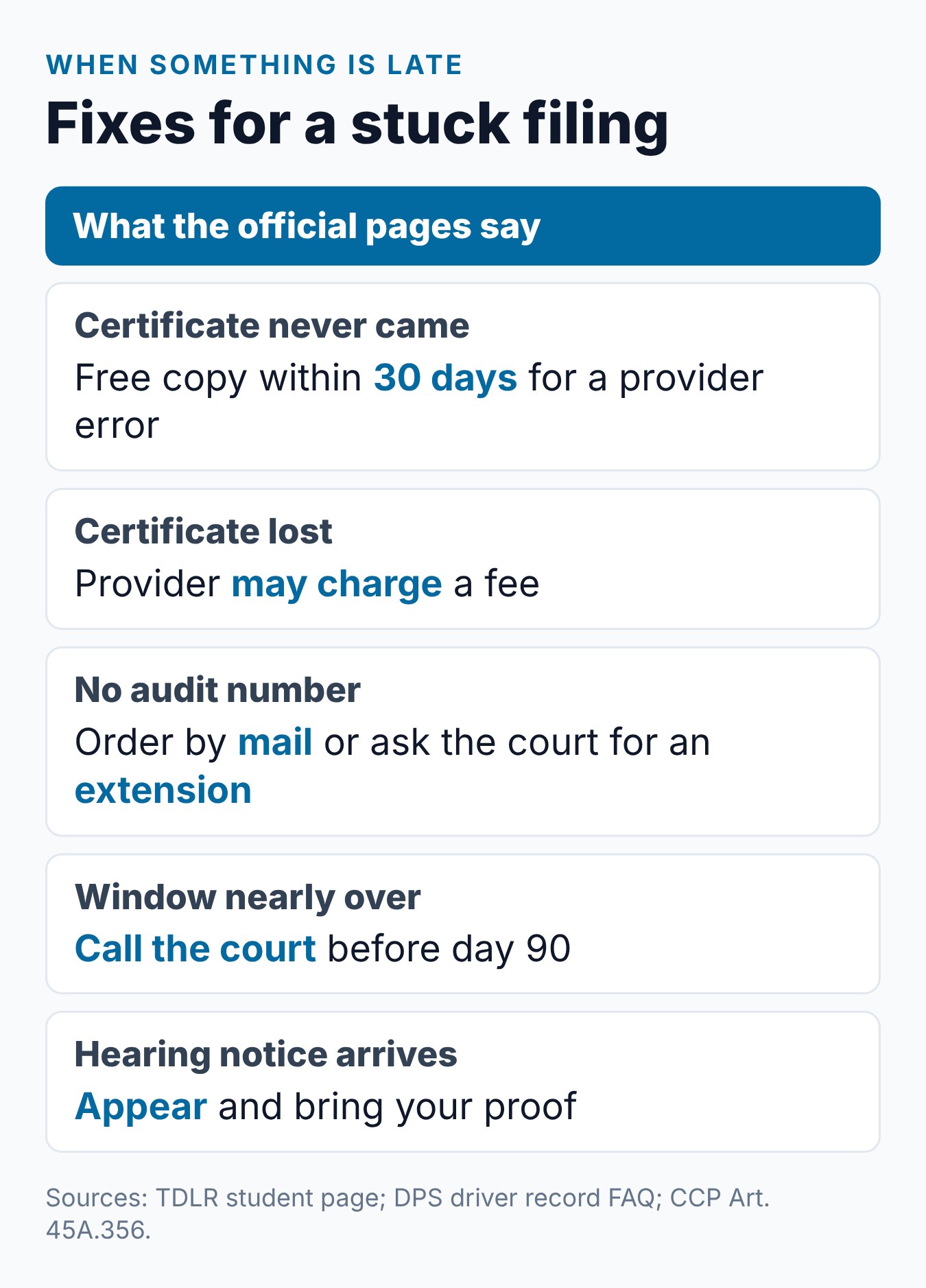
You do not have to wait for a notice to raise good cause. If you see a delay coming, contact the court before day 90 and ask how it handles extensions.
If You Still Have Time
Day 90 has not passed yet? Act on these items now:
- Call the court. Confirm your exact deadline and how the court wants the papers sent.
- Start or finish the course. 16 TAC 84.504 requires at least 360 minutes, so leave room for it.
- Order your record online. The DPS driver record page says online orders print or email instantly. Mail orders take about three weeks.
- Check your certificate. TDLR says it should arrive within 14 days of finishing.
- Sign the affidavit. Ask the court if it has a form for it.
If You Lack an Audit Number
The online DPS order asks for the audit number on your license. The DPS driver record FAQ gives two options if you do not have it. You can order by mail, or you can “contact the court directly to ask for an extension.”
That second option is worth noting. DPS itself sends drivers to the court when the record will be slow.
If Your Certificate Is Late or Wrong
Under 16 TAC 84.63, you can ask for a free copy within 30 days of the certificate’s issue date if it does not arrive or has a provider error. If you lose it yourself, the provider may charge a fee for a new one.
Our certificate guide explains the certificate in more detail.
What to Say When You Call the Court
A clear, short call works best. Have your citation and any court papers in front of you, then cover these items:
- Your name, citation number and the date of your plea.
- What you have finished, such as the course.
- What is still missing, and why.
- When you expect to have the missing item.
- How the court wants you to ask for more time, and how to send the papers.
Write down the date of the call, the name of the person you spoke with, and what they told you.
If Your Case Is Under Deferred Disposition
Deferred disposition is a separate process with its own conditions and a period of up to 180 days. The steps above come from the DSC rules. If your case is under deferred disposition, ask the court what applies, and see our deferred disposition guide.
What a Conviction Means
When the court finds you guilty, the case is treated like any other traffic conviction. Transportation Code Chapter 543 says the court reports it to DPS within seven days.
A conviction shows on your DPS record. DPS describes its Type 2 record as listing all moving violations for three years from the offense date.
Convictions also count toward the habitual violator rule. DPS must suspend a license after four or more moving-violation convictions in 12 months, or seven or more in 24 months.
You also lose the record protection in Art. 45A.357. That protection covers only a charge dismissed under the DSC rules, and a convicted charge was not dismissed.
Insurers can react too. The Texas Department of Insurance says “insurance companies will charge you more if you’ve had accidents or gotten tickets.”
Missing the Deadline vs Missing the Hearing
These are two separate problems, and the second is worse. Missing day 90 starts the notice process. You still get a chance to explain.
Missing the show-cause appearance removes that chance. The law tells the court to find you guilty and impose the sentence if you do not appear.
| Situation | What the law says happens |
|---|---|
| Papers late, notice not yet sent | The court must mail a written notice |
| You appear and show good cause | The court may allow more time for the certificate |
| You appear without good cause | The court finds you guilty and imposes sentence |
| You do not appear | The court finds you guilty and imposes sentence |
What We Found on the TDLR Pages
On the TDLR student page we checked on October 26, 2026, TDLR said driving safety courses “must generally be completed within a certain amount of time.” It added that providers “may require that you complete the course within a specific amount of time.”
The same page said it is the student’s job to send the certificate to the court. So a provider’s own time limit and the court’s 90 days can both apply, and neither one files the papers for you.
Common Mistakes to Avoid
Each of these leads straight into the problem Art. 45A.356 describes:
- Finishing the course but not filing. The certificate, record and affidavit must reach the court.
- Ordering the record by mail late in the window. Mail orders take about three weeks.
- Waiting for the court to remind you. The notice comes only after the deadline is missed.
- Ignoring the notice. Not appearing lets the court find you guilty.
- Showing up empty-handed. Bring proof of your reason and the papers you have.
For the full process from plea to dismissal, see our ticket dismissal guide.
How Requirements Can Vary
The driving safety course rules come from Texas law and TDLR and apply statewide. Each justice or municipal court still sets its own fees, filing steps and contact methods, and the facts of your citation decide which options you have.
Laws, fees and court procedures can change. Check your citation, ask the court that handles your case, and use the TDLR and Texas DPS websites for current rules before you act.
Frequently Asked Questions
Can I still finish the course after 90 days?
Only if the court allows it. If you show good cause, the court may give you more time to present the certificate.
What if I finished the course but never sent the papers?
Contact the court right away. The deadline covers the papers as well as the course, so a finished course alone does not meet it.
What counts as good cause?
The law does not define it. The court decides based on the reason and proof you give.
Does missing the deadline mean an automatic conviction?
No. The court must first mail a notice and require you to appear and show cause. A conviction follows if you do not appear or have no good cause.
My certificate never arrived. What do I do?
Ask the provider for a free copy within 30 days of the issue date, which the rules allow for provider errors. Tell the court about the delay before day 90 if you can.
Can a lawyer help with the show-cause appearance?
A Texas lawyer can explain your options and help you present your reason to the court. This is worth a call if a conviction would cause you serious problems.
Will the conviction be reported to DPS?
Yes. Courts report traffic convictions to DPS within seven days.
Conclusion
Missing the 90-day deadline starts a notice and a show-cause appearance, not an instant conviction. Show good cause and the court may give you more time, but skip the appearance and the court must find you guilty.
If you still have days left, call the court and finish the course and papers now. To get started, you can take Driving Logic’s online Texas driving safety course.
Related Articles
- Texas Defensive Driving for Ticket Dismissal: The Complete Guide
- Texas Defensive Driving Deadline: Request Before the Appearance Date
- Texas Driver Safety Course Certificate: What It Is and How to Submit It
- How to Get Your Texas Driving Record Online
Sources
- Texas Code of Criminal Procedure Chapter 45A (PDF)
- Texas Transportation Code Chapter 543 — Arrest and Prosecution of Violators (PDF)
- TDLR — Taking a Driving Safety Course
- Texas DPS — How to Order Your Driver Record
- Texas DPS — Driver Record FAQ
- Texas Department of Insurance — Auto insurance guide
Billy Forte is the owner of Driving Logic, a state-approved driver improvement course provider serving Texas and other U.S. states.
This article is general information, not legal advice. Texas traffic and driving safety course rules are set by Texas law, TDLR, Texas DPS and each court, and they can change. Check with the court on your citation and the official TDLR and DPS websites for current requirements, and talk to a Texas lawyer about your specific case.