
Updated October 2026 · Reviewed by Billy Forte
The answer on Indiana reckless driving speed is simple: the law sets no number. IC 9-21-8-52 asks whether a speed was unreasonably high, or unreasonably low, “under the circumstances,” and whether it put others at risk or blocked traffic. So no radar reading by itself turns a speeding ticket into a reckless driving charge.
Key Facts
- No number: the reckless driving law names no speed. See what the statute says.
- The test: speed that is unreasonable for the conditions and endangers others or blocks traffic. See the speed clause.
- Speeding stays an infraction: going over the limit is a Class C infraction, even at the top point tier. See fast is not the same as reckless.
- Slow can count: an unreasonably low speed can also be reckless. See slow driving.
- Zones differ: school zone and work site speeding are Class B infractions. See school zones and work sites.
Indiana Reckless Driving Speed: What the Statute Says
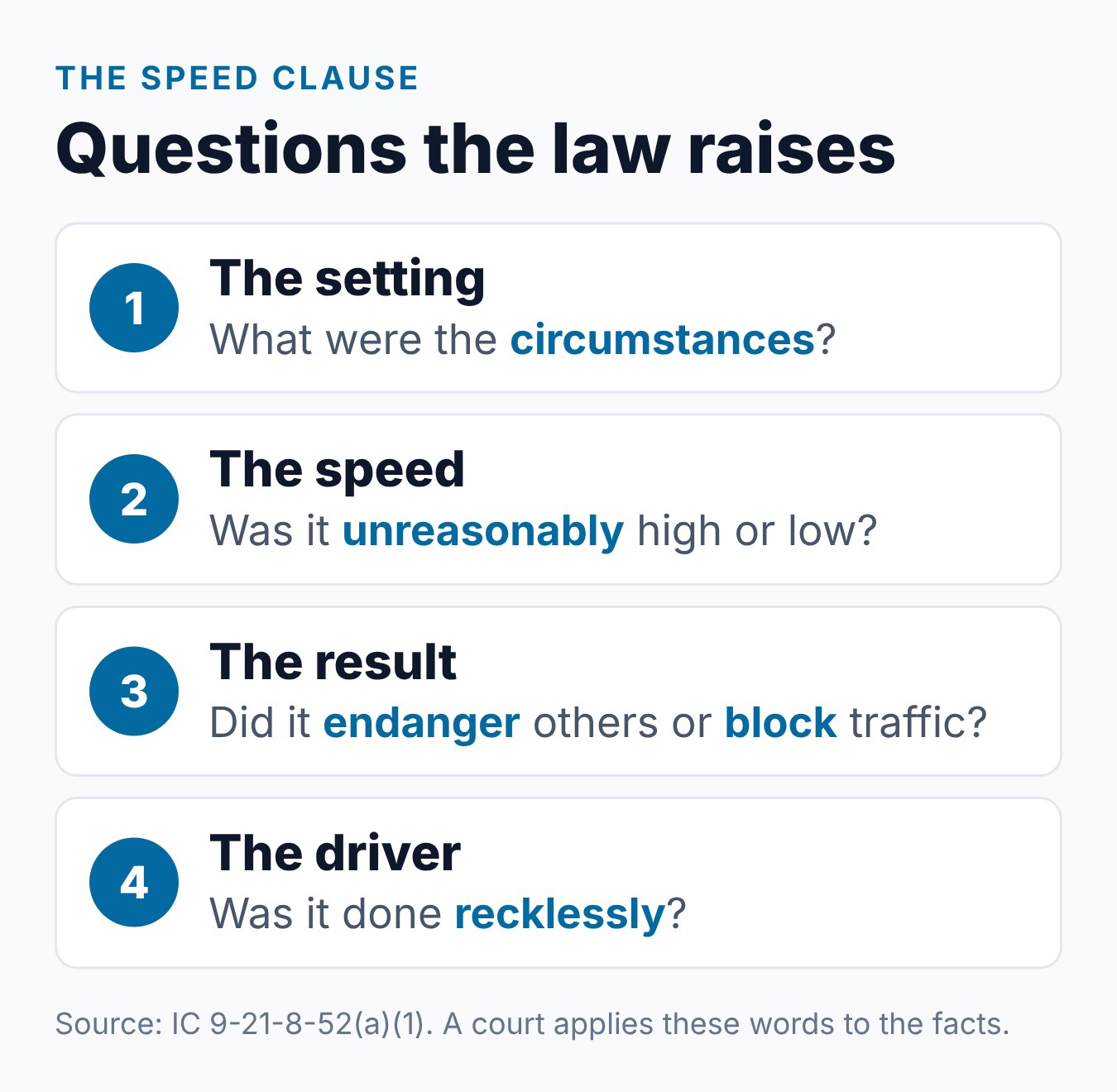
The speed part of the law is the first act in subsection (a). It covers a person who operates a vehicle and recklessly “drives at such an unreasonably high rate of speed or at such an unreasonably low rate of speed under the circumstances as to:”
- “(A) endanger the safety or the property of others; or”
- “(B) block the proper flow of traffic;”
That is the whole speed rule. You can read it in IC 9-21-8-52 in the official 2026 Indiana Code. There is no chart, no tier and no number in it.
Why the Law Uses No Number
The statute judges speed against the setting, not against a sign. “Under the circumstances” points to the conditions at that moment. A speed can be fine in one place and unsafe in another.
The law also needs a result. The speed must endanger people or property, or block the flow of traffic. And the driver must act “recklessly.” All three parts work together.
The Speed Clause, Part by Part
Each phrase in the clause does its own job. This table puts each one in plain words. The plain words are a summary, not a legal test.
| Phrase in the law | What it means in plain words |
|---|---|
| “recklessly” | The driver acted with no real care for a clear danger |
| “unreasonably high rate of speed” | Too fast for the setting |
| “unreasonably low rate of speed” | Too slow for the setting |
| “under the circumstances” | Judged by the road, traffic and conditions at that time |
| “endanger the safety or the property of others” | Puts other people or their things at risk |
| “block the proper flow of traffic” | Holds up the normal movement of traffic |
How a court applies these words to a real drive is a question for that court or an Indiana attorney.
Fast Is Not the Same as Reckless
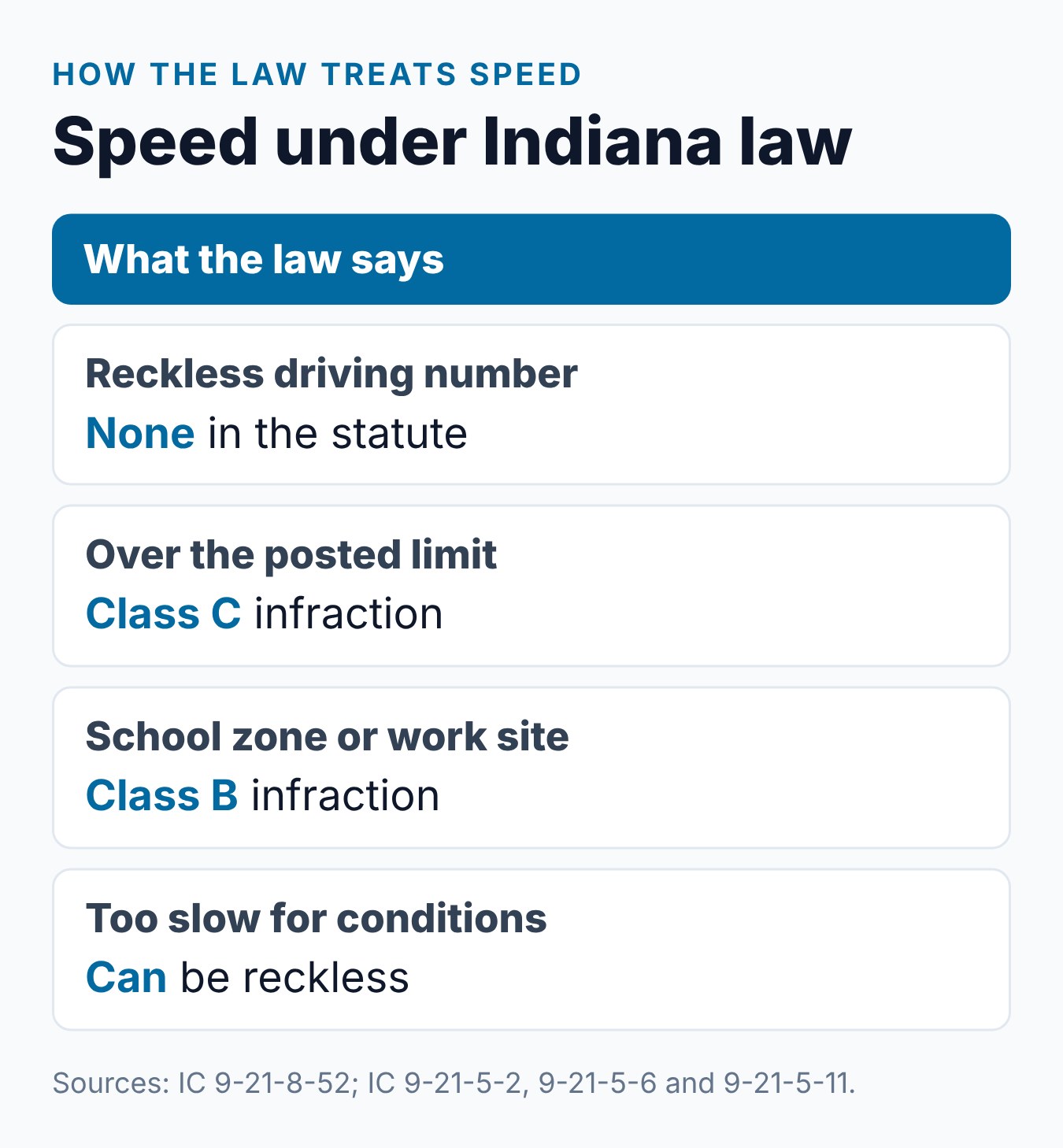
Going over a posted limit is a speeding violation under IC 9-21-5-2. That law makes it a Class C infraction, which is not a crime. The BMV gives 2, 4 or 6 points for ordinary speeding, based on how far over the limit the ticket shows.
Even the highest speeding tier stays an infraction with 6 points. Reckless driving is a separate charge.
A prosecutor may file it when the facts fit the reckless driving statute. How that choice plays out on the ticket side is covered in when a speeding ticket becomes reckless driving.
The Reasonable Speed Rule
Indiana has one more speed law worth knowing. IC 9-21-5-1 makes it a Class C infraction to drive faster than is “reasonable and prudent” for the conditions. That rule also uses conditions, not a number.
So the conditions matter in two places. They can support a speeding infraction. In a reckless case, they are part of the test for the crime.
Posted Limits Are a Different Law
Indiana’s posted speed limits come from a separate law, IC 9-21-5-2. It sets the maximum limits for city streets, highways, interstates and alleys. A driver who goes over one of those limits commits a speeding infraction.
None of those limits is a reckless driving line. They decide what counts as speeding. The reckless driving statute never points back to them.
What the Number on a Ticket Does Change
On a speeding ticket, how far over the limit you were sets the BMV point tier. It does not set the fine tier.
Under IC 34-28-5-4, the most a Class C speeding judgment can be is $500. The caps below that depend on how the driver answers the ticket and on past findings in that county, not on speed.
Slow Driving Can Be Reckless Too
The statute does not only cover fast drivers. It also names an “unreasonably low rate of speed.” That counts when it endangers others or blocks the proper flow of traffic.
This is one more reason no single speed can answer the question. A very slow speed can fit the law, and a high one may not.
Speeding Up to Block a Pass
Speed shows up in one more act in the statute. The fourth act covers a driver who “speeds up or refuses to give one-half (1/2) of the roadway to a driver overtaking and desiring to pass.”
Here the issue is not a rate of speed at all. It is the act of speeding up while another driver is passing. The other acts, such as weaving and blind passing, are explained in what is reckless driving in Indiana.
School Zones and Work Sites
Some places have their own speed rules. These are infractions, not reckless driving, unless a separate charge is filed.
- School zones. Going over a school zone limit set under IC 9-21-5-6 is a Class B infraction, with a judgment of up to $1,000.
- Work sites. Going over a worksite limit under IC 9-21-5-11 is a Class B infraction. The fine is at least $300, at least $500 with one prior in 3 years, and $1,000 with two or more.
- Points. The BMV gives 4, 6 or 8 points for speeding in a school zone or work site, instead of 2, 4 or 6.
Reckless driving near a worksite with workers present is its own crime under IC 9-21-8-56. It is a Class A misdemeanor and carries 8 points.
If Reckless Driving Is Charged
When the speed act is charged, the level depends on the result. The base charge is a Class C misdemeanor.
Damage to another person’s property makes it Class B. Bodily injury makes it Class A.
The reckless driving penalties guide lists the jail and fine limits for each level. The speed act itself has no felony level.
Points: Speeding Compared With Reckless Driving
The BMV point table in 140 IAC 1-4.5-10 treats the two charges differently:
- Speeding on an ordinary road: 2, 4 or 6 points.
- Speeding in a school zone or work site: 4, 6 or 8 points.
- Reckless driving: 6 points, 8 with property damage and 10 with bodily injury.
Points become inactive 24 months after the conviction date. The violation stays on your record. A side-by-side look at the two charges is in reckless driving vs. speeding.
Where Speed Shows Up on Your Record
Both speeding and reckless driving convictions go on your BMV driving record with their points. You can view your record free on myBMV. A certified Official Driver Record costs $4.
At 14 to 18 active points, the BMV sends a warning notice. At 20 active points within 24 months, it suspends the license for 1 month, and the time grows from there.
Where the Driver Safety Program Fits
The Driver Safety Program (DSP) is a BMV-approved course of at least 4 hours. Completing one adds a 4-point credit to your record, once every three years. It works the same after a speeding ticket or a reckless driving conviction.
The credit does not change the charge. The BMV DSP page says completion “will not remove a citation from your driver history.” A “defensive driving” course earns the credit only if it is a Driver Safety Program on the BMV’s approved list.
Details to Check on Your Papers
The charge on your papers tells you which law applies. These details are worth reading closely:
- The section. IC 9-21-5-2 is a speeding infraction. IC 9-21-8-52 is reckless driving. IC 9-21-8-56 is the work zone crime.
- The subsection. A reckless charge under (a)(1) is the speed act.
- Damage or injury. These raise the charge level and the points. The BMV applies the higher points when the court record shows them.
- Court dates and orders. A court order sets its own deadlines and steps.
For what these details mean in your case, ask the court or an Indiana attorney.
What We Found on the Official Pages
On the official 2026 Indiana Code we checked on October 26, 2026, IC 9-21-8-52 had no speed figure in any subsection. Its speed act still covered both high and low speed.
IC 9-21-5-2, the speed limit law, still made a violation a Class C infraction. That section was last amended in 2025.
Common Mistakes to Avoid
Each item comes from Indiana law or the BMV point table:
- Trusting a rule-of-thumb number. The reckless driving law has no speed figure.
- Calling a big speeding ticket a crime. Ordinary speeding is a Class C infraction at every point tier.
- Forgetting the conditions. The law judges speed “under the circumstances.”
- Thinking slow is always safe. An unreasonably low speed can be reckless.
- Ignoring zone rules. School zone and work site speeding are Class B infractions with higher points.
- Expecting the DSP to change a charge. It adds a 4-point credit; the citation stays.
How Requirements Can Vary
Indiana’s point rules, the 4-point credit and the BMV’s Driver Safety Program order come from state law and BMV rules, and they apply statewide. What you must do still depends on whether you take the course by choice, because of a BMV notice, or under a court order. A court order sets its own deadline and proof steps.
Laws, fees and court practice can change. Check your BMV notice, your court order and the Indiana BMV website for current rules before you enroll or file anything.
Frequently Asked Questions
What speed is reckless driving in Indiana?
No speed is named in the law. IC 9-21-8-52 looks at whether the speed was unreasonable under the circumstances and caused danger or blocked traffic.
Is going far over the limit automatically reckless?
No. Ordinary speeding is a Class C infraction, even at the 6-point tier. Reckless driving is a separate charge based on the facts.
Can I get a reckless driving charge for driving too slowly?
It is possible under the law. The statute names an “unreasonably low rate of speed” that endangers others or blocks traffic.
Does a school zone ticket count as reckless driving?
No. It is a Class B infraction under IC 9-21-5-6. It carries higher points than ordinary speeding.
How many points is reckless driving compared with speeding?
Reckless driving is 6, 8 or 10 points. Ordinary speeding is 2, 4 or 6 points.
Does the BMV point table list a reckless speed?
No. The table sorts speeding points by how far over the limit a driver was. Its reckless driving entries go by result: 6, 8 with property damage and 10 with bodily injury.
Can a DSP turn a reckless charge into a speeding ticket?
No. The DSP is a BMV course that adds a 4-point credit to your record. The court handles the charge itself.
Who decides whether my speed was reckless?
A prosecutor decides what to charge, and the court decides the case. For advice on your own case, ask an Indiana attorney.
Conclusion
Indiana reckless driving law has no speed number. It looks at the setting, the risk to others and the driver’s care.
A high-speed ticket stays a Class C infraction unless a separate reckless charge is filed. For the 4-point credit, you can look at Driving Logic’s online Indiana Driver Safety Program.
Related Articles
- Reckless Driving in Indiana: Penalties, Points, and Driver Safety Options
- What Is Reckless Driving in Indiana? IC § 9-21-8-52 Explained
- Indiana Reckless Driving vs. Speeding Ticket: Key Differences
- When Does Speeding Become Reckless Driving in Indiana?
Sources
- Indiana Code § 9-21-8-52 — Reckless driving
- Indiana Code § 9-21-5-2 — Maximum speed limits
- Indiana Code § 9-21-5-6 — Local and school zone speed limits
- Indiana Code § 9-21-5-11 — Worksite speed limits
- Indiana Code § 9-21-8-56 — Reckless operation in a highway worksite
- 140 IAC 1-4.5 — BMV point system rules
- Indiana Code § 34-28-5-4 — Infraction judgments
- Indiana BMV — Citation Points & Driver Safety Program
- Indiana BMV — myBMV
Billy Forte is the owner of Driving Logic, a state-approved driver improvement course provider serving Indiana and other U.S. states.
This article is general information, not legal advice. Indiana BMV rules, court orders, fines and penalties depend on your notice, citation, court and case facts, and they can change. Use official Indiana BMV and court sources, and consult a qualified Indiana attorney for advice about your own case.