
Updated October 2026 · Reviewed by Billy Forte
Is a speeding ticket a misdemeanor in Indiana? No: an ordinary speeding ticket is a Class C infraction, and Indiana law defines a crime as only a felony or a misdemeanor. A judgment still goes to the BMV with points, and some cases that involve speed, such as reckless driving, can be charged as crimes under other laws.
Key Facts
- The class: ordinary speeding is a Class C infraction. See the short answer.
- Not a crime: Indiana defines a crime as a felony or a misdemeanor. See what an infraction is.
- Zones: school zone and work zone speeding are Class B infractions, still not crimes. See zone tickets.
- Still counts: the judgment goes on your BMV record with points. See your record.
- Separate crimes: reckless driving and reckless operation in a work zone are misdemeanors or worse. See criminal charges.
Is a Speeding Ticket a Misdemeanor in Indiana?
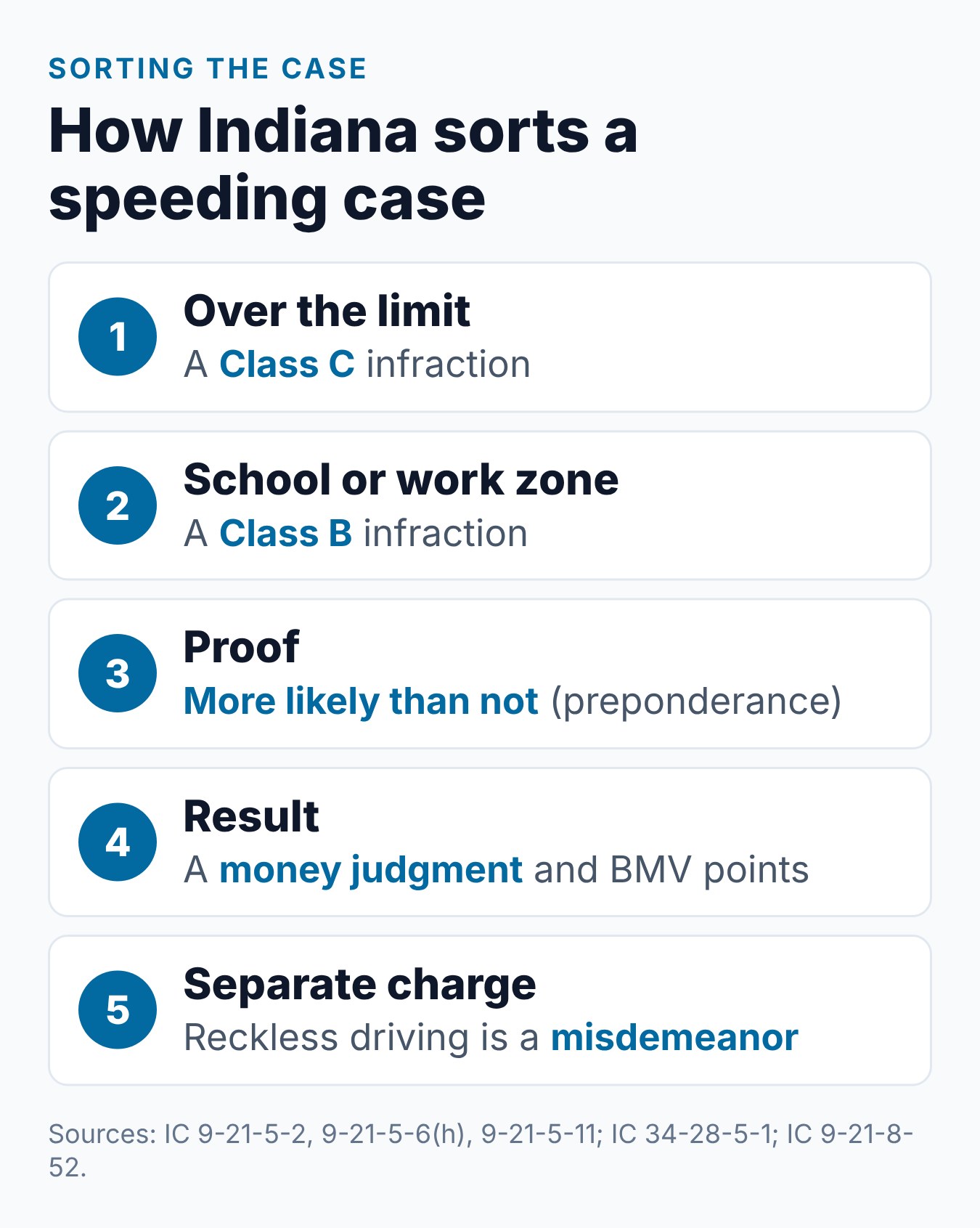
No. Indiana’s speed limit law, IC 9-21-5-2, says a person who breaks a posted maximum limit “commits a Class C infraction.” A nearby section, IC 9-21-5-1, covers driving faster than is reasonable for the conditions. That is also a Class C infraction.
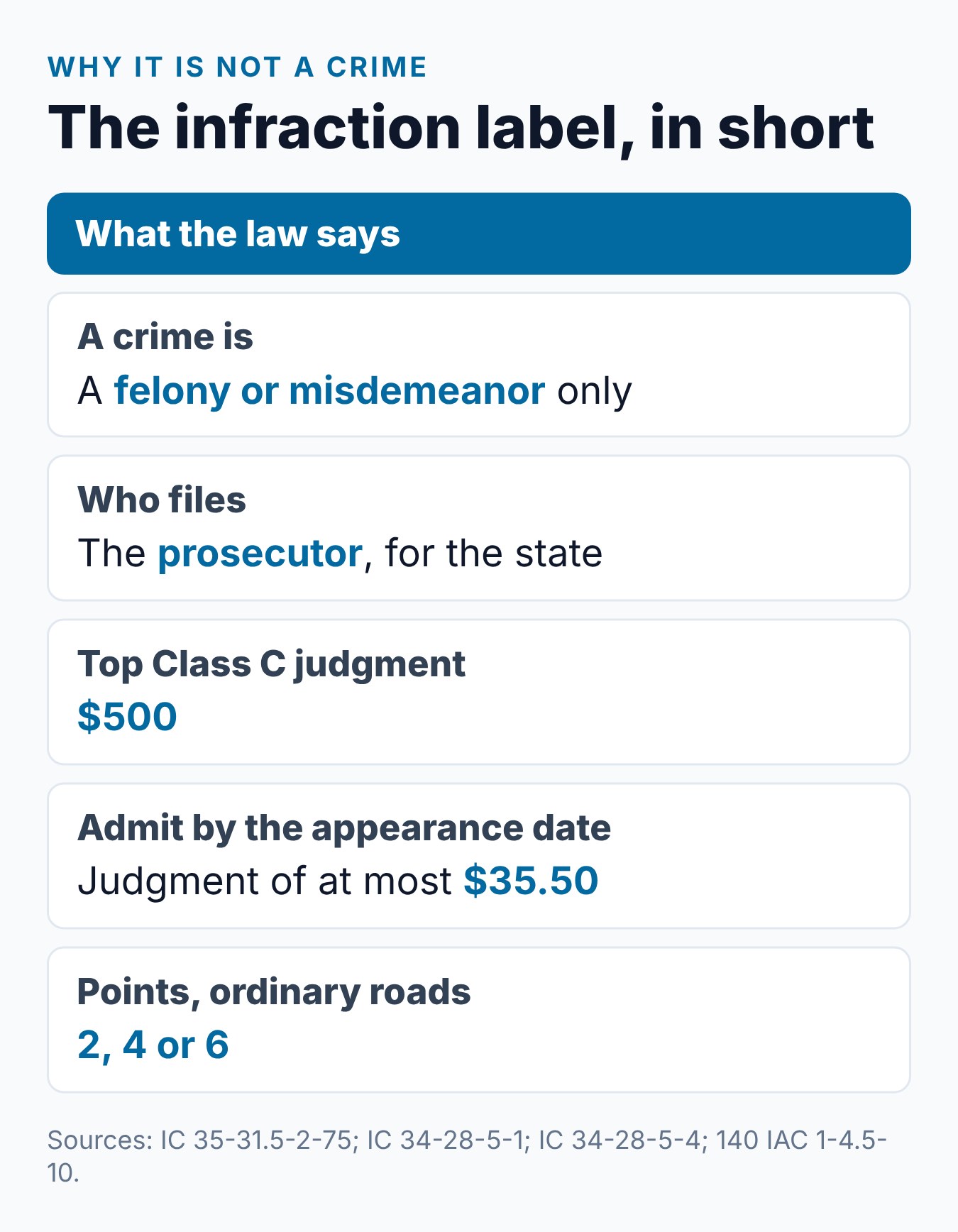
Indiana’s criminal code defines a crime in one line. Under IC 35-31.5-2-75, “‘crime’ means a felony or a misdemeanor.” An infraction is neither, so it is not a crime.
This is true no matter how far over the limit the ticket says. Even more than 25 mph over is still a Class C infraction under the speeding law. It brings more points, but it does not change the class.
What an Infraction Is
An infraction is a civil case brought by the state. Under IC 34-28-5-1, the prosecuting attorney brings it “in the name of the state of Indiana.”
The state must prove the infraction “by a preponderance of the evidence.” In plain words, the court asks whether it is more likely than not that you did it.
The result is a money judgment, not a jail sentence. Under IC 34-28-5-4, a Class C infraction carries a judgment of up to $500. Court costs are added on top.
If you contest the ticket and lose, the cap is $35.50, $250.50 or $500. It depends on moving violations found by a court in that county in the past 5 years.
Indiana’s Infraction Classes
IC 34-28-5-4 sets four classes of infraction. Each has its own top judgment. This table shows where speeding tickets fit:
| Infraction class | Highest judgment | Speeding tickets in this class |
|---|---|---|
| Class A | Up to $10,000 | No speeding ticket covered here |
| Class B | Up to $1,000 | School zone speeding; work site speeding |
| Class C | Up to $500 | Over a posted limit; too fast for conditions |
| Class D | Up to $25 | No speeding ticket covered here |
The Class C limit has a special rule for moving violations. If you admit the ticket, or plead nolo contendere, on or before the appearance date, the judgment can be no more than $35.50. Court costs are added to that.
School Zone and Work Zone Tickets Are Still Not Crimes
Speeding in a marked school zone is a Class B infraction under IC 9-21-5-6(h). Speeding in a work site is also a Class B infraction, under IC 9-21-5-11.
A Class B infraction can bring a higher judgment, up to $1,000. Work site tickets also have a minimum fine of at least $300 for a first one. But a higher class of infraction is still an infraction, so these are not misdemeanors either.
Our guide to school zone and work zone speeding covers those tickets in full.
What Goes on Your Record Anyway
Not being a crime does not mean nothing happens. A speeding judgment is reported to the BMV and adds points to your driving record. The point table gives:
- 2 points for 1 to 15 mph over
- 4 points for 16 to 25 mph over
- 6 points for more than 25 mph over
In a school zone or work site, the values are 4, 6 and 8. The BMV points page says points stay active for two years from the conviction date.
The case is also a court case, with a court record of its own. So “not a crime” is about the type of case. It does not mean the ticket leaves no trace.
The Driver Safety Program (DSP) can lower the point total, not the class of the case. The BMV applies a 4-point credit for a BMV-approved course, once every three years. Every approved course runs at least 4 hours, and the BMV’s maximum price is $55.
Infractions Can Still Lead to BMV Action
A speeding judgment can count toward BMV action even though it is not a crime. Two rules show this.
First, IC 9-30-3-12 covers “traffic judgments,” not just criminal convictions. The BMV must order a Driver Safety Program after two traffic misdemeanor convictions, two traffic judgments, or one of each, for moving violations within 12 months. The course must be finished within 90 days of the notice, or driving privileges are suspended.
Second, the BMV point rules count active points from infractions. A warning notice comes at 14 to 18 active points. A suspension starts at 20 or more active points within 24 months, after any credit.
When Driving Too Fast Becomes a Criminal Charge
Some conduct that involves speed is a crime. A prosecutor would file it as a separate charge under a different law.
The main one is reckless driving, under IC 9-21-8-52. It covers driving at “an unreasonably high rate of speed” under the circumstances so as to endanger people or property, among other acts. The statute sets no mph figure.
Its base level is a Class C misdemeanor. It rises to Class B with damage to another person’s property, and Class A with bodily injury.
A second one is reckless operation near a highway worksite when workers are present, under IC 9-21-8-56. That is a Class A misdemeanor, and it can be a Level 6 or Level 5 felony in listed cases. Reckless homicide is a Level 5 felony under IC 35-42-1-5.
How a case turns into one of these charges is covered in our guide on when a speeding ticket becomes reckless driving. For a side-by-side look, see reckless driving vs. a speeding ticket.
Misdemeanor and Felony Ranges in Indiana
Criminal classes can bring jail time. Infractions end in money judgments. Indiana’s criminal ranges are set in IC 35-50:
- Class C misdemeanor: a fixed term of up to 60 days, and a fine of up to $500.
- Class B misdemeanor: up to 180 days, and up to $1,000.
- Class A misdemeanor: up to 1 year, and up to $5,000.
- Level 6 felony: 6 months to 2½ years, with an advisory term of 1 year, and up to $10,000.
- Level 5 felony: 1 to 6 years, with an advisory term of 3 years, and up to $10,000.
Note the Level 6 range. It can start at 6 months, so the length alone does not tell you whether a case is a felony.
Why the Label Matters
The class of a case changes several things at once:
- The penalty type. An infraction ends in a money judgment. A misdemeanor or felony can bring jail time.
- The proof. Infractions are proved by a preponderance of the evidence.
- The points. Both kinds of case can add BMV points. Reckless driving carries 6, 8 or 10.
- The kind of record. A criminal conviction is a different kind of record from an infraction judgment.
Our guide on traffic violations and background checks explains what we could and could not confirm.
Paying a Ticket Means Admitting an Infraction
Paying a speeding ticket is not a guilty plea to a crime. It is an admission of a Class C infraction. Under IC 34-28-5-4(f), admitting on or before the appearance date caps the judgment at $35.50.
Court costs are added. The Indiana Trial Court Fee Manual lists statutory infraction costs of $139, or $167 where the sheriff’s service fee is collected.
Some prosecutors also offer a deferral program. When the driver meets its terms, the court dismisses the case. Deferral does not apply to commercial motor vehicle offenses.
What We Found in the Official Code
In the 2026 Indiana Code text checked on October 26, 2026, IC 9-21-5-2 still listed speeding over a maximum limit as a Class C infraction. IC 9-21-5-6(h) and IC 9-21-5-11 listed school zone and work site speeding as Class B infractions.
The reckless driving section, IC 9-21-8-52, contained no mph figure. Its levels were Class C, B and A misdemeanors, with felonies only for passing a stopped school bus.
Common Mistakes to Avoid
Each point below comes from Indiana law or the BMV:
- Calling a speeding ticket a misdemeanor. It is a Class C infraction.
- Thinking a big speed makes it a crime. More than 25 mph over is still a Class C infraction, with 6 points.
- Thinking zone tickets are crimes. They are Class B infractions.
- Assuming “not a crime” means no record. The BMV still adds points.
- Treating payment as a criminal plea. It is an admission of an infraction.
- Assuming felonies always mean over a year. A Level 6 felony starts at 6 months.
For the full picture on costs and points, see our Indiana speeding ticket guide.
How Requirements Can Vary
Indiana’s point rules, the 4-point credit and the BMV’s Driver Safety Program order come from state law and BMV rules, and they apply statewide. What you must do still depends on whether you take the course by choice, because of a BMV notice, or under a court order. A court order sets its own deadline and proof steps.
Laws, fees and court practice can change. Check your BMV notice, your court order and the Indiana BMV website for current rules before you enroll or file anything.
Frequently Asked Questions
Is a speeding ticket a crime in Indiana?
No. Ordinary speeding is a Class C infraction. Indiana law defines a crime as a felony or a misdemeanor, and an infraction is neither.
Can a speeding ticket go to jail time?
The infraction itself ends in a money judgment. Jail ranges apply to misdemeanors and felonies, such as reckless driving, which is a separate charge.
Is going 30 mph over a misdemeanor?
Not under the speeding law. More than 25 mph over is still a Class C infraction, with 6 points. A prosecutor could file a separate charge only if the facts fit another law.
Is a school zone ticket a misdemeanor?
No. It is a Class B infraction, with a judgment of up to $1,000. That is a higher class of infraction, not a crime.
Does a speeding ticket go on my record if it is not a crime?
Yes. The judgment goes to the BMV with 2, 4 or 6 points on ordinary roads. Points stay active for two years from the conviction date.
Can the Driver Safety Program change the class of my ticket?
No. The DSP adds a 4-point credit to your BMV record, once every three years. The BMV says it “will not remove a citation from your driver history.”
Will a speeding ticket show up as a criminal conviction?
An ordinary speeding ticket is an infraction, not a crime, so it is not a criminal conviction. It is still a court judgment and a BMV record entry with points.
Who proves the case, and how?
The prosecutor brings the case in the name of the state. The state must prove the infraction by a preponderance of the evidence.
Conclusion
So is a speeding ticket a misdemeanor in Indiana? No, it is a Class C infraction, or Class B in a school or work zone, and not a crime.
The points still count, and the BMV Driver Safety Program page explains the 4-point credit. To earn it, see Driving Logic’s online Indiana Driver Safety Program.
Related Articles
- Indiana Speeding Ticket: Costs, Points, and What to Know
- Indiana Reckless Driving vs. Speeding Ticket: Key Differences
- Will an Indiana Traffic Violation Show Up on a Background Check?
- When Does Speeding Become Reckless Driving in Indiana?
Sources
- Indiana Code § 9-21-5-2 — Maximum speed limits
- Indiana Code § 34-28-5-1 — Infraction actions and deferral
- Indiana Code § 34-28-5-4 — Infraction judgments
- Indiana Code § 9-21-5-6 — Local and school zone speed limits
- Indiana Code § 9-21-5-11 — Worksite speed limits
- Indiana Code § 9-21-8-52 — Reckless driving
- Indiana Code § 9-21-8-56 — Reckless operation in a highway worksite
- Indiana BMV — Driver Record Points
- Indiana BMV — Citation Points & Driver Safety Program
- Indiana Office of Judicial Administration — Trial Court Fee Manual (PDF)
Billy Forte is the owner of Driving Logic, a state-approved driver improvement course provider serving Indiana and other U.S. states.
This article is general information, not legal advice. Indiana BMV rules, court orders, fines and penalties depend on your notice, citation, court and case facts, and they can change. Use official Indiana BMV and court sources, and consult a qualified Indiana attorney for advice about your own case.