
Updated October 2026 · Reviewed by Billy Forte
If you have a court ordered driver safety program Indiana case, start with the order itself, because it sets the course, the deadline and how you prove you finished. A court can require the Driver Safety Program (DSP) on its own terms, and that is separate from a BMV notice. Taking the right course on time and keeping proof is what the order asks of you.
Key Facts
- The order rules: the court’s order sets the course, the deadline and the proof steps. See first steps.
- BMV approval: the order may not require a BMV-approved course, but only an approved course earns the 4-point credit. See BMV approval.
- Court costs: any court may suspend half of the court costs if you complete a DSP. See the court cost rule.
- Not a BMV notice: the 90-day window belongs to BMV notices, not court orders. See court order vs. BMV notice.
- Your record: the course does not remove the citation from your driver history. See your record.
What a Court-Ordered DSP Is
The Driver Safety Program is the Indiana BMV’s course on safe driving habits. The BMV says every approved course lasts at least 4 hours. It is offered in English and Spanish, in a classroom, on DVD or online.
A judge can make the course part of a traffic case. The Indiana Driver’s Manual says, “A judge may also order a driver who commits a traffic offense to attend a DSP.” The BMV’s Driver Safety Program page adds that a court may use the course “as an alternative to suspension of driving privileges.”
So a court order is about your court case. What the court wants, and by when, comes from the court.
Court Ordered Driver Safety Program Indiana: First Steps
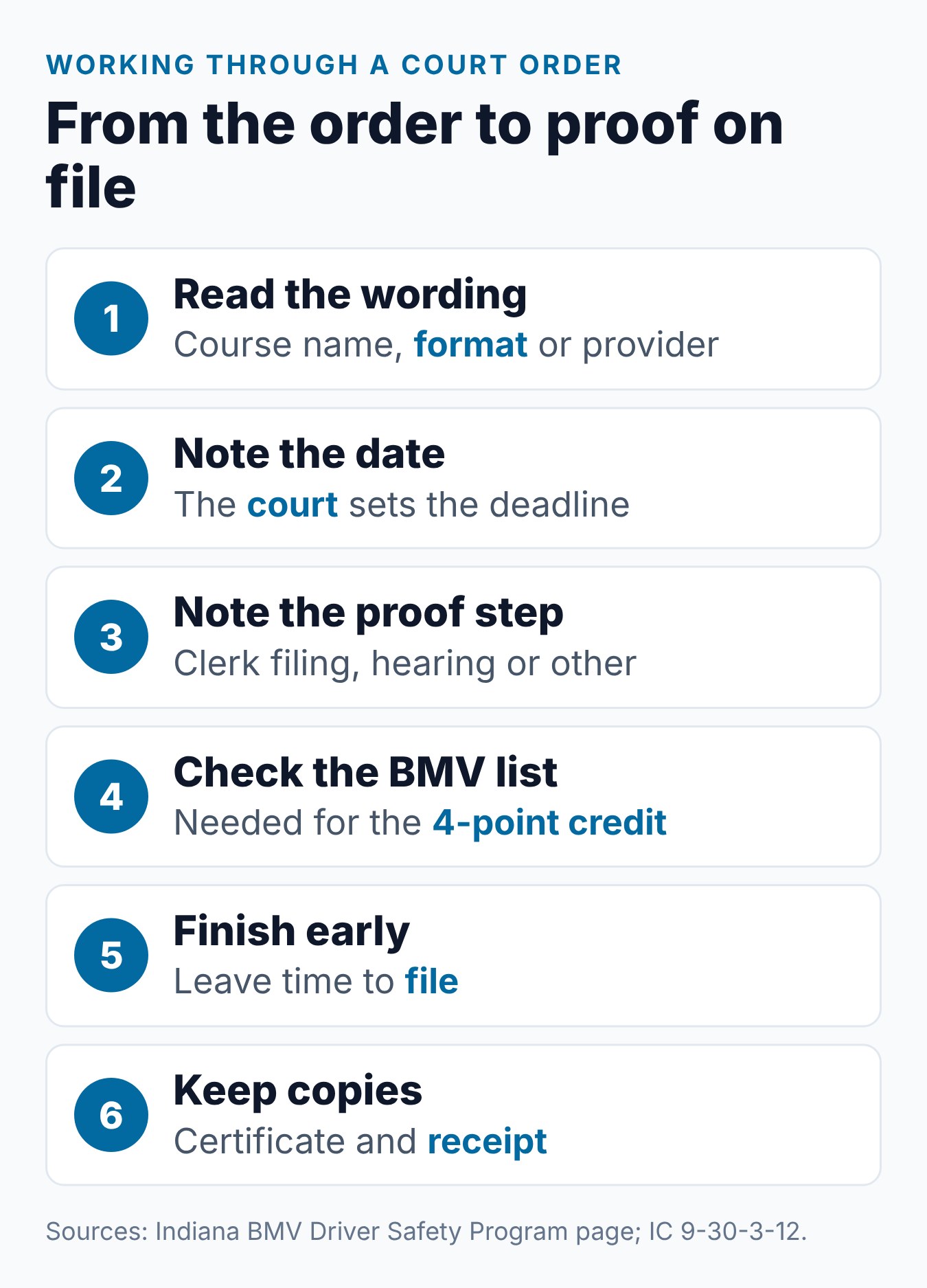
Read the order closely before you sign up for anything. These steps follow what the official sources say:
- Find the course words. Note whether the order says “Driver Safety Program,” names a format, or names a provider.
- Find the deadline. Write down the date the court set. No statewide rule sets it for you.
- Find the proof step. Note whether you file a certificate with the clerk, bring it to a hearing, or do something else.
- Check BMV approval. Find your provider on the BMV’s approved list if you also want the credit.
- Finish early. Leave time for the certificate and any filing before the date.
- Keep copies. Save the certificate and any filing receipt.
If any part of the order is unclear, ask the court clerk. A lawyer can explain how the order applies to your case.
Does the Course Have to Be BMV-Approved?
Not always for the court. The BMV says a court order “may not specifically require participation in a BMV-approved DSP.” So the court decides which course meets its order.
The BMV’s credit is a different matter. The BMV says, “Credit can be applied to your Official Indiana Driver Record only if the course was completed by a BMV-approved Driver Safety (DSP) Program Provider.” A course that is not on the list may satisfy a court and still earn no credit.
The simple way to cover both is a course from a provider on the BMV’s list. Then confirm that the course also fits the words of your order.
Court Order vs. BMV Notice
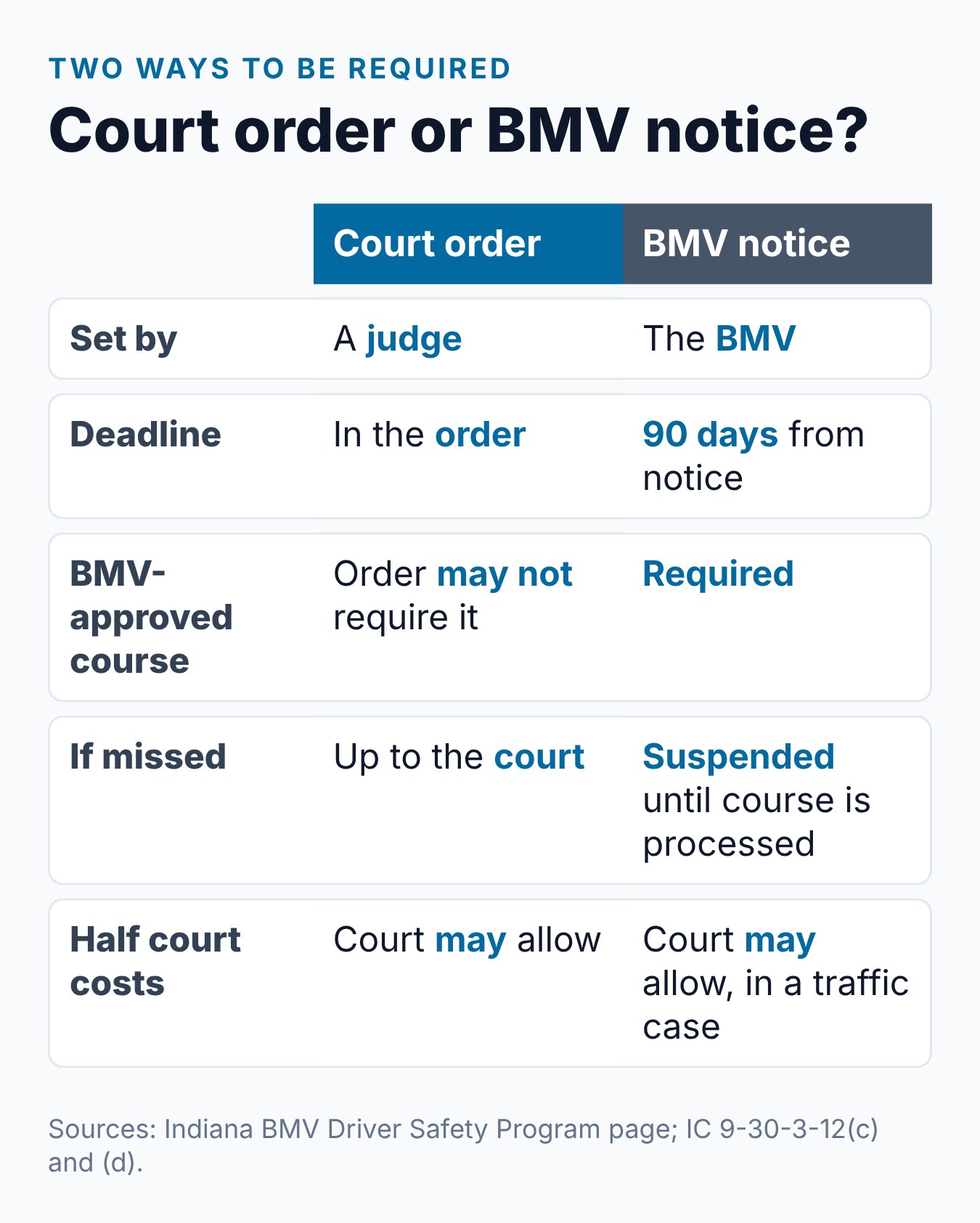
Two different bodies can require the course. They follow different rules:
| Question | Court order | BMV notice |
|---|---|---|
| Who requires it | A judge in your case | The BMV, under IC 9-30-3-12 |
| What triggers it | The court’s decision in a traffic case | Qualifying convictions or judgments, or two pointable incidents under 21 |
| Deadline | Set by the order | 90 days from the notice date |
| Must it be BMV-approved | The order may not require it | Yes |
| If you miss it | Depends on the court | Driving privileges are suspended until the course is completed and processed |
The BMV rule comes from IC 9-30-3-12. It covers two traffic misdemeanor convictions, two traffic judgments, or one of each, for moving violations within 12 months. Our BMV-ordered DSP guide covers that path.
You can have both at once. If so, meet each deadline and each proof step.
The Court Cost Rule
Indiana law gives courts a cost option. IC 9-30-3-12(d) says “any court may suspend one-half (1/2) of each applicable court cost” for a traffic violation. The driver must enroll in and complete a DSP, or “a similar school conducted by an agency of the state or local government.”
The word “may” matters. The court chooses whether to use this rule in your case. Ask the court or the clerk whether it applies to you.
The course fee is separate from court costs. The BMV says the maximum cost for any BMV-approved DSP is $55, and the driver pays it.
Deferral Programs and the DSP
Some traffic cases go into a deferral program. Under IC 34-28-5-1, a prosecutor may set one up for infraction cases. The driver signs an agreement and pays the fees it lists, including a $70 fee to the clerk for a moving traffic offense.
When the driver meets the terms, “the court shall dismiss the action.” The case may not be filed again. If a DSP is one of the terms, finishing it on time is part of meeting the agreement.
Deferral has limits. It does not apply to commercial motor vehicle offenses. The prosecutor decides whether to offer it, so this article cannot say whether you qualify.
Drivers Under 21
Young drivers face two extra rules. First, the BMV’s probationary license page says probationary license holders “will not qualify for court diversion programs.” Probationary licenses are the licenses issued to drivers under 21.
Second, the BMV has its own under-21 trigger. A driver under 21 must take a DSP after twice being the driver in an incident that can carry points while under 21. That rule has no 12-month limit.
Our guide to the Indiana teen Driver Safety Program explains the under-21 rule in full.
What the Course Does to Your Record
A BMV-approved DSP earns a 4-point credit on your Official Driver Record. Under 140 IAC 1-4.5-7, the credit can be entered only once every three years. The BMV says another course extends the credit period three years from the new completion date.
The course does not erase anything. The BMV says completion “will not remove a citation from your driver history.” Any conviction or judgment stays on the record, and its points stay active for 24 months after the disposition date.
Here is the math. A driver with 10 active points who earns the credit is counted at 6. The point rules are in 140 IAC 1-4.5.
Proof of Completion
The court and the BMV get proof in different ways. For the BMV, the provider notifies the BMV, and the credit is applied within 7 to 14 business days of that notice. If it does not appear, the BMV says to email the certificate to BMVDSP@bmv.IN.gov.
For the court, follow the order or the clerk’s directions. The BMV’s notice from the provider does not tell the court you finished. See how to submit your DSP certificate for both paths.
You can check your record on myBMV. The BMV’s driver record page says the Viewable Driver Record is free and the certified Official Driver Record costs $4.
If You Miss the Court’s Deadline
No statewide rule says what a court does when a court-ordered course is late. The result depends on your order and your court. Contact the court or a lawyer as soon as you know you will be late.
A missed BMV deadline is different. The law says the BMV “shall suspend” the privileges of a driver who does not complete a required DSP.
That suspension lasts until the course is completed and processed by the BMV. Our article on what happens if you do not finish covers both cases.
Online or In Person
The BMV allows classroom, DVD and online formats. Every format has the same curriculum standards and the same minimum of four hours.
Whether online meets your order depends on its words. If it names a classroom, follow it. See taking a court-ordered DSP online.
Guides in This Series
Each guide covers one part of an ordered DSP in depth:
- BMV-ordered DSP: who gets a notice and the 90-day deadline.
- BMV text scams: how to tell a fake “final notice” from a real BMV letter.
- Drivers under 21: the incident rule with no 12-month limit.
- Missing a deadline: BMV suspension and court results.
- Submitting your certificate: proof to a court and the BMV’s notice.
- Reckless driving and the DSP: what the credit does for reckless driving points.
- Online and court orders: when an online course fits an order.
What We Found on the Official Pages
On the BMV pages we checked on October 26, 2026, the Driver Safety Program page said a court order “may not specifically require participation in a BMV-approved DSP.” The same page said the credit applies only to courses from BMV-approved providers.
We found no BMV page with a statewide deadline for court-ordered courses. We also found no statewide rule on what a court does if a course is late. Both come from your order and your court.
Common Mistakes to Avoid
Each item comes from Indiana law or a BMV source:
- Using the BMV’s 90 days for a court order. The court’s order sets its own date.
- Assuming any course earns the credit. Only a BMV-approved provider’s course does.
- Assuming the BMV tells the court. The provider notifies the BMV, not your court.
- Expecting the citation to disappear. The BMV says completion does not remove it.
- Taking a second course for a new credit. The credit is entered once every three years.
- Skipping the clerk. If the order is unclear, the clerk can explain the court’s steps.
How Requirements Can Vary
Indiana’s point rules, the 4-point credit and the BMV’s Driver Safety Program order come from state law and BMV rules, and they apply statewide. What you must do still depends on whether you take the course by choice, because of a BMV notice, or under a court order. A court order sets its own deadline and proof steps.
Laws, fees and court practice can change. Check your BMV notice, your court order and the Indiana BMV website for current rules before you enroll or file anything.
Frequently Asked Questions
Can an Indiana court order me to take a DSP?
Yes. The BMV says a court may require a DSP, including as an alternative to suspension. The Driver’s Manual says a judge may order a driver who commits a traffic offense to attend one.
Does a court-ordered course have to be BMV-approved?
The BMV says the court order may not require a BMV-approved course. Only a BMV-approved course earns the 4-point credit, though. Read your order and ask the clerk if it is unclear.
Is the deadline 90 days?
Not for a court order. The 90 days applies to a BMV notice. Your court order sets its own deadline.
Will the course lower my court costs?
It can. Any court may suspend one-half of each applicable court cost if you complete a DSP. The court decides whether to use that rule.
Does finishing the course remove my ticket?
No. The BMV says completion “will not remove a citation from your driver history.” A BMV-approved course adds a 4-point credit, once every three years.
Who tells the court that I finished?
Plan on doing it yourself, the way your order or the clerk directs. The provider’s notice goes to the BMV for the credit.
What if I cannot finish by the court’s date?
Contact the court or a lawyer before the date passes. No statewide rule sets what happens, so the result depends on your court.
Conclusion
A court ordered driver safety program in Indiana follows the court’s order, not the BMV’s 90-day rule. Read the order, choose a course that fits it, finish before the deadline and file proof the way the court asks.
Check that your order allows an online course before you enroll. If it does, you can take Driving Logic’s online Indiana Driver Safety Program.
Related Articles
- BMV Ordered Driver Safety Program Indiana: Who Gets One
- Indiana BMV Text Scam: How to Spot a Fake “Final Notice”
- Indiana Teen Driver Safety Program Rules for Under 21
- What Happens If You Don’t Complete a Court-Ordered DSP in Indiana?
- How to Submit Your Indiana DSP Certificate to the Court or BMV
- Indiana Reckless Driving and the Driver Safety Program: What to Know
- Can I Take the Indiana Driver Safety Program Online If It’s Court-Ordered?
Sources
- Indiana BMV — Citation Points & Driver Safety Program
- Indiana Code § 9-30-3-12 — Driver safety program
- Indiana Code § 34-28-5-1 — Infraction actions and deferral
- Indiana BMV — Probationary License
- 140 IAC 1-4.5 — BMV point system rules
- Indiana BMV — Driver Record
- Indiana BMV — myBMV
Billy Forte is the owner of Driving Logic, a state-approved driver improvement course provider serving Indiana and other U.S. states.
This article is general information, not legal advice. Indiana BMV rules, court orders, fines and penalties depend on your notice, citation, court and case facts, and they can change. Use official Indiana BMV and court sources, and consult a qualified Indiana attorney for advice about your own case.