
Updated October 2026 · Reviewed by Billy Forte
If you are taking your Virginia driving record out of state with a move, the short answer is that the record itself stays with Virginia DMV. When you apply for a license in your new state, that state must check whether you held a license somewhere else if it is a Driver License Compact member, and then it applies its own law. Before you leave, finish any open DMV clinic order or court requirement, because Virginia can still suspend your driving privilege.
Key Facts
- The record stays: Virginia DMV keeps your Virginia driving record after you move. See what stays in Virginia.
- The new state checks: under the Driver License Compact, a new state must check your license history. See what the new state checks.
- Its own law: your new state applies its own law to your record, with a few exceptions. See whose law applies.
- Open orders: a missed DMV clinic order leads to a Virginia suspension. See before you move.
- Copies: you can order your Virginia record online or by mail after you move. See getting your record.
Your Record Stays With Virginia DMV
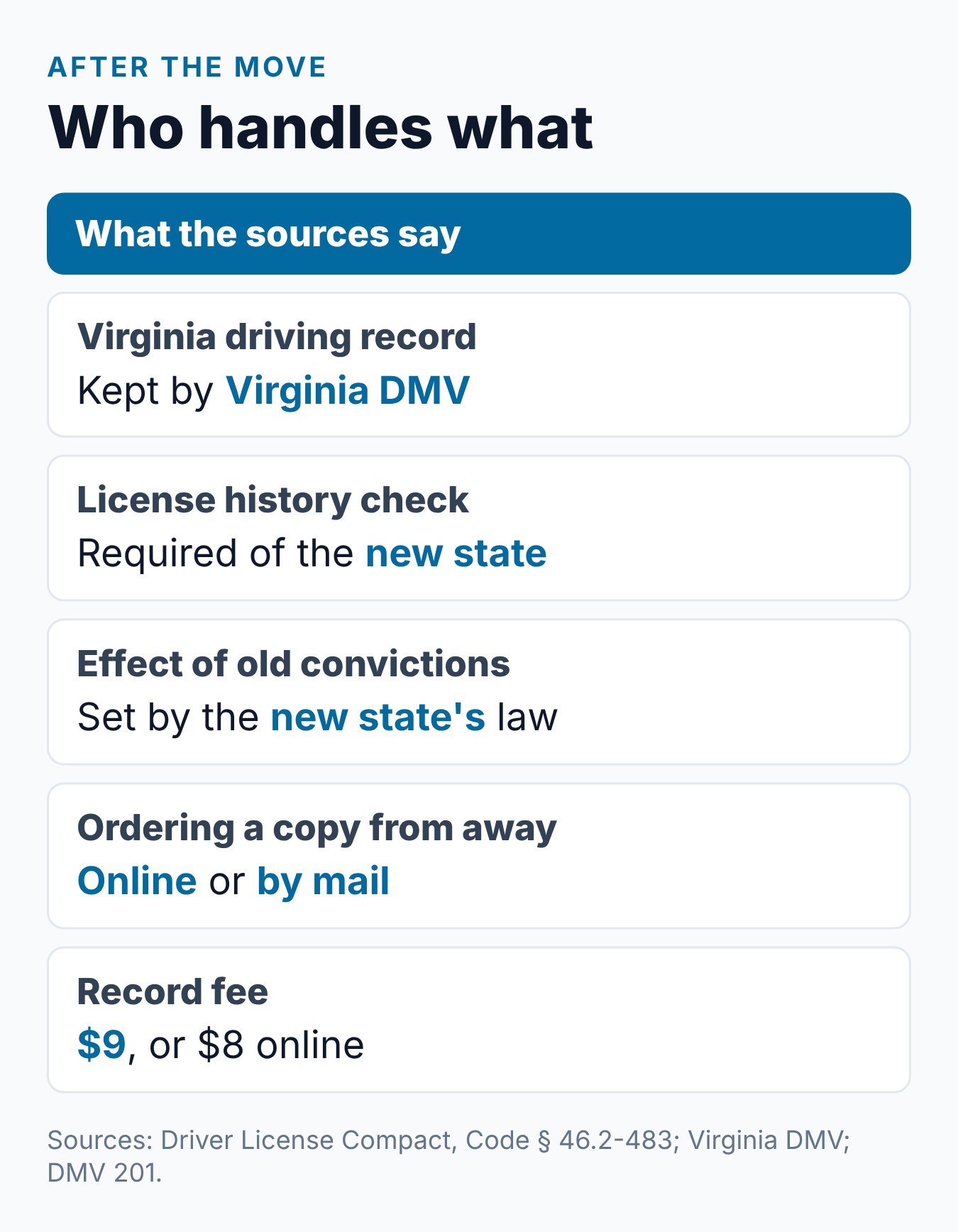
Moving does not close your Virginia driving record. Virginia DMV keeps it, with the convictions and points it already holds.
The usual time rules keep running:
- Points count for 2 years from the offense date, under Code § 46.2-493.
- Convictions stay for a time set per violation. Speeding stays 5 years, and reckless driving stays 11 years.
- Many other 3- and 4-point violations stay 3 years.
A suspension or revocation can keep convictions on the record longer. None of these clocks depend on where you live.
Your Point Balance After You Leave
Your Virginia point balance stays on the Virginia record. Demerit points from Virginia convictions keep counting until 2 years after each offense date. If DMV used them for a suspension or probation, they stay valid until that action ends.
You can still look at the balance from another state. The DMV’s online record request page offers a “Points Balance” link. Check it before you move, so you know what is on file.
Tickets From Other Trips Before You Move
While you hold a Virginia license, tickets from other states can still reach your Virginia record. Code § 46.2-492 gives Virginia demerit points for convictions in other states. So a conviction from a trip can show up on the Virginia record.
Insurance is a separate matter. DMV says insurance company points are not related to DMV demerit points.
What the New State Checks
Virginia is part of the Driver License Compact, found in Code of Virginia § 46.2-483. The compact sets rules that member states follow with each other.
Article V covers new license applications. Before it issues a license, a member state “shall ascertain whether the applicant has ever held” a license in another member state. So your new state will look into your license history.
The compact text does not mention points. It deals with licenses and convictions.
The New State Applies Its Own Law
Article IV of the compact tells the home state what to do with reported conduct. For other offenses, the home state applies its own law. That means your new state decides what a Virginia conviction means there.
For a few serious offenses, the compact says the home state “shall give the same effect to the conduct reported.” They are:
- Manslaughter or negligent homicide.
- Driving under the influence.
- A felony that involves a motor vehicle.
- Failure to stop and render aid.
For your own case, ask the licensing agency in your new state. We cover only the Virginia side here.
How Virginia Handles the Reverse
Virginia’s own law shows how the compact works when someone moves in. Under Code § 46.2-488, Virginia requires a driver to surrender an out-of-state license before it issues a Virginia one.
Your new state will have its own rules for this step.
Safe Driving Points and Clinic Credit
Safe driving points are part of Virginia’s point system. Under Code § 46.2-494, DMV awards 1 safe driving point for each calendar year of safe driving. DMV ties this to each full calendar year you “hold a valid Virginia driver’s license.”
A Driver Improvement Clinic can add 5 safe driving points, once every 24 months. Code § 46.2-498 describes this as subtracting five demerit points from your Virginia total. The balance never goes above +5.
No official source we found says these points carry over to another state. The new state applies its own law. Ask that state’s licensing agency how it treats your record.
Virginia Record and New State: A Quick Comparison
This table sorts the questions by who answers them.
| Question | What the Virginia sources say |
|---|---|
| Who keeps the Virginia record? | Virginia DMV |
| Must the new state check your license history? | Yes, under Article V of the compact |
| Whose law applies to old convictions there? | The new state’s, except for a few serious offenses |
| Do Virginia safe driving points carry over? | No official source we found says so |
| Can you order your Virginia record from away? | Yes, online or by mail |
Before You Move: Close Open Requirements
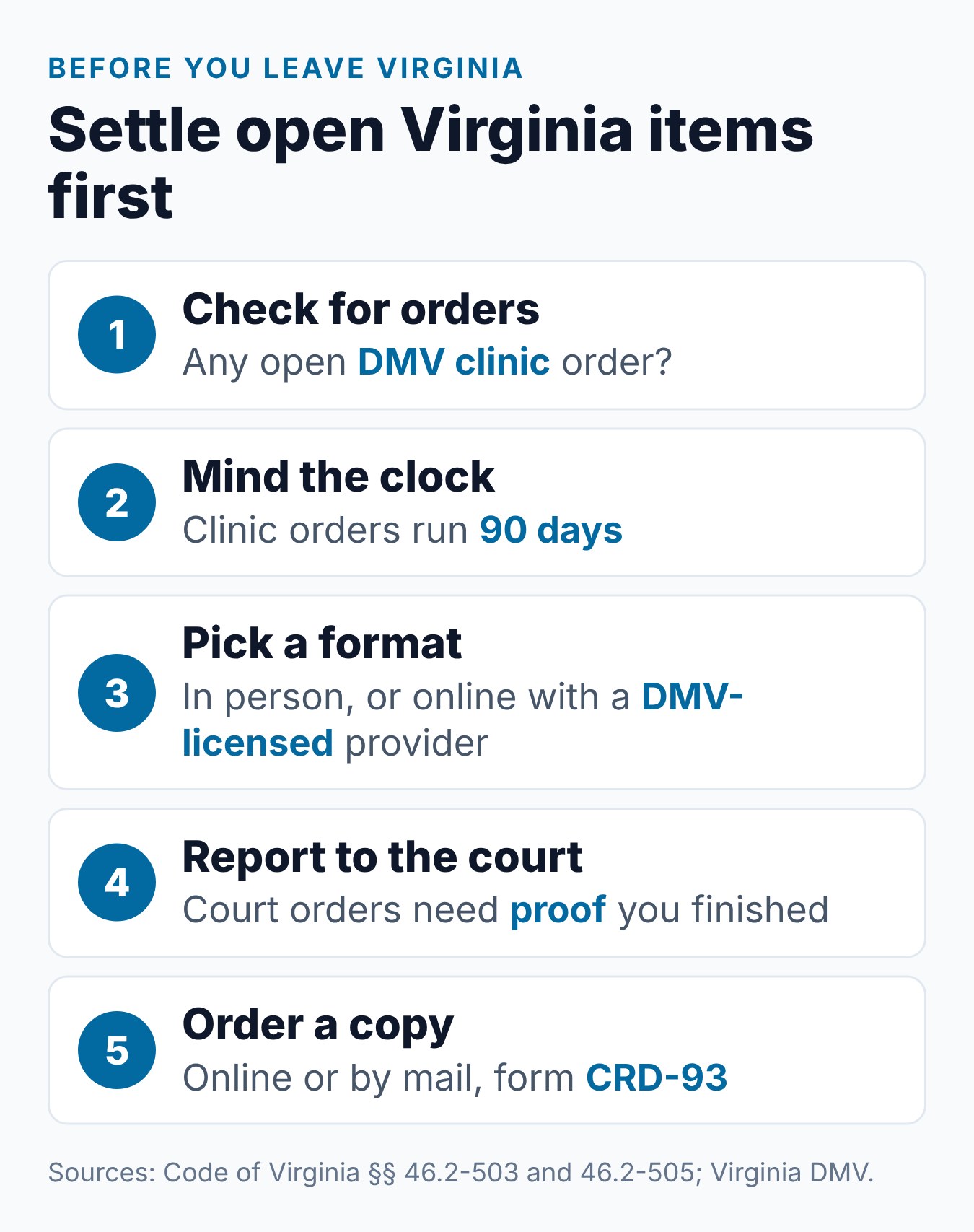
Moving does not cancel a Virginia order. If DMV ordered you to take a clinic, you have 90 days to finish it.
Under Code § 46.2-503, DMV suspends your driving privilege if you miss it. The suspension lasts until you finish.
DMV may give more time in a few cases. Out-of-state college students, and military members or dependents stationed outside Virginia, may get an extension. That only applies where no approved clinic is offered.
When the Clinic Clock Starts
A DMV clinic notice goes out by certified mail. Under Code § 46.2-501, the notice must say the clinic is due within 90 days from the date of the notice.
That date matters during a move. The 90 days run from the notice date, not from the day you open the mail.
Taking the Clinic Before or After You Go
The Driver Improvement Clinic is an 8-hour course. You can take it in person or online. Online, you must use a DMV-licensed online provider, and the 8 hours include the final test.
A clinic may charge no more than $100. The online provider reports completion to DMV and issues a DIC 552B certificate within 24 hours.
Court Requirements
A court order is a separate duty. Under Code § 46.2-505, you must tell the court whether you finished a court-ordered clinic. Not finishing may be punished as contempt of court.
Keep every court date and deadline, even after you move. A Virginia attorney can explain your options for your own case.
Getting Your Virginia Driving Record Out of State
You can still get your Virginia record from another state. The DMV’s record request page lists online, mail and in-person orders. From away, online or mail is the practical choice.
- Online: use DMV’s online record request. It also offers a “Points Balance” link.
- By mail: send form CRD-93 or a written request.
- Fee: DMV form DMV 201 lists $9, or $8 online. A certified copy costs $5 more.
The personal record covers up to 11 years. Our guide to Virginia driving record types explains each version.
Questions to Ask Your New State
Your new state’s licensing agency answers the questions Virginia law cannot. These are worth asking when you apply:
- How does it treat a Virginia conviction on your record?
- Does it use its own point system for past convictions?
- What does it need from you about your Virginia license?
- Will it ask for a copy of your Virginia driving record?
Bring a recent copy of your Virginia record if the agency asks for one.
If You Get a Virginia Ticket Later
You may still drive in Virginia after you move. Article III of the compact covers that case. Virginia “shall report each conviction” of a driver from another member state to the home state.
The home state then applies its own law to that report. Our guide to Virginia tickets for out-of-state drivers covers this case. If you hold another state’s license and want a Virginia clinic, see our guide for out-of-state license holders.
What We Found on the Official Pages
On the official pages we checked on October 27, 2026, the text of Code § 46.2-483 still held Articles III, IV and V as described here. Its history line showed 1968 and 1989, and the compact text did not mention points.
The DMV record request page still listed online, mail and in-person orders. Form CRD-93, revised July 1, 2026, listed the $9 driving record fee.
Common Mistakes
These moving-day errors are measured against the Code of Virginia or DMV pages:
- Thinking a move closes the record. Virginia DMV keeps the record, and its time rules keep running.
- Leaving with an open clinic order. A missed DMV clinic order still leads to a Virginia suspension.
- Ignoring a court order. Not finishing a court-ordered clinic may be punished as contempt.
- Assuming the new state ignores your history. The compact requires a member state to check whether you held another license.
- Assuming Virginia rules follow you. The new state applies its own law, except for a few serious offenses.
- Waiting to order a copy. You can order your Virginia record online or by mail from anywhere.
How Requirements Can Vary
Virginia’s point rules, safe driving points and DMV clinic orders come from the Code of Virginia and DMV rules, and they apply statewide. What you must do still depends on whether you take the clinic by choice, because of a DMV notice, or under a court order. A court order sets its own deadline and proof steps.
Laws, fees and court practice can change. Check your DMV notice, your court order and the Virginia DMV website for current rules before you enroll or file anything.
Frequently Asked Questions
Does my Virginia driving record follow me to another state?
Your Virginia record stays with Virginia DMV. Under the Driver License Compact, your new state must check whether you held a license in another member state. Then it applies its own law.
Do Virginia points transfer when I move?
No official source we found says Virginia points carry over. The new state applies its own law to your record. Ask its licensing agency how it treats Virginia convictions.
Do my safe driving points count in my new state?
We found no official source that says so. Safe driving points are part of Virginia’s point system. Your new state decides how it treats your record.
What if I move with an open DMV clinic order?
The order still applies. If you do not finish the clinic within 90 days, DMV suspends your driving privilege until you finish.
How do I get my Virginia record after I move?
Order it online or by mail with form CRD-93. DMV lists the fee as $9, or $8 online, and a certified copy costs $5 more.
How long do Virginia convictions stay after I move?
The same time rules apply. Speeding stays 5 years, reckless driving stays 11 years, and many other 3- and 4-point violations stay 3 years.
Do I have to give up my old license?
Virginia requires a driver to surrender an out-of-state license before it issues a Virginia one. Your new state sets its own rule, so ask its licensing agency.
Will a Virginia ticket after I move reach my new state?
Yes, if your new state is a Compact member. Under Article III, Virginia reports each conviction to the home state. The home state then applies its own law.
Conclusion
Your Virginia driving record stays with Virginia DMV after you move, and your new state checks your history and applies its own law. Finish any open DMV clinic order or court requirement before you go.
If you need to complete a clinic, you can take the Virginia Driver Improvement Course. If a court ordered your clinic, ask the court first whether it accepts an online course.
Related Articles
- Virginia DMV Points System Explained
- Your Virginia Driving Record: Types, Contents, and How to Read It
- Virginia Speeding Ticket from Out of State: What Happens to Your License
- Virginia Driver Improvement Course for Out of State Drivers
Sources
- Code of Virginia § 46.2-483 — Driver License Compact
- Code of Virginia § 46.2-488 — Surrender of out-of-state license
- Code of Virginia § 46.2-492 — Uniform Demerit Point System
- Virginia DMV — Request a Copy of Your Driver or Vehicle Record
- Virginia DMV — Online Record Request
- Code of Virginia § 46.2-503 — Suspension for failure to attend
- Code of Virginia § 46.2-501 — Notice to attend a clinic
- Code of Virginia § 46.2-493 — Demerit points valid for two years
- Code of Virginia § 46.2-494 — Safe driving point credit
- Code of Virginia § 46.2-505 — Court may direct a clinic
- Virginia DMV — Driver Improvement
Billy Forte is the owner of Driving Logic, a state-approved driver improvement course provider serving Virginia and other U.S. states.
This article is general information, not legal advice. Virginia DMV rules, court orders, fines and penalties depend on your notice, summons, court and case facts, and they can change. Use official Virginia DMV and court sources, and consult a qualified Virginia attorney for advice about your own case.