
Updated October 2026 · Reviewed by Billy Forte
If you searched how many points is a speeding ticket in va, the answer is 3, 4 or 6 demerit points, based on how far over the limit you were. Speeding 1 to 9 mph over is 3 points, 10 to 19 over is 4, and 20 or more over is 6. The points count for 2 years from the offense date, while the speeding conviction stays on your DMV record for 5 years.
Key Facts
- Three levels: 3, 4 or 6 points, set by miles per hour over the limit. See points by speed.
- Reckless by speed: 20 or more over, or over 85 mph, is 6 points and stays 11 years. See the reckless line.
- Points need a conviction: a mailed camera ticket is not a conviction. See what makes points post.
- Time limits: points count 2 years from the offense; a speeding conviction stays 5 years. See how long they count.
- Clinic credit: an eligible clinic can earn 5 safe driving points, once every 24 months. See safe driving points.
How Many Points Is a Speeding Ticket in VA?
Virginia sets speeding points by law. Code § 46.2-492 puts speeding into three bands by miles per hour over the posted limit. The faster you were going over the limit, the higher the band.
DMV uses the same bands on its point lists. Its three-point, four-point and six-point pages show each speeding entry. Each page also shows how many years the conviction stays on your record.
Speeding Points by Miles Over
Here is every speeding entry on DMV’s point lists, with the points and record time DMV shows:
| How far over the limit | Demerit points | DMV entry | Years on the DMV record |
|---|---|---|---|
| 1 to 9 mph over | 3 | Speeding 1-9 mph above the posted limit | 5 |
| 10 to 14 mph over | 4 | Speeding 10-14 mph | 5 |
| 15 to 19 mph over | 4 | Speeding 15-19 mph | 5 |
| 20 mph or more over, charged as speeding | 6 | Speeding 20 mph or more above the posted limit | 5 |
| 20 mph or more over, charged as reckless | 6 | Reckless driving | 11 |
| Over 85 mph, any limit | 6 | Reckless driving, in excess of 85 mph | 11 |
DMV’s four-point page also lists a general “Speeding” entry and a “Speeding 10-19 mph” entry. Both carry 4 points and stay 5 years.
For every other offense, see our full Virginia traffic violation points chart.
Examples at Real Speeds
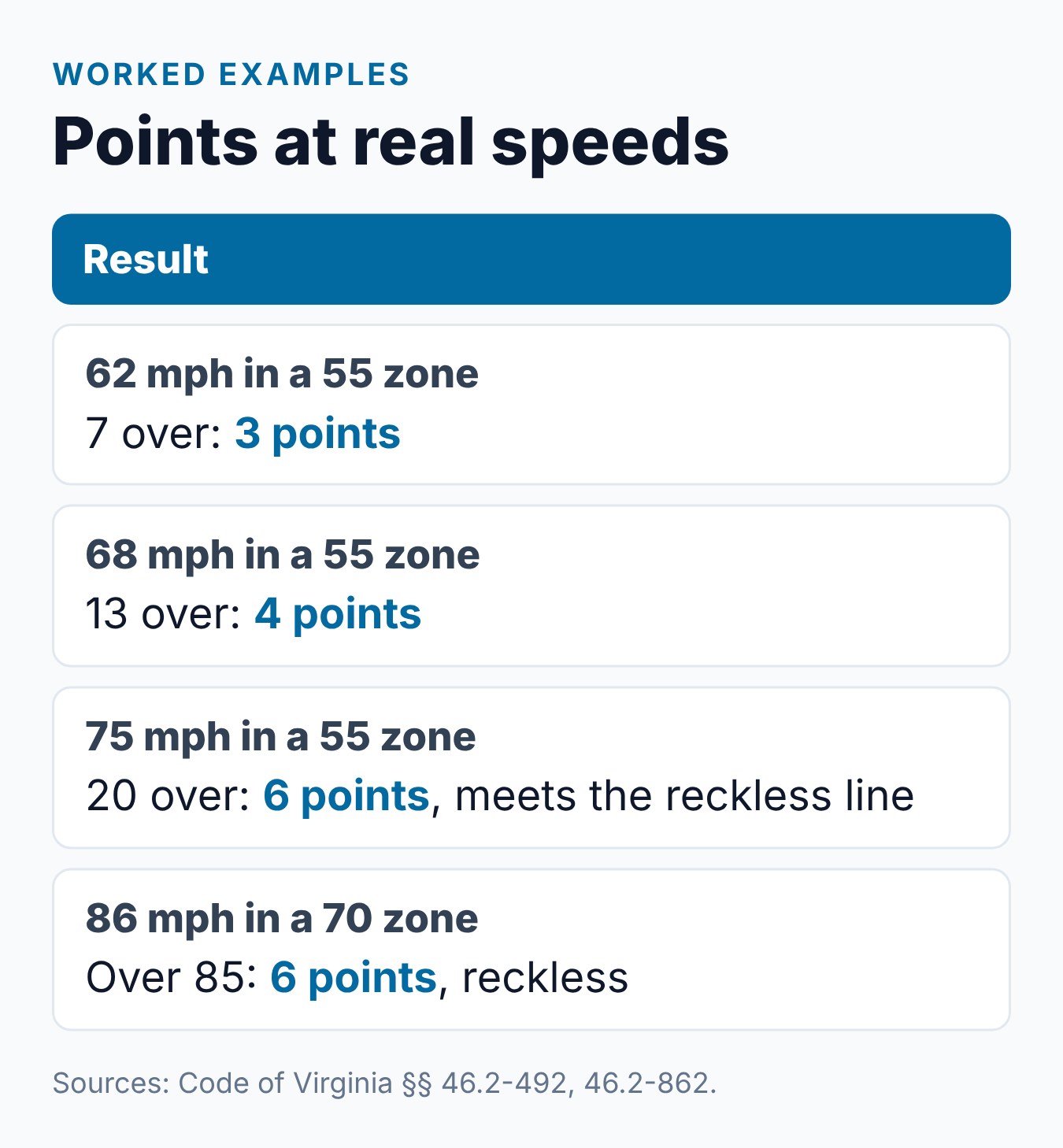
Simple math shows how the bands work. On a road with a 55 mph limit:
- 62 mph is 7 over, so it falls in the 3-point band.
- 68 mph is 13 over, so it falls in the 4-point band.
- 75 mph is 20 over. That meets the 6-point band, and it also meets the reckless line.
On a 70 mph interstate, the over-85 rule matters. 86 mph is only 16 over, but it is over 85 mph. That meets the reckless line, which carries 6 points.
Low limits work the same way. In a 25 mph zone, 45 mph is 20 over, so it reaches the 6-point band and the reckless line.
When the Charge Is Reckless Driving
Some speeding tickets are not plain speeding at all. Under Code § 46.2-862, driving 20 mph or more over the limit, or over 85 mph, is reckless driving.
The points are the same 6, but the rest changes:
- It is a crime. Code § 46.2-868 makes it a Class 1 misdemeanor. Under Code § 18.2-11, that means up to 12 months in jail and/or a fine up to $2,500.
- It stays longer. DMV lists reckless driving convictions for 11 years, not 5.
- It cannot be prepaid. Code § 16.1-69.40:1 leaves reckless driving off the prepayment list.
Our guide on when speeding becomes reckless driving covers the line in depth.
What Makes Points Post
A ticket alone does not add points. Points come from a conviction that reaches DMV. A few rules decide what counts:
- Prepaying is a guilty plea. Under Code § 16.1-69.40:1, your signature has “the same force and effect as a judgment of court.” The conviction is sent to DMV.
- One stop, one set of points. If you are convicted of two or more offenses on one occasion, Code § 46.2-492 gives points for only the higher one.
- Other states count. DMV assigns points for traffic convictions in other states, too.
Mailed camera tickets work differently. Under Code § 46.2-882.1, a mailed speed camera summons is a civil penalty of up to $100.
It is not a conviction and is not part of your driving record. See our speed camera guide.
How Long Speeding Points Count
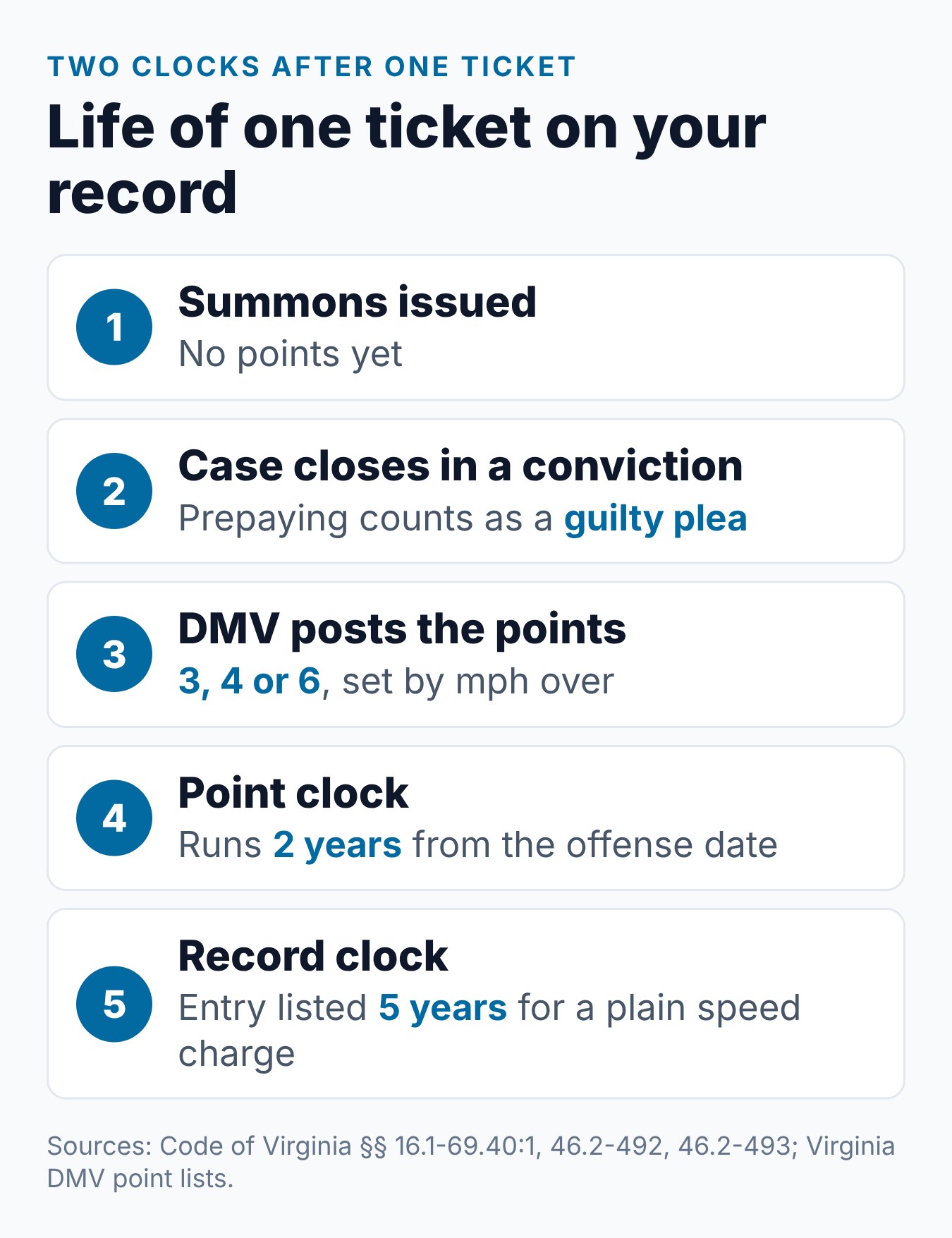
Two clocks run after a speeding conviction, and they are not the same length.
The point clock. Under Code § 46.2-493, demerit points count for 2 years from the date of the offense. They can last longer if DMV used them for an action that is still running.
The record clock. DMV lists every speeding conviction for 5 years. Reckless driving by speed stays 11 years.
DMV’s Moving Violations page says the two dates “are not related.” Our guide on how long points stay explains the point clock, and the speeding record guide covers the 5-year entry.
Points, Fines and Insurance Are Separate
A speeding ticket can touch three different systems. Each one follows its own rules.
- DMV points. These come from Code § 46.2-492, as shown above.
- Fines. A prepaid speeding fine is set per mile per hour by Code § 46.2-878.3, plus a fixed $51 court cost. Our speeding fines guide has the math.
- Insurance. DMV says insurance company points are not related to DMV demerit points. The Bureau of Insurance says increases for violations “may be applied for 36 months.”
So a ticket with only 3 DMV points can still matter for your fine and your premium. See our guide on speeding tickets and insurance.
How Speeding Points Add Up
No single speeding ticket reaches an adult DMV level on its own, since the most it adds is 6 points. Tickets stack, though. For drivers 18 and over, DMV watches totals over 12 and 24 months.
Here is simple math. Three 4-point speeding convictions within 12 months add up to 12 points.
That is the level where DMV requires a Driver Improvement Clinic. Two 6-point convictions in 12 months reach the same 12.
Young drivers face rules that start sooner:
- Ages 18 and 19: any point conviction, including a 3-point speeding ticket, means a required clinic.
- Under 18: DMV acts by the number of convictions, starting with a clinic after the first.
The Virginia DMV points system guide lists every adult level.
Speeding While on Probation
Speeding points matter more after a clinic order. Under Code § 46.2-499, a driver ordered to a clinic is placed on 6 months of probation. A point conviction for an offense during that time brings a suspension tied to the points:
- A 3-point speeding conviction: 45-day suspension.
- A 4-point speeding conviction: 60-day suspension.
- A 6-point speeding conviction: 90-day suspension.
After probation, an 18-month control period follows under Code § 46.2-500. A point violation in that time means 6 more months of probation. Our control period guide explains it.
A Note for CDL Holders
Speed carries extra weight for commercial drivers. Code § 46.2-341.20 lists speeding 15 mph or more over the limit as a serious traffic violation. Two such violations in 3 years mean a 60-day disqualification, and three mean 120 days.
A ticket in a personal car counts only if it leads to a suspension, revocation or cancellation. See our CDL speeding guide.
Safe Driving Points and a Clinic
Safe driving points can offset speeding points. DMV’s Driver Improvement page says an eligible Driver Improvement Clinic earns 5 safe driving points, once every 24 months. Your balance never goes above +5.
Code § 46.2-498 describes this as five demerit points subtracted from your total. The speeding conviction stays on your record for its full 5 years. A clinic taken for an insurance discount earns no points.
How to See Your Speeding Points
You can confirm the points from a ticket on your own record. DMV’s Online Record Request page offers a “Points Balance” link.
You can also order a driving record. It costs $9, or $8 online. Our guide on how to check points covers each way to order one.
What We Found on the Official Pages
On the DMV point pages we checked on October 27, 2026, the speeding entries matched the bands in Code § 46.2-492. Every non-reckless speeding entry showed 5 years, and every reckless entry showed 11.
DMV’s pages note that the listed violations “may change without notice.” Check the lists again before you rely on a number.
Common Mistakes
Each item below comes from the Code of Virginia or a DMV page:
- Treating “85 mph” as the line. The law says over 85 mph, or 20 or more over the limit.
- Thinking points last 5 years. Points count 2 years; the conviction stays 5.
- Treating a mailed camera ticket as a conviction. It is a civil penalty and is not on the driving record.
- Counting both offenses from one stop. Only the higher one gets points.
- Forgetting out-of-state tickets. DMV adds Virginia points for them.
- Assuming a 3-point ticket is minor at 18 or 19. Any point conviction at those ages means a clinic.
How Requirements Can Vary
Virginia’s point rules, safe driving points and DMV clinic orders come from the Code of Virginia and DMV rules, and they apply statewide. What you must do still depends on whether you take the clinic by choice, because of a DMV notice, or under a court order. A court order sets its own deadline and proof steps.
Laws, fees and court practice can change. Check your DMV notice, your court order and the Virginia DMV website for current rules before you enroll or file anything.
Frequently Asked Questions
How many points is 10 over in Virginia?
Ten mph over is 4 points. The 4-point band covers 10 to 19 mph over the limit. The conviction stays on your DMV record for 5 years.
How many points is 15 over in Virginia?
Fifteen mph over is 4 points. DMV lists it as “Speeding 15-19 mph,” and the conviction stays on the record 5 years.
How many points is 20 over in Virginia?
Twenty mph or more over is 6 points. It can also be charged as reckless driving, which stays on the record 11 years instead of 5.
Is going over 85 mph always reckless?
Under Code § 46.2-862, driving over 85 mph is reckless driving regardless of the posted limit. It carries 6 points.
Does an out-of-state speeding ticket add Virginia points?
Yes. DMV assigns demerit points for traffic convictions in other states. They count toward the same totals as a Virginia ticket.
Do speeding points start on the ticket date?
The 2-year point count starts on the date of the offense. Points post only after a conviction reaches DMV.
Does a speed camera ticket add points?
A mailed speed camera summons is a civil penalty of up to $100. It is not a conviction and is not part of your driving record.
Can a clinic help with speeding points?
An eligible clinic can earn 5 safe driving points, once every 24 months, which can offset demerit points. The speeding conviction stays on your record.
Conclusion
A Virginia speeding ticket adds 3, 4 or 6 points, based on how far over the limit you were. Those points count for 2 years, but the conviction stays 5 years, or 11 for reckless driving.
If you want to earn 5 safe driving points and you are eligible, you can take the Virginia Driver Improvement Course. If a court ordered your clinic, ask the court whether it accepts an online course.
Related Articles
- Virginia DMV Points System Explained
- Virginia Traffic Violation Points Chart: How Many Points for Each Offense
- How Long Do Points Stay on Your License in VA?
- Virginia Reckless Driving Speed: 20 Over or Over 85 MPH
Sources
- Virginia DMV — Three Point Violations
- Virginia DMV — Four Point Violations
- Virginia DMV — Six Point Violations
- Virginia DMV — Moving Violations and Point Assessments
- Virginia DMV — Traffic Violations, Drivers Age 18 and Over
- Virginia DMV — Driver Improvement
- Code of Virginia § 46.2-492 — Uniform Demerit Point System
- Code of Virginia § 46.2-493 — Demerit points valid for two years
- Code of Virginia § 46.2-862 — Exceeding speed limit (reckless)
- Code of Virginia § 46.2-868 — Reckless driving; penalties
- Code of Virginia § 18.2-11 — Punishment for misdemeanors
- Code of Virginia § 16.1-69.40:1 — Traffic infractions, prepayment
- Code of Virginia § 46.2-882.1 — Photo speed monitoring; civil penalty
- Code of Virginia § 46.2-341.20 — CDL disqualification for serious traffic violations
- Code of Virginia § 46.2-498 — Driver improvement clinics; voluntary attendance
- Code of Virginia § 46.2-878.3 — Prepayment of speeding fines
- Virginia DMV — Online Record Request
- Virginia Bureau of Insurance — Consumer’s Guide for Auto Insurance
- Code of Virginia § 46.2-499 — Driver’s license probation
- Code of Virginia § 46.2-500 — Driver control period
Billy Forte is the owner of Driving Logic, a state-approved driver improvement course provider serving Virginia and other U.S. states.
This article is general information, not legal advice. Virginia DMV rules, court orders, fines and penalties depend on your notice, summons, court and case facts, and they can change. Use official Virginia DMV and court sources, and consult a qualified Virginia attorney for advice about your own case.