
Updated October 2026 · Reviewed by Billy Forte
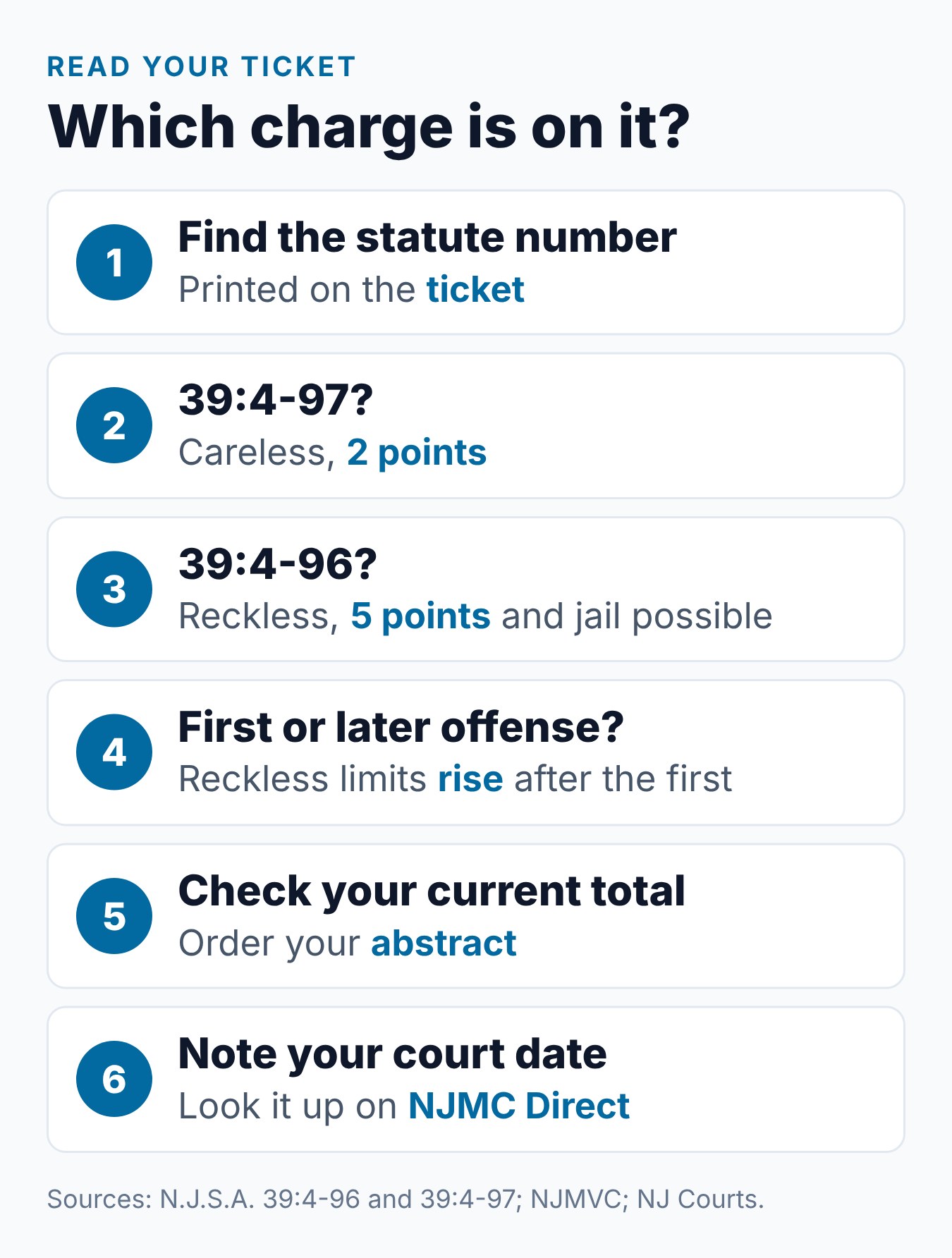
The careless vs reckless driving NJ difference starts with the wording of two laws: careless driving is driving “without due caution and circumspection,” while reckless driving is driving with “willful or wanton disregard.” Careless driving (N.J.S.A. 39:4-97) carries 2 points on the New Jersey Motor Vehicle Commission (NJMVC) schedule, and reckless driving (N.J.S.A. 39:4-96) carries 5. Only the reckless driving law lists its own penalties, which include possible jail time and fines.
Key Facts
- Careless driving: N.J.S.A. 39:4-97, 2 points. See the careless driving law.
- Reckless driving: N.J.S.A. 39:4-96, 5 points. See the reckless driving law.
- Penalties: reckless driving can mean up to 60 days in jail for a first offense. See the penalties.
- Point gap: 3 points, which can decide a surcharge or a suspension. See the point math.
- Course: an approved course removes 2 points from either one but dismisses neither. See what a course can do.
Careless vs Reckless Driving NJ at a Glance
We read both statutes and the NJMVC points schedule on October 25, 2026. Here is how the two charges compare:
| Careless driving | Reckless driving | |
|---|---|---|
| Statute | N.J.S.A. 39:4-97 | N.J.S.A. 39:4-96 |
| Key words in the law | “without due caution and circumspection” | “willful or wanton disregard” |
| NJMVC points | 2 | 5 |
| First offense penalty in the statute | None stated in the section | Up to 60 days in jail, a $50 to $200 fine, or both |
| Second or later offense | None stated in the section | Up to three months in jail, a $100 to $500 fine, or both |
| Effect of an approved course | Removes 2 points, no dismissal | Removes 2 points, no dismissal |
Both laws require driving that endangers, or could endanger, people or property. The difference is in how the law describes the driver’s disregard for that danger.
What the Careless Driving Law Says
N.J.S.A. 39:4-97 covers driving “carelessly, or without due caution and circumspection.” The driving must be done in a manner that could “endanger, or be likely to endanger, a person or property.”
The key idea is a lack of care. The law does not use words like “willful” or “wanton.” It focuses on whether the driver took enough care.
The section does not state a penalty. So any fine for careless driving comes from the court, not from this section. Our guide on how many points careless driving is in NJ explains what its 2 points can lead to.
What the Reckless Driving Law Says
N.J.S.A. 39:4-96 covers driving with “willful or wanton disregard” of the safety of others. As with careless driving, the driving must endanger, or could endanger, people or property.
The words “willful or wanton” set a higher bar than “without due caution.” They point to a stronger kind of disregard than a lack of care. That is one reason the points and penalties are higher.
Penalties Written Into 39:4-96
Unlike the careless driving section, the reckless driving section lists penalties:
- First offense: up to 60 days in jail, a fine of $50 to $200, or both.
- Second or later offense: up to three months in jail, a fine of $100 to $500, or both.
These are the limits in the statute. The court decides the actual penalty in each case. We do not predict outcomes, and this is not legal advice.
Why the 3-Point Gap Matters
Points add up on your NJMVC record. The NJMVC point system page sets two lines: 6 or more points within three years brings a surcharge, and 12 or more brings a suspension.
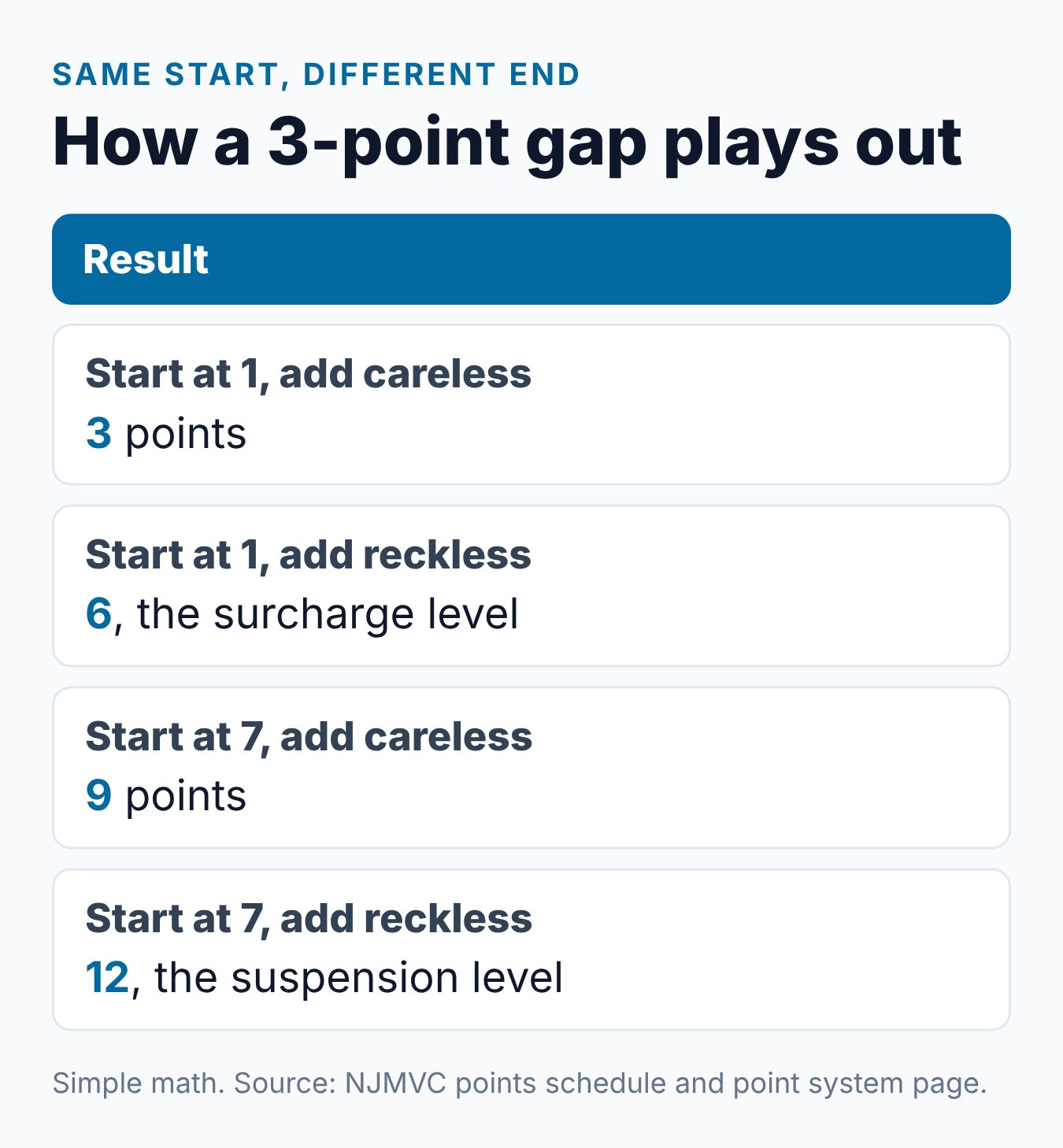
A 3-point gap can decide which side of a line you land on. Here are simple math examples:
- Starting at 1 point: careless driving brings you to 3, but reckless driving brings you to 6, the surcharge level.
- Starting at 7 points: careless driving brings you to 9, but reckless driving brings you to 12, the suspension level.
- Starting at 0: reckless driving alone puts you at 5, one point short of the surcharge level.
Surcharge Amounts
The NJMVC surcharges page sets a $150 surcharge at 6 points. Each point over six adds $25. The surcharge is billed every year for three years.
So 6 points means $150 a year, and 9 points means $225 a year. You pay surcharges to NJSVS, not to the MVC.
How Long the Points Weigh on You
NJMVC keeps a permanent record, but your point total can drop. A full year with no violations and no suspensions removes 3 points. The year starts on the date of your last violation or your most recent restoration.
That rule treats both charges the same way, but the starting point differs. A careless driving conviction leaves fewer points to work off. A reckless driving conviction alone still leaves 2 points after one clean year.
Your driver history abstract shows five years of New Jersey moving violations, points, accidents and suspensions. It costs $15 from NJMVC.
If Your Total Reaches 12
At 12 or more points, NJMVC suspends your license and mails you a notice first. A 5-point reckless driving ticket gets you there faster than a 2-point careless driving ticket.
NJMVC may offer the Driver Improvement Program to a driver facing suspension. It is a three-hour program that removes 3 points, and you can attend it in place of all or part of the suspension. The DIP FAQ lists a $75 NJMVC fee plus a class fee of no more than $75.
You can take DIP only after NJMVC sends a notice offering it. A defensive driving course cannot be used in its place.
Other Charges on the Schedule
The points schedule lists other charges near these two. Knowing them helps you read a ticket:
- Unsafe driving (39:4-97.2): 4 points, but only for a third or later offense within five years.
- Tailgating (39:4-89): 5 points, the same as reckless driving.
- Racing on a highway: 5 points.
- Speeding 30 or more mph over (39:4-98): 5 points.
Speeding deserves a closer look. A driver going 30 or more mph over the limit gets the same 5 points as reckless driving, under a different law. Our guide to the NJ speeding ticket covers each speeding band.
Each of these is its own law. The statute number on your ticket tells you which one you were charged with. For the full table, see NJ license points by violation.
How the Court Side Works
Points come from NJMVC, but the charge itself is handled by a municipal court. The NJ Courts municipal court page explains the basic steps for any ticket:
- Look it up. The NJMC Direct system shows the violation number, the court date and the court’s name.
- Pay, if allowed. Some tickets do not need a court appearance and can be paid. Paying means you are pleading guilty.
- Plead not guilty. The judge hears the case on your court date, and a prosecutor may contact you first.
- Ask for a new date. You can request a different court date if you cannot attend.
NJ Courts also say you might be entitled to a public defender, based on the charge and income rules. The court provides an interpreter at no cost for court events. We describe these steps only as general information, not legal advice.
What a Course Can Do for Either Charge
An approved defensive driving course works the same way for both charges. Under N.J.A.C. 13:21-24.2, it reduces your points by two after you finish. It does not dismiss a careless or a reckless driving ticket.
The limits are the same too:
- Once in any five-year period.
- Only points on your record when you finish the course.
- Never below zero.
- No effect on a suspension NJMVC has already proposed.
With 5 reckless driving points, a course would leave 3. With 2 careless driving points, a course would leave 0. Those are current totals, which matter for the 12-point suspension level.
The credit does not help with a surcharge. The NJMVC surcharges page says the course reduction and the yearly safe driving credit do not reduce a surcharge point total.
The NJMVC Driver Programs page lists State-approved classroom and online courses. The provider reports your completion to NJMVC within 7 to 10 business days.
The Insurance Angle
NJMVC says points may raise your insurance rates. After an approved course, N.J.S.A. 17:33B-45.1 requires your insurer to reduce your premium by an amount it sets.
That reduction lasts three years from the next policy period. It ends early with a suspension or four or more points. A single reckless driving conviction is 5 points, so it would reach that mark.
Common Mistakes to Avoid
These mistakes come from the two statutes and the NJMVC rules:
- Treating the two as the same. They are separate laws with different points.
- Quoting a careless driving fine from the statute. Section 39:4-97 names none.
- Missing the jail term in 39:4-96. Reckless driving lists possible jail time, even for a first offense.
- Forgetting about later offenses. A second reckless driving conviction has higher limits.
- Expecting a course to dismiss either ticket. It removes 2 points only.
- Ignoring your total. A 5-point ticket can push you to 6 or 12.
- Using a course in place of DIP. NJMVC does not allow that swap.
- Mailing your own course certificate. NJMVC accepts completion proof only from the provider.
How Requirements Can Vary
New Jersey’s point system and defensive driving rules are set by state law and NJMVC rules, and they apply statewide. Fines and court costs come from the municipal court that handles your ticket, so the amount you owe depends on the court and the violation.
Insurance discounts also differ. State law requires insurers to reduce your premium after an approved course, but each insurer sets the amount.
Check the NJMVC Driver Programs page, your driver history abstract, and your insurer for current rules before you sign up for a course.
Frequently Asked Questions
What is the difference between careless and reckless driving in NJ?
Careless driving is driving “without due caution and circumspection” and carries 2 points. Reckless driving is driving with “willful or wanton disregard” and carries 5 points. Only the reckless driving law lists jail time and fines.
How many points is reckless driving in NJ?
Reckless driving under N.J.S.A. 39:4-96 carries 5 points on the NJMVC schedule. Careless driving carries 2.
Can you go to jail for reckless driving in NJ?
The statute allows up to 60 days in jail for a first offense and up to three months for a later one. A fine, or both, is also possible. The court decides the penalty in each case.
What is the fine for careless driving in NJ?
The careless driving section does not state a fine. The amount comes from the court or the violations bureau schedule. Our careless driving NJ points guide explains where to find it.
Can a defensive driving course remove reckless driving points?
An approved course removes 2 points from your record, once in any five-year period. With 5 reckless driving points, that leaves 3. The course does not dismiss the ticket.
Does reckless driving cause a surcharge in NJ?
Not by itself, because 5 points is below the 6-point level. Any other points within three years would push you to 6 or more. Then you owe at least $150 a year for three years.
Does a second reckless driving conviction carry more?
Yes. N.J.S.A. 39:4-96 allows up to three months in jail, a fine of $100 to $500, or both for a second or later conviction. The points stay at 5 per conviction.
Do reckless driving points come off over time?
Your total drops by 3 points for each year with no violations or suspensions. With only 5 reckless driving points, one clean year leaves 2. NJMVC still keeps the conviction on its permanent record.
Conclusion
Careless driving and reckless driving use different words, carry different points and have different penalties in the law. Reckless driving is 5 points with possible jail time, while careless driving is 2 points with no penalty in its section. Driving Logic’s New Jersey Defensive Driving Course is coming soon, and NJMVC lists State-approved courses on its Driver Programs page.
Related Articles
- Careless Driving NJ Points, Fines, and What to Know
- How Many Points Is Careless Driving in NJ?
- NJ Points on License: What Each Common Violation Is Worth
Sources
- N.J.S.A. 39:4-97 — Careless driving
- N.J.S.A. 39:4-96 — Reckless driving
- NJMVC — Points Schedule
- NJMVC — Point System and Suspensions
- NJMVC — Surcharges
- NJMVC — Driver History Abstract
- N.J.A.C. 13:21-24.2 — Point reduction for a defensive driving course
- NJMVC — Driver Programs (defensive driving course, DIP, PDP, approved providers)
- N.J.S.A. 17:33B-45.1 — Insurance premium reduction after a defensive driving course
- NJMVC — Driver Improvement and Probationary Driver Programs
- NJMVC — Driver Improvement Program FAQ
- New Jersey Courts — Municipal Court Self-Help
Billy Forte is the owner of Driving Logic, a state-approved driver improvement course provider serving Florida and other U.S. states.
This article is general information, not legal advice. New Jersey point rules, surcharges, and insurance discounts are set by New Jersey law, the Motor Vehicle Commission, and your insurer, and can change. Check the NJMVC website, the court on your ticket, and your insurer for current requirements.