
Updated October 2026 · Reviewed by Billy Forte
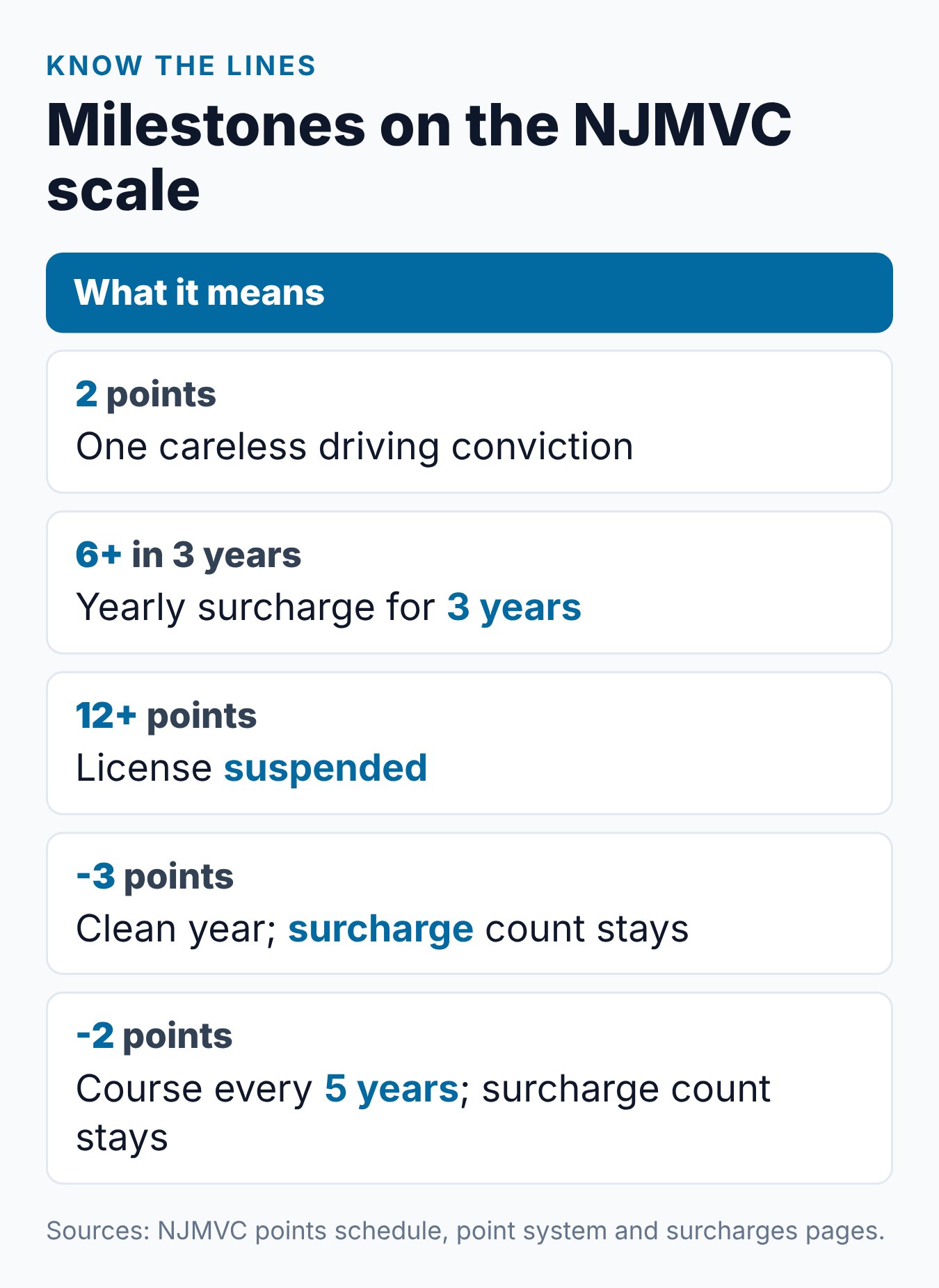
If you are asking how many points is careless driving in NJ, the answer is 2 points on the New Jersey Motor Vehicle Commission (NJMVC) points schedule. That is the same as speeding 1 to 14 mph over the limit. The real effect depends on your total, because 6 or more points within three years brings a surcharge and 12 or more brings a suspension.
Key Facts
- Points: careless driving under N.J.S.A. 39:4-97 carries 2 points. See the answer.
- Same as: speeding 1 to 14 mph over and failure to stop at a stop sign. See the comparison.
- Surcharge: 6 or more points within three years costs $150 a year, plus $25 per point over six. See the math.
- Clean year: a year with no violations or suspensions removes 3 points. See how points come off.
- Course: an approved course removes 2 points once in any five-year period. See the course rule.
How Many Points Is Careless Driving in NJ?
The NJMVC points schedule lists careless driving, N.J.S.A. 39:4-97, at 2 points. We checked that row on October 25, 2026. The number is the same for a first ticket and a later one.
Points are NJMVC’s way of tracking driving behavior. Each conviction on the schedule adds its points to your record. NJMVC then looks at your total to decide on surcharges and suspensions.
The careless driving law itself, N.J.S.A. 39:4-97, says nothing about points. The point value comes only from the NJMVC schedule.
Two Points Next to Other Violations
Two points is the low end of the schedule, but it is not zero. These violations also carry 2 points:
- Speeding 1 to 14 mph over the limit under 39:4-98.
- Failure to observe stop or yield signs under 39:4-144.
- Failure to yield to a pedestrian in a crosswalk under 39:4-35 and 39:4-36.
- Failure to obey traffic signals under 39:4-81.
Other tickets carry more. Improper turns carry 3 points, and improper passing carries 4. Reckless driving and tailgating each carry 5.
The schedule also lists “unsafe driving” under 39:4-97.2. It carries 4 points, but only for a third or later offense within five years.
That is a different law from careless driving. For the full list, see our guide to NJ license points by violation.
When the Points Count
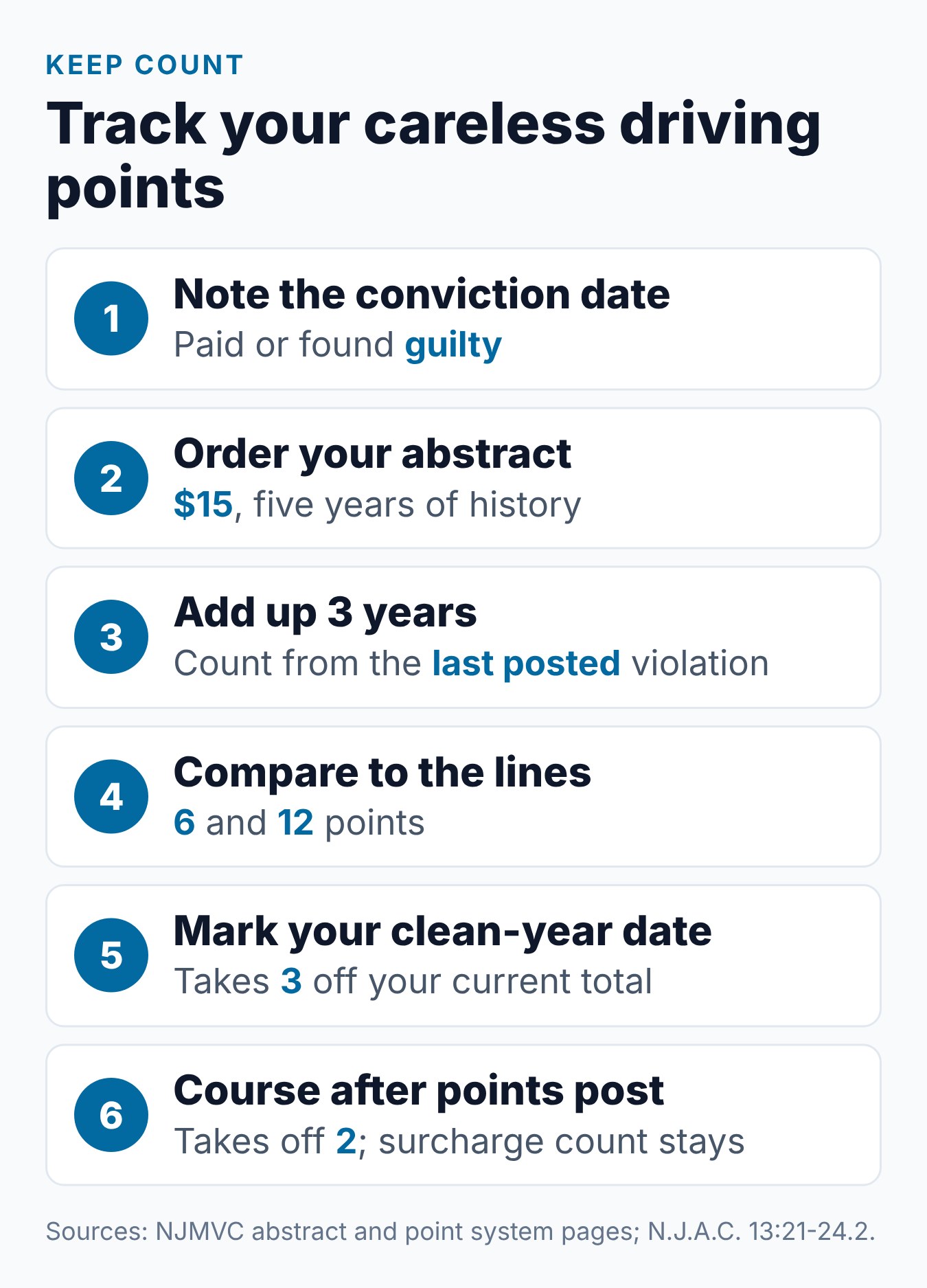
The 2 points go on your record after a conviction. Paying the ticket counts, because NJ Courts say paying the fine means you are pleading guilty. A guilty finding in court counts too.
A careless driving ticket from another state still adds 2 points. The NJMVC point system page says any moving violation committed outside New Jersey is assessed 2 points under 39:5D-4.
To see your points, order a driver history abstract. The NJMVC abstract page says it shows five years of New Jersey moving violations, points, accidents and suspensions. It costs $15.
You can order it online with a User ID, your New Jersey license or ID, and a credit or debit card. You can also mail Form DO-21 or bring it to a counter. Our guide to the NJ driving record abstract walks through each way.
Look for the careless driving entry, its date and its 2 points. The violation date matters, because both the clean-year count and the course credit are figured from dates.
What 2 Points Can Lead To
Two points matter most when they push you past a line. The table below adds 2 careless driving points to a few starting totals. It assumes all points fall inside the same three-year window.
| Points before | Points after careless driving | What the NJMVC rules say |
|---|---|---|
| 0 | 2 | Below the surcharge level |
| 4 | 6 | Surcharge of $150 a year for three years |
| 7 | 9 | Surcharge of $225 a year ($150 plus 3 x $25) |
| 10 | 12 | License suspended; notice sent by mail |
These are simple math examples, not predictions about any one driver. Point credits do not lower the surcharge count, as we explain below. Your own abstract is the only true count.
The Surcharge Window
The NJMVC surcharges page counts points within three years from the last posted violation. At 6 points, the bill is $150. Each point over six adds $25.
The surcharge is billed every year for three years. You pay it to NJSVS, not to the MVC, and payment plans are available. Our guide to NJ MVC surcharge points covers the other surcharge types.
The Suspension Level
At 12 or more points, the NJMVC point system page says your license will be suspended. You get a notice of scheduled suspension by mail first. If 2 careless driving points would take you to 12, the stakes are much higher than the ticket itself.
A Second Careless Driving Ticket
Each conviction adds its own points. Two careless driving convictions add 4 points, and three add 6. If those fall within three years, three tickets alone would reach the surcharge level.
A second ticket can also end an insurance benefit. We explain that in the insurance section below.
Right After a Suspension or Program
The timing of new points matters more after certain events. Under N.J.A.C. 13:19-10.6, a new violation within one year after a restoration, an official warning, or a DIP or PDP can lead to another suspension. For a first such violation, the rule sets these lengths:
- Within 6 months: 90 days.
- From 6 to 9 months: 60 days.
- From 9 to 12 months: 45 days.
So in that one-year window, a 2-point careless driving ticket can carry far more weight than its points suggest.
Probationary Drivers
Drivers with a probationary license face a lower line. The PDP FAQ says the Probationary Driver Program is required for probationary license holders who build up more than two points. It is also required after certain convictions.
A careless driving ticket is exactly 2 points. Any other points on top of it would go past that line.
How the 2 Points Come Off
NJMVC keeps a permanent record of all points, even after deductions. Your current point total can go down in a few ways, each with its own rule.
These credits lower your current total, which matters for the 12-point suspension level. They do not help with surcharges. The NJMVC surcharges page says the 3-point safe driving credit and the 2-point course reduction do not reduce a surcharge point total.
A Clean Year
A full year with no violations and no suspensions removes 3 points. The year begins on the date of your last violation or your most recent restoration. With 5 points, one clean year leaves 2.
An Approved Course
A defensive driving course approved by NJMVC removes 2 points. Under N.J.A.C. 13:21-24.2, the credit is allowed once in any five-year period. The total cannot go below zero.
NJMVC says the reduction works only if there are points on your record when you finish. So the careless driving points must post first. The credit is figured from the dates of your offenses and the date you complete the course.
The course does not dismiss the ticket or remove the conviction. It changes only your point total.
After you finish, the provider tells NJMVC within 7 to 10 business days, and NJMVC does not accept certificates from drivers. Our guide to the NJ defensive driving 2-point reduction covers the timing.
DIP and PDP
The Driver Improvement Program removes 3 points. You can take it only after NJMVC sends a notice offering it, once every two years. The Probationary Driver Program also removes 3 points, one time, when NJMVC orders it.
For all the reductions side by side, see our guide to NJ license points reduction.
Points Are Separate From the Fine
The 2 points and the fine are two different things. The court handles the fine, and NJMVC handles the points. The careless driving law names no fine, so the amount comes from your court or the violations bureau schedule.
For what a careless driving ticket costs, see our guide on how much a careless driving ticket costs in NJ. For how it compares with a 5-point charge, read careless vs reckless driving in NJ.
Points and Your Insurance
NJMVC says getting points on your license may also increase your insurance rates. It also warns that your insurer might not factor point deductions into your rate. So lower points on your record do not always mean a lower bill.
An approved course has its own insurance rule. Under N.J.S.A. 17:33B-45.1, insurers must reduce your premium after you complete one. The insurer sets the amount.
The reduction lasts three years, starting with the next policy period. It ends early if your license is suspended or you build up four or more points. Two careless driving tickets would reach that four-point mark.
Common Mistakes to Avoid
These mistakes come from the NJMVC rules:
- Thinking 2 points is nothing. Two points can cross the 6-point surcharge line or the 12-point suspension line.
- Counting from the wrong date. The surcharge window runs three years from the last posted violation.
- Taking a course too early. The course removes only points on the record when you finish.
- Expecting a negative balance. A course cannot take your total below zero.
- Using a course twice in five years. The second one gives no point credit.
- Counting on credits to stop a surcharge. Course and clean-year credits do not reduce the surcharge point total.
- Waiting for DIP without a notice. DIP is open only after NJMVC offers it.
- Ignoring the year after a restoration. A new ticket in that year can bring a new suspension.
- Guessing your total. Your abstract shows the real count, so check it before you plan.
How Requirements Can Vary
New Jersey’s point system and defensive driving rules are set by state law and NJMVC rules, and they apply statewide. Fines and court costs come from the municipal court that handles your ticket, so the amount you owe depends on the court and the violation.
Insurance discounts also differ. State law requires insurers to reduce your premium after an approved course, but each insurer sets the amount.
Check the NJMVC Driver Programs page, your driver history abstract, and your insurer for current rules before you sign up for a course.
Frequently Asked Questions
How many points is a careless driving ticket in NJ?
A careless driving ticket carries 2 points on the NJMVC schedule once you are convicted. Paying the ticket counts as a guilty plea, so the points post then too.
Will 2 points suspend my NJ license?
Not by themselves. NJMVC suspends a license at 12 or more points. If you already have 10 points, 2 more would reach that level.
Do careless driving points cause a surcharge?
Only if your total reaches 6 or more points within three years. Then you owe $150 a year for three years, plus $25 a year for each point over six.
How long do careless driving points stay on my record?
NJMVC keeps a permanent record. Your point total drops by 3 for each year with no violations or suspensions. Our pillar guide on careless driving NJ points covers the full picture.
Can a defensive driving course remove careless driving points?
Yes, an approved course removes 2 points, once in any five-year period. The points must be on your record when you finish. The course does not dismiss the ticket.
Is careless driving the same points as speeding?
It matches speeding 1 to 14 mph over the limit, at 2 points. Speeding 15 to 29 mph over carries 4 points, and 30 or more over carries 5.
Does an out-of-state careless driving ticket add points in NJ?
Yes. NJMVC assesses 2 points for a moving violation committed outside New Jersey, under N.J.S.A. 39:5D-4. That matches the 2 points for careless driving here.
Can careless driving points end my insurance course reduction?
They can. State law ends the course-based premium reduction if you build up four or more points. Two careless driving convictions add up to 4 points.
Conclusion
Careless driving adds 2 points in New Jersey, and those points matter most when they push your total to 6 or 12. Check your abstract, track the three-year window, and know that a clean year or an approved course lowers your current total but not the surcharge count. Driving Logic’s New Jersey Defensive Driving Course is coming soon, and the NJMVC Driver Programs page lists State-approved courses now.
Related Articles
- Careless Driving NJ Points, Fines, and What to Know
- How to Reduce Points on License NJ: Automatic Credits
- NJ MVC Surcharge: What It Is and How Points Trigger It
- Careless vs Reckless Driving NJ: Key Differences
Sources
- NJMVC — Points Schedule
- NJMVC — Point System and Suspensions
- NJMVC — Surcharges
- N.J.S.A. 39:4-97 — Careless driving
- N.J.S.A. 39:4-96 — Reckless driving
- NJMVC — Driver History Abstract
- N.J.A.C. 13:21-24.2 — Point reduction for a defensive driving course
- N.J.A.C. 13:19-10.6 — Violations after restoration, warning or a program
- NJMVC — Driver Programs (defensive driving course, DIP, PDP, approved providers)
- N.J.S.A. 17:33B-45.1 — Insurance premium reduction after a defensive driving course
- NJMVC — Driver Improvement and Probationary Driver Programs
- NJMVC — Probationary Driver Program FAQ
- New Jersey Courts — Municipal Court Self-Help
Billy Forte is the owner of Driving Logic, a state-approved driver improvement course provider serving Florida and other U.S. states.
This article is general information, not legal advice. New Jersey point rules, surcharges, and insurance discounts are set by New Jersey law, the Motor Vehicle Commission, and your insurer, and can change. Check the NJMVC website, the court on your ticket, and your insurer for current requirements.