
Updated October 2026 · Reviewed by Billy Forte
Texas Impact Teen Drivers, the program DPS calls Impact Texas Teen Drivers (ITTD), teaches new drivers the risks and consequences of distracted driving, with a focus on cell phones and multitasking at the wheel. DPS requires the free, 2-hour video for teens 15 to 17 in a parent-taught or minor driver education course. It matters because TxDOT counted 86,384 crashes caused by distracted driving on Texas roads for 2025.
Key Facts
- Main subject: distracted driving and what it costs. See what the program covers.
- Approach: real stories and hard facts, not just rules. See the core message.
- Texas numbers: 299 deaths from distracted driving crashes for 2025, per TxDOT. See the Texas data.
- Teen law link: drivers under 18 may not use a phone while driving, even hands-free. See why it matters.
- Not a substitute: ITTD does not replace the distracted driving lesson in driver education. See the course link.
What the Program Covers
DPS states the purpose of its Impact Texas Drivers program in one sentence. It is “designed to educate drivers about the risks and consequences of distracted driving, ultimately saving lives.”
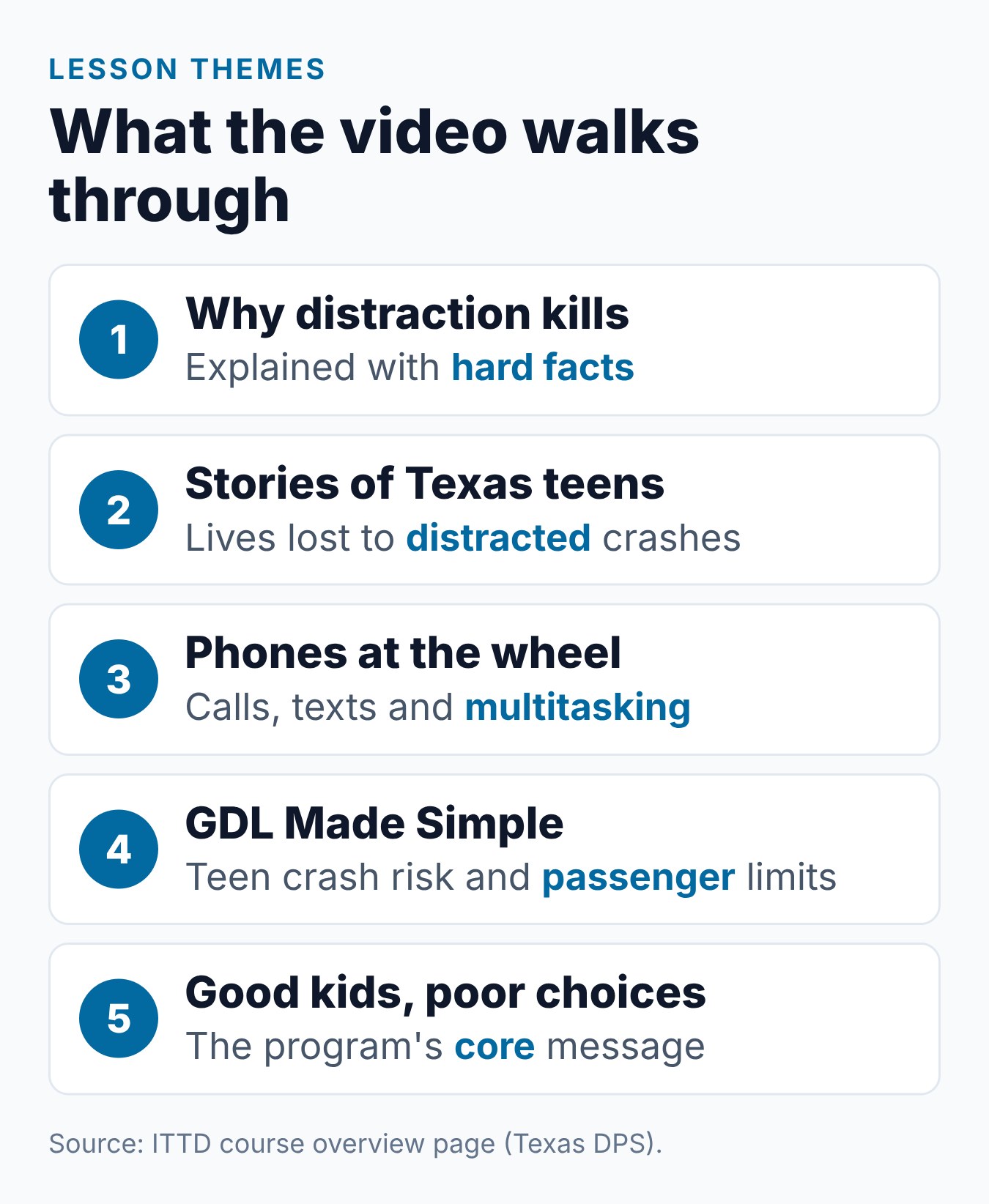
The ITTD course overview fills in the details. Based on that page, the teen program covers:
- The dangers of distracted driving, explained “with hard facts.”
- Real-life stories of teens who died in distracted driving crashes.
- Cell phone use and trying to multitask while driving.
- Texas facts and materials, adapted for Texas drivers.
- “GDL Made Simple,” a video on teen crash risk and Texas limits for new drivers, such as passenger rules.
TDLR describes the whole program in plain terms. Its provisional license page calls it “a free, two-hour informational video about distracted driving.”
How the Content Is Delivered
The lessons come in video form. The ITTD FAQ says the two hours are split into eight modules, and each one must be finished before the next opens.
For the format and setup, see what to expect in ITTD.
Who the Lessons Are For
DPS aims ITTD at drivers aged 15 to 17 taking an approved parent-taught or minor driver education course. Adults have a shorter, 1-hour program called ITAD.
Timing shapes how the lessons land. DPS places ITTD after the behind-the-wheel driver education requirements, so the teen watches it with real driving hours already done.
That also means the video comes right before the teen drives with fewer limits. A learner license needs a licensed adult 21 or older in the front passenger seat, and that rule is not on the DPS list of provisional license limits.
The Core Message
The course overview sums up its view of teens in one line: “It is not about bad kids doing bad things, but about good kids making poor choices.”
That framing matters. The program does not treat distraction as a problem only for reckless drivers. It treats it as a choice any new driver can face, every time a phone lights up.
Where the Idea Came From
The overview says ITTD is modeled on Impact Teen Drivers, a nonprofit effort from California. Texas built its version with Texas-specific statistics and materials.
So the stories and numbers point to Texas roads. That keeps the lessons close to home for a Texas teen.
What Counts as Distracted Driving
ITTD centers on phones, but distraction is broader. TxDOT runs a campaign called “Talk.
Text. Crash.” and defines the problem simply: “Distracted driving is any activity that takes your attention away from the road while driving.”
TxDOT lists examples beyond the phone:
- Phone use: texting, talking or glancing at a cell phone.
- Food and drink: eating and drinking behind the wheel.
- Controls: programming a navigation system or adjusting the radio or temperature.
- Reaching: grabbing for something in the back seat.
That wider list helps a teen see the point of the program. A phone is the biggest focus of ITTD, but any of these pulls attention off the road.
Distracted Driving on Texas Roads
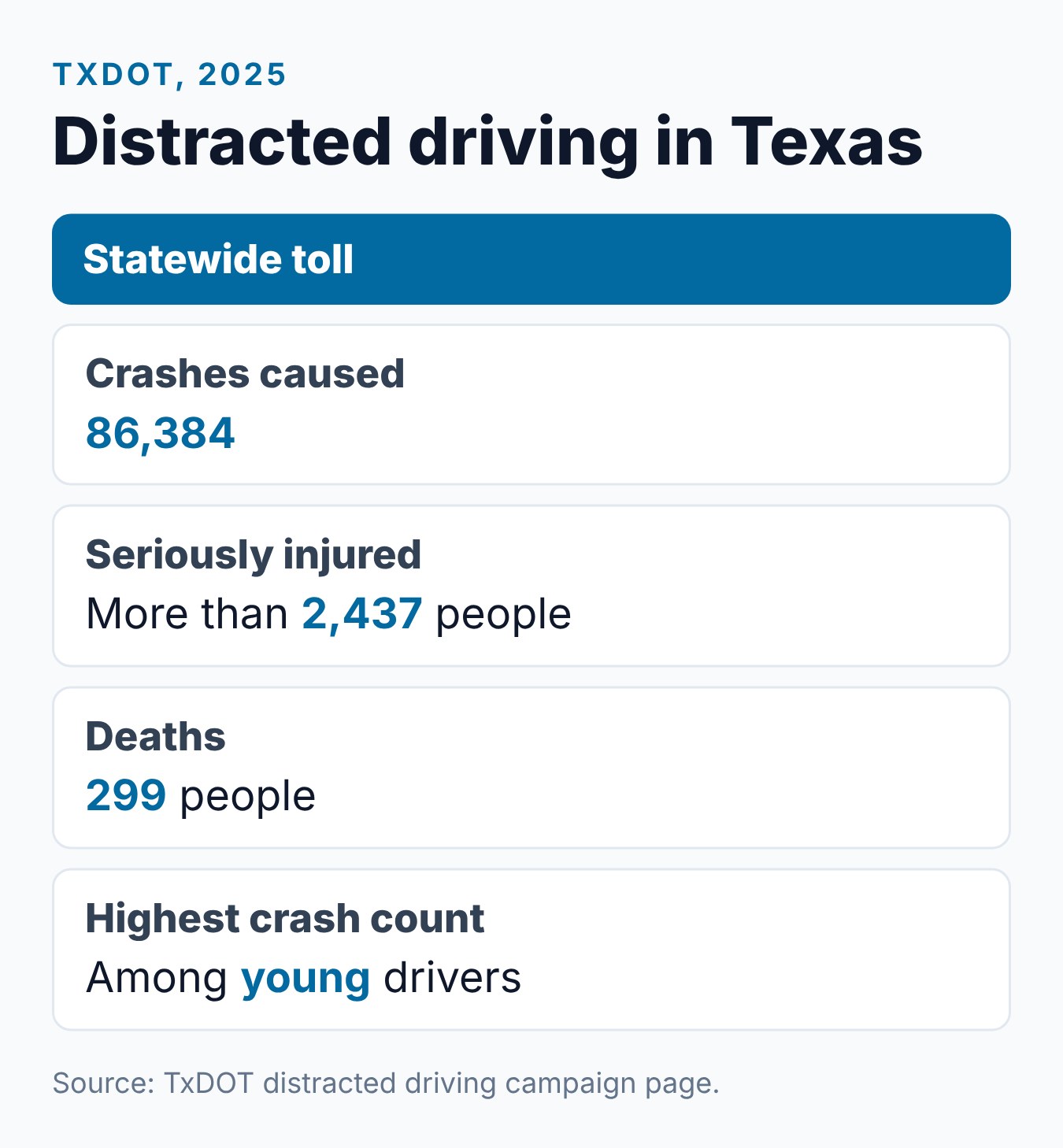
The Texas Department of Transportation (TxDOT) tracks distracted driving crashes. Its distracted driving page gives these figures for 2025:
- 86,384 crashes on Texas roads were caused by distracted driving.
- More than 2,437 people were seriously injured as a result.
- 299 people died.
TxDOT adds one line that speaks to families. It says, “The number of crashes was highest among young drivers.”
The DPS page opens with the same concern. It says, “Distracted driving is a serious threat to Texas roads.”
Texting Is Illegal for Every Driver
TxDOT says that since Sept. 1, 2017, it has been illegal to read, write or send a text while driving in Texas. That rule covers drivers of every age.
Teens face a stricter rule on top of it, covered in the next section.
Why It Matters for New Teen Drivers
For drivers under 18, Texas law goes further than a texting ban. Under Transportation Code 545.424, a driver under 18 may not use a wireless communication device while driving, except in an emergency.
The law says a “wireless communication device” includes both handheld and hands-free devices. So a teen cannot make a hands-free call while driving, outside an emergency.
The fine under that section runs from $25 to $99. With a prior conviction, it runs from $100 to $200.
The Same Rule With a Learner or Provisional License
DPS applies the phone ban at both teen license stages. Learner license holders and provisional license holders are barred from all cell phone use, including hands-free, except in an emergency.
ITTD puts a face on that rule. Instead of just reading the law, the teen sees what happens when it is broken. Our Texas teen cell phone law guide covers the law in full.
Limits for New Drivers
The “GDL Made Simple” part reviews Texas limits on new drivers. DPS lists two that apply to provisional license holders:
- Passengers: no more than one passenger under 21 who is not a family member.
- Late hours: no driving from midnight to 5 a.m., unless for work, school activities or a medical emergency.
These limits connect to the same idea as ITTD. Fewer distractions in the car means more attention on the road. Our guide to provisional license restrictions explains each one.
Resources Beyond the Video
The ITTD Resources page offers more material to share. It lists ten distracted driving posters as PDF files, seven of them with Spanish versions, and asks visitors to share them with friends, family and schools.
The page states, “Distracted Driving is the #1 killer of teens in America.” It also lists a video called “1 Week on Texas Highways,” which it marks as containing graphic content.
The page says crashes caused by distracted driving are “100% preventable.” Families can use these materials to keep the topic going after the modules end.
TxDOT Tips That Match the Lessons
TxDOT gives drivers a short list of habits. They line up with what ITTD teaches:
- “Always give driving your full attention.”
- Pull off the road entirely and come to a complete stop before you talk or text.
- Put your phone away, turn it off, or use an app or phone settings to block texts and calls.
- Tell friends and family you will not answer calls or texts while driving.
For a teen under 18, the pull-over habit fits the law. Section 545.424 bars phone use while driving, except in an emergency, so the call waits until the car is stopped off the road.
A Safety Program, Not a Box to Check
ITTD is a requirement, but its goal is behavior. DPS says the ITD program aims at “ultimately saving lives.”
Here are simple ways a family can make the lessons stick. These are ideas, not DPS rules:
- Talk after each module. Ask what the teen noticed and what surprised them.
- Set a phone plan. Agree where the phone goes before the car moves.
- Match the law. Remind the teen that hands-free calls are off-limits under 18.
- Model it. Adults who drive with the teen can follow the same habits.
The certificate proves the video was watched. The habits are what protect the teen.
How ITTD Connects to Driver Education
ITTD adds to driver education. It does not replace any of it.
DPS says the ITD programs “do not replace the distracted driving module in the 24-hour teen driver education course.” So a teen meets the topic twice: once in the course and once in ITTD.
The course is the bigger piece. Teen driver education includes at least 24 classroom hours under 16 TAC 84.500 and 44 in-car hours, with 30 hours of practice and at least 10 at night.
ITTD comes after the behind-the-wheel requirements and before the driving skills test. For the stage-by-stage view, read ITTD vs PTDE. For an overview of the whole program, see our Impact Texas Teen Drivers guide.
Our Review of the Course Overview
On the ITTD course overview and Resources pages we checked on October 26, 2026, the program was described as eight video parts. The overview named cell phones and multitasking as the focus.
The Resources page listed ten distracted driving poster titles. Their messages were about phones and texting, such as “You are smarter than your smart phone.”
Common Mistakes About the Content
Each point is checked against the official pages and Texas law:
- Thinking hands-free is fine for teens. Section 545.424 covers hands-free devices for drivers under 18.
- Thinking the law only bans texting. For drivers under 18, the ban covers wireless device use, except in an emergency.
- Treating ITTD as the course. It does not replace the distracted driving module in driver education.
- Rushing to get it done early. DPS places it after behind-the-wheel work, and the certificate lasts 90 days.
- Forgetting the message after the test. The phone rule applies for as long as the driver is under 18.
How Requirements Can Vary
Texas driver education rules come from TDLR, and driver license rules come from Texas DPS. They apply statewide, but what you need depends on the student’s age, the course method, and whether the classroom part comes from a parent-taught course, a driving school, or a public school.
Fees, forms, and office procedures can change. Check the TDLR parent-taught pages and the DPS driver license pages before each step, and follow the instructions from your course provider.
Frequently Asked Questions
What does Texas Impact Teen Drivers teach?
It teaches the risks and consequences of distracted driving. The course overview says it focuses on cell phone use and multitasking, using real stories and Texas facts.
Why does Texas require ITTD?
DPS says the ITD program aims to educate drivers about distracted driving and save lives. TxDOT counted 299 deaths from distracted driving crashes on Texas roads for 2025.
Does ITTD cover Texas teen driving limits?
Yes, in part. The course overview says its “GDL Made Simple” video reviews teen crash risk and Texas limits for new drivers, such as passenger rules.
Can a teen use a hands-free phone while driving in Texas?
No. Transportation Code 545.424 bars drivers under 18 from using wireless devices while driving, including hands-free devices, except in an emergency.
Is there anything to memorize for ITTD?
The DPS and ITD pages do not describe a quiz or exam. The goal is to understand the risks, then finish all eight modules for the certificate.
Does ITTD replace the distracted driving lesson in driver education?
No. DPS says the ITD programs do not replace the distracted driving module in the 24-hour teen course.
Where can I find the ITTD posters?
On the ITTD Resources page. It lists distracted driving posters as PDF files and asks visitors to share them with friends, family and schools.
Conclusion
Texas Impact Teen Drivers uses real stories and Texas facts to show new drivers why a phone and a steering wheel do not mix. It backs up a teen phone law that bans even hands-free use under 18. Driving Logic’s Texas Parent Taught Drivers Ed course is coming soon, and the TDLR provider search lists licensed driver education courses until then.
Related Articles
- What Is Impact Texas Teen Drivers (ITTD)? The Complete Guide
- Impact Texas Teen Drivers Questions: What to Expect in the Course
- ITTD vs PTDE: Where Does Impact Texas Teen Drivers Fit in the Licensing Process?
- Texas Teen Driving Cell Phone Law: What Parents Should Know
Sources
- Texas DPS — Impact Texas Drivers (ITD) Program
- Impact Texas Drivers (official DPS course site)
- TDLR — Parent-Taught Provisional License
- Texas Transportation Code § 545.424 — Operation of vehicle by person under 18
- Texas DPS — Texas Provisional License as a Teen
- 16 Tex. Admin. Code § 84.500 — Courses of instruction (24 classroom hours)
Billy Forte is the owner of Driving Logic, a state-approved driver improvement course provider serving Texas and other U.S. states.
This article is general information, not legal advice. Texas driver education and licensing rules are set by TDLR, Texas DPS, and Texas law, and can change. Check the official TDLR and DPS websites for current requirements.