
Updated October 2026 · Reviewed by Billy Forte
The Texas ID card vs drivers license choice comes down to driving: a license lets you drive and also proves who you are, while an ID card only proves who you are. Texas law lets you hold one or the other, but not both, so DPS takes back your ID when you apply for a license. A license also needs tests and, at ages 18 to 24, a driver education course, while the DPS ID card page lists no test.
Key Facts
- Purpose: a license is for driving and identity; an ID card is for identity only. See what each card does.
- One card only: Texas law permits a license or an ID card, “but not both.” See the not-both rule.
- Fees: $33 for a new license at 18 to 84; $16 for an ID at 59 and younger, $6 at 60 and older. See the comparison.
- Length: a license lasts eight years and an ID card six years. See the comparison.
- Same papers: both need proof of lawful presence, residency and identity. See applying for an ID.
Texas ID Card vs Drivers License at a Glance
The two cards share an application form and the same core document groups. They differ in what you must pass and what you pay.
| Feature | Driver license | ID card |
|---|---|---|
| Lets you drive | Yes | No |
| Proves identity | Yes | Yes |
| New card fee | $33 (ages 18 to 84) | $16 (59 and younger), $6 (60 and older) |
| How long it lasts | Eight years | Six years |
| Tests | Vision, knowledge and driving | None listed on the DPS ID page |
| Driver education | Six-hour course at ages 18 to 24 | Not required |
| Impact Texas Drivers | Before the driving test | Not required |
| Replacement fee | $11 | $11 |
The fees come from the DPS fee page. The ID card details come from the DPS ID card page.
What Each Card Does
A Texas driver license gives you the legal right to drive the class of vehicle on the card. It also works as photo identification.
A Texas ID card does only the second job. DPS issues it to Texas residents for “up to six years.” It does not let you drive.
Both cards are issued by Texas DPS. Both carry the same REAL ID marking, covered below.
The Not-Both Rule
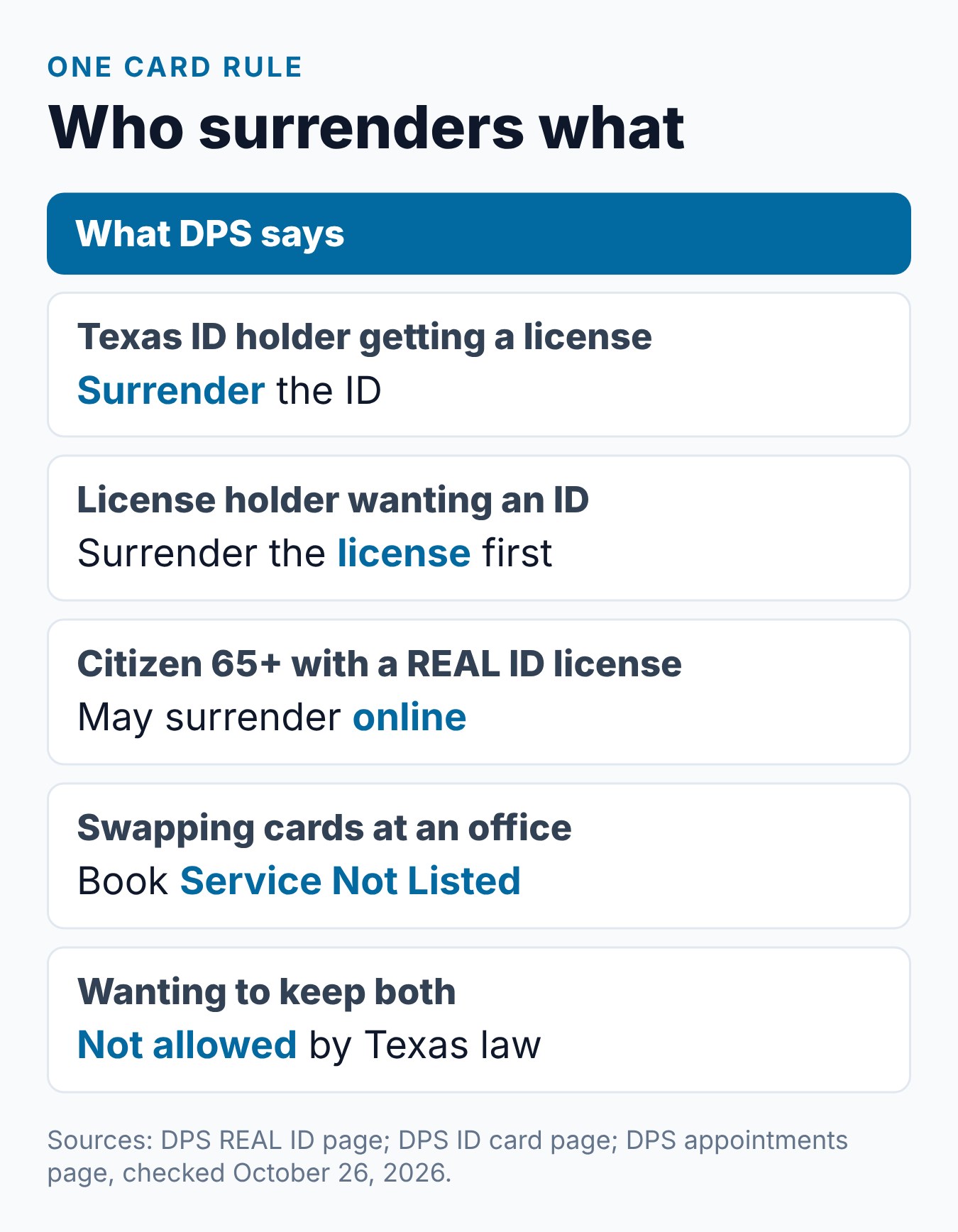
This is the rule that shapes the whole choice. The DPS REAL ID page says, “Real ID and Texas Law only permits a person to hold a driver license or identification card, but not both.” It points to Transportation Code § 521.182, in Chapter 521.
DPS repeats the rule in three places:
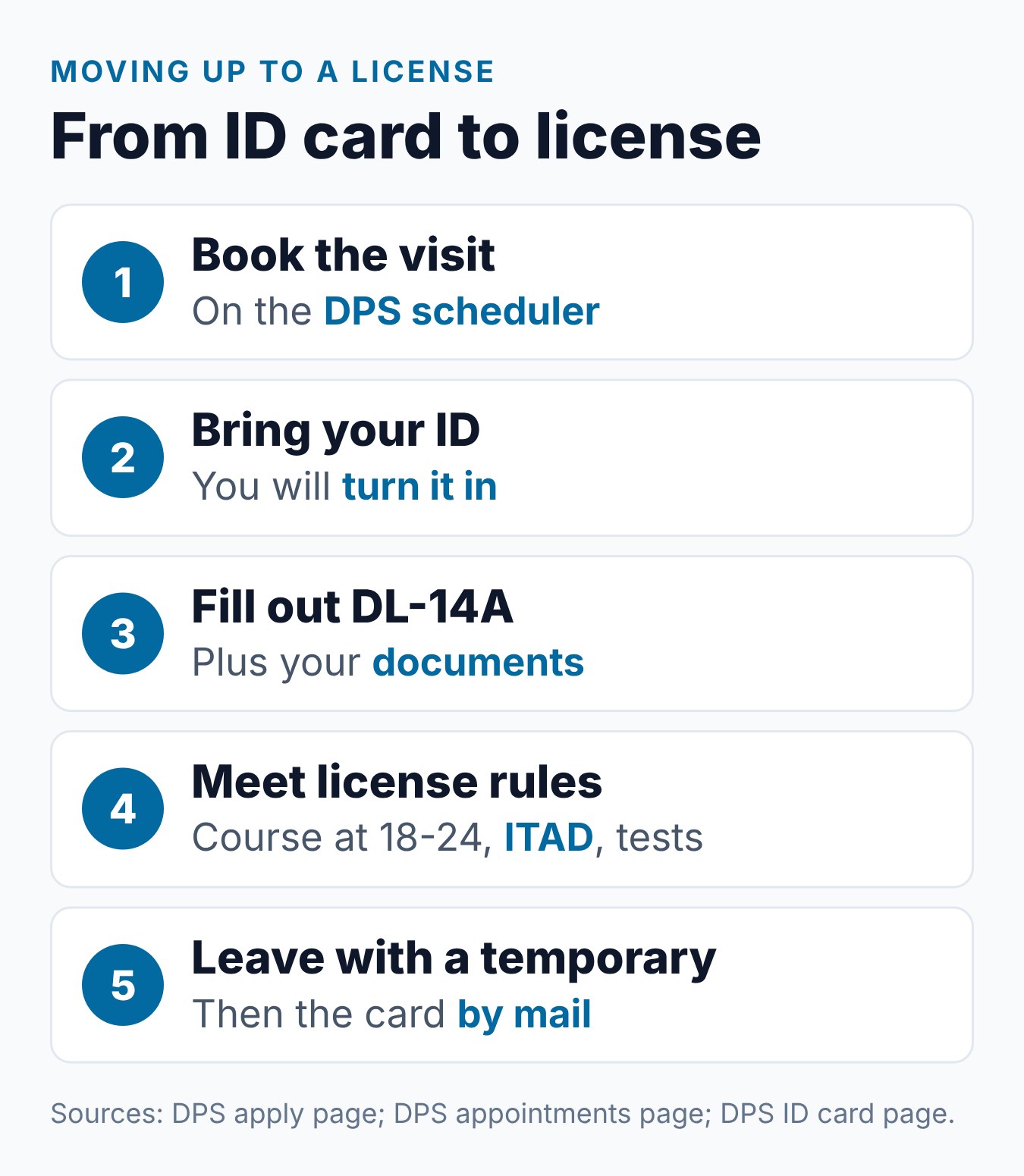
- The apply page: “If you already have a Texas ID, you will need to surrender it.”
- The ID card page: a license holder is “no longer eligible to apply for an identification card unless you surrender your driver license.”
- The appointments page: you cannot hold both at once, so bring the card you are giving up.
So you pick one card at a time. Moving from one to the other means turning in the first.
Applying for an ID Card
The ID card path is shorter. The DPS ID card page lists these steps:
- Book an appointment.
- Fill out Form DL-14A, which DPS calls the identification card application.
- Bring proof of citizenship or lawful presence, Texas residency and identity.
- Sign for the card, give thumbprints and have your photo taken.
- Pay the fee.
The ID card page mentions no written or driving test. DPS checks your Social Security number electronically. If it cannot be verified, the card cannot be issued.
You get a temporary ID at the office. Check its printed details before you leave.
Applying for a License
A license adds tests and, for some ages, courses. First-time applicants pass a vision test, a knowledge test and a driving test.
Ages 18 to 24 also take a six-hour adult course. Applicants 18 and older who take the driving test need an ITAD or ITTD certificate dated within 90 days. Our step-by-step license guide covers the order.
The driving test comes last. The Texas Driver Handbook says it is given only after all other exams are passed and proof of insurance is shown. You bring a car with valid registration and insurance.
The Documents Are the Same
Both cards draw on the same document rules. You prove:
- Citizenship or lawful presence, with one document from the DPS list.
- Texas residency, with two printed documents showing your name and address.
- Identity, with one primary, two secondary, or one secondary plus two supporting documents.
- Your Social Security number.
A license adds proof of insurance for each vehicle you own, or a statement that you own none. Our document guide lists what counts.
Comparing the Cost Over Time
The prices cover different lengths of time. Simple math puts them side by side:
- License, ages 18 to 84: $33 for eight years, about $4.13 a year.
- ID card, 59 and younger: $16 for six years, about $2.67 a year.
- ID card, 60 and older: $6 for six years, $1 a year.
A first license can bring other costs. The adult course at 18 to 24 is priced by each provider. A third-party driving test fee is set by the school.
ITAD is free. Our cost guide covers each one.
The REAL ID Star
Both cards can carry the star. DPS says, “All original, renewal or replacement driver license and identification cards issued, will now have a star to indicate they are Real ID compliant.”
DPS also began issuing a new card design on August 18, 2025. Our after-the-test guide covers what arrives in the mail.
Switching Between the Cards
Your needs can change. Here is how DPS handles a switch:
- ID to license. Apply for the license and surrender the ID. You still meet every license requirement, including the tests.
- License to ID. Surrender the license to become eligible for an ID card.
- Booking a switch. The DPS appointments page says to choose “Service Not Listed” and bring the card you are giving up.
DPS also lists an online option for one group. U.S. citizens age 65 or older with a REAL ID-compliant Texas license can surrender it online through a Texas by Texas account.
Cards From Another State
The one-card idea reaches past Texas cards too. The DPS REAL ID page says you must surrender any unexpired license or ID card from another state when you get a Texas one.
New residents may drive on an out-of-state license for up to 90 days after moving, says the DPS Moving to Texas page. Our new residents guide covers that switch.
Limited-Term Versions
Both cards come in a limited-term form for some non-citizens. The DPS fee page lists a limited-term license at $33 and a limited-term ID at $16.
Each one expires when lawful presence ends. For “duration of status,” it expires in one year. Our guide for immigrants explains the lawful presence check.
Replacing and Fixing a Card
A lost, stolen or damaged card costs $11 to replace, for either type. The expiration date does not change.
Check your temporary card before you leave the office. DPS says to tell the specialist if any printed detail is wrong.
Fee Breaks on Each Card
The fee page lists a free license for veterans with a 60 percent disability rating who meet the exemption rules. The ID card page also says some disabled veterans may qualify for a fee exemption.
Teens follow other rules. A license for a driver under 18 costs $16 and expires on the 18th birthday. The ID card page lists no minimum age for a standard ID.
Which Card Fits Your Plans
The choice depends on what you need the card to do. If you plan to drive, you need a license.
If you only need photo ID, the ID card does that job. It also skips the course, ITAD and the tests.
Some people hold an ID while they work toward a license. If you do, plan to surrender the ID at your license appointment. You cannot keep both.
After You Apply
Both cards follow the same delivery steps. You leave with a temporary card, and the permanent one comes by mail.
DPS says a new license “will typically arrive by mail within 2-3 weeks.” You can track either card on the DPS Where’s My Driver License or ID Card page.
What We Found on the Official Pages
On the DPS pages we checked on October 26, 2026, the ID card page listed no minimum age for a standard ID. It named Form DL-14A as the application and listed no test. It said the permanent card is mailed in about 2-3 weeks.
The REAL ID page linked the one-card rule to Transportation Code § 521.182. The appointments page told people swapping cards to pick “Service Not Listed.”
Common Mistakes to Avoid
Each item comes from a DPS page:
- Planning to keep both cards. Texas law permits one or the other.
- Leaving the ID at home on license day. DPS asks you to surrender it.
- Thinking an ID lets you drive. It is for identification only.
- Skipping the Social Security check. DPS cannot issue an ID if the number cannot be verified.
- Using the wrong booking option for a swap. DPS says to choose “Service Not Listed.”
How Requirements Can Vary
Texas driver license rules come from state law, Texas DPS rules and TDLR rules, and they apply statewide. What you need still depends on your age, whether you hold a license from another state, and which tests you have already passed.
Laws, fees and office procedures can change. Check the Texas DPS and TDLR websites for current rules before you book an appointment or enroll in a course.
Frequently Asked Questions
Can I have a Texas driver license and an ID card at the same time?
No. DPS says Texas law permits a driver license or an ID card, “but not both.” You surrender one to get the other.
Is a Texas ID card cheaper than a license?
Yes. An ID card is $16 at 59 and younger and $6 at 60 and older. A new license is $33 at ages 18 to 84.
Do I take a test for a Texas ID card?
The DPS ID card page lists no written or driving test. You prove your documents, give thumbprints, have a photo taken and pay the fee.
How long is a Texas ID card good for?
DPS says up to six years for Texas residents. A license for ages 18 to 84 lasts eight years.
What happens to my ID when I get my license?
You surrender it when you apply. DPS lists this on its apply page.
Do both cards have the REAL ID star?
DPS says all original, renewal and replacement licenses and ID cards now carry the star.
Do new residents keep their out-of-state license?
No. DPS says you must surrender an unexpired license or ID from another state when you get a Texas card. You may drive on the out-of-state license for up to 90 days after moving.
Can I use my ID card to drive while I wait for my license?
No. An ID card does not let you drive. After you pass your tests, DPS gives you a temporary license to drive on while the card is mailed.
Conclusion
A Texas license lets you drive and proves identity, while an ID card only proves identity, and you can hold just one. Both use the same documents, but a license adds tests and, at 18 to 24, a driver education course.
If you are moving from an ID to a license, bring the ID to surrender. For the course, see Driving Logic’s online Texas adult driver education course.
Related Articles
- How to Get a Texas Driver’s License at 18: The Complete Step-by-Step Guide
- How Much Does It Cost to Get Your First Texas Driver’s License?
- Texas Driver’s License Requirements: Everything You Need Before Your DPS Appointment
- What Documents Do You Need for Your First Texas Driver’s License?
Sources
- Texas DPS — REAL ID
- Texas DPS — Driver License Fees
- Texas DPS — Apply for a Texas Driver License
- Texas DPS — Driver License Services Appointments
- Texas DPS — U.S. Citizenship or Lawful Presence Requirement
- Texas DPS — Texas Residency Requirement
- Texas DPS — Identification Requirements
- Texas DPS — Where Is My Driver License or ID Card?
- Texas DPS — Texas Driver Handbook (DL-7, PDF)
- Texas DPS — Moving to Texas
- Texas Transportation Code Chapter 521 — Driver’s Licenses (PDF)
Billy Forte is the owner of Driving Logic, a state-approved driver improvement course provider serving Texas and other U.S. states.
This article is general information, not legal advice. Texas driver license and driver education rules are set by Texas law, Texas DPS and TDLR, and they can change. Check the official DPS and TDLR websites for current requirements before you apply.