
Updated October 2026 · Reviewed by Billy Forte
The Texas first time drivers license documents that DPS asks for prove four things: your U.S. citizenship or lawful presence, your identity, your Texas residency and your Social Security number. You also bring proof of insurance or a statement that you own no vehicle, plus your course certificates if your age requires them. Each group has its own list, so this page walks through them one at a time.
Key Facts
- Lawful presence: one document from the right category, such as a U.S. passport or a certified birth certificate. See citizenship or lawful presence.
- Identity: three ways to prove it, and no photocopies. See proof of identity.
- Residency: two printed documents with your name and Texas address. See Texas residency.
- Insurance: proof for each vehicle you own, or a statement that you own none. See insurance.
- Course papers: the ADE-1317 for ages 18 to 24 and a printed ITAD certificate. See course certificates.
What the Texas First Time Drivers License Documents Must Prove
The DPS Apply for a Texas Driver License page lists what to gather before your visit. Each item answers a different question about you.
| What DPS checks | What you bring |
|---|---|
| Citizenship or lawful presence | One document from the right category |
| Identity | One primary, two secondary, or one secondary plus two supporting |
| Texas residency | Two printed documents, one showing 30 days in Texas |
| Social Security | Your Social Security number |
| Vehicles | Proof of insurance for each vehicle, or a no-vehicle statement |
| Driver education | ADE-1317 (ages 18 to 24) and a printed ITAD certificate |
The same page notes one more item for new residents. If you surrender an out-of-state license, you also show Texas registration for each vehicle you own.
Proof of Citizenship or Lawful Presence
DPS asks for “one document from the appropriate category.” Its citizenship and lawful presence page groups applicants by status.
U.S. citizens can bring one of these:
- A valid U.S. passport book or passport card.
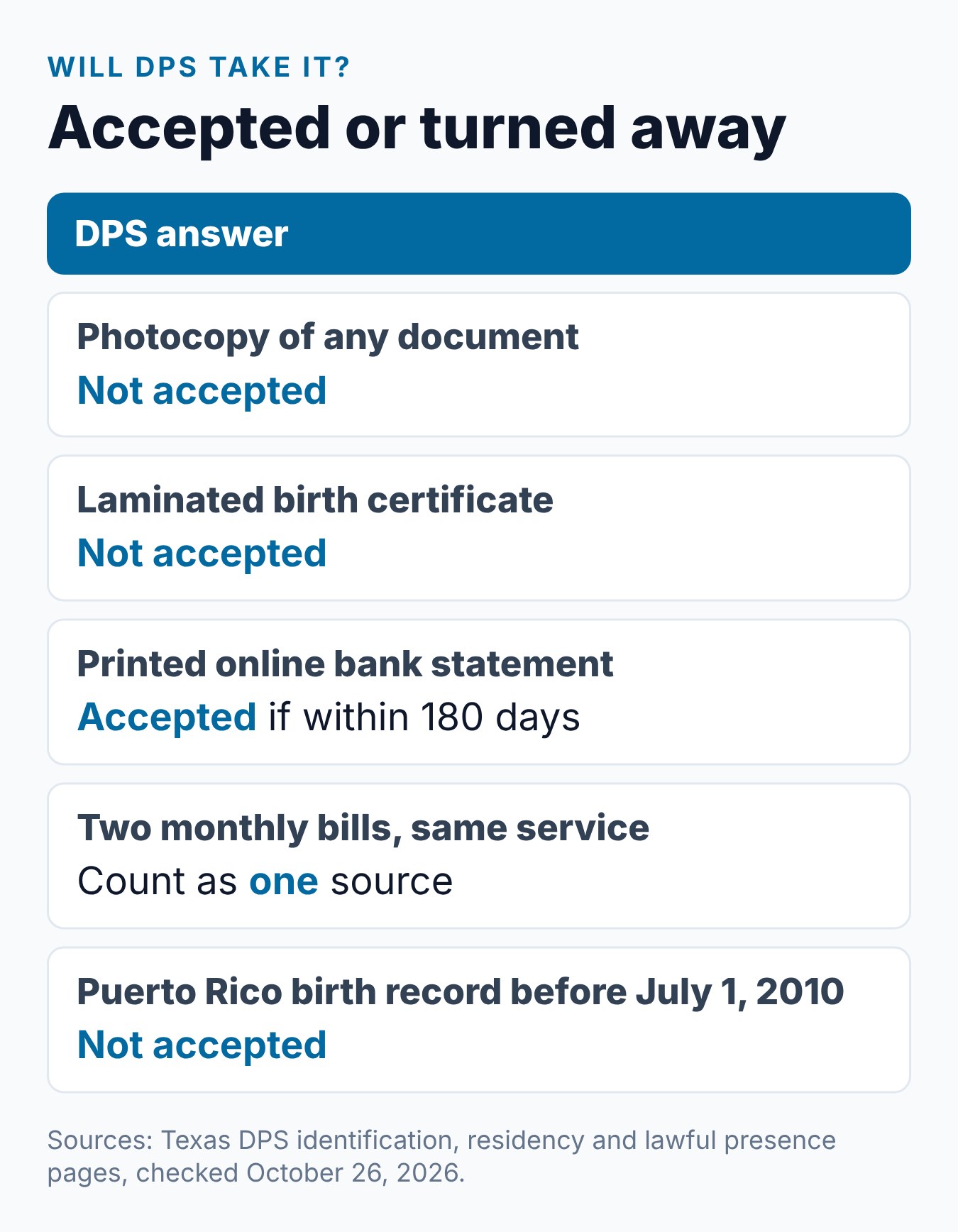
- A certified birth certificate from a state vital statistics office or a similar agency. Laminated copies and photocopies are not accepted.
- A Consular Report of Birth Abroad or Certificate of Report of Birth.
- A certificate of citizenship or naturalization with a photo.
- A U.S. citizen ID card, Form I-179 or I-197.
DPS also notes that Puerto Rican birth certificates issued before July 1, 2010, are not accepted.
Permanent residents, refugees, asylees and U.S. nationals use a separate list. It includes the Permanent Resident Card (I-551) and the Employment Authorization Document (I-766). DPS checks these with the Department of Homeland Security, and our guide for immigrants and non-citizens covers that list and the check in depth.
Proof of Identity: Three Ways
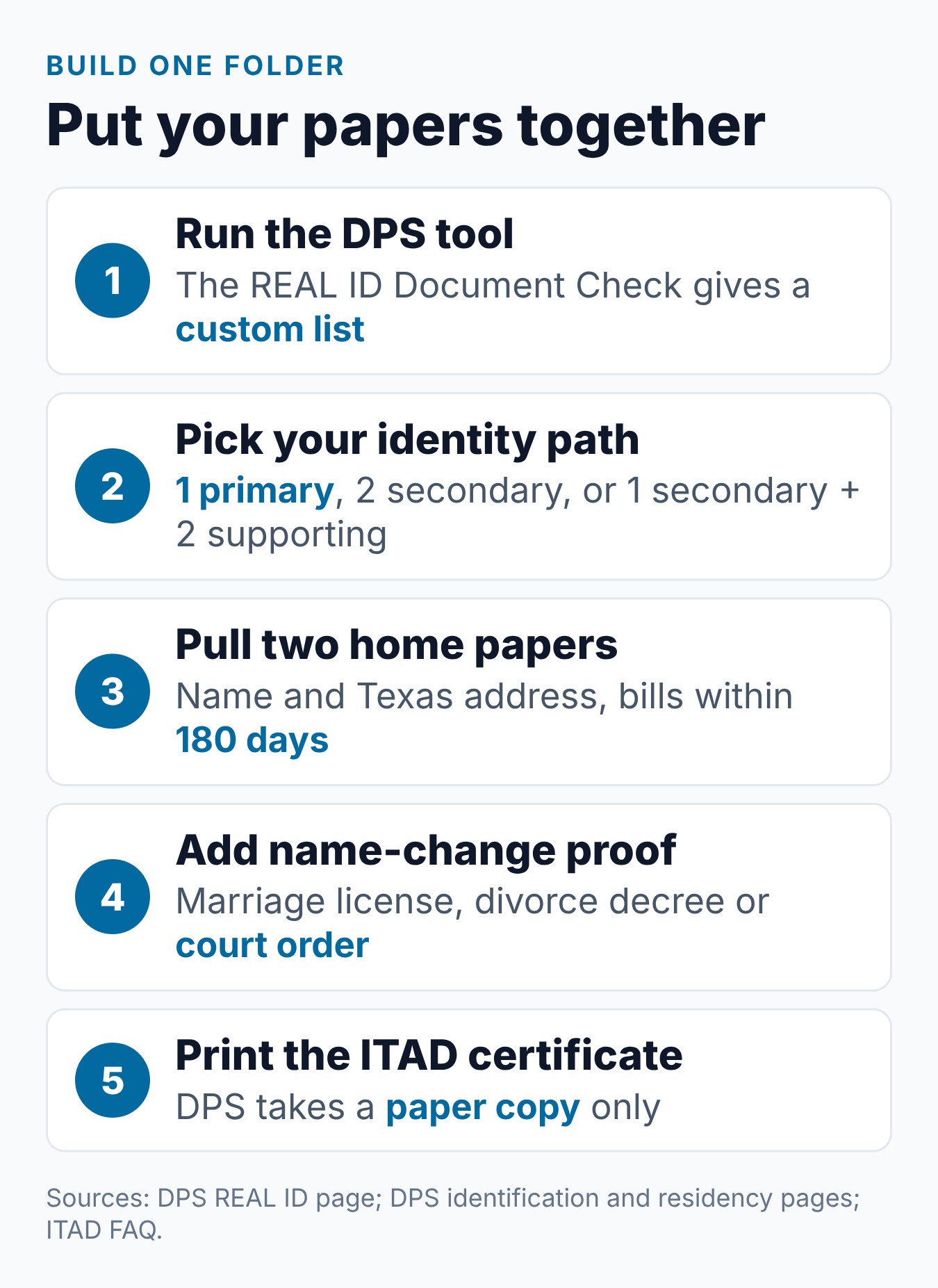
The DPS identification requirements page says “There are three ways” to prove who you are. Pick the one that fits the papers you have.
- One primary document.
- Two secondary documents.
- One secondary document plus two supporting documents.
All documents must be originals or certified copies. The page says “No photocopies can be accepted.” Certified documents should not be laminated.
Primary Documents
One of these is enough on its own:
- A Texas license or ID card expired no more than two years.
- A U.S. passport book or card.
- A U.S. certificate of citizenship or naturalization.
- Certain DHS photo documents, such as a permanent resident card or work permit.
- A foreign passport with an attached visa and Form I-94, with some exceptions.
- An unexpired U.S. military ID for active, reserve or retired members.
Secondary Documents
You need two of these, or one plus two supporting documents:
- A certified birth certificate from a state vital statistics office.
- A certified court order showing an official name change.
- For citizens born abroad, a Consular Report of Birth Abroad.
Supporting Documents
DPS lists a long set of supporting papers. A few examples are a Social Security card, a W-2 or 1099, school records, a Texas voter card and a Medicare or Medicaid card. An insurance policy held for two years in a row also counts.
Some items must come from a U.S. state, territory or Canadian province. The DPS page marks those with asterisks, so check the list before you rely on one.
When Your Name Does Not Match
Your name and date of birth must match across your documents. If your name changed, you must bring legal proof of the change.
DPS names these examples:
- A marriage license.
- A divorce decree.
- A court order for a name change.
- A revised birth certificate.
- A marriage verification letter from the Department of State Health Services.
If some other detail does not match, DPS says to speak with a License and Permit Specialist. Bring the name-change paper even if you think the clerk will not ask.
Two Proofs of Texas Residency
The DPS residency page asks for “two printed documents” from its list. Both must show your name and your Texas home address. At least one must show you have lived in Texas for 30 days or more.
Printed copies of electronic statements are fine. Bills and statements must be dated within 180 days of your application.
Accepted papers include:
- A deed, mortgage statement or residential lease.
- A Texas voter registration card.
- A utility bill, such as electric, water, internet or cell phone.
- A bank or credit card statement.
- A current auto, renters or homeowners insurance policy or card.
- A pay stub, or a W-2 or 1099 for the last tax year.
- A Texas school report card or transcript for the current year.
Two papers can come from the same company only when it provides more than one home service. Two monthly bills for the same service do not count as two documents.
If you cannot find two, DPS says you may be able to fill out a Texas Residency Affidavit (Form DL-5). People surrendering a valid out-of-state license still show residency, but the 30-day rule is waived for them.
Your Social Security Number
The apply page lists your Social Security number as its own item. A Social Security card also shows up on the supporting identity list. Bring the card if you have it, since it can do double duty there.
Insurance or a No-Vehicle Statement
DPS asks for “Proof of Insurance for each vehicle you own or a statement affirming you do not own a vehicle.” If you own no car, you sign that statement instead.
The road test has its own rule. The vehicle you drive must have valid registration and insurance. You do not need to be named on the policy, but you cannot be listed as an excluded driver.
Course Certificates
Your age decides which course papers you bring.
- Ages 18 to 24: the ADE-1317 from a six-hour adult driver education course. DPS waives this for adults 18 and older who surrender a valid, unexpired out-of-state license.
- Ages 25 and older: no driver education certificate is required.
- Anyone taking the driving test: an Impact Texas Drivers certificate dated within 90 days of the test.
The ITAD FAQ is firm about paper. It says “You must print the certificate and submit a paper copy.” An emailed copy on your phone will not work for the test.
For the ADE-1317, keep the copy your provider sends you. Our ADE-1317 certificate guide explains the name and the two-year rule.
Extra Papers for New Residents
People moving to Texas with a license from another state follow a slightly different list. The DPS Moving to Texas page covers their path.
- Your out-of-state license. You must surrender it when you get a Texas card.
- Vehicle registration. You show current Texas registration for each vehicle you own. Vehicles are registered with the Texas Department of Motor Vehicles, not DPS.
- Residency. You still bring two papers, but the 30-day rule is waived when you surrender a valid license.
Adults 18 and older with a valid license, or one not expired more than two years, skip the course and ITAD. Our new residents guide explains that exemption.
Form DL-14A
The application itself is Form DL-14A. DPS says you can fill out the DL-14A form online or at the office. Filling it out at home lets you check spellings against your documents first.
The REAL ID Document Check Tool
DPS offers a free REAL ID Document Check tool. It asks questions about your age, citizenship, name and vehicles. At the end, it gives “a customized checklist of which documents to bring.”
The tool also asks whether you want a license or an ID card. DPS notes the checklist may not cover every case. Use it as a starting point, then compare it with the official pages above.
What We Found on the Official Pages
On the DPS pages we checked on October 26, 2026, three details stood out. The identity page did not use the phrase “verifiable identity document.” It simply listed the three ways.
The residency page allowed printed copies of electronic statements. The apply page said vehicle registration proof applies only to new residents who surrender an out-of-state license.
Common Mistakes to Avoid
Each item comes from a DPS page or the ITAD FAQ:
- Bringing a photocopy. DPS accepts originals or certified copies only.
- Using a laminated birth certificate. DPS does not accept laminated copies.
- Old bills. Bills and statements must be dated within 180 days.
- Two bills for one service. Separate monthly statements for the same service do not count as two.
- Skipping the name-change paper. Names must match, or you show legal proof of the change.
- An emailed ITAD copy. DPS wants a printed paper certificate.
For the non-document items, such as tests and the fee, see our first-time requirements checklist.
How Requirements Can Vary
Texas driver license rules come from state law, Texas DPS rules and TDLR rules, and they apply statewide. What you need still depends on your age, whether you hold a license from another state, and which tests you have already passed.
Laws, fees and office procedures can change. Check the Texas DPS and TDLR websites for current rules before you book an appointment or enroll in a course.
Frequently Asked Questions
Can I use a photocopy of my birth certificate?
No. DPS accepts originals or certified copies only. It also does not accept laminated birth certificates.
How many residency documents do I need?
You need two printed documents with your name and Texas address. At least one must show 30 days of Texas residency.
Is a Social Security card required?
DPS asks for your Social Security number. The card is also on the supporting identity list, so it can help there too.
What if my married name differs from my birth certificate?
Bring legal proof of the change, such as a marriage license or court order. Names must match across your documents.
Do I need my ADE-1317 if I am 25?
No. DPS has no driver education requirement for first-time applicants 25 and older. You still need a printed ITAD certificate dated within 90 days of the driving test.
Can bank statements count for residency?
Yes. Bank and credit card statements are on the list if dated within 180 days. Printed copies of online statements are accepted.
What if I cannot find two residency papers?
DPS says you may be able to fill out a Texas Residency Affidavit, Form DL-5. Ask a License and Permit Specialist whether it fits your case.
How do I get a personal document list?
Use the DPS REAL ID Document Check tool. It asks a few questions and builds a checklist for your visit.
Conclusion
Your first Texas license file needs proof of lawful presence, identity, residency and your Social Security number, plus insurance and course papers. Check each document against the DPS lists before your appointment.
Run the DPS checklist tool for a list that fits you. If you are 18 to 24, you can start with Driving Logic’s online Texas adult driver education course.
Related Articles
- How to Get a Texas Driver’s License at 18: The Complete Step-by-Step Guide
- Texas Driver’s License Requirements: Everything You Need Before Your DPS Appointment
- Texas Driver’s License for Immigrants and Non-Citizens: What You Need to Know
- How to Book a Texas DPS Appointment for Your First Driver’s License
Sources
- Texas DPS — Apply for a Texas Driver License
- Texas DPS — Identification Requirements
- Texas DPS — Texas Residency Requirement
- Texas DPS — U.S. Citizenship or Lawful Presence Requirement
- Texas DPS — REAL ID
- Texas DPS — Moving to Texas
- Texas DPS — Impact Texas Drivers (ITD) Program
- Texas DPS — Impact Texas Adult Drivers FAQ
- 16 Tex. Admin. Code § 84.43 — Driver education certificates
Billy Forte is the owner of Driving Logic, a state-approved driver improvement course provider serving Texas and other U.S. states.
This article is general information, not legal advice. Texas driver license and driver education rules are set by Texas law, Texas DPS and TDLR, and they can change. Check the official DPS and TDLR websites for current requirements before you apply.