
Updated October 2026 · Reviewed by Billy Forte
Texas approved adult drivers ed is a six-hour adult course taught by a provider that TDLR, the Texas Department of Licensing and Regulation, has licensed. Texas law says DPS may not issue a first license to an applicant under 25 without a certificate from an approved course. You can check any provider’s license for free in TDLR’s online search before you pay.
Key Facts
- Who approves: TDLR licenses adult course providers and their instructors. See what approval means.
- Why it matters: the law accepts only a TDLR-approved adult course or a full driver education course. See the law.
- How to check: use TDLR’s Driver Education Provider search. See how to verify.
- What to match: the provider’s name and TDLR license number must appear on its site and payment pages. See signs to check.
- No shortcuts: teen hours and out-of-state hours do not count toward the Texas adult course. See unapproved courses.
What Texas Approved Adult Drivers Ed Means
TDLR regulates driver education in Texas. It licenses the companies that teach it and the instructors who work for them. “Approved” means TDLR has licensed both the provider and the course it offers.
The rules differ a little by format:
- Online. Under 16 TAC 84.503, the company “must hold an online driver education provider license.” Students must get instruction from a licensed driver education instructor.
- In person. Under 16 TAC 84.502, TDLR may approve an in-person adult course endorsement. A licensed instructor must be physically present.
Both formats must follow the state’s adult program of instruction. Both must give students access to the Texas Driver Handbook.
The Law Behind the Approval
The rule comes from Transportation Code § 521.1601, in Chapter 521. It says DPS may not issue a license to a person under 25 unless they submit a driver education certificate. That certificate must show one of two things:
- Completion of a full driver education course, or
- For applicants 18 or older, completion of an adult course approved by TDLR.
The section was added by Senate Bill 1317 in 2009. TDLR’s power to license providers comes from Education Code Chapter 1001.
There is one exemption in the statute. Subsection (b) says the section “does not apply to a person who holds a valid driver’s license issued by another state.” Our new residents guide explains that rule.
Why Approval Matters for Your Certificate
Only an approved course can issue the adult certificate, called the ADE-1317. Providers order certificate numbers from TDLR. Under 16 TAC 84.43, they may issue certificates only to students who finish the course.
TDLR treats these certificates as government records. The rule says misuse can lead to the loss of a license or approval, or to criminal charges. Each certificate must also show TDLR’s complaint contact information on the front.
A certificate from a course TDLR has not approved does not meet § 521.1601. That is why a quick check before you enroll matters. Our ADE-1317 guide covers the certificate itself.
Types of Approved Adult Courses
TDLR’s search sorts providers by course type. Two types are only for adults, and two serve both minors and adults:
| Course type in TDLR search | What the rules say |
|---|---|
| Online Exclusively for Adults | Enrollment at 18 or older (16 TAC 84.503) |
| In-Person Exclusively for Adults | For ages 18 to under 25 (16 TAC 84.502) |
| Online for Minors and Adults | A full driver education course, which § 521.1601 also accepts |
| In-Person for Minors and Adults | Also a full driver education course under § 521.1601 |
| Parent Taught for Teens | A teen program, not the adult six-hour course |
Under 16 TAC 84.503, students 18 to under 25 must finish either the full adult-only course or the full minor and adult course. The rule adds, “Partial completion of either course does not satisfy the requirements.”
How to Verify a Provider
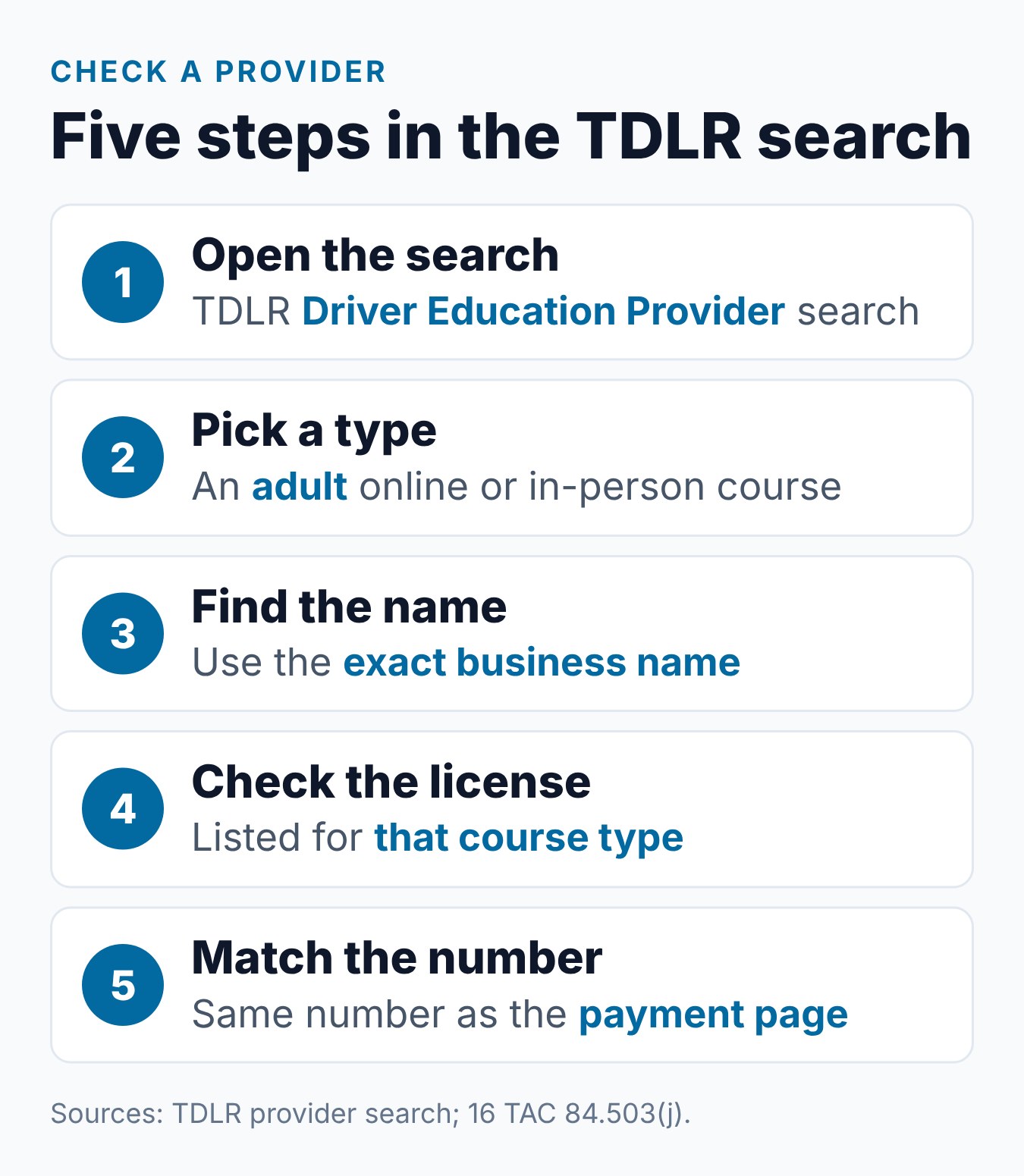
TDLR’s free Driver Education Provider search is the tool to use. Follow these steps:
- Open the search. It is linked from TDLR’s Do I Need Driver Ed? page.
- Pick the course type. Choose the online or in-person adult option you want.
- Find the provider. Look for the exact business name shown on the course website.
- Check the license. Confirm the provider shows up for that course type.
- Match the number. Compare the TDLR license number in the search with the one on the provider’s payment page.
Keep a note of the provider’s name and license number. It helps if you have a question later.
What the Search Is and Is Not
TDLR says its directory is “provided for the sole purpose of verifying the license status of driver education providers.” It adds, “Inclusion in this list is not an endorsement, recommendation, or advertising.”
There is one gap to know. TDLR notes that “Public schools may provide Driver Education courses that are not included in this tool.” If you plan to use a public school course, ask the school directly.
Signs to Check on a Provider Site
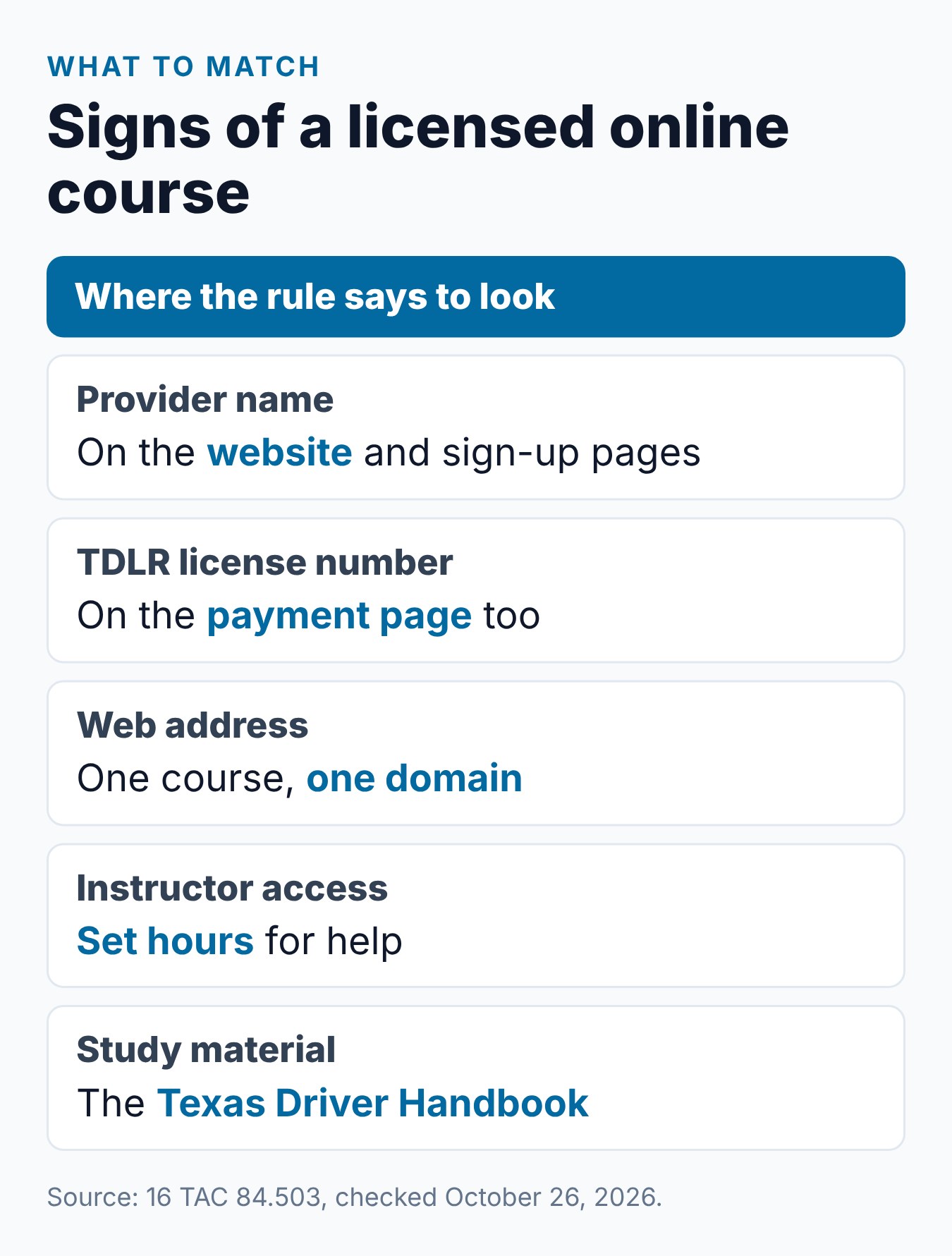
The online rule gives you a few things to look for. Under 16 TAC 84.503:
- Name and number. The provider’s name and TDLR license number must appear on its website and on its sign-up and payment pages.
- One domain. Each online course must run from a single website domain.
- Redirects. If another site sends you to the course, the landing page must show the provider’s name and license number before and during sign-up and payment.
- Instructor hours. The provider must set hours when you can reach a trained instructor and get technical help.
- Study material. Each student must have access to the current Texas Driver Handbook or similar material.
If a site does not show a TDLR license number, check the search before you pay.
Signs to Check at an In-Person School
Classroom courses follow 16 TAC 84.502. That rule gives you a few more things to notice:
- A teacher in the room. The licensed instructor must be physically present.
- Class size. A provider may not enroll more than 36 students, not counting makeup students.
- A seat for each student. Every student needs a seat and a desk or table.
- Limited media. Videos, guest speakers and other media may not total more than 150 minutes.
- ID at sign-up. The provider must make a reasonable effort to verify each student’s identity.
Questions to Ask Before You Enroll
A license check tells you the provider is approved. These questions, based on the rules, tell you how its course works:
- Does the course give the highway signs and traffic laws test? Texas law lets a licensed provider give those parts of the DPS knowledge test.
- When are instructors available? Online providers must set hours for instructor and technical help.
- When will the certificate be issued? Online providers must issue it by the 15th working day after you finish.
- Does the provider set a deadline to finish? The online rule sets none, so ask about the provider’s own policy.
What Happens With an Unapproved Course
The law names only two courses that count. These are a full driver education course or a TDLR-approved adult course. A class that is neither does not meet § 521.1601 for an applicant under 25.
Some other hours do not count either:
- Teen hours. The TDLR student FAQ says teen classroom hours “cannot be applied to the 6-hour adult driver education classroom hour requirements.”
- Out-of-state hours. The same FAQ says, “Out of state hours do not transfer to Texas.” It tells students to enroll in a Texas program.
- Part of a course. Partial completion does not meet the rule, as noted above.
If you are unsure about a course, ask TDLR before you start. TDLR’s Do I Need Driver Ed? page lists (800) 803-9202 (in state) and (512) 463-6599.
Where DPS Fits
TDLR approves the course, and Texas DPS issues the license. The DPS Choosing a Driver Education Course page says the six-hour adult course is “required for all persons between the ages of 18 and 24 before testing for a driver license.” It sends readers to TDLR’s site for course options.
DPS also lists the certificate by name. Its third-party skills testing page says applicants 18 to 24 need “ADE-1317/ADEE-1317” or a DE-964 to test with an approved school.
Approval Is Not One License for Every Course
TDLR licenses more than one kind of course. Driving safety providers, who teach defensive driving, have their own license and their own search. A driving safety course is used for ticket dismissal or insurance discounts, not for a first license.
So check that the provider is licensed for adult driver education, not only for driving safety. Our guide on adult driver education vs defensive driving compares the two.
What We Found on the Official Pages
On the TDLR pages we checked on October 26, 2026, the provider search listed five course types. Two were adult-only: “Online Exclusively for Adults” and “In-Person Exclusively for Adults.”
TDLR’s Do I Need Driver Ed? page said “all persons under 25 must take a driver education course.” It also linked to a Texas Workforce Commission program that helps some people pay for driver education.
Common Mistakes to Avoid
Each item comes from Texas law or a TDLR rule or page:
- Paying before you check. The TDLR license search is free.
- Picking a driving safety course. It is a different TDLR license and a different course.
- Counting teen classroom hours. TDLR says they do not apply to the adult course.
- Using out-of-state hours. TDLR says they do not transfer to Texas.
- Ignoring a missing license number. The rule requires it on the site and payment pages.
- Stopping partway. Partial completion does not meet the rule.
How Requirements Can Vary
Texas driver license rules come from state law, Texas DPS rules and TDLR rules, and they apply statewide. What you need still depends on your age, whether you hold a license from another state, and which tests you have already passed.
Laws, fees and office procedures can change. Check the Texas DPS and TDLR websites for current rules before you book an appointment or enroll in a course.
Frequently Asked Questions
What does TDLR-approved mean?
It means TDLR has licensed the provider and its adult course. Online providers need an online driver education provider license, and a licensed instructor must teach.
How do I check if a provider is approved?
Use TDLR’s free Driver Education Provider search. Pick the adult course type, find the provider, and match its license number to the one on its payment page.
What if my course was not TDLR-approved?
Texas law accepts only a full driver education course or a TDLR-approved adult course for applicants under 25. A certificate from any other class does not meet that law. Ask TDLR before you take another course.
Are public school courses in the search?
Not always. TDLR says public schools may offer driver education courses that are not in its search tool. Ask the school directly.
Can I use my teen driver ed hours?
No. TDLR says teen classroom hours cannot be applied to the six-hour adult course. You must finish the full adult course or the full teen program.
Can an in-person class have any number of students?
No. Under 16 TAC 84.502, a provider may not enroll more than 36 students in an adult class, not counting makeup students. Each student needs a seat and a desk or table.
Does TDLR recommend providers?
No. TDLR says inclusion in its search “is not an endorsement, recommendation, or advertising.” The search only confirms license status.
Is a TDLR-approved defensive driving course the same thing?
No. Defensive driving, or the driving safety course, has its own TDLR license and is used for tickets or insurance discounts. It does not meet the adult driver education rule.
Conclusion
Texas approved adult drivers ed comes from a provider TDLR has licensed for the adult course. Texas law requires it for applicants under 25, and TDLR’s free search lets you confirm a license before you pay.
Match the provider’s license number to the one in the search. When you are ready, see Driving Logic’s online Texas adult driver education course.
Related Articles
- Texas Adult Driver Education (ADE) Course: The Complete Guide
- How the Texas 6-Hour Adult Driver Education Course Works Online
- Texas ADE-1317 Certificate: What It Is and How to Use It at DPS
- Texas Adult Driver Education vs. Defensive Driving Course: What’s the Difference?
Sources
- Texas Transportation Code Chapter 521 — Driver’s Licenses (PDF)
- Texas Education Code Chapter 1001 — Driver and Traffic Safety Education (PDF)
- TDLR — Driver Education Provider Search
- TDLR — Do I Need Driver Education?
- TDLR — Driver Education Student FAQ
- 16 Tex. Admin. Code § 84.502 — Adult driver education (in person)
- 16 Tex. Admin. Code § 84.503 — Adult driver education (online)
- 16 Tex. Admin. Code § 84.43 — Driver education certificates
- Texas DPS — Choosing a Driver Education Course
- Texas DPS — Third Party Skills Testing Program
Billy Forte is the owner of Driving Logic, a state-approved driver improvement course provider serving Texas and other U.S. states.
This article is general information, not legal advice. Texas driver license and driver education rules are set by Texas law, Texas DPS and TDLR, and they can change. Check the official DPS and TDLR websites for current requirements before you apply.