
Updated October 2026 · Reviewed by Billy Forte
Texas adult driver education vs defensive driving comes down to purpose: adult driver education (ADE) is the six-hour course adults 18 to 24 take for a first Texas license, while defensive driving is used for ticket dismissal or insurance discounts. TDLR regulates both, and both run 360 minutes, but they have different instruction minimums, tests and certificates. One cannot replace the other.
Key Facts
- ADE purpose: required for first-time license applicants 18 through 24. See what ADE is for.
- Defensive driving purpose: ticket dismissal or insurance discounts, and anyone can take it. See what defensive driving is for.
- Length: both 360 minutes; ADE needs 330 minutes of instruction, defensive driving needs 300. See the comparison.
- Certificates: ADE-1317 for ADE; a Uniform Certificate of Course Completion for defensive driving. See certificates.
- No swapping: neither course meets the other’s legal purpose. See why.
Texas Adult Driver Education vs Defensive Driving, Side by Side
Here is how the two courses compare under TDLR rules:
| Feature | Adult driver education (ADE) | Defensive driving (driving safety course) |
|---|---|---|
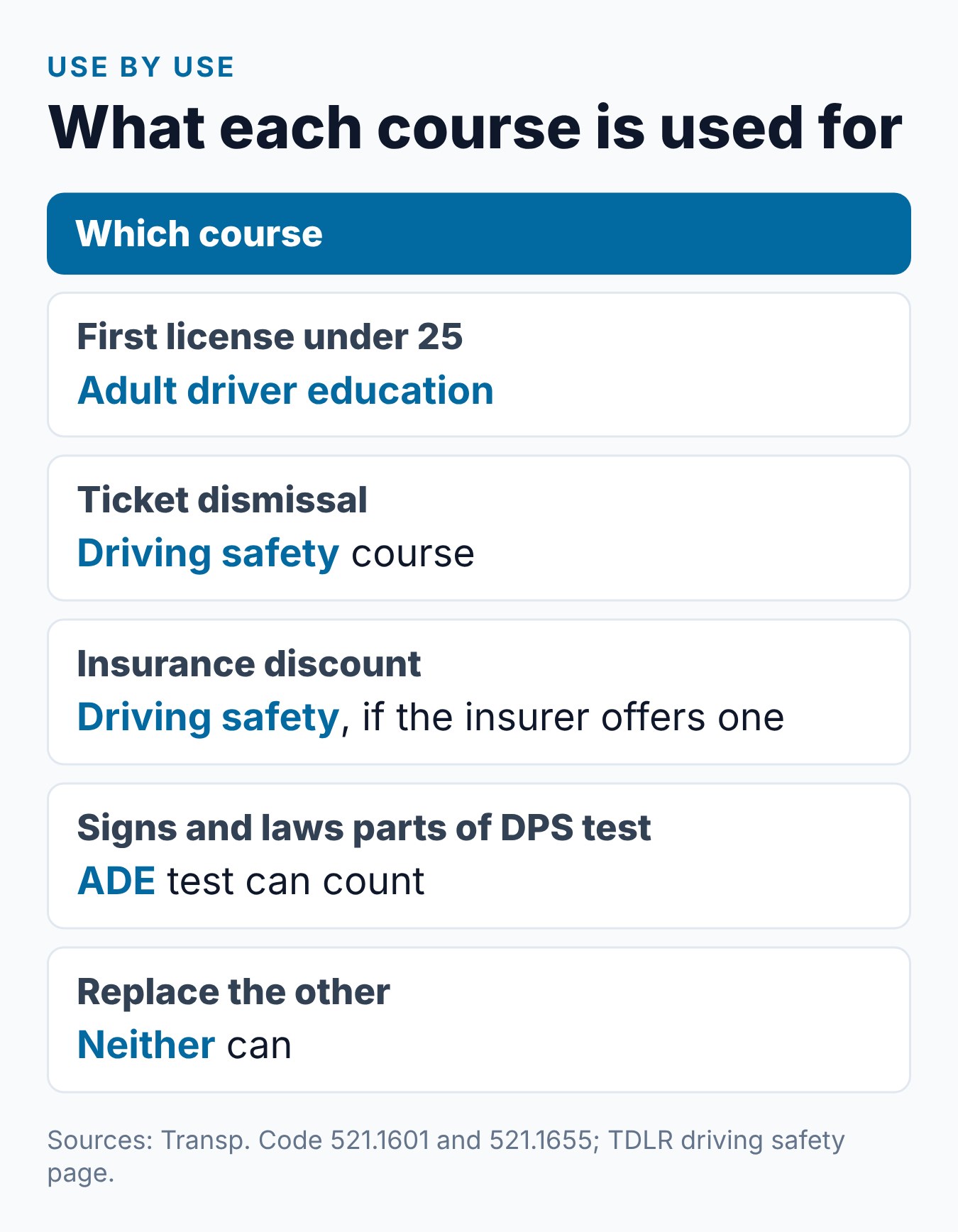
| Main use | First Texas license, ages 18 to 24 | Ticket dismissal or insurance discount |
| Who can take it | 18 and older online; 18 to under 25 in person | TDLR says “anyone can take” it |
| Total length | 360 minutes | At least 360 minutes |
| Instruction | At least 330 minutes | At least 300 minutes |
| Course exam | Signs and laws: 70% each in person; 30+ questions online | At least 20 questions; 70% to pass |
| Certificate | ADE-1317 | Uniform Certificate of Course Completion |
| TDLR rule | 16 TAC 84.502 and 84.503 | 16 TAC 84.504 |
The two share a regulator and a length. Almost everything else differs.
What Adult Driver Education Is For
ADE exists to meet a license rule. DPS says applicants “18 through 24 years of age and applying for your first Texas driver license” must take a six-hour adult course. Its apply page adds that there are “No driver education requirements for ages 25 and older.”
The rule comes from Transportation Code § 521.1601, in Chapter 521. DPS may not license a person under 25 without a driver education certificate. For applicants 18 or older, a TDLR-approved adult course meets that rule.
The course tests highway signs and traffic laws. Texas law lets a licensed provider give those parts of the DPS knowledge test, and a passed test counts for DPS. Our ADE course guide covers the whole course.
What Defensive Driving Is For
Defensive driving is TDLR’s driving safety course, or DSC. TDLR’s Taking a Driving Safety Course page says, “Any licensed driving safety provider may offer a 6-hour course that can be used for ticket dismissal or insurance discounts.”
It is open to any driver. TDLR says, “While anyone can take a driving safety course, there are specific legal requirements to using a driving safety class for ticket dismissal.” It tells drivers to first get notice from the court that they are eligible.
Two more points from the same page:
- You still owe any fines and fees tied to the ticket.
- “It is your responsibility to send the certificate of completion to the court and or insurance company.”
If you want an insurance discount, ask your insurer whether it accepts a driving safety course before you sign up.
The Names Can Be Confusing
The words sound alike, but they name different courses:
- Driver education is for getting a license. The adult version is the six-hour ADE course.
- Defensive driving is the common name for the driving safety course. It is for drivers with a ticket or who want a discount.
TDLR draws this line itself. Its Do I Need Driver Ed? page lists defensive driving as a separate course, a driving safety course, not driver education. It also links to separate provider searches for each one.
Why One Cannot Replace the Other
Each course meets a different law. Section 521.1601 accepts only a full driver education course or a TDLR-approved adult course for a first license under 25. A defensive driving certificate is neither.
The test rule is narrow too. Section 521.1655 lets a licensed driver education provider give the sign and law parts of the DPS exam. It does not name driving safety providers.
The reverse also holds. A court that allows a driving safety course expects a driving safety certificate. An ADE-1317 is a driver education form.
Two Different Certificates
Each course issues its own form:
- ADE-1317. The adult driver education certificate. TDLR’s current template is named ADEE-1317. Online providers must issue it by the 15th working day after you finish.
- Uniform Certificate of Course Completion. The driving safety certificate, set by 16 TAC 84.63. TDLR says you should get it within 14 days of finishing.
Under 16 TAC 84.43, an ADE-1317 also cannot replace a DE-964, the teen course certificate. Our ADE-1317 guide covers that form.
How the Time Is Split
Both courses fill 360 minutes, but the split differs.
ADE. The adult rules, 16 TAC 84.502 and 16 TAC 84.503, require at least 330 minutes of instruction. The other 30 minutes go to breaks or required topics.
Defensive driving. The driving safety rule, 16 TAC 84.504, says “A minimum of 300 minutes of instruction is required.” The total must be at least 360 minutes.
So ADE has 30 more minutes of required teaching time.
What Each Course Teaches
ADE follows TDLR’s adult program of instruction. Each student must have access to the Texas Driver Handbook, and the course must test highway signs and traffic laws.
The driving safety rule lists its own topics. Some of them are:
- Respect for traffic laws and traffic safety duties.
- What police do at a traffic stop.
- Child passenger safety seats.
- Safe driving near oversize or overweight vehicles.
- The dangers of street racing.
Both courses share one new topic. TDLR announced that driver education and driving safety courses completed on or after Sept. 1, 2026, must cover work zones.
Testing Differences
The exams match each course’s purpose:
- ADE in person. At least 70 percent on the highway signs exam and on the traffic laws exam.
- ADE online. A final of at least 30 questions on signs and laws. Missing more than 30 percent means a retest, and three failed finals fails the course.
- Defensive driving. A final of at least 20 questions from the required units. You need 70 percent or more.
Only the ADE test can count toward the DPS knowledge test, and only with limits. Our ADE test guide explains them.
Two More Courses That Get Mixed In
Two other names come up in the same searches. Neither is ADE or defensive driving.
ITAD. Impact Texas Adult Drivers is a free, 1-hour DPS video about distracted driving. Applicants 18 and older who take the driving test need it, or the teen version, ITTD.
DPS says to take it after the adult course. Our ITAD vs ADE guide compares the two.
The teen course. Drivers under 18 take a full driver education course and get a DE-964.
Section 521.1601 also accepts a full driver education course for applicants under 25. TDLR says teen classroom hours cannot be applied to the six-hour adult course, so finish whichever course you start.
Which One Do You Need?
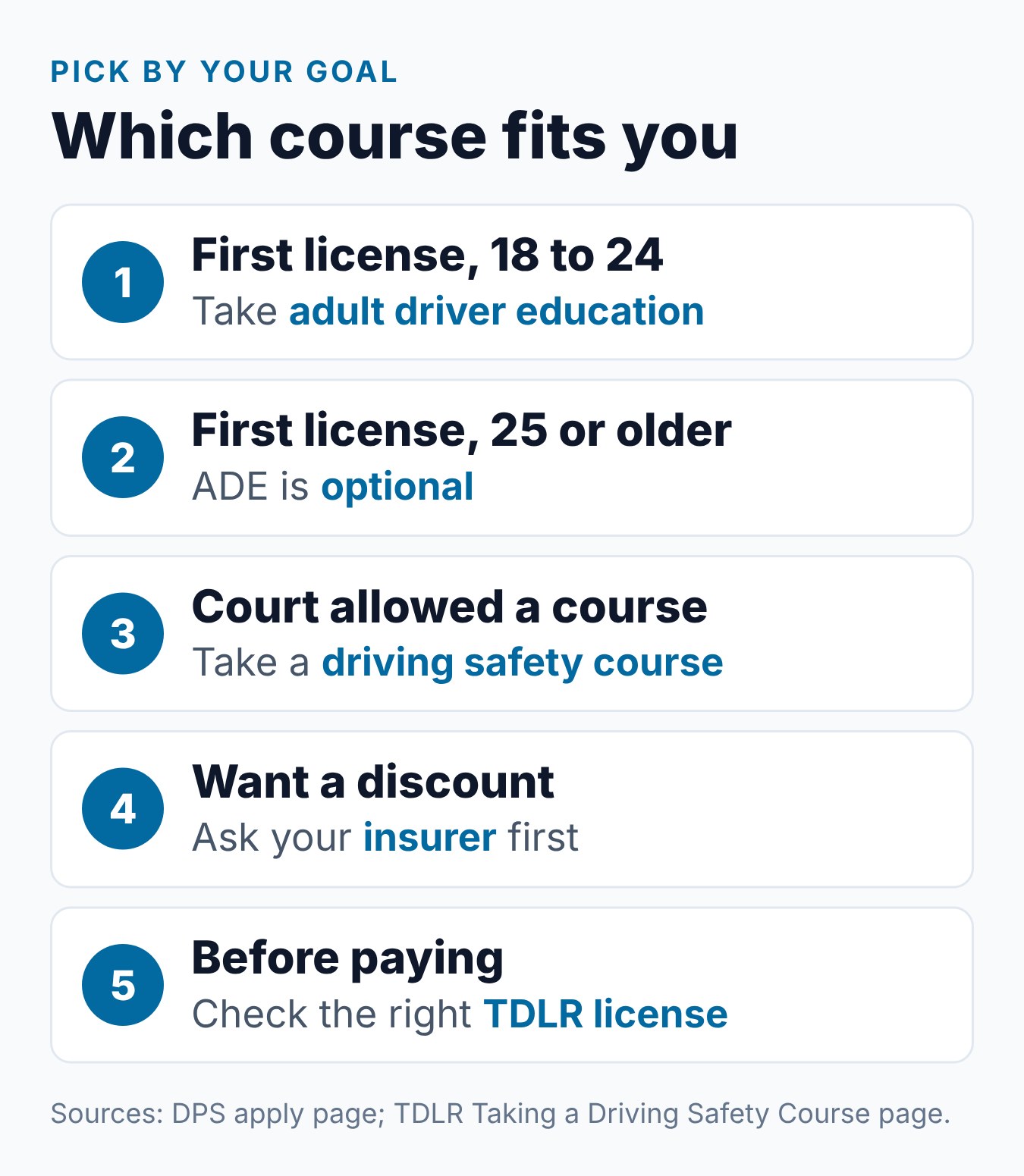
Match the course to your goal:
- First Texas license at 18 to 24. Take ADE from a TDLR-licensed provider.
- First license at 25 or older. ADE is optional; DPS calls it “highly recommended.”
- A court allowed a course for your ticket. Take a driving safety course and follow the court’s rules.
- Insurance discount. Ask your insurer, then take a driving safety course if it applies.
Nothing in the rules stops one person from taking both at different times. They simply meet different needs.
A Simple Way to Decide
Ask yourself one question: do you have a Texas license yet? If not, and you are 18 to 24, you need driver education. If you already drive and a court or insurer is involved, you are looking at a driving safety course.
If you are 25 or older with no license, neither course is required. You still take ITAD and the DPS tests. Our over-25 guide explains that path.
Checking the Provider’s License
TDLR licenses driver education providers and driving safety providers separately. So a provider licensed for one may not be licensed for the other.
Check the right list before you pay. Our TDLR approval guide shows how for adult driver education.
What We Found on the Official Pages
On the TDLR pages we checked on October 26, 2026, the driving safety page described a 6-hour course for “ticket dismissal or insurance discounts.” It said anyone can take one.
TDLR’s Do I Need Driver Ed? page listed defensive driving apart from driver education. The two rules we compared, 16 TAC 84.503 and 84.504, both showed a latest change effective Dec. 1, 2024.
Common Mistakes to Avoid
Each item comes from a TDLR rule or page, or Texas law:
- Taking defensive driving for a first license. It does not meet § 521.1601.
- Taking ADE for a ticket. A court expects a driving safety certificate.
- Assuming “6 hours” means the same course. The instruction minimums differ.
- Checking the wrong TDLR list. Each course type has its own provider search.
- Expecting a defensive driving test to count at DPS. The law names driver education providers.
- Skipping the court step for a ticket. TDLR says to confirm eligibility with the court first.
How Requirements Can Vary
Texas driver license rules come from state law, Texas DPS rules and TDLR rules, and they apply statewide. What you need still depends on your age, whether you hold a license from another state, and which tests you have already passed.
Laws, fees and office procedures can change. Check the Texas DPS and TDLR websites for current rules before you book an appointment or enroll in a course.
Frequently Asked Questions
What is the difference between ADE and defensive driving in Texas?
ADE is the six-hour course adults 18 to 24 need for a first Texas license. Defensive driving is the driving safety course used for ticket dismissal or insurance discounts. TDLR regulates both.
Can I use defensive driving to get my first license?
No. Texas law requires a full driver education course or a TDLR-approved adult course for applicants under 25. A driving safety course is neither.
Can I use ADE to dismiss a ticket?
No. A court that allows a course for a ticket expects a driving safety course certificate. The ADE-1317 is a driver education certificate.
Are both courses six hours?
Both run at least 360 minutes. ADE needs at least 330 minutes of instruction, while defensive driving needs at least 300.
Does a defensive driving test count for the DPS written test?
No source we found says so. The Texas law that lets a course test count names licensed driver education providers, not driving safety providers.
Can anyone take defensive driving?
Yes. TDLR says anyone can take a driving safety course. Using it to dismiss a ticket has legal rules, so check with the court first.
Is ITAD the same as defensive driving?
No. ITAD is a free, 1-hour DPS video about distracted driving. It is needed before the driving test and does not dismiss tickets.
Do I get a certificate from both?
Yes, but they differ. ADE gives the ADE-1317, and defensive driving gives a Uniform Certificate of Course Completion.
Conclusion
Texas adult driver education vs defensive driving is a question of purpose. ADE meets the first-license rule for ages 18 to 24, and defensive driving is for tickets or insurance discounts.
Pick the course that matches your goal and check the provider’s TDLR license. For a first license, see Driving Logic’s online Texas adult driver education course.
Related Articles
- Texas Adult Driver Education (ADE) Course: The Complete Guide
- Texas ADE-1317 Certificate: What It Is and How to Use It at DPS
- TDLR-Approved Adult Driver Education in Texas: What It Means and How to Verify
- ITAD vs ADE: What Is the Difference Between Impact Texas Adult Drivers and Adult Driver Education?
Sources
- TDLR — Taking a Driving Safety Course
- 16 Tex. Admin. Code § 84.504 — Driving safety course length
- 16 Tex. Admin. Code § 84.63 — Uniform certificate of course completion
- 16 Tex. Admin. Code § 84.502 — Adult driver education (in person)
- 16 Tex. Admin. Code § 84.503 — Adult driver education (online)
- 16 Tex. Admin. Code § 84.43 — Driver education certificates
- Texas Transportation Code Chapter 521 — Driver’s Licenses (PDF)
- Texas DPS — Apply for a Texas Driver License
- TDLR — Do I Need Driver Education?
- TDLR — Courses must include work zone information starting Sept. 1, 2026
- Texas DPS — Impact Texas Drivers (ITD) Program
- TDLR — Driver Education Student FAQ
Billy Forte is the owner of Driving Logic, a state-approved driver improvement course provider serving Texas and other U.S. states.
This article is general information, not legal advice. Texas driver license and driver education rules are set by Texas law, Texas DPS and TDLR, and they can change. Check the official DPS and TDLR websites for current requirements before you apply.