
Updated October 2026 · Reviewed by Billy Forte
The Impact Texas Adult Drivers video covers the dangers of distracted driving, using facts, Texas statistics and real-life stories of people killed or seriously injured in distracted-driving crashes. DPS sums up its theme in one line: “good people making poor choices,” centered on cell phones and multitasking behind the wheel. DPS does not publish what each of the three parts covers, so this guide sticks to what DPS says about the video as a whole.
Key Facts
- Topic: the dangers of distracted driving, explained “with factual evidence.” See what DPS says.
- Method: Texas statistics, videos and real-life stories. See what DPS says.
- Theme: good people making poor choices, centered on phone use and multitasking. See the theme.
- Model: an initiative from the California non-profit Impact Teen Drivers. See where the idea came from.
- Texas law: Transportation Code § 545.4251 bans texting while driving unless the vehicle is stopped. See the law.
What DPS Says the Impact Texas Adult Drivers Video Covers
The ITAD course overview is the main DPS source on content. It describes ITAD as “a 3-part video that explains, with factual evidence, the dangers of distracted driving.”
The same page lists what the program uses. It names “state-specific statistics, videos and materials.” DPS says these aim to engage adult drivers in defining what distracted driving is and who it affects. They also aim “to help emphasize the problem of reckless and distracted driving.”
Personal stories are a core part. The overview says the video includes “real life stories of people that have lost their life from distracted driving as well as those who were seriously injured.” The DPS ITD page says the same in shorter form: the program “features real-life stories.”
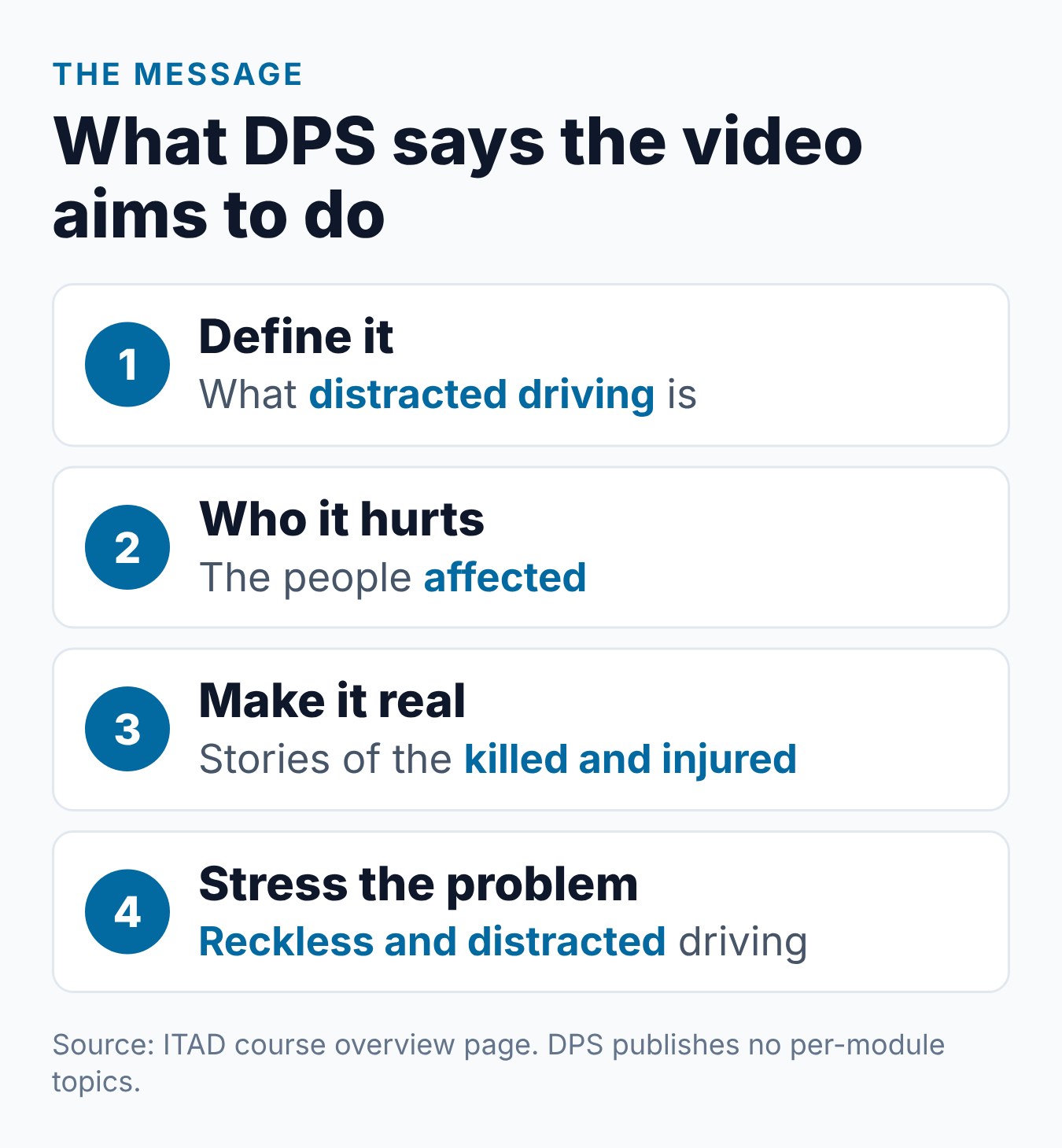
Put simply, DPS says the program aims to do these things:
- Define it. What distracted driving is.
- Show who it hurts. Who is affected by it.
- Make it real. Stories of people killed and people seriously injured.
- Stress the problem. Reckless and distracted driving as a danger.
The Theme: Good People, Poor Choices
DPS gives the video a clear point of view. The overview says, “It is not about bad people doing bad things, but about good people making poor choices.”
It then names the choices. They “center around cell phone use as well as attempting to multitask in the vehicle.”
In other words, DPS aims the message at ordinary drivers, not at bad actors. The real-life stories show what those choices can cost.
Where the Idea Came From
ITAD did not start from scratch. The overview says “This program is modeled after an initiative developed by the California non-profit Impact Teen Drivers.”
DPS developed ITAD as part of its Impact Texas Drivers (ITD) program. The teen side of that program, Impact Texas Teen Drivers, is a 2-hour video for ages 15 to 17. Our guide to the Impact Texas Drivers program explains how the two fit together.
The Impact Texas Drivers portal carries a short tagline: “Saving Lives Through Awareness and Education.”
What DPS Does Not Say About Each Part
The video has three modules. The ITAD FAQ says you can view them independently, and “Each module must be completed in its entirety in order to progress to the next module.”
DPS stops there. It does not publish a title, topic list or summary for any single module. It also publishes no quiz questions or answers.
So we do not describe what module 1, 2 or 3 teaches. Any page that claims to list lesson-by-lesson content is not quoting DPS. For how the modules work and when to watch them, see how the three ITAD modules work.
How the Video Relates to the Six-Hour Course
Applicants 18 to 24 meet distracted driving in two places. One is the six-hour adult driver education course. The other is the ITAD video.
DPS keeps them apart. The DPS ITD page says ITD programs “do not replace the distracted driving module” in the six-hour adult course. The ITAD FAQ says “ITAD is a separate requirement” and should be completed after the course.
So the video is an extra layer, not a stand-in. Our ITAD vs ADE comparison lays out the other differences.
Texas Numbers Behind the Topic
DPS says ITAD uses state-specific statistics, but it does not post them on the ITAD pages. TxDOT, the Texas Department of Transportation, does publish yearly figures. Its distracted driving campaign page says that in 2025, “distracted driving was responsible for 86,384 crashes on Texas roads.”
The same page counts the harm. It says more than 2,437 people were seriously injured, and 299 died. TxDOT runs a statewide awareness campaign on the topic called “Talk.
Text. Crash.”
Texas Distracted-Driving Laws in Context
ITAD focuses on phone use, and Texas law has rules on that too. These come from Transportation Code Chapter 545. This is general information, not legal advice.
The Texting Ban, § 545.4251
TxDOT says, “Since Sept. 1, 2017, it has been illegal to read, write, or send a text while driving in Texas.” The rule sits in § 545.4251.
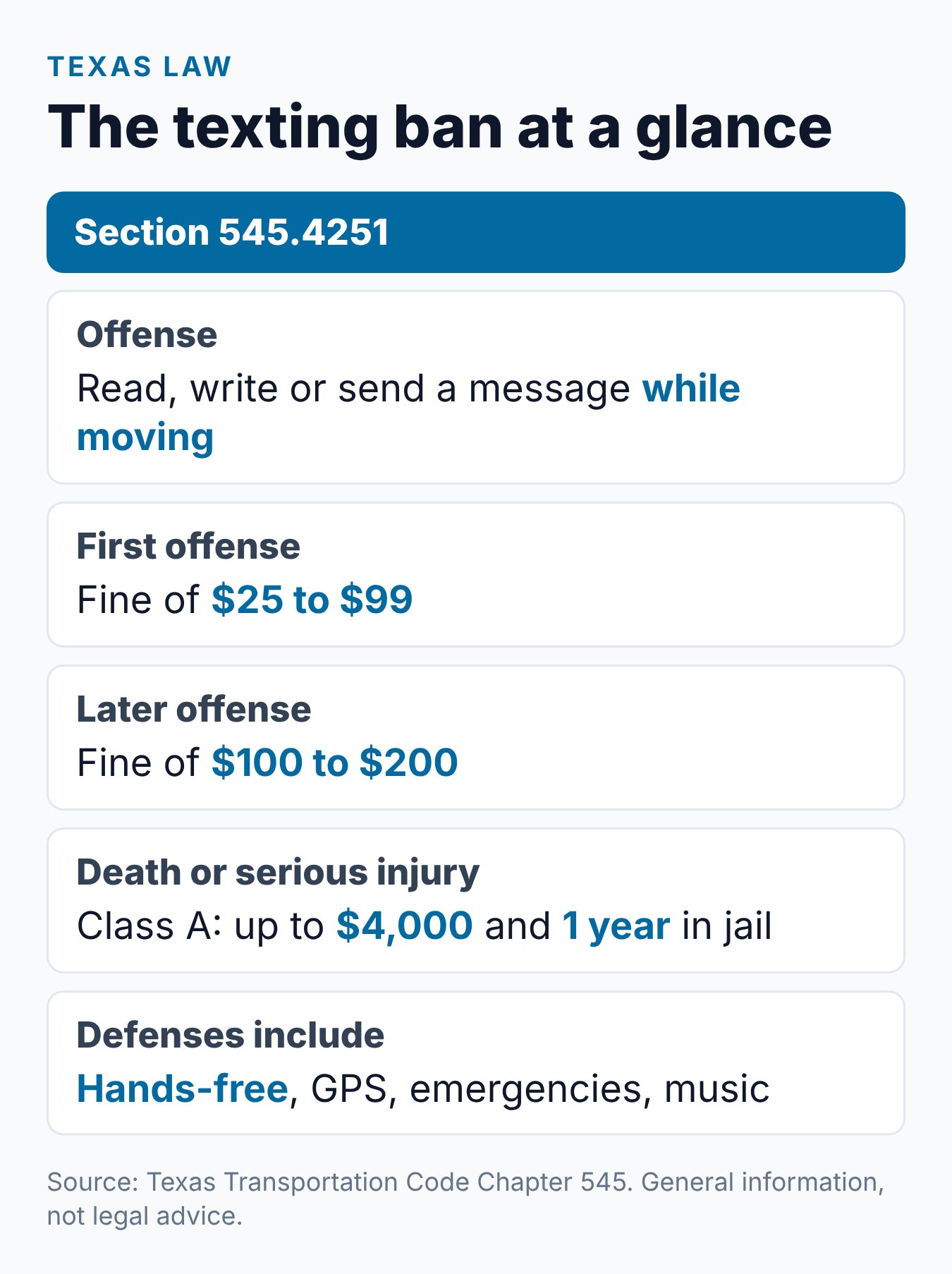
Section 545.4251(b) makes it an offense for a driver to use a portable wireless communication device “to read, write, or send an electronic message while operating a motor vehicle unless the vehicle is stopped.”
The law lists defenses. A driver may use a device in these ways, among others:
- With a hands-free device.
- To navigate with a GPS or navigation system.
- To report illegal activity or summon emergency help.
- To read a message the driver reasonably believed was about an emergency.
- To activate a function that plays music.
Penalties Under § 545.4251
The fines step up with repeat offenses. A first offense is a misdemeanor with a fine of at least $25 and not more than $99. A later offense carries a fine of at least $100 and not more than $200.
The penalty is much higher if someone is badly hurt. If the driver caused the death or serious bodily injury of another person, the offense is a Class A misdemeanor, punishable by a fine of up to $4,000, up to one year in jail, or both. The section also preempts local rules on this conduct.
School Crossing Zones, § 545.425
A separate section covers school crossing zones. Section 545.425 bars using a wireless communication device while driving in a school crossing zone. It allows use when the vehicle is stopped or the device is used with a hands-free device.
The section also gives defenses for an emergency call, such as to a police department or hospital. Another defense applies if the required sign was not posted at the entrance to the zone.
Getting the Most From the Hour
There is nothing to memorize, but a little setup helps you follow the stories. These points come from the ITAD pages:
- Use a computer. The portal says the video needs a desktop or laptop, not a phone, tablet or iPad.
- Pick Chrome or Firefox. Those are the two browsers the portal names.
- Give each module your full time. Each one must be finished before the next opens.
- Watch close to your test date. The certificate is valid for 90 days.
The Knowledge Test Connection
The same topic appears on the DPS knowledge test. Transportation Code § 521.161, in Chapter 521, says the license exam covers the effects of phone use and other distractions. It also covers traffic signs and Texas traffic laws.
ITAD is not a test, and DPS does not say it counts toward that exam. Still, the subject overlaps. See our guide to ITAD questions and what to expect for more on ITAD and testing.
Who Watches the Video
DPS rule 37 TAC 15.62 says applicants 18 or older must complete an ITD program before the skills exam. They may choose ITAD or the teen version. The DPS ITD page lists ITAD for drivers 18 to 24 in adult driver education and for drivers 25 or older.
The Texas Driver Handbook puts it simply. All applicants must complete the ITD course “appropriate for their age group” before the driving exam. Our ITAD guide explains who must take it and who is exempt.
One group skips the video entirely. The DPS Moving to Texas page exempts adults 18 and older with a valid out-of-state license, or one not expired over two years, from ITD.
What We Found on the Official Pages
On the ITAD and DPS pages we checked on October 26, 2026, the course overview was the only page that described the video’s content. It named the topic, the methods, the theme and the California model. It did not name any module or lesson.
The overview page also linked to a course overview video. The FAQ covered the modules only as a rule about order.
Neither page listed lesson titles, learning goals or questions. The DPS ITD page described the stories as “highlighting the devastating impact of distracted driving.”
Common Mistakes to Avoid
Each point comes from a DPS page or Texas law:
- Expecting a lesson-by-lesson outline. DPS publishes none for ITAD.
- Thinking the video is only about texting. DPS also names multitasking in the vehicle.
- Treating ITAD as the course’s distracted-driving lesson. DPS says it does not replace that module.
- Assuming the topic stays in the video. The DPS knowledge test also covers phone use and distractions.
- Expecting different texting rules in each city. Section 545.4251 preempts local rules on this conduct.
How Requirements Can Vary
Texas driver license rules come from state law, Texas DPS rules and TDLR rules, and they apply statewide. What you need still depends on your age, whether you hold a license from another state, and which tests you have already passed.
Laws, fees and office procedures can change. Check the Texas DPS and TDLR websites for current rules before you book an appointment or enroll in a course.
Frequently Asked Questions
What is the Impact Texas Adult Drivers video about?
Distracted driving. DPS describes it as a 3-part video that explains the dangers of distracted driving with factual evidence, Texas statistics and real-life stories.
What does module 1 cover?
DPS does not say. It publishes no topic list for any single module. It only says each module must be finished before the next.
Does the video include real stories?
Yes. DPS says it includes real-life stories of people who lost their lives to distracted driving and people who were seriously injured.
What is the main message of ITAD?
DPS says, “It is not about bad people doing bad things, but about good people making poor choices.” Those choices center on cell phone use and multitasking in the vehicle.
Who made the ITAD video?
DPS developed it as part of the Impact Texas Drivers program. DPS says it was modeled after an initiative from the California non-profit Impact Teen Drivers.
Is texting while driving illegal in Texas?
Transportation Code § 545.4251 makes it an offense to read, write or send an electronic message while driving unless the vehicle is stopped. The law lists defenses, such as using a hands-free device.
Where can I find Texas distracted-driving numbers?
TxDOT publishes them. Its distracted driving page says distracted driving caused 86,384 crashes on Texas roads in 2025, with 299 deaths.
Does the ITAD video replace the distracted-driving lesson in my adult course?
No. The DPS ITD page says ITD programs do not replace the distracted driving module in the six-hour adult driver education course.
Conclusion
The Impact Texas Adult Drivers video is about distracted driving, told through facts, Texas statistics and real-life stories. DPS frames it around good people making poor choices, with a focus on phones and multitasking.
DPS does not publish module-by-module topics, so treat any lesson outline you find elsewhere with care. If you still need the six-hour course first, see Driving Logic’s online Texas adult driver education course.
Related Articles
- What Is Impact Texas Adult Drivers (ITAD)? The Complete Guide
- ITAD Video: How the 3 Modules Work and When to Watch
- Impact Texas Adult Drivers Questions: What to Expect in the Course
- ITAD vs ADE: What Is the Difference Between Impact Texas Adult Drivers and Adult Driver Education?
Sources
- Texas DPS — Impact Texas Adult Drivers Course Overview
- Texas DPS — Impact Texas Adult Drivers FAQ
- Texas DPS — Impact Texas Drivers (ITD) Program
- Texas DPS — Impact Texas Drivers website
- Texas Transportation Code Chapter 545 — Operation and Movement of Vehicles (PDF)
- Texas Transportation Code Chapter 521 — Driver’s Licenses (PDF)
- Texas DPS — Texas Driver Handbook (DL-7, PDF)
- 37 Tex. Admin. Code § 15.62 — Impact Texas Drivers program
- Texas DPS — Moving to Texas
Billy Forte is the owner of Driving Logic, a state-approved driver improvement course provider serving Texas and other U.S. states.
This article is general information, not legal advice. Texas driver license and driver education rules are set by Texas law, Texas DPS and TDLR, and they can change. Check the official DPS and TDLR websites for current requirements before you apply.