
Updated October 2026 · Reviewed by Billy Forte
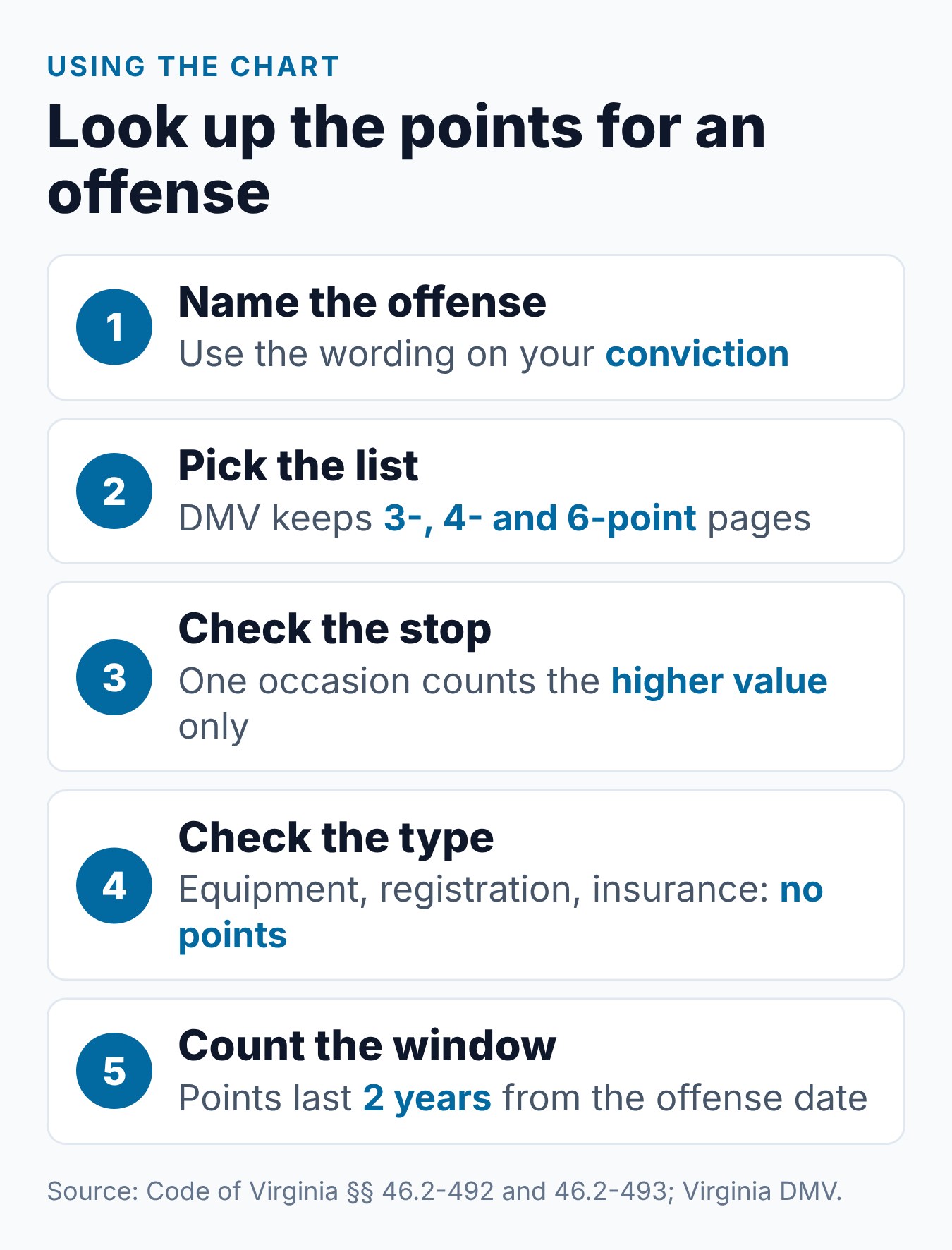
Virginia demerit points are added to your driving record at 3, 4 or 6 points for each point-carrying traffic conviction, and the offense sets the number. The Virginia DMV keeps three lists, one for each point value. This chart sorts the main entries from those lists so you can find your offense.
Key Facts
- Three values: every pointable conviction carries 3, 4 or 6 demerit points. See the full chart.
- Speeding tiers: 1 to 9 mph over is 3 points, 10 to 19 over is 4, and 20 or more over is 6. See speeding points.
- No points: equipment, registration and insurance convictions carry no demerit points. See offenses with no points.
- One stop: when one occasion leads to two or more convictions, only the higher value counts. See one stop, one charge.
- Two years: points count for 2 years from the offense date. See how long points count.
Where the Points Chart Comes From
The point values come from state law. Code of Virginia § 46.2-492 sets up the Uniform Demerit Point System. It gives each conviction up to six points, based on how serious the offense is.
The DMV turns that law into three public lists:
Each list carries the same warning: “The violations listed may change without notice.” So treat any chart, including this one, as a guide. Your own DMV driving record shows the points DMV actually assigned.
Virginia Demerit Points by Offense
The table below uses the DMV’s own wording where it can. The “Group” column is our label to help you scan. It is not a DMV term.
| Offense (DMV wording) | Points | Group |
|---|---|---|
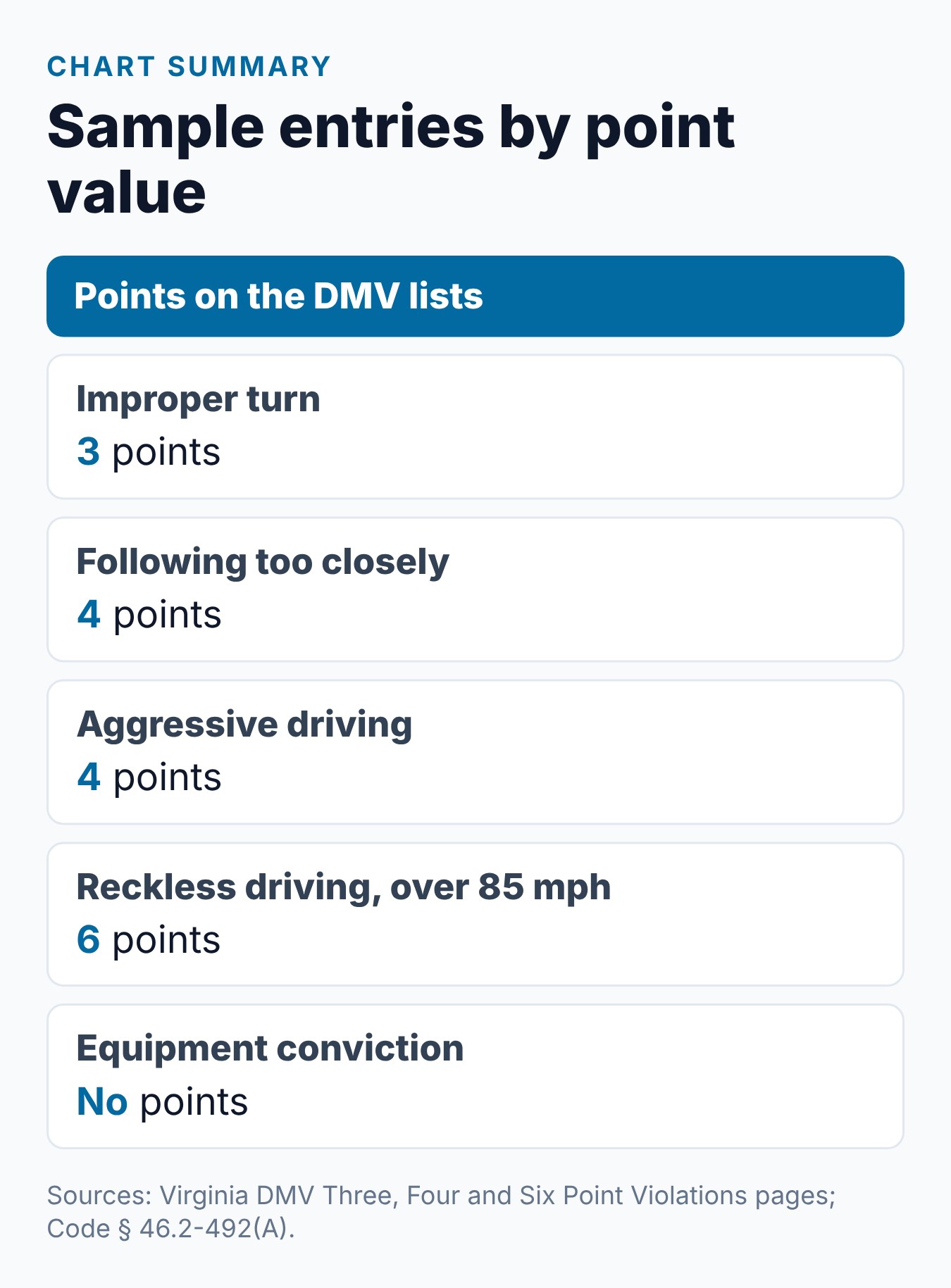
| Reckless driving, speeding in excess of 85 mph | 6 | Speed, reckless |
| Reckless driving, 20 mph or more above the posted limit | 6 | Speed, reckless |
| Speeding 20 mph or more above the limit (not reckless) | 6 | Speed |
| Reckless driving, racing | 6 | Reckless |
| Reckless driving, driving too fast for conditions | 6 | Reckless |
| Driving while intoxicated | 6 | Alcohol |
| Driving after illegally consuming alcohol, under age 21 | 6 | Alcohol |
| Driving while license is suspended or revoked | 6 | License |
| Failure to stop at a crash with injury or death | 6 | Crash |
| Speeding 10 to 19 mph above the limit | 4 | Speed |
| Failure to yield right-of-way | 4 | Right-of-way |
| Following too closely | 4 | Spacing |
| Improper signal | 4 | Signals |
| Failure to obey traffic signal | 4 | Signals |
| Passing when unsafe | 4 | Passing |
| Aggressive driving | 4 | Conduct |
| Improper backing, stopping or turning | 4 | Turns |
| Speeding 1 to 9 mph above the limit | 3 | Speed |
| Improper passing | 3 | Passing |
| Improper driving | 3 | Conduct |
| Improper turn | 3 | Turns |
| Failure to obey highway sign | 3 | Signs |
| Use of handheld communications device | 3 | Phone |
| Passenger restriction or curfew violation | 3 | Teen license |
The DMV lists hold more entries than this table. Check the full pages if your offense is not here.
Six-Point Offenses
Six points is the top value. The DMV’s six-point list includes several kinds of reckless driving. Among them are speeding in excess of 85 mph, speeding 20 mph or more over the limit, racing, and passing a school bus.
The same list holds other serious offenses. These include driving while intoxicated, driving while suspended or revoked, and manslaughter. Failure to stop at the scene of a crash is 6 points when it involves injury, death, or property damage of $1,000 or more.
Four-Point Offenses
The four-point list includes right-of-way and spacing rules. The list names failure to yield, following too closely, improper signal, and failure to obey a traffic signal. It also names passing when unsafe and aggressive driving.
The four-point list also includes two entries that are easy to miss. Failure to obey highway lane markings is 4 points. So is passing a stopped school bus when it is not charged as reckless.
Three-Point Offenses
Three points is the lowest value. The list includes speeding 1 to 9 mph over, improper passing, improper driving, and an improper turn. It also lists failure to obey a highway sign and use of a handheld communications device.
Two three-point entries apply to young drivers. They are a passenger restriction violation and a curfew violation. Our guide to DMV points for teen drivers explains those limits.
Speeding Points at a Glance
Speed is the most detailed part of the chart. Code § 46.2-492 sets three tiers:
- 1 to 9 mph over: 3 points.
- 10 to 19 mph over: 4 points.
- 20 mph or more over: 6 points.
Speed can also become reckless driving. Under Code § 46.2-862, driving 20 mph or more over the limit, or over 85 mph, is reckless driving. Reckless driving is 6 points and a Class 1 misdemeanor.
Our speeding points guide covers each speeding tier in more depth.
Offenses That Carry No Points
Not every conviction adds points. Code § 46.2-492(A) says DMV does not give points for equipment, registration or insurance convictions. The exception is when the law says otherwise for that offense.
Two more rules matter here:
- Stopping to rest. Code § 46.2-492(C) says no points go on for stopping on a shoulder to rest, if the court so finds.
- Records without points. The DMV’s Moving Violations and Point Assessments page says DMV also posts traffic violations “that do not carry demerit points.”
So a conviction can be posted to your record without any demerit points.
One Traffic Stop, One Point Charge
A single traffic stop can lead to more than one conviction. Code § 46.2-492(E) limits the points in that case. DMV assigns points for only one offense from the same occasion, and it uses the higher value.
Here is a simple example. A driver is convicted of following too closely (4 points) and an improper turn (3 points) from one stop. DMV counts 4 points, not 7.
Both convictions can still appear on the record. The rule limits the points, not the entries.
Out-of-State Tickets Use the Same Chart
A ticket from another state can still add Virginia demerit points. Code § 46.2-492(B) gives points for convictions in other states, in federal courts and in Canada. The DMV point pages say the same thing.
The DMV point pages put it plainly. Demerit points “will also be assigned to your record for traffic convictions incurred in other states.”
How Long Chart Points Count
Points count for 2 years from the offense date. Code § 46.2-493 sets this rule. If DMV uses the points for a suspension or probation, they stay valid until that action ends.
The conviction is a separate entry, with its own time limit. Each DMV list shows, in parentheses, how many years a conviction stays on the record.
Speeding stays 5 years, and reckless driving stays 11 years. Many other 3- and 4-point violations stay 3 years.
A suspension or revocation can keep convictions on the record longer. Our guide on how long violations stay on a Virginia driving record explains the details.
Adding Up Your Points
DMV adds the points from each conviction in a set window. For example, a 4-point and a 6-point conviction in 12 months make 10 points.
For drivers 18 and over, the totals lead to DMV action. DMV may mail an advisory letter at 8 points in 12 months or 12 in 24.
It orders a Driver Improvement Clinic at 12 points in 12 months or 18 in 24. Our DMV points system guide walks through every level.
Young drivers follow different rules. Under 18, DMV acts on the number of convictions, not a point total. Drivers aged 18 and 19 must take a clinic after any demerit-point conviction.
Safe Driving Points and the Chart
Safe driving points work on the other side of the chart. DMV adds 1 safe driving point for each full calendar year with a valid Virginia license and no violations or suspensions. The balance never goes above +5.
An eligible Driver Improvement Clinic earns 5 safe driving points, once every 24 months. Code § 46.2-498 describes this as subtracting five demerit points from your total. A clinic taken only for an insurance discount earns no points.
The conviction stays on the record either way. See what the clinic does for points for the full rules.
What We Found on the Official Pages
On the DMV point pages we checked on October 27, 2026, all three lists were live. Each one still carried the note that the violations “may change without notice.”
The six-point list still named speeding in excess of 85 mph as reckless driving. That matches Code § 46.2-862. The history line for Code § 46.2-492 ended in 2002, so we found no recent change to the point values.
Common Mistakes
Each item below comes from the Code of Virginia or a DMV point list:
- Calling a signal ticket 3 points. “Improper signal” is on the four-point list.
- Mixing up the passing entries. “Improper passing” is 3 points, but “passing when unsafe” is 4.
- Mixing up the turning entries. “Improper turn” is 3 points, but “improper backing, stopping or turning” is 4.
- Assuming every 6-point offense is reckless. Speeding 20 or more over can be a regular 6-point speeding conviction.
- Adding up every charge from one stop. Only the higher value counts for one occasion.
- Expecting points for an equipment conviction. Equipment convictions carry no points unless the law says otherwise.
- Mixing up points and record time. Points count 2 years, but the conviction can stay much longer.
How Requirements Can Vary
Virginia’s point rules, safe driving points and DMV clinic orders come from the Code of Virginia and DMV rules, and they apply statewide. What you must do still depends on whether you take the clinic by choice, because of a DMV notice, or under a court order. A court order sets its own deadline and proof steps.
Laws, fees and court practice can change. Check your DMV notice, your court order and the Virginia DMV website for current rules before you enroll or file anything.
Frequently Asked Questions
How many points is a speeding ticket in Virginia?
It depends on the speed. Speeding 1 to 9 mph over is 3 points, 10 to 19 over is 4, and 20 or more over is 6. Reckless driving by speed is also 6 points.
What is the highest point value in Virginia?
Six points is the highest value for one conviction. Reckless driving, driving while intoxicated and driving while suspended are all on the six-point list.
How many points is following too closely?
Following too closely is a 4-point violation on the DMV list. The DMV list says the conviction stays on the record for 3 years.
How many points is using a handheld phone while driving?
Use of a handheld communications device is on the three-point list. Like other points, they count for 2 years from the offense date.
Do equipment tickets add points in Virginia?
No, as a general rule. Code § 46.2-492(A) says equipment, registration and insurance convictions carry no demerit points unless the law says otherwise.
Do I get points for every ticket from one stop?
No. When one occasion leads to two or more convictions, DMV assigns points for only one. It uses the offense with the higher value.
Can the point values change?
Yes. Each DMV list says the violations “may change without notice.” Check the DMV pages and your own driving record for the values that apply to you.
Conclusion
Virginia demerit points come in three values, 3, 4 and 6, and the DMV lists show which offense carries which. Points count for 2 years from the offense date, while the conviction can stay longer.
An eligible Driver Improvement Clinic can earn 5 safe driving points, once every 24 months, which offsets part of your total. When you are ready, take the Virginia Driver Improvement Course, and if a court ordered your clinic, ask the court first whether it accepts an online course.
Related Articles
- Virginia DMV Points System Explained
- How Many Points Is a Speeding Ticket in VA? The DMV Rules
- How Long Does Reckless Driving Stay on Record in VA?
- Does Taking a Driver Improvement Course Remove Points or Tickets in Virginia?
Sources
- Virginia DMV — Three Point Violations
- Virginia DMV — Four Point Violations
- Virginia DMV — Six Point Violations
- Virginia DMV — Moving Violations and Point Assessments
- Code of Virginia § 46.2-492 — Uniform Demerit Point System
- Code of Virginia § 46.2-493 — Demerit points valid for two years
- Code of Virginia § 46.2-862 — Exceeding speed limit (reckless)
- Code of Virginia § 46.2-498 — Driver improvement clinics; voluntary attendance
- Virginia DMV — Driver Improvement
Billy Forte is the owner of Driving Logic, a state-approved driver improvement course provider serving Virginia and other U.S. states.
This article is general information, not legal advice. Virginia DMV rules, court orders, fines and penalties depend on your notice, summons, court and case facts, and they can change. Use official Virginia DMV and court sources, and consult a qualified Virginia attorney for advice about your own case.