
Updated October 2026 · Reviewed by Billy Forte
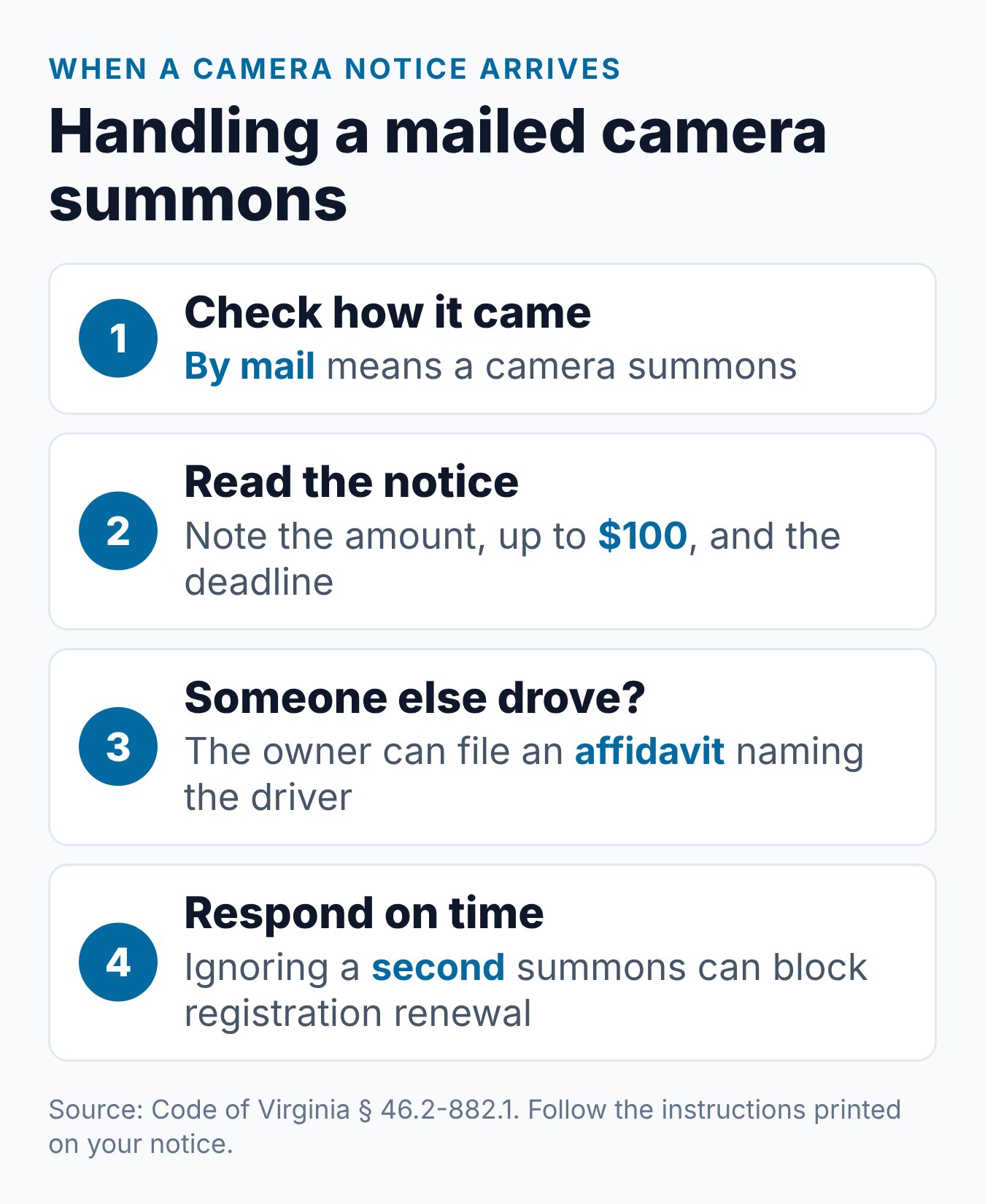
A mailed virginia speed camera ticket is a civil penalty of up to $100, and the Code of Virginia says it “shall not be deemed a conviction.” It is not part of your driving record, and it is not used for insurance purposes. A ticket an officer hands you at the time is different, so read your notice to see which type you have.
Key Facts
- Civil penalty: a mailed camera summons carries a civil penalty of no more than $100. See what a camera ticket is.
- Not on your record: it is not a conviction, not part of your driving record and not used for insurance. See the driving record.
- 10 mph trigger: the vehicle must be going at least 10 mph over the posted limit. See where cameras are used.
- Officer tickets differ: a summons handed to you by an officer is a regular traffic case. See the comparison.
- Officer tickets carry points: a conviction from an officer’s ticket adds 3, 4 or 6 points by speed. See officer tickets.
- Do not ignore it: if a second summons is ignored, DMV can refuse to renew the registration. See ignoring a notice.
What a Virginia Speed Camera Ticket Is
Virginia calls this system photo speed monitoring. The rules are in Code of Virginia § 46.2-882.1. A device records a vehicle going too fast, and a summons is mailed for the violation.
The result is a civil penalty, not a criminal or traffic conviction. The Code says “Such civil penalty shall not exceed $100.” Check your notice for the amount you owe.
Who Gets the Notice
The camera records the vehicle, not the person driving it. The statute puts the summons on the vehicle owner at first. The owner can then show who was driving, as covered below.
Does a Camera Ticket Go on Your Driving Record?
No. Section 46.2-882.1 says a mailed summons “shall not be deemed a conviction as an operator.” It also says the violation is not made part of the operating record.
The same section says the violation is not used for insurance purposes. So a mailed camera summons should not reach your insurer through your DMV record.
Points and the Camera Summons
DMV demerit points come with convictions. Code § 46.2-492 assigns 3, 4 or 6 points per conviction. A mailed camera summons is not a conviction under the Code, and it is not on the driving record.
DMV’s point assessment page explains what happens after a conviction. That process starts with a conviction, which a camera summons is not.
Camera Ticket vs. Officer Ticket
Section 46.2-882.1 draws a clear line. A summons that an officer hands you at the time of the violation is a regular traffic case. A conviction from it goes on your driving record.
| Question | Mailed camera summons | Summons from an officer |
|---|---|---|
| How you get it | By mail, to the vehicle owner | Handed to the driver |
| Type of case | Civil penalty | Traffic infraction or crime |
| Amount set by law | Up to $100 | Prepaid fine of $6 per mph over, plus $51 court cost |
| A conviction? | No | Yes, if you prepay or are found guilty |
| On the driving record? | No | Yes |
| Used for insurance? | No | DMV notifies insurers upon request |
The officer column uses Code § 46.2-878.3 for the prepaid rate and § 16.1-69.48:1 for the $51 fixed fee. Higher prepaid rates apply in some zones.
How to Tell Which One You Have
Start with how you got it. A notice that came in the mail after the fact points to a camera summons. A summons an officer gave you during a stop is a regular traffic case.
Then read the notice itself and follow its instructions. If anything is unclear, call the office listed on the notice or the court.
Where Cameras Can Be Used
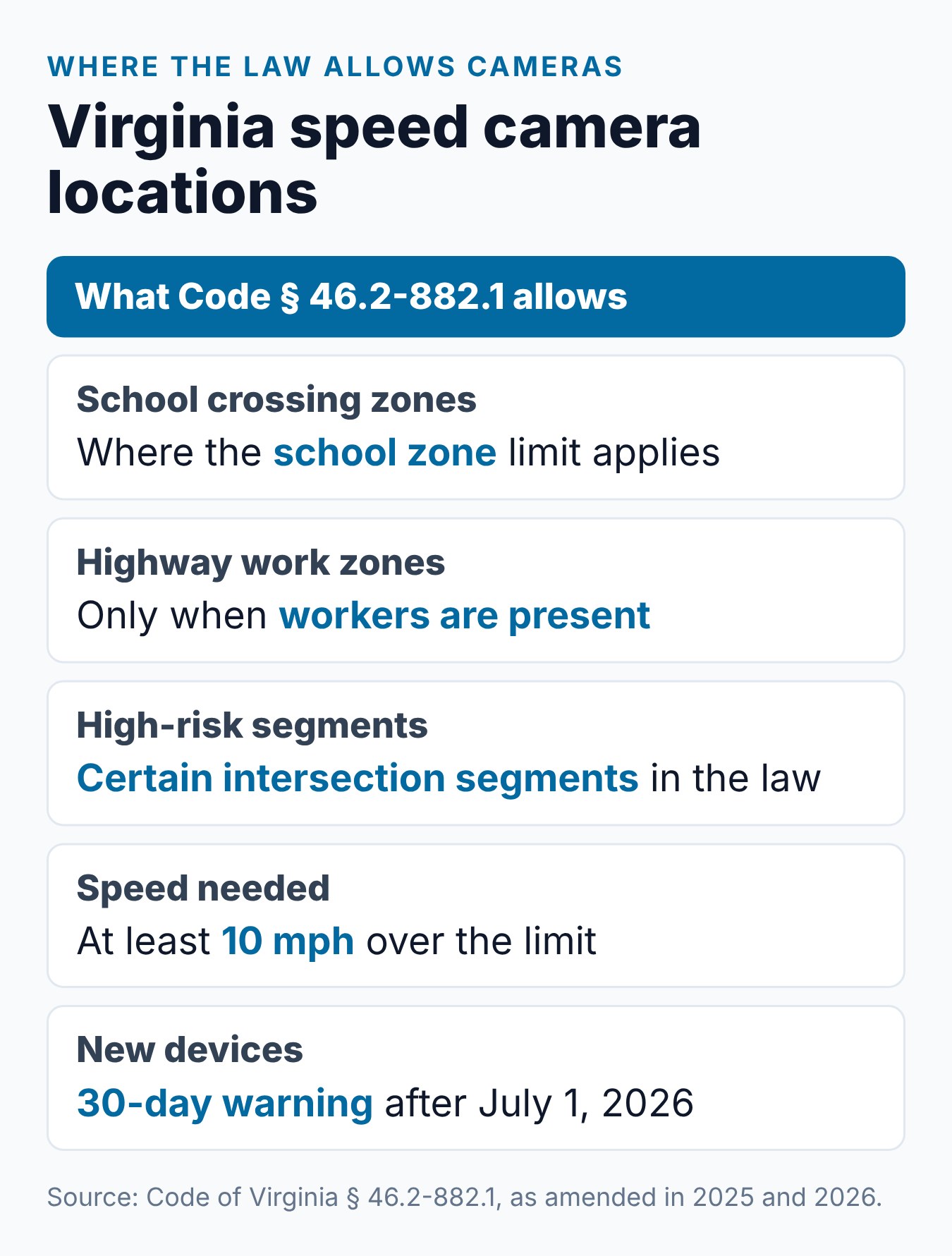
Virginia does not allow speed cameras just anywhere. Section 46.2-882.1 lists the places. They include:
- School crossing zones
- Highway work zones, when workers are present
- Certain high-risk intersection segments
- Other places the law names
The device can only be used when a vehicle is going “at least 10 miles per hour above the posted speed limit.” A vehicle 5 mph over the limit does not meet that test.
School crossing zones and work zones also carry higher fines for speeding infractions. Our school zone and work zone guide covers those fines.
Cameras in School and Work Zones
The two named zones each have their own speed rules. In a school crossing zone, Code § 46.2-873 sets a 25 mph limit between the school signs while they are posted or lit. The signs are in use for 30 minutes before and after regular school hours, and at other times children are present.
In a highway work zone, a camera may be used only when workers are present. Code § 46.2-878.1 also ties the higher work zone fine to workers being present and signs being posted. A mailed camera summons in either zone is still capped at $100.
If You Were Not Driving
The owner is not stuck with a ticket for someone else’s driving. Under § 46.2-882.1, the owner can rebut the presumption in a few ways:
- An affidavit that names the person who was driving.
- Testimony in court about who was driving.
- A police report showing the vehicle was stolen.
Each method has its own rules in the statute. Read the instructions on your notice before you send anything.
If a Notice Is Ignored
A camera summons is not a conviction, but it still needs a response. Section 46.2-882.1 says that if a second summons is ignored, DMV can refuse to renew the vehicle’s registration.
That is the consequence the statute names. The official sources we checked did not list other steps. Follow the deadline printed on your notice.
Recent Changes to the Camera Law
Section 46.2-882.1 has changed in recent sessions. Its history line lists chapters from 2025 and several from 2026.
Two dates stand out in the current text:
- July 1, 2026: a 30-day warning period applies to devices placed after this date.
- July 1, 2027: some parts of the section, on signs and certificates, change on this date.
The rule that keeps a mailed camera summons off your driving record and away from insurers did not change.
What We Found on the Official Pages
When we read the camera statute on October 27, 2026, § 46.2-882.1 showed a history line ending in 2026, with chapters 963 through 970, 986 and 1033. It still capped the civil penalty at $100.
It still said a mailed summons “shall not be deemed a conviction as an operator.” It still kept the violation off the operating record and out of insurance use.
Section 46.2-873 showed a history line ending in 2026, chapter 337. Its current text still set the 25 mph school crossing limit and the $250 fine cap for a school zone speeding infraction.
When the Ticket Came From an Officer
If an officer gave you the summons, the camera rules above do not apply. The case follows the normal path for a speeding charge. Prepaying is a guilty plea under Code § 16.1-69.40:1, and the conviction goes to DMV.
A conviction then adds demerit points by speed:
- 1 to 9 mph over: 3 points.
- 10 to 19 mph over: 4 points.
- 20 mph or more over: 6 points.
DMV’s three-point list shows a speeding conviction kept on the record for 5 years. Driving 20 mph or more over the limit, or over 85 mph, is reckless driving, which cannot be prepaid.
Checking Your Own Driving Record
You can confirm what is on your record by ordering a copy. DMV’s record request page lets you order online, by mail or in person. A driving record costs $9, or $8 online.
The personal-use record looks back up to 11 years. A mailed camera summons should not appear on it, since the Code keeps it off the operating record.
Where a Driver Improvement Clinic Fits
A Driver Improvement Clinic deals with your DMV point balance. A mailed camera summons is not a conviction and is not on your driving record. The clinic works on point balances from convictions.
If you also have convictions on your record, the clinic may still be useful. The clinic runs 8 hours with a DMV-licensed provider, and no provider may charge more than $100. An eligible completion earns 5 safe driving points, once every 24 months.
You get either the point benefit or an insurance discount, not both. A clinic taken only for insurance earns no safe driving points.
Common Mistakes
Each item below comes from Code § 46.2-882.1 or a related Virginia law:
- Treating a camera notice like a criminal charge. It is a civil penalty of up to $100.
- Assuming an officer’s ticket works the same way. A summons handed to you at the time is a regular traffic case.
- Ignoring the notice. DMV can refuse registration renewal after a second ignored summons.
- Paying for someone else’s driving without checking. The owner can name the driver by affidavit.
- Expecting cameras on every road. The Code allows them only in the places it names.
- Thinking any speed triggers a camera. The vehicle must be at least 10 mph over the limit.
- Mixing up camera penalties and zone fines. A camera summons is capped at $100. The $250 and $500 caps are for school and work zone speeding infractions.
How Requirements Can Vary
Virginia’s point rules, safe driving points and DMV clinic orders come from the Code of Virginia and DMV rules, and they apply statewide. What you must do still depends on whether you take the clinic by choice, because of a DMV notice, or under a court order. A court order sets its own deadline and proof steps.
Laws, fees and court practice can change. Check your DMV notice, your court order and the Virginia DMV website for current rules before you enroll or file anything.
Frequently Asked Questions
Does a camera speeding ticket go on your record in Virginia?
No. Code § 46.2-882.1 says a mailed camera summons is not a conviction as an operator and is not made part of your operating record.
Does a Virginia speed camera ticket add demerit points?
The Code says a mailed camera summons is not a conviction and is not on your driving record. Virginia demerit points are assigned per conviction under Code § 46.2-492.
Is a speed camera ticket a criminal charge?
No. A mailed camera summons is a civil penalty under Code § 46.2-882.1. The Code says it is not a conviction as an operator.
How much is a Virginia speed camera ticket?
The civil penalty cannot be more than $100. Check the amount and the deadline on your notice.
Will a camera ticket raise my insurance?
The Code says a mailed camera violation is not used for insurance purposes. A ticket from an officer is different and can reach your insurer.
What if someone else was driving my car?
The owner can file an affidavit naming the driver, or testify in court. A police report can show the vehicle was stolen.
What happens if I ignore a camera ticket?
If a second summons is ignored, DMV can refuse to renew the vehicle’s registration. Follow the deadline on your notice.
How fast do I have to be going for a camera ticket?
At least 10 mph over the posted speed limit. The camera can only be used in places the law allows, such as school crossing zones and work zones with workers present.
Conclusion
A mailed Virginia speed camera ticket is a civil penalty of up to $100, not a conviction, and it stays off your driving record. A ticket an officer hands you is a regular case that can add points. If you have point convictions on your record, you can take the Virginia Driver Improvement Course by choice to earn 5 safe driving points.
Related Articles
- Virginia Speeding Ticket: Costs, Points, and What Happens Next
- Virginia Work Zone and School Zone Speeding Tickets: Higher Fines
- How Does a Virginia Speeding Ticket Affect Your Car Insurance?
- Is a Virginia Speeding Ticket a Misdemeanor or Just a Traffic Infraction?
Sources
- Code of Virginia § 46.2-882.1 — Photo speed monitoring; civil penalty
- Code of Virginia § 46.2-492 — Uniform Demerit Point System
- Code of Virginia § 46.2-873 — School crossing speed limits
- Code of Virginia § 46.2-878.1 — Work zone speed limits
- Virginia DMV — Request a Copy of Your Driver or Vehicle Record
- Code of Virginia § 46.2-878.3 — Prepayment of speeding fines
- Code of Virginia § 16.1-69.48:1 — Fixed fee in district court
- Code of Virginia § 16.1-69.40:1 — Traffic infractions, prepayment
- Virginia DMV — Moving Violations and Point Assessments
- Virginia DMV — Three Point Violations
- Virginia DMV — Driver Improvement
Billy Forte is the owner of Driving Logic, a state-approved driver improvement course provider serving Virginia and other U.S. states.
This article is general information, not legal advice. Virginia DMV rules, court orders, fines and penalties depend on your notice, summons, court and case facts, and they can change. Use official Virginia DMV and court sources, and consult a qualified Virginia attorney for advice about your own case.