
Updated October 2026 · Reviewed by Billy Forte
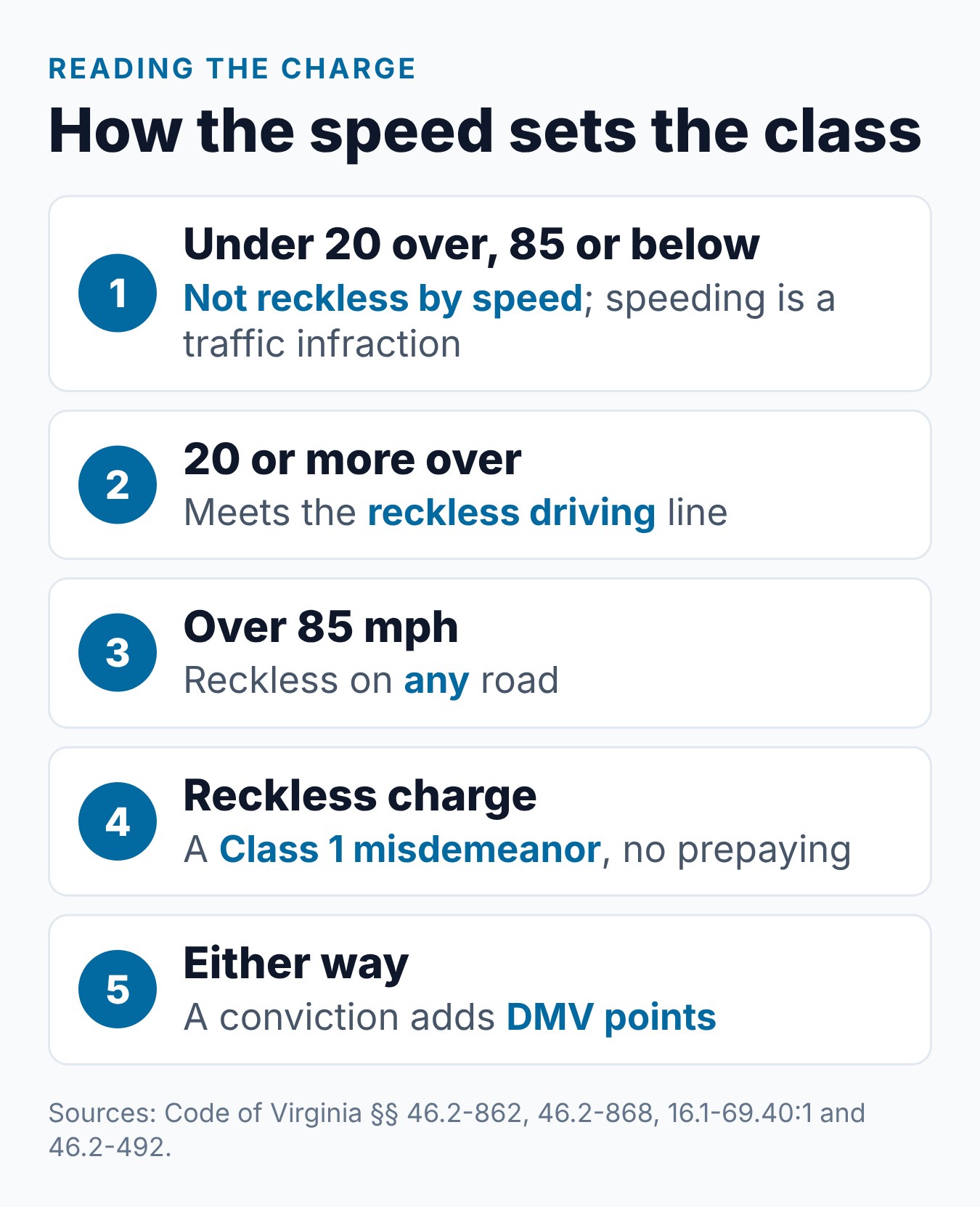
Is a speeding ticket a misdemeanor in Virginia? A normal one is not, because it is a traffic infraction, and the Code says infractions are “not deemed to be criminal in nature.” Speeding becomes a Class 1 misdemeanor only when it is charged as reckless driving: 20 mph or more over the limit, or over 85 mph.
Key Facts
- Infraction: a regular speeding ticket is a traffic infraction, not a crime. See what an infraction is.
- Misdemeanor line: 20 mph or more over the limit, or over 85 mph, is reckless driving, a Class 1 misdemeanor. See when it becomes a misdemeanor.
- Penalty gap: reckless driving can bring up to 12 months in jail and a fine up to $2,500. See the comparison.
- Points either way: speeding adds 3, 4 or 6 DMV points, and reckless driving adds 6. See DMV points.
- Record time: DMV keeps speeding 5 years and reckless driving 11 years. See your records.
What a Traffic Infraction Is
Virginia sorts offenses into felonies, misdemeanors and traffic infractions. Code of Virginia § 18.2-8 defines the last group. It says traffic infractions are “violations of public order” and “not deemed to be criminal in nature.”
A regular speeding ticket falls in this group. It is handled as an infraction unless the charge is reckless driving.
The Default Fine Limit
Title 46.2 sets a default rule for its violations. Under § 46.2-113, unless a law says otherwise, a violation is a traffic infraction. Its fine can be no more than the fine for a Class 4 misdemeanor.
Code § 18.2-11 sets that Class 4 fine at “not more than $250.” So $250 is the default cap for an infraction, unless another law sets a different amount.
What Speeding Costs as an Infraction
Speeding has its own prepaid rate. Code § 46.2-878.3 sets $6 for each mph over the limit, with higher rates in some zones. A fixed $51 court cost applies to traffic infractions under § 16.1-69.48:1, and other fees can be added.
When Speeding Becomes a Misdemeanor
The speed can decide the class. Code § 46.2-862 says a driver is guilty of reckless driving at a speed of:
- 20 mph or more over the speed limit, or
- over 85 mph, no matter what the posted limit is.
Code § 46.2-868 then says, “Every person convicted of reckless driving under the provisions of this article is guilty of a Class 1 misdemeanor.” That makes it a criminal offense, not an infraction.
Our article on when speeding becomes reckless driving covers the speed line in more depth.
Class 1 Misdemeanor Penalties
Section 18.2-11 sets the range for a Class 1 misdemeanor. It allows “confinement in jail for not more than twelve months and a fine of not more than $2,500, either or both.”
A court can also act on the license. Under § 46.2-392 and § 46.2-393, a court may suspend the license for up to 6 months, or order the Intelligent Speed Assistance Program instead. Over 100 mph, the court must order one of these.
Is a Speeding Ticket a Misdemeanor in Virginia? Side by Side
This table compares a regular speeding infraction with reckless driving by speed:
| Question | Speeding infraction | Reckless driving by speed |
|---|---|---|
| Legal class | Traffic infraction | Class 1 misdemeanor |
| Criminal? | “Not deemed to be criminal” | Yes, a misdemeanor |
| Highest penalty | $250 default cap, unless a law sets another | Up to 12 months in jail and $2,500 |
| Can it be prepaid? | Yes, if on the prepayable list | No |
| Fixed court cost | $51 | $61 |
| DMV points | 3, 4 or 6 | 6 |
| Years on the DMV record | 5 | 11 |
The court cost figures come from § 16.1-69.48:1, which sets $51 for infractions and $61 for misdemeanors. Other fees can be added in both cases.
What “Not Criminal” Means for Your Record
An infraction is not a crime, but it still leaves a mark. A speeding conviction goes on your DMV driving record. DMV’s four-point list shows speeding convictions kept for 5 years.
Reckless driving is different. DMV’s six-point list shows reckless driving by speed kept for 11 years.
It is also a Class 1 misdemeanor under the Code. DMV adds that a suspension or revocation can keep convictions on the record even longer.
The DMV Record and Court Records
This page covers the DMV driving record, which DMV describes on its point pages. Those pages do not describe court records. For questions about a court or criminal record in your case, ask the court clerk or a Virginia attorney.
Our guide on how long violations stay on your record covers DMV retention for each type of violation.
How to Tell Which Charge You Have
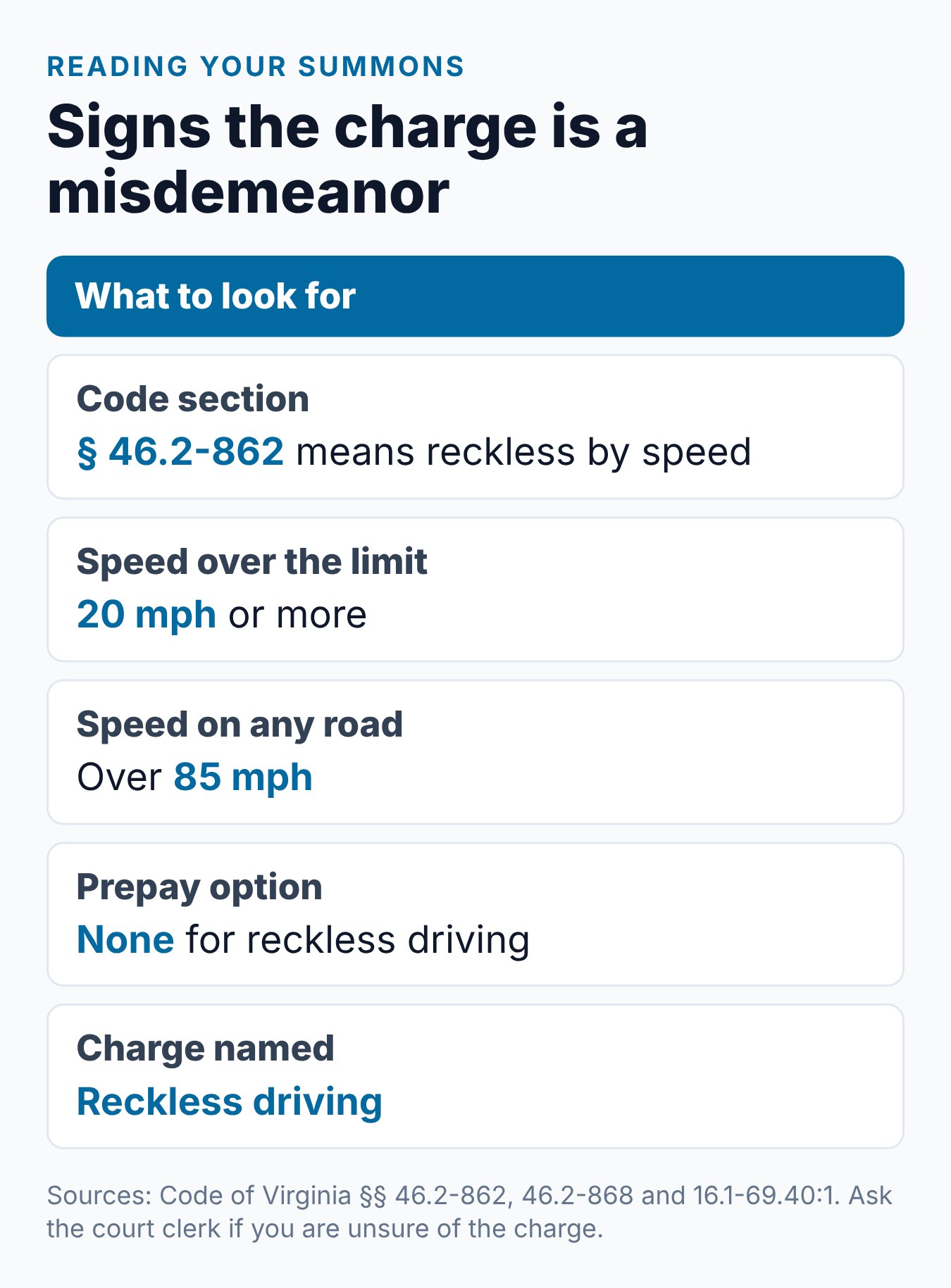
The charge on your summons decides the class, not the speed alone. If the summons names Code § 46.2-862, the charge is reckless driving by speed. That is a Class 1 misdemeanor.
If the charge is plain speeding, the case is a traffic infraction. When you are not sure, call the clerk of the court named on your summons. The clerk can tell you what the charge is and whether it can be prepaid.
Other Driving Offenses That Are Misdemeanors
Speed is not the only path to a misdemeanor. Reckless driving also covers driving “so as to endanger the life, limb, or property of any person” under Code § 46.2-852. Section 46.2-868 makes that a Class 1 misdemeanor as well.
Driving while your license is suspended or revoked is a Class 1 misdemeanor under Code § 46.2-301. Like reckless driving, it cannot be prepaid.
Both Add DMV Points
The class of offense does not change the fact that points apply. Under Code § 46.2-492:
- Speeding 1 to 9 mph over: 3 points.
- Speeding 10 to 19 mph over: 4 points.
- Speeding 20 mph or more over: 6 points.
- Reckless driving: 6 points.
Points count for 2 years from the date of the offense. For drivers 18 and over, DMV may send an advisory letter at 8 points in 12 months.
It requires a clinic at 12 points in 12 months. At 18 points in 12 months, the result is a 90-day suspension or 9 months in the Intelligent Speed Assistance Program, plus a clinic (Code § 46.2-506).
A 20-Over Ticket Can End Two Ways
DMV’s six-point list shows two separate entries for the same speed. One is reckless driving for “speeding 20 mph or more above the posted speed limit,” kept 11 years. The other is plain speeding 20 mph or more over, kept 5 years.
Both carry 6 points. The conviction on your record decides which entry applies.
Drivers Under 20
For young drivers, an infraction can still lead to a required clinic. Under Code § 46.2-334.02, a driver aged 18 or 19 must attend a clinic after any demerit-point conviction. Under 18, the first such conviction also means a required clinic.
Prepaying an Infraction vs. a Misdemeanor
The class also affects how a case can end. Code § 16.1-69.40:1 lets drivers prepay offenses on the Supreme Court’s list without a court appearance. Prepaying is a guilty plea, and the conviction goes to DMV.
The same section bars prepayment for reckless driving. It also bars it for DUI and driving while suspended or revoked.
So a reckless driving charge needs a court appearance. Missing a court date adds a $35 fee under Code § 16.1-69.48:1.
Where a Driver Improvement Clinic Fits
A Driver Improvement Clinic does not change the class of a charge. It does not take a conviction off the record either. It is an 8-hour course, offered by DMV-licensed providers, with a $100 price cap.
A court may order a clinic after a conviction, and the court decides if you get safe driving points. Taken by choice, an eligible completion earns 5 safe driving points, once every 24 months.
You get either the point benefit or an insurance discount, not both. A clinic taken only for insurance earns no safe driving points. Our reckless driving clinic guide explains how the clinic relates to reckless driving.
What We Found on the Official Pages
We reviewed the Code sections behind this page on October 27, 2026. Section 46.2-862 had a history line ending in 2020. It still set the reckless line at 20 mph or more over, or over 85 mph.
Section 46.2-868 also showed no change since 2020, and still made reckless driving a Class 1 misdemeanor. Section 16.1-69.40:1, amended in a 2026 special session, still excluded reckless driving from prepayment.
The court cost section, § 16.1-69.48:1, was last amended in 2025 by chapter 121. Its fees were still $51 per infraction case and $61 per misdemeanor case.
Common Mistakes
Each item below comes from the Code of Virginia or a DMV page:
- Calling every speeding ticket a crime. A regular speeding ticket is a traffic infraction.
- Calling an infraction “civil.” The Code says it is “not deemed to be criminal,” not that it is civil.
- Using the wrong speed line. Reckless driving by speed starts at 20 mph or more over, or over 85 mph.
- Thinking an infraction leaves no record. A speeding conviction stays on the DMV record 5 years.
- Trying to prepay reckless driving. The Code bars it.
- Thinking reckless driving is a felony. The Code makes it a Class 1 misdemeanor.
- Skipping court on an infraction. It is not a crime, but the Code adds a $35 fee when a defendant fails to appear.
How Requirements Can Vary
Virginia’s point rules, safe driving points and DMV clinic orders come from the Code of Virginia and DMV rules, and they apply statewide. What you must do still depends on whether you take the clinic by choice, because of a DMV notice, or under a court order. A court order sets its own deadline and proof steps.
Laws, fees and court practice can change. Check your DMV notice, your court order and the Virginia DMV website for current rules before you enroll or file anything.
Frequently Asked Questions
Is speeding a crime in Virginia?
A regular speeding ticket is not. Code § 18.2-8 says traffic infractions are “not deemed to be criminal in nature.” Reckless driving by speed is a Class 1 misdemeanor.
Is 20 over a misdemeanor in Virginia?
Driving 20 mph or more over the limit is reckless driving under Code § 46.2-862. Reckless driving is a Class 1 misdemeanor under Code § 46.2-868.
Does a speeding ticket go on your criminal record in Virginia?
A regular speeding ticket is a traffic infraction, which the Code says is not criminal in nature. It still goes on your DMV driving record for 5 years. For court record questions, ask the court clerk.
Is reckless driving a felony in Virginia?
No. Code § 46.2-868 makes reckless driving a Class 1 misdemeanor. It can bring up to 12 months in jail and a fine up to $2,500.
What is the most a speeding infraction can cost?
Under Code § 46.2-113, the default fine cap for a Title 46.2 infraction is the Class 4 misdemeanor fine of $250, unless another law sets a different amount. For example, work zone speeding can bring a fine up to $500 under Code § 46.2-878.1 when workers are present and signs are posted.
Can I prepay a reckless driving ticket?
No. Code § 16.1-69.40:1 bars prepayment for reckless driving, so the case is handled in court.
Do court costs differ for a misdemeanor?
Yes. The fixed fee in Code § 16.1-69.48:1 is $61 for a misdemeanor, compared with $51 for a traffic infraction. Other fees can be added.
Do both add DMV points?
Yes. Speeding adds 3, 4 or 6 points based on the speed, and reckless driving adds 6. Points count for 2 years from the offense date.
Conclusion
A regular Virginia speeding ticket is a traffic infraction, not a crime, but it still adds points and stays on your DMV record for 5 years. At 20 mph or more over, or over 85 mph, it becomes reckless driving, a Class 1 misdemeanor.
For a voluntary way to add 5 safe driving points, you can take the Virginia Driver Improvement Course online. If a judge ordered your clinic, check with the court that it accepts an online course.
Related Articles
- Virginia Speeding Ticket: Costs, Points, and What Happens Next
- Virginia Reckless Driving Speed: 20 Over or Over 85 MPH
- Reckless Driving in VA: Penalties, Points and the Clinic
- How Long Does Reckless Driving Stay on Record in VA?
Sources
- Code of Virginia § 18.2-8 — Felonies, misdemeanors and traffic infractions defined
- Code of Virginia § 46.2-113 — Violations of Title 46.2; penalties
- Code of Virginia § 18.2-11 — Punishment for misdemeanors
- Code of Virginia § 46.2-862 — Exceeding speed limit (reckless)
- Code of Virginia § 46.2-868 — Reckless driving; penalties
- Code of Virginia § 46.2-392 — License suspension on conviction
- Code of Virginia § 46.2-393 — License suspension for reckless offenses
- Code of Virginia § 16.1-69.40:1 — Traffic infractions, prepayment
- Code of Virginia § 16.1-69.48:1 — Fixed fee in district court
- Code of Virginia § 46.2-492 — Uniform Demerit Point System
- Code of Virginia § 46.2-506 — Suspension for excessive points
- Code of Virginia § 46.2-852 — Reckless driving; general rule
- Code of Virginia § 46.2-301 — Driving while suspended or revoked
- Code of Virginia § 46.2-334.02 — Licenses for persons under 20
- Code of Virginia § 46.2-878.1 — Work zone speed limits
- Virginia DMV — Six Point Violations
- Virginia DMV — Four Point Violations
Billy Forte is the owner of Driving Logic, a state-approved driver improvement course provider serving Virginia and other U.S. states.
This article is general information, not legal advice. Virginia DMV rules, court orders, fines and penalties depend on your notice, summons, court and case facts, and they can change. Use official Virginia DMV and court sources, and consult a qualified Virginia attorney for advice about your own case.