
Updated October 2026 · Reviewed by Billy Forte
A Virginia driving record is your history with the Virginia DMV, including your traffic convictions, and the demerit points they carry. DMV offers five record types, and each one looks back a different number of years. You can order one online, by mail or in person for $9, or $8 online.
Key Facts
- What it holds: convictions, demerit points and violations with no points. See what the record contains.
- Five types: personal use, employment, TNC, insurance and habitual offender restoration. See the record types.
- Cost: $9, or $8 online, plus $5 for a certified copy. See fees.
- Three ways to order: online, by mail with form CRD-93, or in person. See how to order.
- Employers need consent: the employment record needs your signed release. See who else can see it.
What a Virginia Driving Record Is
Your driving record is the file Virginia DMV keeps on you as a driver. Courts report traffic convictions to DMV, and DMV posts them to your record. DMV also adds the demerit points for each conviction.
DMV’s Request a Copy of Your Driver or Vehicle Record page lists the record types and the ways to order. That page is the starting point for any record request.
What a Virginia Driving Record Contains
The official sources name several kinds of entries. A record can include:
- Traffic convictions. Each one stays for a period DMV sets for that violation.
- Demerit points. Each point conviction carries 3, 4 or 6 points under Code § 46.2-492.
- Violations with no points. DMV says it “also posts to your record traffic violations that do not carry demerit points.”
- Out-of-state convictions. DMV assigns Virginia demerit points for traffic convictions in other states.
- One value per occasion. If two or more offenses happen on one occasion, points are given for only one, the higher value, under Code § 46.2-492.
- Longer retention. A suspension or revocation can keep convictions on the record longer.
Your point total can also include safe driving points. DMV assigns one for each full calendar year that you hold a valid Virginia license and drive without violations or suspensions. They are added in early April for the year before.
DMV’s Moving Violations and Point Assessments page explains these rules. It also says the dates points come off “are not related to the dates that convictions are removed.”
What Is Not on the Record
Some items do not appear as convictions. A mailed speed camera summons is one. Code § 46.2-882.1 says it “shall not be deemed a conviction as an operator.” It is not part of your driving record and is not used for insurance.
A speeding ticket an officer hands you at the time is different. That is a regular conviction, and it goes on your record.
Insurance company points are not on DMV’s list either. DMV says they “are developed by individual companies and are not related to DMV demerit points.”
The Five Record Types
DMV offers five driver record types. The main difference is how far back each one looks.
| Record type | How far back it looks | Notes from DMV |
|---|---|---|
| Driver/Personal Use | Up to 11 years | For your own use |
| Driver/Employment/School/Military | Up to 7 years | Must come with a signed release |
| Driver/TNC | 7 years | Transportation network company record |
| Driver/Insurance summary | Up to 5 years | Insurance-focused summary |
| Driver/Habitual Offender Restoration | 11 years | For habitual offender restoration |
The personal use and habitual offender restoration records both look back 11 years. For a check of your own history, the personal use record is the one made for you.
Which Record to Choose
Pick the record that matches why you need it. Here is how the types line up with common needs:
- Checking your own history: the personal use record, up to 11 years.
- A job, school or military request: the employment record, up to 7 years, with your signed release.
- A transportation network company (TNC) request: the TNC record, 7 years.
- An insurance question: the insurance summary, up to 5 years.
Form CRD-93 says, “An authorization from the subject is required for employers and others not authorized by Virginia code.” So an employer cannot get your employment record without your consent, unless Virginia law allows it.
How to Order Your Record
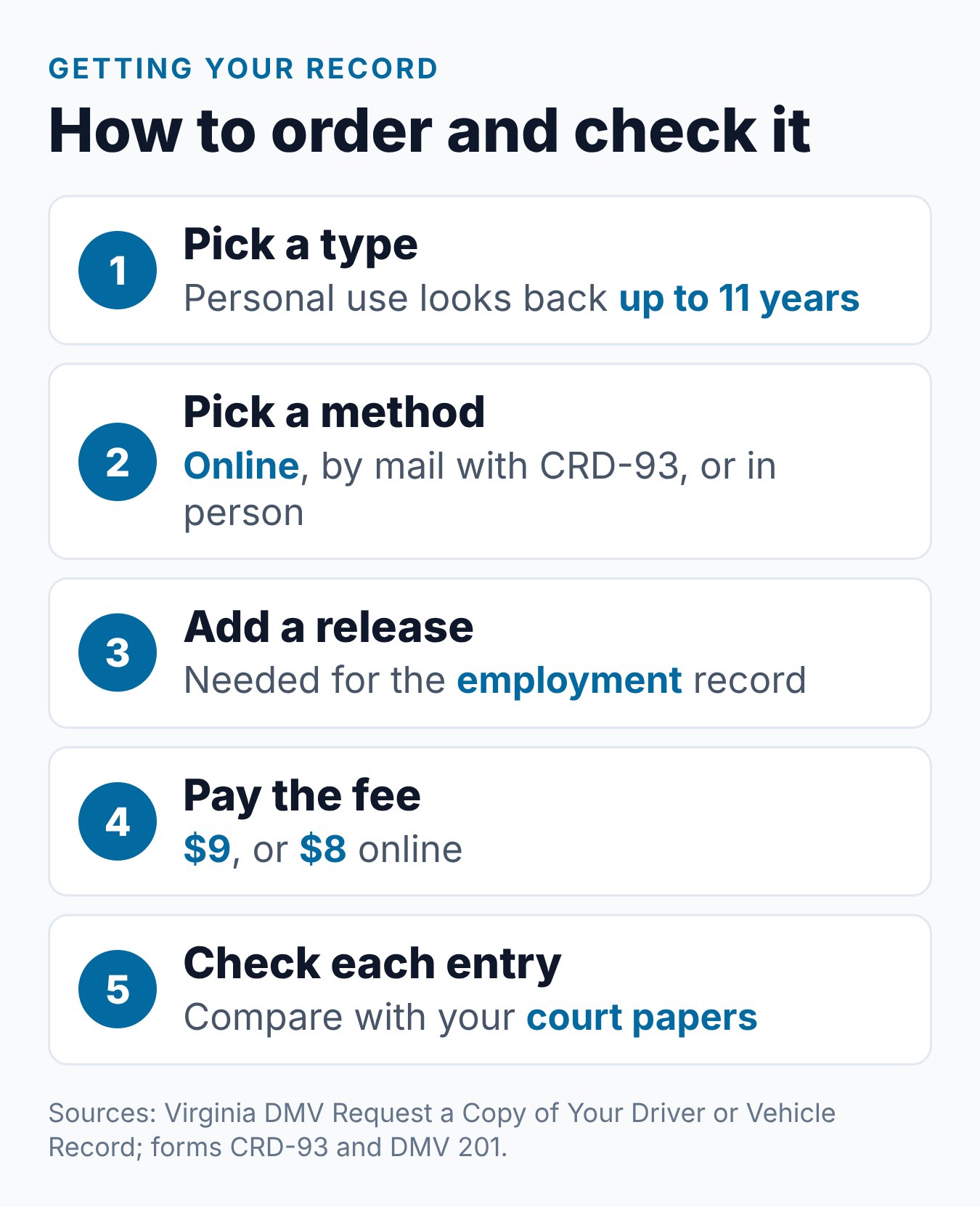
DMV gives you three ways to order:
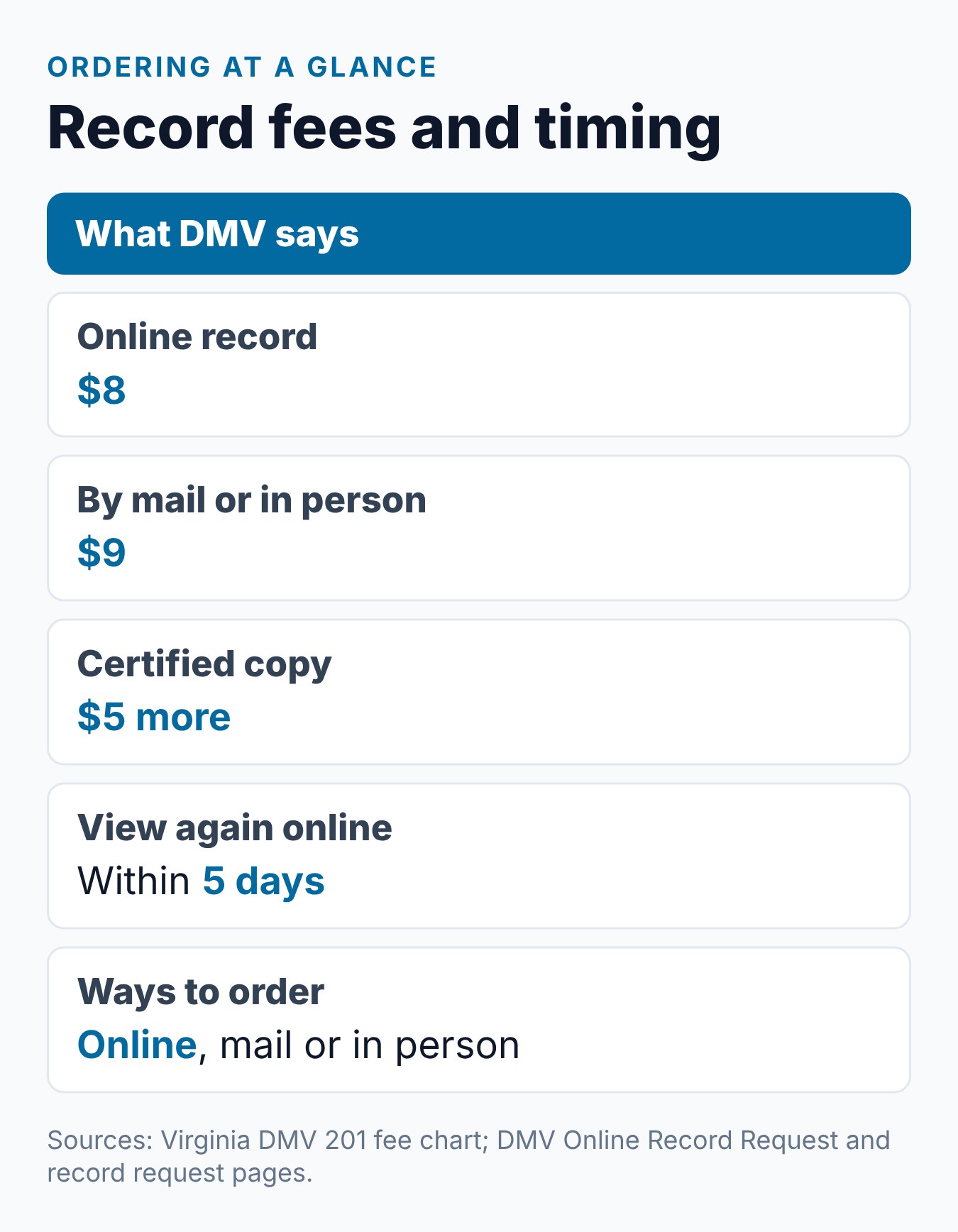
- Online. Use DMV’s online record request. DMV says, “Records that you view may be viewed again within 5 days.”
- By mail. Send form CRD-93 or a written request.
- In person. Visit a DMV office.
The online page also has a “Points Balance” link. Use it if you only need your current point total. Our guide on checking your points covers that route.
Fees for a Virginia DMV Driving Record
DMV’s fee chart, form DMV 201, lists the costs. A driving record costs $9, or $8 online. A certified copy costs $5 more.
Ask whoever wants your record whether they need a certified copy. That way you pay the extra $5 only when it is needed.
How to Read Your Record
DMV does not publish a guide to the record’s layout. You can still check the facts that matter. Go through each entry with these questions:
- Is the conviction yours? Compare it with your court papers, including the date and the charge.
- What is the offense date? Demerit points count for 2 years from that date, under Code § 46.2-493.
- How many points? Each conviction should carry 3, 4 or 6 points, or none.
- How long will it stay? That depends on the violation, not on the points.
- Is there a suspension or other action? Points used for one stay valid until it ends.
If something looks wrong, our guide on disputing a record error explains what the official sources say.
How Long Entries Stay
Each conviction has its own period. DMV’s point lists show the years in parentheses beside each violation.
For example, speeding stays 5 years, and reckless driving stays 11 years. Many other 3- and 4-point violations stay 3 years.
Some commercial-vehicle DUI convictions stay on the record permanently. DMV marks those entries with an asterisk on its point lists.
DMV notes that “The violations listed may change without notice.” For the full list, see our guide on how long violations stay on a Virginia record.
Why Your Record Matters for Points
DMV uses the points on your record to decide when to act. For drivers 18 and over, DMV may send an advisory letter at 8 points in 12 months or 12 in 24. It orders a clinic at 12 in 12 or 18 in 24.
At 18 points in 12 months or 24 in 24, DMV suspends the license for 90 days and requires a clinic. Under Code § 46.2-506, as amended in 2025, 9 months in the Intelligent Speed Assistance Program plus the clinic is the other option. Our points system guide explains each step.
So your record is more than a list of past tickets. It shows how close you are to the next DMV action.
Tickets From Other States
Virginia is part of the Driver License Compact, under Code § 46.2-483. Under the Compact, a state reports convictions of drivers from other member states to their home state. The home state then applies its own laws.
DMV adds Virginia points for convictions you get in other states. That is why an out-of-state ticket can appear on your Virginia record. If you are moving away, see our guide on your Virginia record after a move.
Who Else Can See Your Record
Your record is not open to everyone. These are the groups the official sources name:
- Insurers. After a conviction, DMV “Notifies your insurance company upon request.”
- Employers. They need your signed release for the employment record.
- School bus and driving instructor employers. DMV runs a Mandatory Driving Record Monitoring Program for these drivers.
- Other employers. DMV offers a voluntary “Driver Alert” program.
Our guide on background checks explains what employers can see.
The Clinic and Your Record
A Driver Improvement Clinic does not remove a conviction from your record. An eligible completion can lower your point total by 5, once every 24 months. Code § 46.2-498 calls this subtracting five demerit points from your total.
Clinics must report completion to DMV electronically within 24 hours. An online provider also gives you a DIC 552B certificate within 24 hours.
Keep that certificate with your records. After the report reaches DMV, you can check your point balance online.
What We Found on the Official Pages
On the official pages we checked on October 27, 2026, DMV’s record request page still listed the five driver record types and their lookback periods. Form DMV 201, revised August 10, 2026, still listed $9 for a driving record and $8 online.
Form CRD-93, revised July 1, 2026, still required the subject’s authorization for employers. The online record request page still offered the “Points Balance” link.
Common Mistakes
Each item below comes from a Virginia DMV page, form or the Code:
- Ordering the wrong record. The insurance summary looks back only 5 years.
- Expecting an employer to pull your record without consent. The employment record needs your signed release.
- Reading points and convictions as one clock. DMV says their dates are not related.
- Looking for a mailed camera ticket. It is not a conviction and is not on the record.
- Forgetting out-of-state tickets. DMV assigns Virginia points for them.
- Missing the online window. Records you view online may be viewed again only within 5 days.
How Requirements Can Vary
Virginia’s point rules, safe driving points and DMV clinic orders come from the Code of Virginia and DMV rules, and they apply statewide. What you must do still depends on whether you take the clinic by choice, because of a DMV notice, or under a court order. A court order sets its own deadline and proof steps.
Laws, fees and court practice can change. Check your DMV notice, your court order and the Virginia DMV website for current rules before you enroll or file anything.
Frequently Asked Questions
How do I get my Virginia driving record?
Order it from DMV online, by mail with form CRD-93 or a written request, or in person. It costs $9, or $8 online. A certified copy costs $5 more.
How far back does a Virginia DMV driving record go?
It depends on the type. The personal use record goes back up to 11 years. The employment record goes back up to 7 years, and the insurance summary up to 5.
Does my record show my point balance?
DMV’s online record request offers a “Points Balance” link. Use it to see your current point total. DMV does not publish a guide to the record’s layout.
Can my employer see my driving record?
Only with your signed release, unless Virginia law allows it. Form CRD-93 says an authorization from the subject is required for employers.
Do speed camera tickets show on my record?
A mailed speed camera summons is not a conviction and is not part of your driving record. A ticket handed to you by an officer is a conviction and does show.
Does the Driver Improvement Clinic clear my record?
No. The conviction stays for its listed period. An eligible clinic can lower your point total by 5, once every 24 months.
Do I need a certified copy?
Only if the person asking for your record wants one. A certified copy costs $5 more than a regular driving record. Ask before you order.
What if I find an error on my record?
Compare the entry with your court papers first. Courts report convictions to DMV. If you disagree with a DMV order, you can appeal within 30 days of the order.
Conclusion
Your Virginia driving record shows your convictions and demerit points, and the record type you order sets how far back it looks. Order your personal record to see the full picture before you plan your next step.
If you want to lower your point total, take the Virginia Driver Improvement Course. If a court ordered your clinic, ask the court whether it accepts an online course.
Related Articles
- Virginia DMV Points System Explained
- How to Check Points on License VA: DMV Point Balance
- Virginia Driving Record Dispute: How to Fix a DMV Error
- Will a Virginia Traffic Violation Show Up on a Background Check?
Sources
- Virginia DMV — Request a Copy of Your Driver or Vehicle Record
- Virginia DMV — Online Record Request
- Virginia DMV — Moving Violations and Point Assessments
- Virginia DMV — The Points System
- Code of Virginia § 46.2-492 — Uniform Demerit Point System
- Code of Virginia § 46.2-493 — Demerit points valid for two years
- Code of Virginia § 46.2-882.1 — Photo speed monitoring; civil penalty
- Code of Virginia § 46.2-498 — Driver improvement clinics; voluntary attendance
- Code of Virginia § 46.2-483 — Driver License Compact
- Code of Virginia § 46.2-506 — Suspension for excessive points
- Virginia DMV — Six Point Violations
- Virginia DMV — Form DIC 551, Online Driver Improvement Clinic Agreement (PDF)
Billy Forte is the owner of Driving Logic, a state-approved driver improvement course provider serving Virginia and other U.S. states.
This article is general information, not legal advice. Virginia DMV rules, court orders, fines and penalties depend on your notice, summons, court and case facts, and they can change. Use official Virginia DMV and court sources, and consult a qualified Virginia attorney for advice about your own case.