
Updated October 2026 · Reviewed by Billy Forte
If you are asking how long do points stay on your license in va, the answer is 2 years from the date of the offense. Points can last longer if DMV used them for a suspension, probation or other action that is still running. The conviction itself stays on your record for a separate period that DMV sets for each violation.
Key Facts
- The rule: demerit points count for 2 years from the offense date. See the 2-year rule.
- Start date: the clock starts on the day of the offense, not the court date. See when the clock starts.
- Exception: points used for a DMV action stay valid until that action ends. See when points last longer.
- Convictions: they stay for their own listed period, such as 5 years for speeding. See two different clocks.
- Offsets: safe driving points can offset demerit points while they count. See safe points in the meantime.
How Long Do Points Stay on Your License in VA?
The Code sets one period for all demerit points. Code § 46.2-493 says points “shall be valid for a period of two years from the date the offense was committed.”
DMV says the same thing on its Moving Violations and Point Assessments page. Demerit points “remain on your record for two years from the date that you commit the offense.”
The rule does not change with the size of the offense. A 3-point violation, a 4-point violation and a 6-point violation all count for the same 2 years.
The Clock Starts on the Offense Date
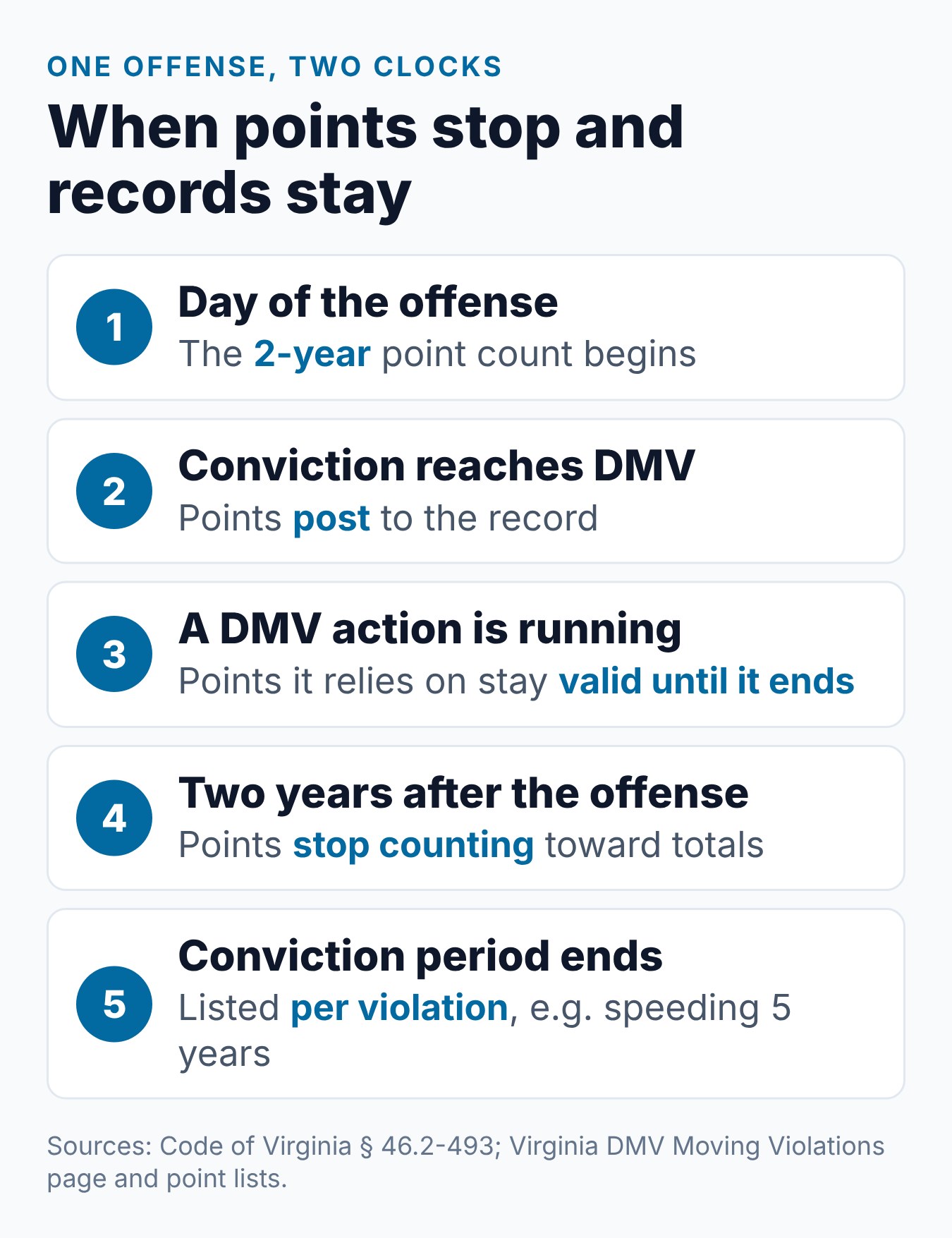
The start date is the day of the offense. It is not the day you paid, the day of court or the day DMV posted the points.
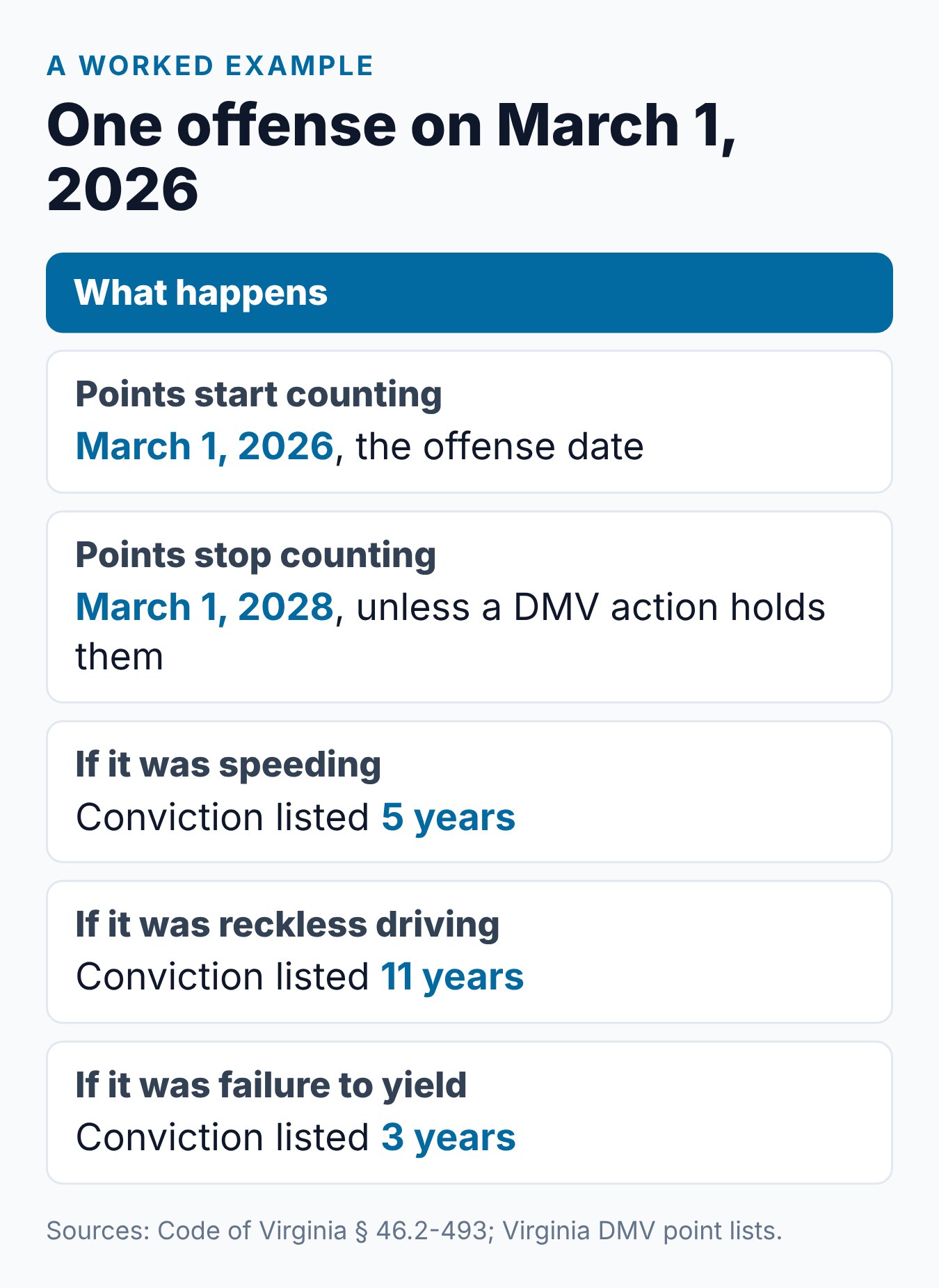
Here is a simple example. Say an offense took place on March 1, 2026. Its points count until March 1, 2028, even if the court date came months after the offense.
This has a practical effect. Points post only after a conviction reaches DMV, but the 2-year count has already been running since the offense.
When Points Last Longer
Code § 46.2-493 has one exception. If DMV used the points as the basis for a suspension, revocation, probation or other action, they “remain valid until” that action has ended.
Here is how that can play out under DMV’s rules:
- Probation. A clinic order starts 6 months of probation under Code § 46.2-499. Points behind the order stay valid while it runs.
- Suspension. At 18 points in 12 months or 24 in 24, Code § 46.2-506 brings a 90-day suspension or 9 months in the Intelligent Speed Assistance Program, plus a clinic. Points behind that action stay valid until it ends.
So the 2-year date on a ticket is the normal end, not a promise. Our license suspension guide explains what happens at the top level.
Two Different Clocks
Points and convictions do not leave your record together. DMV says the dates points are removed “are not related to the dates that convictions are removed from your record.”
| What is on the record | How long it lasts | Where the rule comes from |
|---|---|---|
| Demerit points | 2 years from the offense date, or longer during a DMV action | Code § 46.2-493 |
| The conviction | A period set for each violation | DMV point lists |
| A conviction tied to a suspension or revocation | Can stay longer than the listed period | DMV Moving Violations page |
DMV’s three-point, four-point and six-point pages give each period. A few examples:
- Speeding: 5 years.
- Reckless driving: 11 years.
- Failure to yield right-of-way: 3 years.
DMV does not say whether these periods run from the offense date or the conviction date. Our guide on how long violations stay covers each violation.
Why the 2-Year Rule Matters for DMV Levels
DMV acts on point totals, and only points that still count go into a total. For drivers 18 and over, DMV looks at any 12 months and any 24 months in a row.
That means old points can drop out of a total. Here is simple math: a driver with 10 points, 4 of them from an offense more than 2 years old, has 6 points that still count.
The levels start at 8 points in 12 months or 12 in 24. The Virginia DMV points system guide lists each one.
Points and a Required Clinic
The 2-year rule also shapes when DMV orders a clinic. For drivers 18 and over, DMV requires one at 12 points in 12 months or 18 in 24. The notice gives you 90 days to finish.
Only points that still count can push you to that level. Once the order is made, the points behind it stay valid while the action runs.
A DMV-ordered clinic still earns 5 safe driving points for a driver 18 or older. That credit can offset demerit points that have not yet reached their 2-year date.
A Two-Ticket Example
Dates make the rule easier to see. Here is simple math for one adult driver with two offenses:
- January 10, 2026: an offense that leads to a 4-point conviction.
- September 5, 2026: an offense that leads to a 6-point conviction.
- Within that 12-month window: 10 points count, which is past the advisory letter level of 8.
- January 10, 2028: the 4 points from the first offense stop counting. Six points remain.
- September 5, 2028: the 6 points from the second offense stop counting.
This example assumes no DMV action held the points longer. The two convictions stay on the record for their own listed periods.
Safe Points in the Meantime
You do not have to wait 2 years for help with your total. Safe driving points can offset demerit points while they count.
Code § 46.2-494 lets DMV apply safe points to offset an equal number of demerit points. There are two ways to earn them:
- A clean calendar year: 1 point, added in early April for the year before.
- An eligible clinic: 5 points, once every 24 months.
The balance stops at +5. Code § 46.2-498 describes the clinic benefit as five demerit points subtracted from your total. The conviction stays on the record either way.
Probation and Control Are Different Periods
Some drivers mix up the 2-year rule with DMV’s watch periods. They are separate.
After a clinic order, Code § 46.2-499 places you on 6 months of probation. Then Code § 46.2-500 adds an 18-month control period. A point violation during control brings 6 more months of probation.
Points DMV used for the clinic order stay valid until probation ends. Otherwise, these periods do not change the 2-year count.
They set how DMV reacts to new violations. Our control period guide explains them.
What the 2-Year Rule Does Not Cover
The 2-year rule is about DMV demerit points only. Other parts of your history run on other timelines:
- Insurance. DMV says insurance company points are not related to DMV demerit points. The Bureau of Insurance says increases for violations “may be applied for 36 months.”
- Record lookbacks. A personal-use record covers up to 11 years, an employment record 7 years and an insurance record 5 years.
- Violations without points. DMV also posts traffic violations that carry no demerit points.
Points From Other States
Tickets outside Virginia do not escape the system. DMV says demerit points “will also be assigned to your record for traffic convictions incurred in other states.”
Those become Virginia demerit points. The Code’s 2-year rule in § 46.2-493 covers demerit points, so check the offense date on each one.
Points for Young Drivers
The 2-year rule covers every driver. What changes for young drivers is how DMV acts.
Ages 18 and 19 must take a clinic after any demerit-point conviction. Under 18, DMV acts by the number of convictions, not by point totals. Our teen points guide has the full rules.
How to Track the Dates
Use your driving record and your court papers to find each offense date. DMV’s online record request also has a “Points Balance” link for a quick total.
A short routine keeps the dates straight:
- Find each offense date using your record and your court papers.
- Add 2 years to get the normal end date for those points.
- Check for a running DMV action, such as probation or a suspension, that could hold the points longer.
- Note any safe driving points, which can offset demerit points while they count. Our guide on how to check points explains how to order a record and what it costs.
What We Found on the Official Pages
On the DMV pages we checked on October 27, 2026, the Moving Violations page still said points stay 2 years from the offense date. It still said point dates and conviction dates are not related.
The DMV point lists still showed 5 years for speeding and 11 years for reckless driving. They also noted that the listed violations “may change without notice.”
Common Mistakes
Each item below comes from the Code of Virginia or a DMV page:
- Counting from the court date. The 2-year count starts on the offense date.
- Thinking bigger tickets last longer in points. All demerit points count for 2 years.
- Thinking the ticket leaves with the points. The conviction stays for its own listed period.
- Forgetting a running DMV action. Points used for probation or a suspension stay valid until it ends.
- Ignoring out-of-state tickets. DMV adds Virginia demerit points for them.
- Expecting a clinic to clear a conviction. It credits your total by 5; the conviction stays.
How Requirements Can Vary
Virginia’s point rules, safe driving points and DMV clinic orders come from the Code of Virginia and DMV rules, and they apply statewide. What you must do still depends on whether you take the clinic by choice, because of a DMV notice, or under a court order. A court order sets its own deadline and proof steps.
Laws, fees and court practice can change. Check your DMV notice, your court order and the Virginia DMV website for current rules before you enroll or file anything.
Frequently Asked Questions
Do Virginia points go away after 2 years?
Yes. They stop counting 2 years from the offense date. The one exception is points DMV used for a suspension, probation or other action that is still running.
Do 6-point violations stay longer than 3-point ones?
Not as points. All demerit points count for 2 years. The conviction periods differ, though, such as 5 years for speeding and 11 for reckless driving.
Does the 2-year count start at my court date?
No. Code § 46.2-493 counts from the date the offense was committed.
Why is an old ticket still on my record?
The conviction has its own period, set for each violation. DMV says point dates and conviction dates are not related.
Can I make points count for less than 2 years?
The Code does not shorten the 2-year count. Safe driving points can offset demerit points while they count, including 5 from an eligible clinic once every 24 months.
Do points count while my license is suspended?
Points that DMV used as the basis for a suspension stay valid until the suspension ends. That is true even if 2 years from the offense have passed.
Does a clinic make points expire sooner?
No. The 2-year count stays the same. An eligible clinic instead credits your total by 5 points, once every 24 months, and the conviction stays on the record.
Do points from another state follow the same rule?
DMV assigns Virginia demerit points for convictions in other states. The Code’s 2-year rule covers demerit points, so count from each offense date.
Conclusion
Virginia demerit points count for 2 years from the offense date, unless DMV used them for an action that is still running. The conviction stays on a separate clock set for each violation.
If you want to offset points before they expire and you are eligible, you can take the Virginia Driver Improvement Course. If a court ordered your clinic, ask the court whether it accepts an online course.
Related Articles
- Virginia DMV Points System Explained
- How Long Does Reckless Driving Stay on Record in VA?
- How to Check Points on License VA: DMV Point Balance
- Virginia License Suspension for Points: What Happens and How to Reinstate
Sources
- Virginia DMV — Moving Violations and Point Assessments
- Virginia DMV — The Points System
- Virginia DMV — Three Point Violations
- Virginia DMV — Four Point Violations
- Virginia DMV — Six Point Violations
- Virginia DMV — Traffic Violations, Drivers Age 18 and Over
- Virginia DMV — Driver Improvement
- Code of Virginia § 46.2-493 — Demerit points valid for two years
- Code of Virginia § 46.2-492 — Uniform Demerit Point System
- Code of Virginia § 46.2-494 — Safe driving point credit
- Code of Virginia § 46.2-498 — Driver improvement clinics; voluntary attendance
- Code of Virginia § 46.2-499 — Driver’s license probation
- Code of Virginia § 46.2-500 — Driver control period
- Code of Virginia § 46.2-506 — Suspension for excessive points
- Virginia Bureau of Insurance — Consumer’s Guide for Auto Insurance
- Virginia DMV — Request a Copy of Your Driver or Vehicle Record
Billy Forte is the owner of Driving Logic, a state-approved driver improvement course provider serving Virginia and other U.S. states.
This article is general information, not legal advice. Virginia DMV rules, court orders, fines and penalties depend on your notice, summons, court and case facts, and they can change. Use official Virginia DMV and court sources, and consult a qualified Virginia attorney for advice about your own case.