
Updated October 2026 · Reviewed by Billy Forte
If you want to know how to check points on license va, the short answer is to use DMV’s “Points Balance” link or order your Virginia driving record online, by mail or in person. A record costs $9, or $8 online, and a certified copy costs $5 more. Demerit points count for 2 years from the offense date, so check the dates as well as the total.
Key Facts
- Simplest place to look: DMV’s online record request page has a “Points Balance” link. See option 1.
- Full record: order online, by mail with form CRD-93, or in person. See ways to order.
- Cost: $9 for a driving record, $8 online, and $5 more for a certified copy. See fees.
- What counts: points from offenses in the last 2 years, set by the offense date. See reading your points.
- Errors: if something looks wrong, contact DMV. See if something looks wrong.
How to Check Points on License VA: Three Ways
DMV gives you three ways to see where you stand. Each one fits a different need.
- The Points Balance link. Use this for a quick look at your point total.
- An online driving record. Use this for more detail than the total alone.
- A record by mail or in person. Use this when you want a paper copy or a certified copy.
The first option answers “how many points?” The other two give the full record behind that number.
Option 1: The Points Balance Link
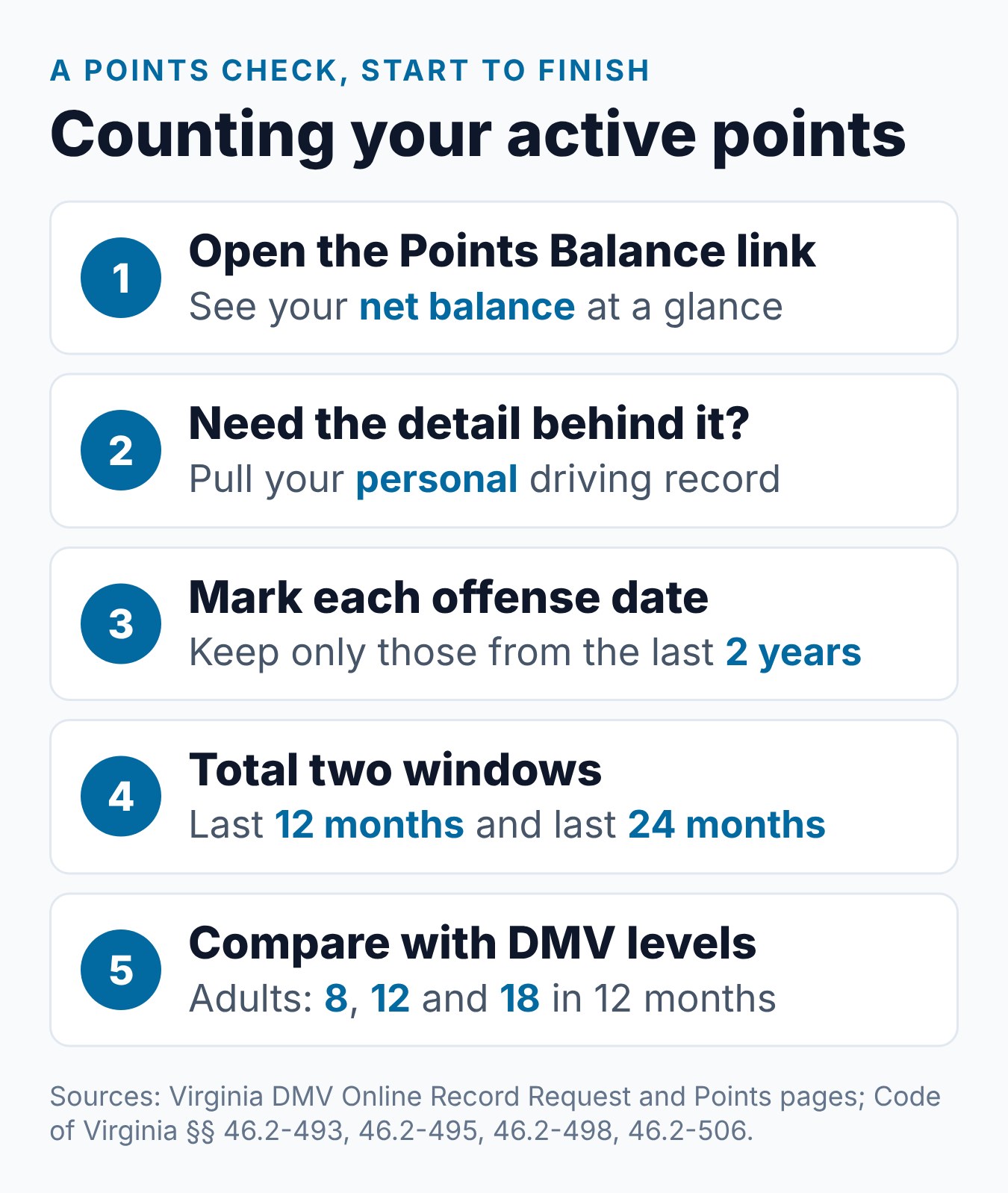
DMV’s Online Record Request page offers a “Points Balance” link. It is the simplest way to see your current point balance.
DMV’s points pages point you to the same tool. They say to “check your points balance to see where your record stands,” with a link to log on and see your balance.
The balance sets safe driving points against active demerit points. Our guide to the safe driving points balance explains what the number means.
Option 2: Order Your Record Online
The same online page lets you order your driving record. The online fee is $8.
Two timing rules apply, according to the page:
- Viewed records: a record you view online “may be viewed again within 5 days.”
- Mailed records: records sent by mail go out “within 5 business days.”
An online record gives the detail behind your balance. Compare it with your court papers to match each conviction to its points.
Option 3: By Mail or In Person
DMV’s record request page lists two more ways to order:
- By mail: send form CRD-93, or a written request.
- In person: visit DMV.
A mailed or in-person driving record costs $9. Form CRD-93 lists the same $9 fee.
What It Costs
DMV’s fee chart, form DMV 201, sets these amounts:
| What you order | Fee |
|---|---|
| Driving record, by mail or in person | $9 |
| Driving record, online | $8 |
| Certified driving record | $5 added to the record fee |
A certified copy is the record plus DMV’s certification. Ask whoever wants your record, such as a court, whether it needs one.
Which Record to Order
DMV offers several record types, and each looks back a different length of time:
- Personal use: up to 11 years.
- Employment, school or military: up to 7 years, and it needs your signed release.
- Insurance summary: up to 5 years.
For checking your own points, a personal record is the natural choice. Our guide to Virginia driving record types covers each one in depth.
What to Check on Your Record
A total is only part of the story. Look at these items one by one:
- Offense dates. Under Code § 46.2-493, points count for 2 years from the date of the offense.
- Point values. Each conviction carries 3, 4 or 6 points under Code § 46.2-492.
- Out-of-state convictions. DMV assigns Virginia points for convictions in other states.
- Violations with no points. DMV also posts traffic violations that do not carry demerit points.
- Safe driving points. These offset demerit points, up to a balance of +5.
Points can stay valid past 2 years in one case. If DMV used them for a suspension, probation or other action, they last until that action ends.
Do the Math
Once you have your record, you can count your own totals. For drivers 18 and over, DMV looks at points within any 12 months and any 24 months.
Here is a simple example. A driver with a 4-point conviction and a 6-point conviction, both for offenses in the last 12 months, has 10 points in that window. That is past the advisory letter level of 8 in 12 months but below the clinic level of 12.
The Virginia DMV points system guide lists every level. Under 18, DMV acts by the number of convictions instead.
Questions Your Record Can Answer
A record check is most useful when you know what you are asking. Use these questions as a guide:
- How many points came from offenses in the last 12 months? This is the short window DMV watches.
- How many came from offenses in the last 24 months? This is the long window.
- Are any points still held by a suspension or probation? Those stay valid until the action ends.
- Did a clean year add a safe point in April? It should appear after DMV’s yearly award.
- Did my clinic credit post? Look after the provider has reported your completion.
Young Drivers Should Count Convictions
For drivers under 20, the number of convictions can matter more than the point total. Ages 18 and 19 face a required clinic after any demerit-point conviction. A seat belt or child restraint violation counts too.
Under 18, DMV acts by the number of convictions, not by points. So a teen checking a record should count convictions as well as points. Our teen points guide explains each step.
Safe Points on Your Record
Your balance can include credits as well as demerit points. Under Code § 46.2-494, DMV applies safe driving points to offset an equal number of demerit points.
DMV adds 1 safe point for each full calendar year with a valid Virginia license and no violations or suspensions. An eligible clinic adds 5, once every 24 months. A clinic taken for an insurance discount adds none, and the balance never goes above +5.
Points and Convictions Run on Different Clocks
Your record can list a conviction whose points no longer count. DMV’s Moving Violations page says the dates points are removed “are not related to the dates that convictions are removed.”
For example, a speeding conviction stays on the record for 5 years. Its points count for only 2. See how long points stay for the full rule.
When to Check
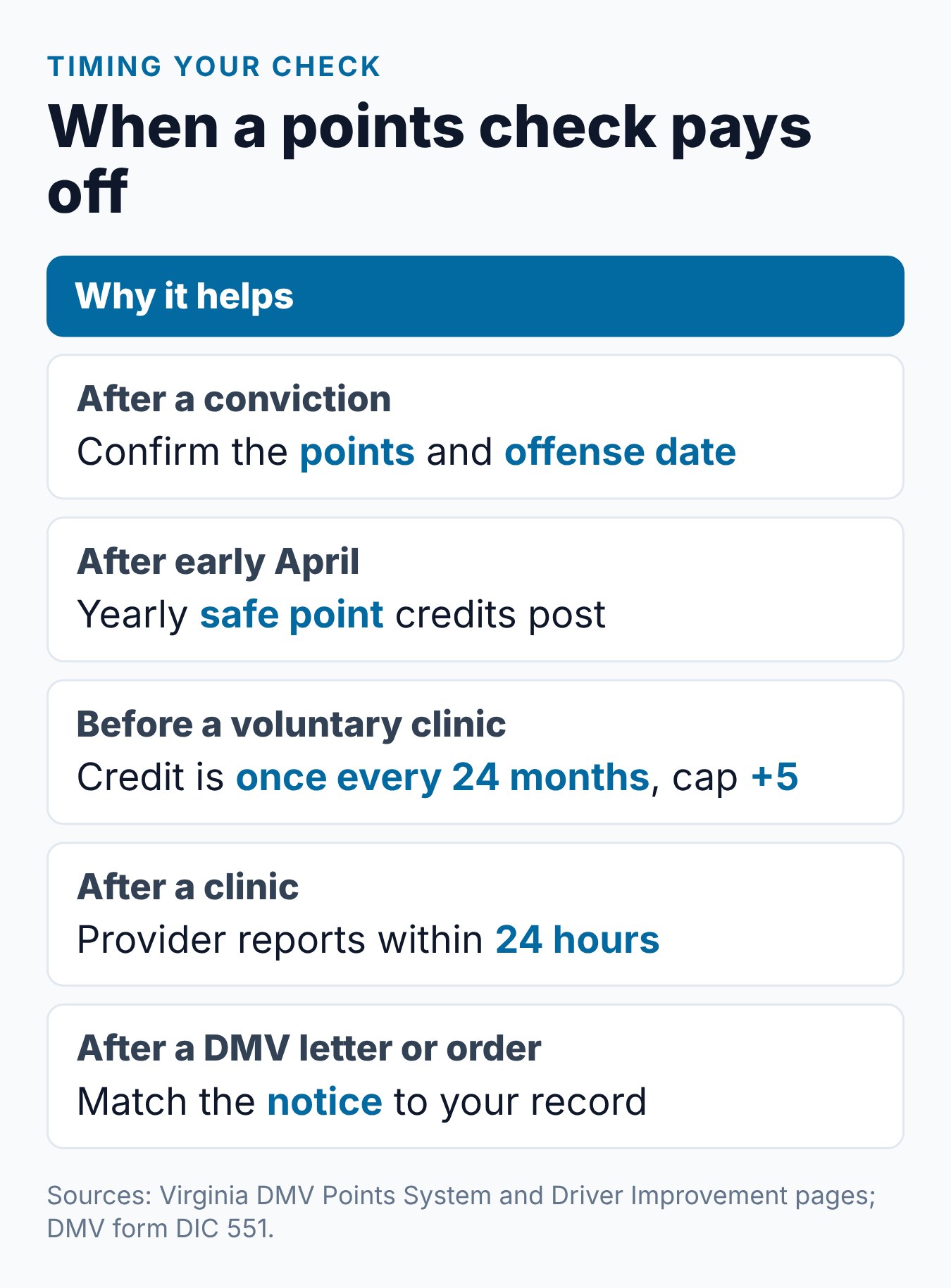
A few moments make a check worth the time:
- After a conviction. Confirm the points posted and the offense date is right.
- After early April. DMV adds yearly safe driving points then.
- Before a voluntary clinic. The clinic credit comes once every 24 months, and the balance stops at +5.
- After a clinic. The provider reports completion to DMV within 24 hours, according to DMV form DIC 551.
- After a DMV letter or order. Compare the notice with your record.
If DMV Writes to You
A letter from DMV is a good reason to check your record the same week. The law sets how each notice arrives:
- Advisory letter: DMV may send it by first-class mail at 8 points in 12 months or 12 in 24 (Code § 46.2-495).
- Clinic notice: it goes by certified mail and gives you 90 days from the notice date (Code § 46.2-501).
- Appeal: a clinic order, probation or suspension can be appealed within 30 days of the order (Code § 46.2-489).
Comparing the notice with your record helps you see which convictions DMV counted.
If Something Looks Wrong
If a conviction, date or point value looks wrong, contact DMV about it.
We did not find a DMV page that sets out a step-by-step correction process. Our guide on record errors explains what the official sources do say.
Who Else Can See Your Record
You are not the only one who can ask for a record. DMV offers an employment record, but it “must be accompanied by a signed release.”
Form CRD-93 says the same idea in its own words. An authorization from you is required for employers and others not authorized by Virginia code.
DMV also runs a voluntary “Driver Alert” program for employers. See our guide on background checks.
What We Found on the Official Pages
On the DMV pages we checked on October 27, 2026, the Online Record Request page still offered the “Points Balance” link. It still said viewed records can be viewed again within 5 days and mailed records go out within 5 business days.
DMV 201, revised August 10, 2026, listed the $9 record, the $8 online record and the $5 certification fee. CRD-93, revised July 1, 2026, listed the $9 driving record fee.
Common Mistakes
Each item below comes from the Code of Virginia or a DMV page:
- Counting every conviction on the record. Points count only for 2 years from the offense date.
- Counting from the court date. The offense date starts the 2-year count.
- Ordering an employment record for yourself. It needs a signed release; a personal record shows up to 11 years.
- Skipping out-of-state tickets. DMV adds Virginia points for them.
- Expecting a second clinic credit too soon. The credit comes once every 24 months.
- Paying for a certified copy you do not need. It costs $5 more.
How Requirements Can Vary
Virginia’s point rules, safe driving points and DMV clinic orders come from the Code of Virginia and DMV rules, and they apply statewide. What you must do still depends on whether you take the clinic by choice, because of a DMV notice, or under a court order. A court order sets its own deadline and proof steps.
Laws, fees and court practice can change. Check your DMV notice, your court order and the Virginia DMV website for current rules before you enroll or file anything.
Frequently Asked Questions
How do I check my points online?
Use the “Points Balance” link on DMV’s Online Record Request page. You can also order your driving record online for $8.
How much does a Virginia driving record cost?
A driving record costs $9 by mail or in person and $8 online. A certified copy costs $5 more.
Can I check my points by mail?
Yes. Send DMV form CRD-93 or a written request. DMV says mailed records go out within 5 business days.
Why does my record show a ticket with no active points?
Points count for 2 years from the offense date, but the conviction stays on the record for its own listed period. DMV says the two dates are not related.
Which record should I order to see my points?
A personal-use record covers up to 11 years and is meant for your own use. Employment and insurance records look back 7 and 5 years.
How soon can I see my record?
A record you view online may be viewed again within 5 days. DMV says mailed records are sent within 5 business days.
Will my insurer see the same points?
Not the same points. DMV says insurance company points are set by each company and are not related to DMV demerit points. DMV notifies your insurance company of a conviction upon request.
Do tickets from other states show up?
DMV assigns Virginia demerit points for traffic convictions in other states. Check your record for any out-of-state conviction and its date.
Conclusion
To check your points, use DMV’s Points Balance link or order your driving record online, by mail or in person. Then look at the offense dates, because points count for only 2 years.
If your total is climbing and you are eligible for the 5-point credit, you can take the Virginia Driver Improvement Course. If a court ordered your clinic, ask the court whether it accepts an online course.
Related Articles
- Virginia DMV Points System Explained
- Your Virginia Driving Record: Types, Contents, and How to Read It
- What Is a Safe Driving Points Balance in Virginia?
- Virginia Driving Record Dispute: How to Fix a DMV Error
Sources
- Virginia DMV — Request a Copy of Your Driver or Vehicle Record
- Virginia DMV — Online Record Request
- Virginia DMV — The Points System
- Virginia DMV — Moving Violations and Point Assessments
- Virginia DMV — Driver Improvement
- Virginia DMV — Form DIC 551, Online Driver Improvement Clinic Agreement (PDF)
- Code of Virginia § 46.2-493 — Demerit points valid for two years
- Code of Virginia § 46.2-494 — Safe driving point credit
- Code of Virginia § 46.2-492 — Uniform Demerit Point System
- Code of Virginia § 46.2-495 — Advisory letters
- Code of Virginia § 46.2-501 — Notice to attend a clinic
- Code of Virginia § 46.2-489 — Driver improvement regulations; appeals
Billy Forte is the owner of Driving Logic, a state-approved driver improvement course provider serving Virginia and other U.S. states.
This article is general information, not legal advice. Virginia DMV rules, court orders, fines and penalties depend on your notice, summons, court and case facts, and they can change. Use official Virginia DMV and court sources, and consult a qualified Virginia attorney for advice about your own case.