
Updated October 2026 · Reviewed by Billy Forte
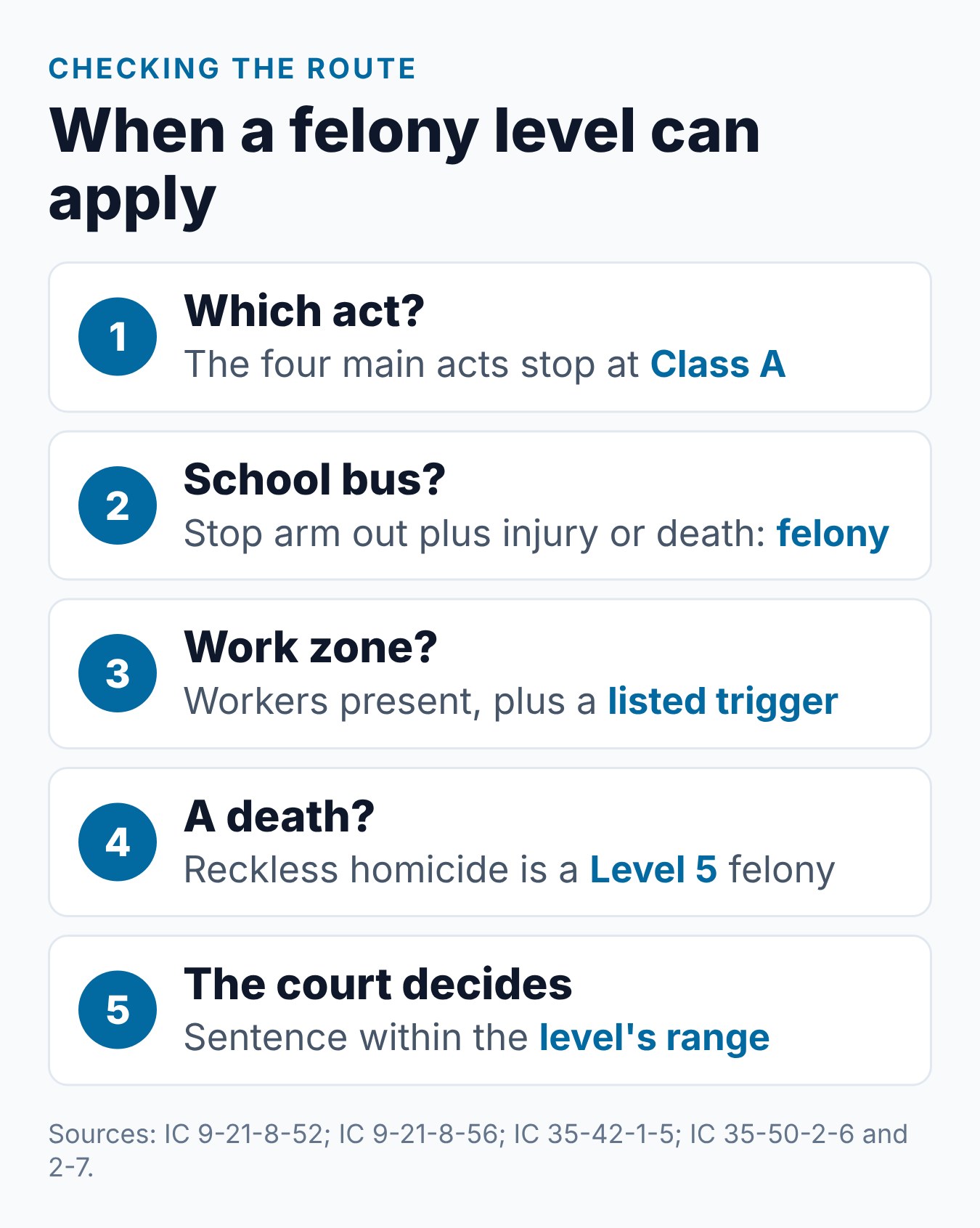
If you are asking is reckless driving a felony in Indiana, the answer for basic reckless driving is no: under IC 9-21-8-52(a), it tops out at a Class A misdemeanor. Felony levels come from three other routes: the school bus act in the same law, reckless driving in a work zone with workers present, and separate crimes such as reckless homicide. Each route has its own trigger, and all but two work zone triggers involve an injury or a death.
Key Facts
- Basic reckless driving: never a felony; the top level is a Class A misdemeanor. See the main statute.
- School bus act: Level 6 with bodily injury, Level 5 with death. See route 1.
- Work zones: Level 6 or Level 5 in listed cases when workers are present. See route 2.
- Other crimes: reckless homicide and criminal recklessness. See route 3.
- Sentences: Level 6 is 6 months to 2.5 years; Level 5 is 1 to 6 years. See sentencing ranges.
Is Reckless Driving a Felony in Indiana Under the Main Statute?
The main reckless driving law is IC 9-21-8-52. Subsection (a) lists four acts, such as unreasonable speed for the conditions and weaving through a line of traffic. None of those four acts is ever a felony.
Their levels run by result. The base charge is a Class C misdemeanor.
Damage to another person’s property makes it Class B. Bodily injury makes it Class A, the highest level for these acts.
So a felony needs something more. It needs the school bus act, the work zone law or a separate crime.
Felony Route 1: The School Bus Act
Subsection (b) covers a driver who “recklessly passes a school bus stopped on a roadway or a private road” while its arm signal device is extended. The base level is a Class A misdemeanor.
The law then adds two felony levels:
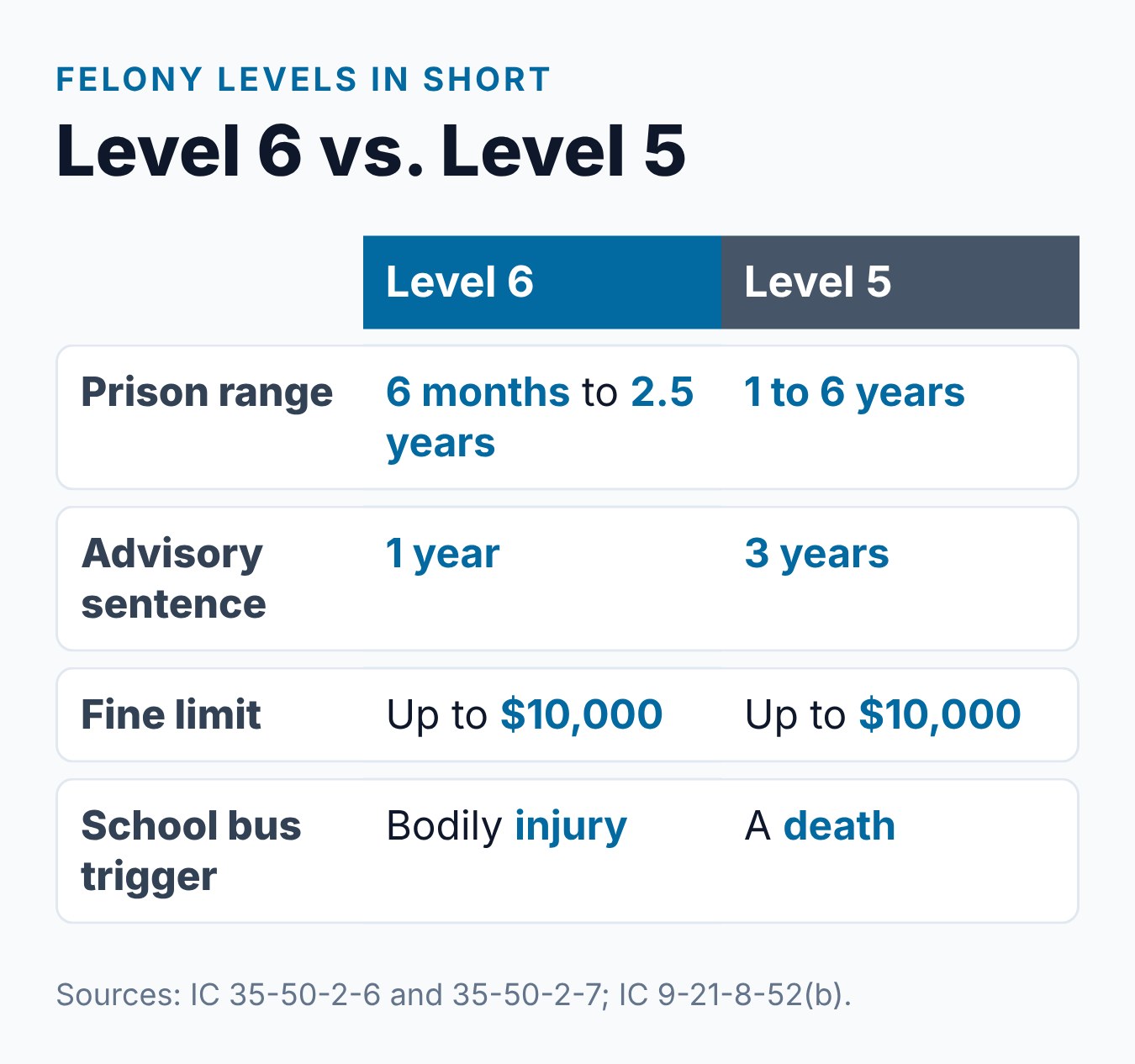
- Level 6 felony if the act “causes bodily injury to a person.”
- Level 5 felony if it “causes the death of a person.”
The law says “bodily injury” here, not “serious bodily injury.” The court may also suspend driving privileges for 90 days, or for 1 year with a prior offense.
Felony Route 2: Reckless Driving in a Work Zone
IC 9-21-8-56 covers reckless driving in the immediate vicinity of a highway worksite when workers are present. The base level is a Class A misdemeanor. It becomes a felony in four listed cases:
- Level 6: the driver has a prior unrelated conviction under that section in the past 5 years.
- Level 6: the driver is operating while intoxicated, in violation of IC 9-30-5-1 or 9-30-5-2.
- Level 6: the driving results in bodily injury to a worker in the worksite.
- Level 5: the driving results in the death of a worker in the worksite.
This is the only felony route on this page that can turn on a past conviction. Work zone tickets of all kinds are covered in school zone and work zone speeding.
What Counts as a Prior Here
The work zone law uses exact words for its prior-conviction trigger. It covers a driver who “has a prior unrelated conviction under this section in the previous five (5) years.” So the prior must be under the same work zone section, within that 5-year window.
Work Zone Speeding Is Not This Crime
Speeding in a work site falls under a different law, IC 9-21-5-11. It is a Class B infraction with a fine of at least $300, which is not a crime. The felony levels above apply only to reckless operation under IC 9-21-8-56.
Felony Route 3: Separate Crimes
Some deadly or dangerous driving is charged under the criminal code, not the traffic code. Two laws stand out:
- Reckless homicide. Under IC 35-42-1-5, a person who recklessly kills another human being commits a Level 5 felony.
- Criminal recklessness. IC 35-42-2-2 starts as a Class A misdemeanor. Aggressive driving that results in serious bodily injury is a Level 6 felony. Aggressive driving that results in death or catastrophic injury is a Level 5 felony.
Which law a prosecutor uses depends on the facts. That choice belongs to the prosecutor and the court, not to a rule of thumb.
The Felony Routes Side by Side
This table sums up each route. It shows only the felony triggers, not the misdemeanor levels.
| Route | Law | Level 6 felony when | Level 5 felony when |
|---|---|---|---|
| Basic reckless driving | IC 9-21-8-52(a) | Never | Never |
| School bus act | IC 9-21-8-52(b) | It causes bodily injury | It causes a death |
| Work zone, workers present | IC 9-21-8-56 | Prior in 5 years, OWI, or a worker is injured | A worker dies |
| Reckless homicide | IC 35-42-1-5 | Not a Level 6 route | Recklessly killing a person |
| Criminal recklessness | IC 35-42-2-2 | Aggressive driving with serious bodily injury | Aggressive driving with death or catastrophic injury |
Felony Sentencing Ranges
Indiana’s felony sentencing law sets the range for each level:
- Level 6 felony (IC 35-50-2-7): between 6 months and 2.5 years, with an advisory sentence of 1 year. The fine can be up to $10,000.
- Level 5 felony (IC 35-50-2-6): between 1 and 6 years, with an advisory sentence of 3 years. The fine can be up to $10,000.
The advisory sentence is a guideline sentence the law names for each level. The judge sets the actual sentence in each case.
Level 6 and the Class A Option
IC 35-50-2-7 gives the court one more choice for a Level 6 felony. Under listed conditions, the court may enter the judgment as a Class A misdemeanor, or convert it later. Whether that applies is a question for the court and an Indiana attorney.
Points for Each Route
The BMV point table in 140 IAC 1-4.5-10 lists:
- Reckless driving: 6 points, 8 with property damage, 10 with bodily injury.
- Reckless operation in a highway work zone: 8 points.
- Passing a stopped school bus with the arm signal out: 8 points.
- Criminal recklessness with a vehicle: 8 points.
- Reckless homicide with a vehicle: 10 points.
The rule adds two limits. Under 140 IAC 1-4.5-10(b)(4), the BMV does not presume property damage or injury for reckless driving points unless the court order or abstract says so. Under (d), points come from the table in effect on the date of the violation.
Points become inactive 24 months after the conviction date. The violation itself stays on the record.
License Effects Beyond Points
The school bus act carries its own court suspension of 90 days, or 1 year with a prior. In property damage and injury cases under subsection (a), the court may recommend a suspension of up to 1 year.
The BMV Driver’s Manual also lists reckless driving among the offenses that count toward Habitual Traffic Violator status. Three such judgments within 10 years can make a driver a Habitual Traffic Violator, with a 10-year suspension.
Watch the Exact Words
The felony laws do not all use the same injury words. The school bus act and the work zone law say “bodily injury.” The criminal recklessness felony levels say “serious bodily injury,” and “death or catastrophic injury.”
These words are set by each statute. What they mean in a given case is for the court to decide.
Where the Driver Safety Program Fits
The Driver Safety Program (DSP) is a BMV-approved course of at least 4 hours. Completing one adds a 4-point credit to your driving record, once every three years. It has no role in deciding whether a charge is a felony.
The BMV DSP page says completion “will not remove a citation from your driver history.” A course counts toward a court case only if the court orders or accepts it. If a court orders a DSP, the order sets the deadline and proof steps. Under IC 9-30-3-12, any court may suspend half of the court costs for a traffic violation when the driver completes a DSP.
The course comes in English and Spanish, in a classroom, on DVD or online. The BMV caps the price of any approved course at $55.
Questions to Bring to an Attorney
A felony charge is serious, and the rules above are only the starting point. These questions come from the laws themselves:
- Which statute and subsection is charged?
- Which level does the charge claim, and what result does it rely on?
- Could the court enter a Level 6 judgment as a Class A misdemeanor under IC 35-50-2-7?
- Is a license suspension possible under the charged law?
- How many BMV points would a conviction add?
What We Found on the Official Pages
On the official 2026 Indiana Code we checked on October 26, 2026, the only felony levels in IC 9-21-8-52 were in subsection (b), the school bus act. Those levels date from a 2019 law.
IC 9-21-8-56 listed its Level 6 and Level 5 cases for work zones with workers present. IC 35-42-1-5 still made reckless homicide a Level 5 felony.
Common Mistakes to Avoid
Each item comes from Indiana law:
- Calling all reckless driving a felony. The four main acts stop at a Class A misdemeanor.
- Adding “serious” to the school bus rule. It says “bodily injury.”
- Forgetting work zones. IC 9-21-8-56 has its own felony levels.
- Mixing up the laws. Reckless homicide and criminal recklessness are separate crimes.
- Assuming every felony needs a prior. Only the work zone law uses one.
- Treating the DSP as a defense. It adds a record credit; the court decides the case.
How Requirements Can Vary
Indiana’s point rules, the 4-point credit and the BMV’s Driver Safety Program order come from state law and BMV rules, and they apply statewide. What you must do still depends on whether you take the course by choice, because of a BMV notice, or under a court order. A court order sets its own deadline and proof steps.
Laws, fees and court practice can change. Check your BMV notice, your court order and the Indiana BMV website for current rules before you enroll or file anything.
Frequently Asked Questions
Is reckless driving a felony in Indiana?
Not under the four main acts in IC 9-21-8-52(a). The school bus act, the work zone law and some separate crimes have felony levels.
Is reckless driving with an injury a felony?
Not under subsection (a). There, bodily injury makes it a Class A misdemeanor. Injury leads to a felony only on the school bus, work zone or criminal recklessness routes.
When is passing a school bus a felony?
When recklessly passing a stopped school bus with its arm extended causes bodily injury, it is a Level 6 felony. When it causes death, it is a Level 5 felony.
Can a work zone case be a felony without an injury?
Yes, in two listed cases. A prior conviction under that section in 5 years, or driving while intoxicated, makes it a Level 6 felony.
What is the sentence for a Level 6 felony?
Between 6 months and 2.5 years, with an advisory sentence of 1 year, and a fine of up to $10,000. The court may treat it as a Class A misdemeanor in some cases.
How many points does a felony reckless case add?
It depends on the offense. Reckless driving is 6, 8 or 10 points. Work zone reckless operation, school bus passing and criminal recklessness with a vehicle are 8 each.
Should I talk to a lawyer about a felony charge?
This article gives general rules only. For a felony charge, an Indiana attorney can explain what applies to your case.
Conclusion
Basic reckless driving in Indiana is a misdemeanor, with a Class A level at most. Felony levels come only from the school bus act, the work zone law with workers present, or separate crimes.
A conviction still adds BMV points, and a DSP can offset 4 of them once every three years. For that course, see Driving Logic’s online Indiana Driver Safety Program.
Related Articles
- Reckless Driving in Indiana: Penalties, Points, and Driver Safety Options
- Reckless Driving Indiana First Offense: What to Know
- What Is Reckless Driving in Indiana? IC § 9-21-8-52 Explained
- Indiana Work Zone and School Zone Speeding Tickets: Higher Fines
Sources
- Indiana Code § 9-21-8-52 — Reckless driving
- Indiana Code § 9-21-8-56 — Reckless operation in a highway worksite
- Indiana Code § 9-21-5-11 — Worksite speed limits
- 140 IAC 1-4.5 — BMV point system rules
- Indiana BMV — Citation Points & Driver Safety Program
- Indiana Code § 9-30-3-12 — Driver safety program
Billy Forte is the owner of Driving Logic, a state-approved driver improvement course provider serving Indiana and other U.S. states.
This article is general information, not legal advice. Indiana BMV rules, court orders, fines and penalties depend on your notice, citation, court and case facts, and they can change. Use official Indiana BMV and court sources, and consult a qualified Indiana attorney for advice about your own case.