
Updated October 2026 · Reviewed by Billy Forte
A reckless driving Indiana first offense has no penalty tier of its own, because IC 9-21-8-52 grades every case by what the driving caused. With no damage or injury, a first offense is a Class C misdemeanor; damage to someone else’s property makes it Class B, and bodily injury makes it Class A. The judge sets the sentence within those limits, and the BMV adds 6, 8 or 10 points.
Key Facts
- No first-offense tier: the statute does not treat a first case as its own level. See no separate tier.
- The result decides: no harm, property damage or bodily injury. See what sets the level.
- No felony for the four main acts: felony levels exist only on other routes. See felony question.
- Points: 6, 8 or 10 for one conviction. See points.
- DSP: a 4-point credit once every three years; it does not decide the court case. See the DSP.
Reckless Driving Indiana First Offense: No Separate Tier
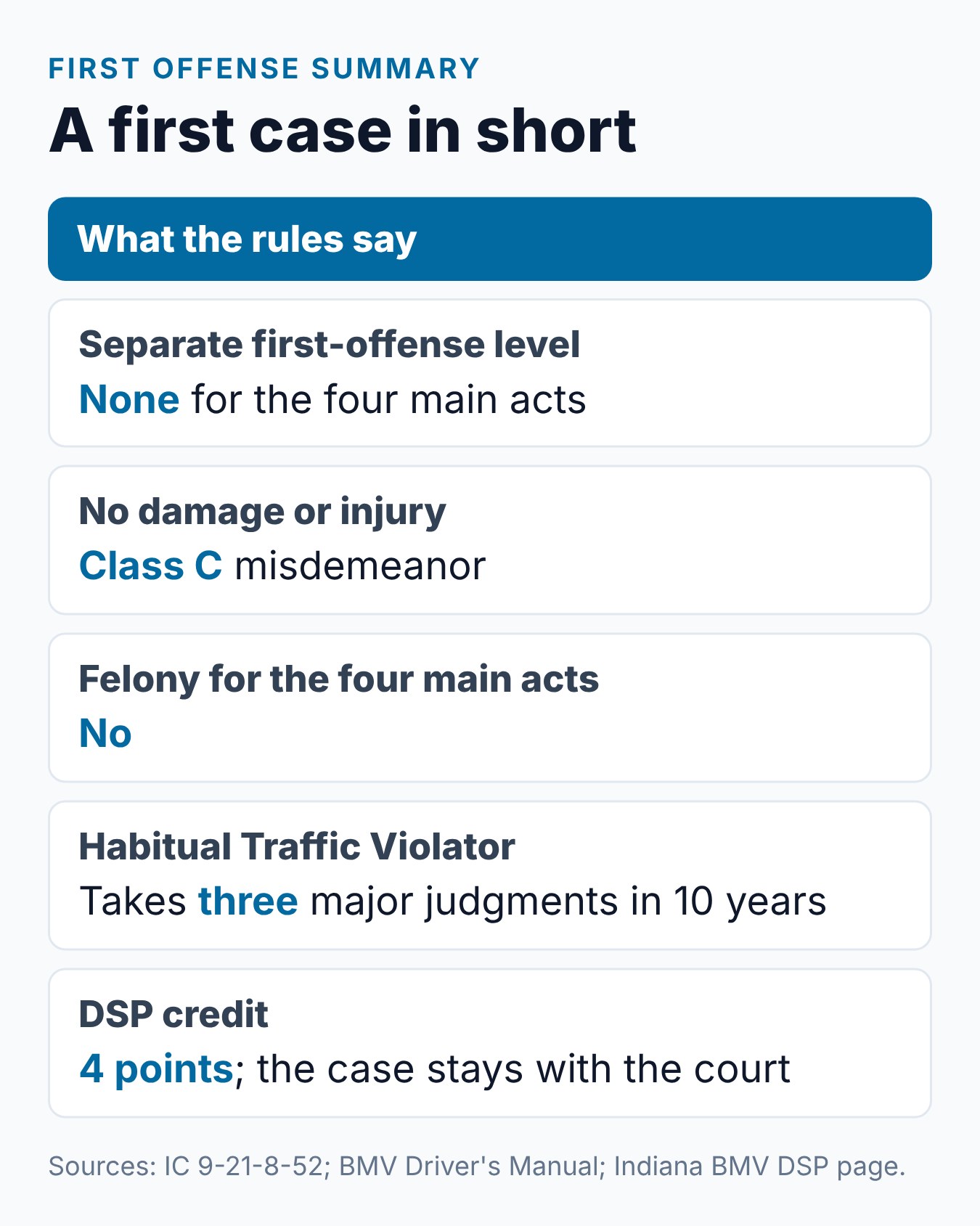
Some laws set a lower penalty for a first offense and a higher one for repeats. IC 9-21-8-52 does not do that for its four main acts. A first case and a later case use the same levels.
The only prior-offense rule in the section is about the license in school bus cases. There, a prior offense can stretch a court suspension from 90 days to 1 year.
What Sets the Level Instead
The charge level depends on the result of the driving. The jail and fine limits come from IC 35-50-3, Indiana’s misdemeanor sentencing law.
- No damage or injury: a Class C misdemeanor, up to 60 days in jail and a fine of up to $500.
- Damage to another person’s property: a Class B misdemeanor, up to 180 days and up to $1,000.
- Bodily injury to a person: a Class A misdemeanor, up to 1 year and up to $5,000.
So two first offenses can be charged at very different levels. A quiet drive with no harm and a drive that hurts someone are not treated alike.
What “Another Person’s Property” Means Here
The Class B level in subsection (c) applies when the offense “results in damage to the property of another person.” The words point to someone else’s property. The Class A level applies when the offense “causes bodily injury to a person.”
Your court papers should show which result is charged. If they do not, ask the court clerk or your attorney.
Two Acts With Their Own Levels
Two related offenses start higher, even for a first case:
- The school bus act. Recklessly passing a stopped school bus with its stop arm out starts as a Class A misdemeanor under subsection (b).
- The work zone law. Reckless operation near a highway worksite with workers present starts as a Class A misdemeanor under IC 9-21-8-56.
The Judge Decides Within the Limits
The jail and fine numbers above are limits. They are the most the law allows for each level. The judge decides the actual sentence in each case.
This article does not list factors a judge may weigh. Those depend on the court and the facts. An Indiana attorney can explain how a court in your county handles these cases.
Can a First Offense Be a Felony?
Not under the four main acts. Their highest level is a Class A misdemeanor, with bodily injury. Felony levels come only from other routes:
- School bus act: a Level 6 felony with bodily injury, and a Level 5 felony with death.
- Work zone law: a Level 6 or Level 5 felony in the cases that law lists.
- Other laws: for example, reckless homicide is a Level 5 felony under IC 35-42-1-5.
Note that some of these routes do not need a prior case. Injury or death can raise even a first school bus or work zone case. The full list is in is reckless driving a felony in Indiana.
Points From One Conviction
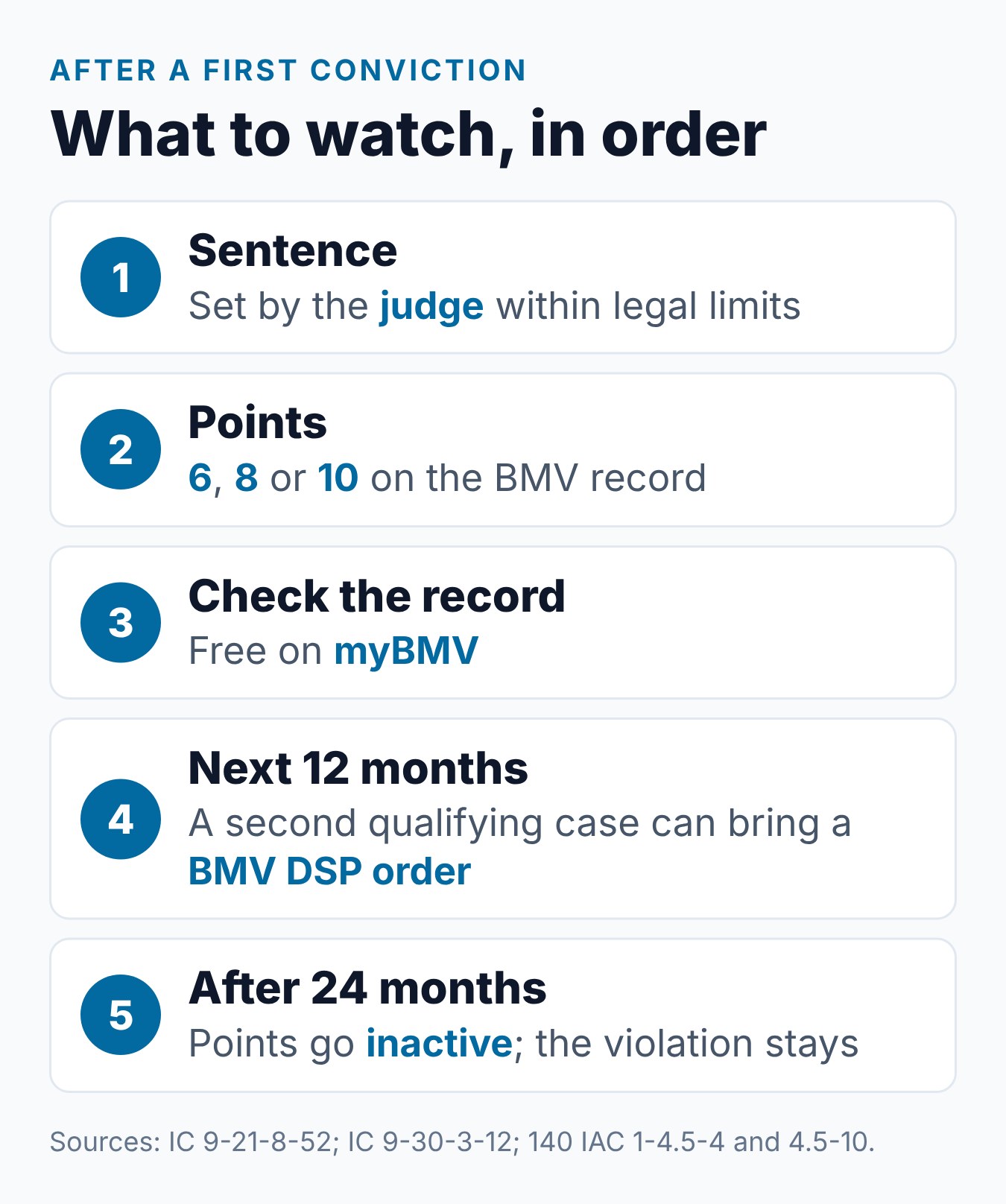
The BMV adds points under 140 IAC 1-4.5-10. One reckless driving conviction adds 6 points. It adds 8 with property damage and 10 with bodily injury.
The BMV does not assume damage or injury when it posts these points. It uses the higher value when the court order or court record says so.
How One Conviction Fits the Point Rules
The BMV sends a warning notice at 14 to 18 active points. It suspends a license at 20 or more active points within 24 months. So one conviction alone, at 6, 8 or 10 points, stays below the warning level.
Other convictions in the same 24 months add to the total. Points become inactive 24 months after the conviction date, as the BMV points page explains. The violation itself stays on the record.
License Effects of a First Offense
A first offense can still affect your license in several ways. Each comes from a different rule, and each has its own trigger.
| Who acts | What they can do | When |
|---|---|---|
| The court | Recommend a suspension of up to 1 year | Property damage or bodily injury cases |
| The court | Suspend driving privileges for 90 days | School bus cases |
| The BMV | Send a warning notice | 14 to 18 active points |
| The BMV | Suspend the license, starting at 1 month | 20 or more active points in 24 months |
| The BMV | Order a Driver Safety Program | Two qualifying convictions or judgments in 12 months |
The BMV’s 12-Month Rule
Under IC 9-30-3-12, the BMV must order a DSP after two traffic misdemeanor convictions, two traffic judgments, or one of each, for moving violations within 12 months. You then have 90 days from the notice to finish it, or your driving privileges are suspended. Points alone do not trigger the order.
Habitual Traffic Violator Status
The BMV Driver’s Manual lists reckless driving among the offenses that count toward Habitual Traffic Violator status. That status takes three such judgments within 10 years. A single first offense does not reach that count.
The Driver Safety Program After a First Offense
The Driver Safety Program (DSP) is a BMV-approved course of at least 4 hours. Completing one adds a 4-point credit to your record. The credit can be entered only once every three years.
It comes in English and Spanish, in a classroom, on DVD or online. The BMV caps the price of any approved course at $55, and the driver pays.
The BMV DSP page says completion “will not remove a citation from your driver history.” The course does not change the criminal case unless the court orders it or accepts it.
Here is the math. A driver whose only active points are 6 from a first reckless conviction has 2 after the credit. If a court orders the DSP, the order sets the deadline and proof steps.
Any court may also suspend half of the court costs for a traffic violation when the driver completes a DSP. The reckless driving and DSP guide covers this in more depth.
Checking Your Record After a Conviction
You can see your record and points free on myBMV. A certified Official Driver Record costs $4.
If the record shows a material error, such as the wrong point value, you can ask for a material error review. Under IC 9-33-2-1, the BMV must decide within 30 days.
After a DSP, the provider notifies the BMV. The credit is applied within 7 to 14 business days of that notice. If it does not appear, email your certificate to BMVDSP@bmv.IN.gov.
Questions to Ask the Court or an Attorney
A first case can raise questions the statute does not answer for you. These are fair questions to bring to the court or an Indiana attorney:
- Which subsection is charged, and which level does that make it?
- Does the charge claim property damage or bodily injury?
- Has the court ordered a course, and what is the deadline?
- If a course is ordered, does the order allow an online course?
- How and when should proof of a course be filed?
A First Offense vs. a Speeding Ticket
A first speeding ticket is a Class C infraction, which is not a crime. A first reckless driving charge is a misdemeanor, which is a crime. The full comparison is in reckless driving vs. speeding.
What We Found on the Official Pages
On the official 2026 Indiana Code we checked on October 26, 2026, IC 9-21-8-52 had no first-offense or repeat-offense level for its four main acts. The one prior-offense rule was the school bus license suspension in subsection (e).
The work zone law, IC 9-21-8-56, did use prior convictions. A prior conviction under that section in the past 5 years can raise a case to a Level 6 felony.
Common Mistakes to Avoid
Each item comes from Indiana law or a BMV rule:
- Expecting a lighter first-offense level. The statute has none for the four main acts.
- Counting only 6 points. Damage means 8 and injury means 10.
- Thinking a first offense is always minor. Injury makes it a Class A misdemeanor.
- Missing a second violation’s effect. Two qualifying convictions or judgments in 12 months bring a BMV order.
- Using the DSP as a defense. It adds a credit to your record; the court decides the case.
- Missing a court deadline. A court order sets its own dates and proof steps.
How Requirements Can Vary
Indiana’s point rules, the 4-point credit and the BMV’s Driver Safety Program order come from state law and BMV rules, and they apply statewide. What you must do still depends on whether you take the course by choice, because of a BMV notice, or under a court order. A court order sets its own deadline and proof steps.
Laws, fees and court practice can change. Check your BMV notice, your court order and the Indiana BMV website for current rules before you enroll or file anything.
Frequently Asked Questions
What is the penalty for a first reckless driving offense in Indiana?
It depends on the result. With no damage or injury, it is a Class C misdemeanor, up to 60 days and $500. Property damage makes it Class B, and bodily injury makes it Class A.
Is a first reckless driving offense a felony?
Not under the four main acts in IC 9-21-8-52. Felony levels apply only to the school bus act, the work zone law in listed cases, or other crimes.
How many points is a first reckless driving conviction?
Six points, or 8 with property damage and 10 with bodily injury. Points become inactive 24 months after the conviction date.
Will I lose my license for a first offense?
Not automatically. A court may recommend a suspension of up to 1 year in damage or injury cases. The BMV also suspends at 20 active points within 24 months.
Does the DSP help with a first offense?
It adds a 4-point credit to your BMV record, once every three years. It does not remove the citation or decide the court case.
Do I need to take a DSP after a first offense?
Only if a court orders it or the BMV sends a notice. The BMV order follows two qualifying convictions or judgments in 12 months.
Does a first offense stay on my record?
The points become inactive 24 months after the conviction date. The violation itself stays on the record, and no rule gives it an end date.
Who can advise me on my own case?
An Indiana attorney. The court and the BMV can answer questions about deadlines and records.
Conclusion
A first reckless driving offense in Indiana is graded by its result, not by being first. The levels run from Class C to Class A, with 6, 8 or 10 points.
If a court ordered a course, check that the order allows an online course before you start. To learn about the 4-point credit, see Driving Logic’s online Indiana Driver Safety Program.
Related Articles
- Reckless Driving in Indiana: Penalties, Points, and Driver Safety Options
- Is Reckless Driving a Felony in Indiana? What to Know
- Indiana Reckless Driving and the Driver Safety Program: What to Know
- Indiana Reckless Driving vs. Speeding Ticket: Key Differences
Sources
- Indiana Code § 9-21-8-52 — Reckless driving
- Indiana Code § 9-21-8-56 — Reckless operation in a highway worksite
- 140 IAC 1-4.5 — BMV point system rules
- Indiana BMV — Driver Record Points
- Indiana Code § 9-30-3-12 — Driver safety program
- Indiana BMV — Citation Points & Driver Safety Program
- Indiana BMV — myBMV
- Indiana BMV — Material Error Review Request
- Indiana Code § 9-33-2-1 — Material errors in BMV records
Billy Forte is the owner of Driving Logic, a state-approved driver improvement course provider serving Indiana and other U.S. states.
This article is general information, not legal advice. Indiana BMV rules, court orders, fines and penalties depend on your notice, citation, court and case facts, and they can change. Use official Indiana BMV and court sources, and consult a qualified Indiana attorney for advice about your own case.