
Updated October 2026 · Reviewed by Billy Forte
If you searched how many points to suspend license in indiana, the answer is 20 active points within 24 months, counted after any Driver Safety Program credit. At 20 points the BMV’s rule sets a one-month suspension, and each 2 more points adds a month, up to 12 months at 42 or more. A warning notice comes first, at 14 to 18 active points.
Key Facts
- Suspension starts at 20: 20 active points in 24 months means a one-month suspension. See the suspension table.
- Steps of 2: each 2 more points adds one month, to 12 months at 42 or more. See reading the table.
- Warning first: 14 to 18 active points brings a warning notice. See the warning notice.
- Credit counts first: the BMV applies the table after any DSP credit. See the DSP credit.
- Review rights: a driver who gets a penalty has administrative review rights. See your review rights.
- Reinstatement: check your requirements and fees on myBMV. See how to reinstate.
How Many Points to Suspend License in Indiana
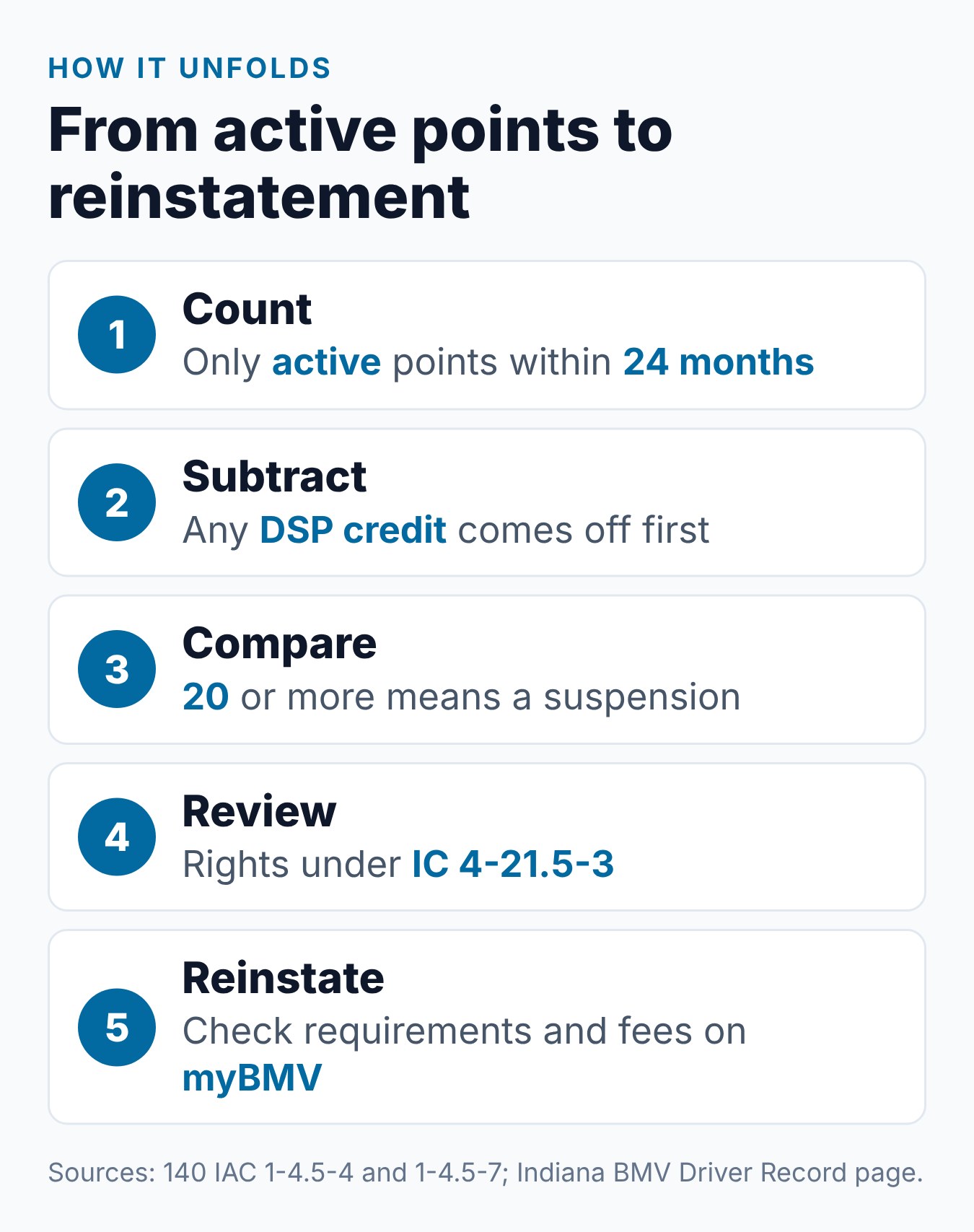
The answer comes from a BMV rule, 140 IAC 1-4.5-4. It says a person “accumulating twenty (20) or more active points, after any credit earned by completion of a driver safety program, within a twenty-four (24) month period shall receive a penalty.”
Three parts of that sentence matter:
- Active points. Points count only while they are active.
- After any credit. A DSP credit comes off before the BMV looks at the total.
- Within 24 months. The window is two years.
Points become inactive 24 months after the disposition date of each violation. So the total can rise with a new conviction and fall as older points expire.
The Indiana Point Suspension Table
Here is the full table from 140 IAC 1-4.5-4(b), in plain words:
| Active points (after any DSP credit) | Result |
|---|---|
| 14 to 18 | Warning notice |
| 20 | 1-month suspension |
| 22 | 2-month suspension |
| 24 | 3-month suspension |
| 26 | 4-month suspension |
| 28 | 5-month suspension |
| 30 | 6-month suspension |
| 32 | 7-month suspension |
| 34 | 8-month suspension |
| 36 | 9-month suspension |
| 38 | 10-month suspension |
| 40 or more | 11-month suspension |
| 42 or more | 12-month suspension |
The rule writes the last two rows as “Forty (40) or more” and “Forty-two (42) or more.” So 42 is the top step, at 12 months.
Reading the Table
The pattern is steady. Each step is 2 points and one month.
Three quick examples show how it works:
- 20 active points. One month.
- 30 active points. Six months.
- 44 active points. Twelve months, the top of the table.
The table uses the same levels for every driver. There is no separate table for drivers under 21. For their other rules, see probationary license rules under 21.
The Warning Notice
The rule says “Fourteen (14) to eighteen (18) points will result in a warning notice.” That is the only step below 20.
A warning notice is not a suspension. It tells you that your total is close to the suspension level.
The rule sets no action at 14 to 18 points beyond the notice itself, and the warning range ends where the suspension range begins. At 18 active points, one 2-point conviction would bring the total to 20.
How the DSP Credit Fits Before the Table
A Driver Safety Program (DSP) from a BMV-approved provider earns a 4-point credit. The rule, 140 IAC 1-4.5-7, says it can be entered only once every three years.
The suspension rule counts points “after any credit.” Here is the simple math:
- 22 active points minus a 4-point credit leaves 18.
- 18 falls in the warning range, not the suspension range.
The credit does not erase a conviction. The BMV’s Driver Safety Program page says completion “will not remove a citation from your driver history.” For how the credit is timed and applied, see how the 4-point credit works.
When Points Drop Out of the Count
Points do not count forever. The BMV says they “stay active on an individual’s driving record for two years from the conviction date.”
The violation itself stays. Rule 140 IAC 1-4.5-4(d) says “the violation shall remain a part of the person’s record.” Only the points go inactive.
That is why a total can fall without any action from you. For example, a driver with 22 active points has 16 once a 6-point conviction goes inactive. For the timing rules, see how long points stay on your Indiana driving record.
How Points Add Up Toward 20
Each conviction adds the value set in the point table, 140 IAC 1-4.5-10. A few values show how fast a total can grow:
- Speeding 16 to 25 mph over: 4 points.
- Following too closely: 6 points.
- Reckless driving: 6 points, or 8 with property damage.
- OWI: 8 points.
So five 4-point convictions within 24 months reach 20. Two 8-point convictions and one 4-point conviction also reach 20. For every value, see the Indiana BMV demerit points chart.
Tickets From Other States Count Too
Points are not limited to Indiana roads. Rule 140 IAC 1-4.5-5 says the BMV “shall assess points” for violations in another state when Indiana has a matching violation.
Those points are assessed as if the violation happened in Indiana. They count toward the same 24-month total and the same table.
Check Your Total Before It Reaches 20
Your record shows where you stand. The certified Official Driver Record costs $4 and lists “Current Points.” An asterisk marks each conviction whose points are still active.
The free Viewable Driver Record is also on myBMV. Check the conviction dates too, since each set of points goes inactive 24 months after its own disposition date.
Your Review Rights
The rule gives drivers a way to challenge a penalty. It says a person who gets a penalty “has the administrative review rights provided under IC 4-21.5-3.”
IC 4-21.5-3 is Indiana’s law on administrative review. The BMV notice and that law set the steps. For help with your own case, talk to an Indiana attorney.
A Separate Hearing After Three Offenses
One more rule sits beside the table. Rule 140 IAC 1-4.5-4(c) says, “If, during any twelve (12) month period, a person has committed three (3) moving traffic offenses, the bureau may, upon written notice, require the person to submit to an administrative hearing.”
This hearing is not tied to a point total. It turns on the count of offenses. The rule also says “may,” so it is the BMV’s choice.
If a Court Changes a Violation
Courts can change cases after the fact. Rule 140 IAC 1-4.5-4(e) covers this.
If a court “vacates, dismisses, amends, or otherwise modifies a violation,” the BMV must act. It must “modify the pending or existing excessive points suspension accordingly.” It does so within a reasonable time after it gets the court’s record.
Suspensions That Are Not Based on Points
A point suspension is only one kind. Two others are worth knowing:
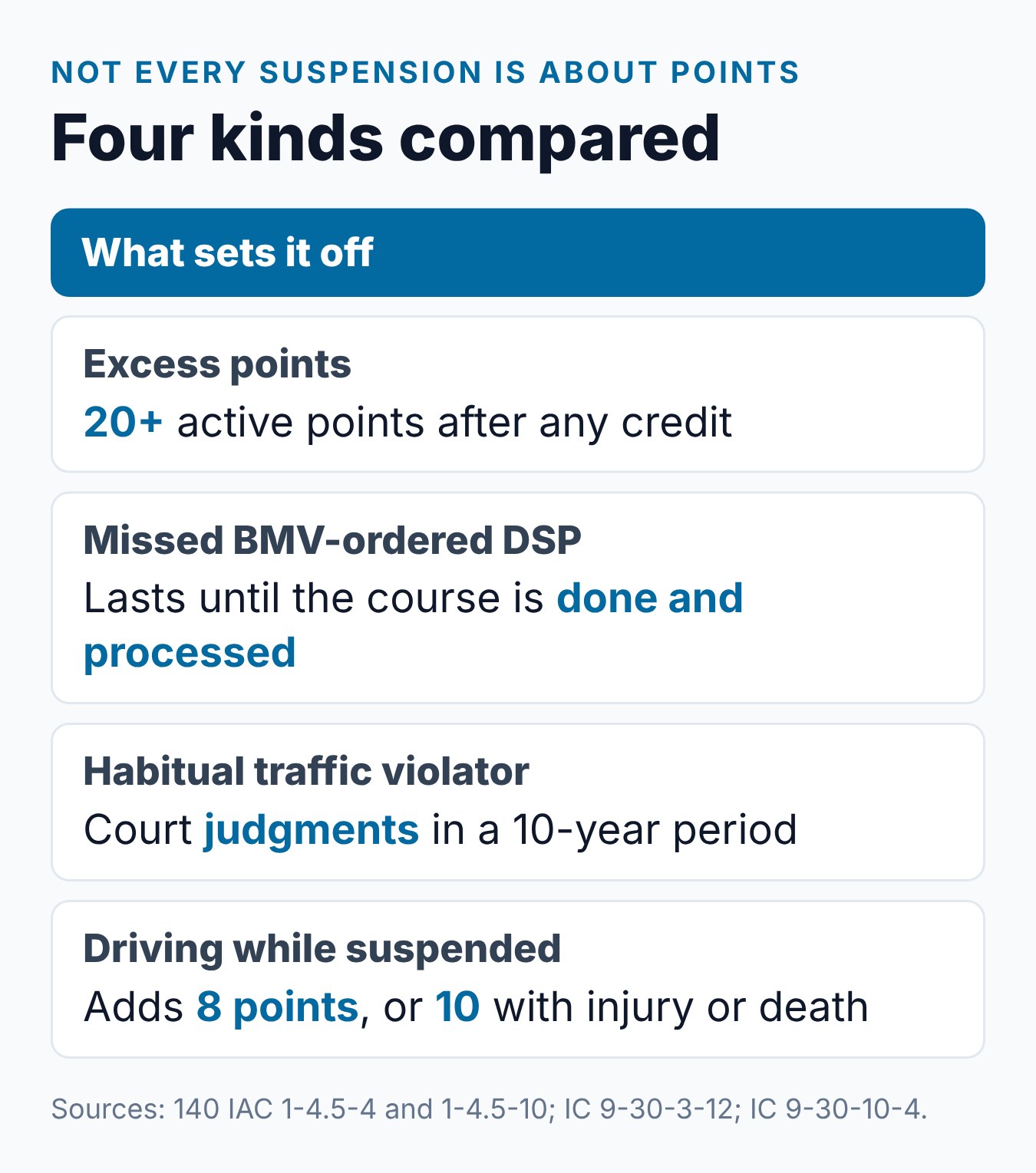
- Missed BMV-ordered DSP. Under IC 9-30-3-12, the BMV must suspend a driver who does not attend or finish a required DSP. The manual says it lasts “until such time as you successfully complete the DSP course and the completion is processed by the BMV.”
- Habitual traffic violator. IC 9-30-10-4 counts court judgments within a 10-year period, not points. Its levels are 2, 3 or 10 judgments, with lists of qualifying offenses.
A BMV-ordered DSP comes from convictions or judgments, not from points. Our guide to the BMV-ordered Driver Safety Program covers that notice and its 90 days.
Driving While Suspended Adds Points
Driving during a suspension makes things worse. Under the point table in 140 IAC 1-4.5-10, it carries 8 points.
If it results in bodily injury or death, it carries 10 points. Rule 140 IAC 1-4.5-8 adds that a person gets the same points and sanctions even without a valid license or permit.
How to Reinstate
Reinstatement steps depend on your record. The BMV’s driver record page links to a myBMV page on reinstatement requirements and fees.
Use these steps:
- Read your notice. Follow what it says, and check your record.
- Check myBMV. Look up your reinstatement requirements and any fees on myBMV.
- Clear other items. A missed BMV-ordered DSP needs the course done and processed.
- Order your record. The $4 Official Driver Record shows active and stayed suspensions.
This article does not list fee amounts. The amount depends on your record, so use the figure myBMV shows you.
What We Found on the Official Pages
On the BMV pages checked on October 26, 2026, the points page said, “Points stay active on an individual’s driving record for two years from the conviction date.” The DSP page showed a modified date of May 14, 2026.
The official 2026 edition of 140 IAC 1 still had the table above, with steps every 2 points. Neither page set a separate table for drivers under 21.
Common Mistakes to Avoid
Each item comes from 140 IAC 1-4.5 or IC 9-30-3-12:
- Counting inactive points. Only active points within 24 months count.
- Forgetting the credit. The table applies after any DSP credit.
- Using wide point bands. The table steps every 2 points, not every 5.
- Mixing up the hearing rule. The BMV hearing rule turns on three moving offenses in 12 months, not a point total.
- Thinking points trigger a DSP order. Convictions or judgments do.
- Driving while suspended. That adds 8 more points, or 10 with injury or death.
How Requirements Can Vary
Indiana’s point rules, the 4-point credit and the BMV’s Driver Safety Program order come from state law and BMV rules, and they apply statewide. What you must do still depends on whether you take the course by choice, because of a BMV notice, or under a court order. A court order sets its own deadline and proof steps.
Laws, fees and court practice can change. Check your BMV notice, your court order and the Indiana BMV website for current rules before you enroll or file anything.
Frequently Asked Questions
How many points suspend a license in Indiana?
Twenty active points within 24 months, after any DSP credit. That brings a one-month suspension under 140 IAC 1-4.5-4.
What happens at 14 points?
The rule calls for a warning notice at 14 to 18 active points. It is not a suspension.
Do old points count toward a suspension?
Only active points count. Points become inactive 24 months after the disposition date of the violation. The violation itself stays on your record, but its points no longer add to the total.
Does the DSP credit help before a suspension?
The table counts points after any DSP credit. A BMV-approved course adds a 4-point credit, once every three years. It does not remove the conviction.
Is the table different for drivers under 21?
No. The same table applies. Drivers under 21 have other rules, such as the under-21 DSP requirement and a written test at renewal with any active points.
Can I challenge a points suspension?
The rule says drivers who get a penalty have administrative review rights under IC 4-21.5-3. Ask an Indiana attorney about your own case.
Do tickets from other states count toward a suspension?
Yes, when Indiana has a matching violation. Rule 140 IAC 1-4.5-5 says the points are assessed as if the violation happened in Indiana.
How do I get my license back?
Check your reinstatement requirements and fees on myBMV. Finish anything else on your record, such as a required DSP.
Conclusion
So how many points to suspend license in Indiana? Twenty active points within 24 months, after any DSP credit, brings one month, and the table climbs to 12 months at 42 or more.
A 4-point credit from Driving Logic’s online Indiana Driver Safety Program counts before the table applies, once every three years. If a court ordered your course, check that the order allows an online course.
Related Articles
- Indiana Points on License: How the BMV System Works
- Indiana BMV Demerit Points Chart: How Many Points for Each Violation
- Indiana DSP 4 Point Credit: How It Works
- BMV Ordered Driver Safety Program Indiana: Who Gets One
Sources
- 140 IAC 1-4.5 — BMV point system rules
- Indiana BMV — Driver Record Points
- Indiana BMV — Citation Points & Driver Safety Program
- Indiana Code § 9-30-3-12 — Driver safety program
- Indiana BMV — Driver Record
- Indiana BMV — myBMV
Billy Forte is the owner of Driving Logic, a state-approved driver improvement course provider serving Indiana and other U.S. states.
This article is general information, not legal advice. Indiana BMV rules, court orders, fines and penalties depend on your notice, citation, court and case facts, and they can change. Use official Indiana BMV and court sources, and consult a qualified Indiana attorney for advice about your own case.