
Updated October 2026 · Reviewed by Billy Forte
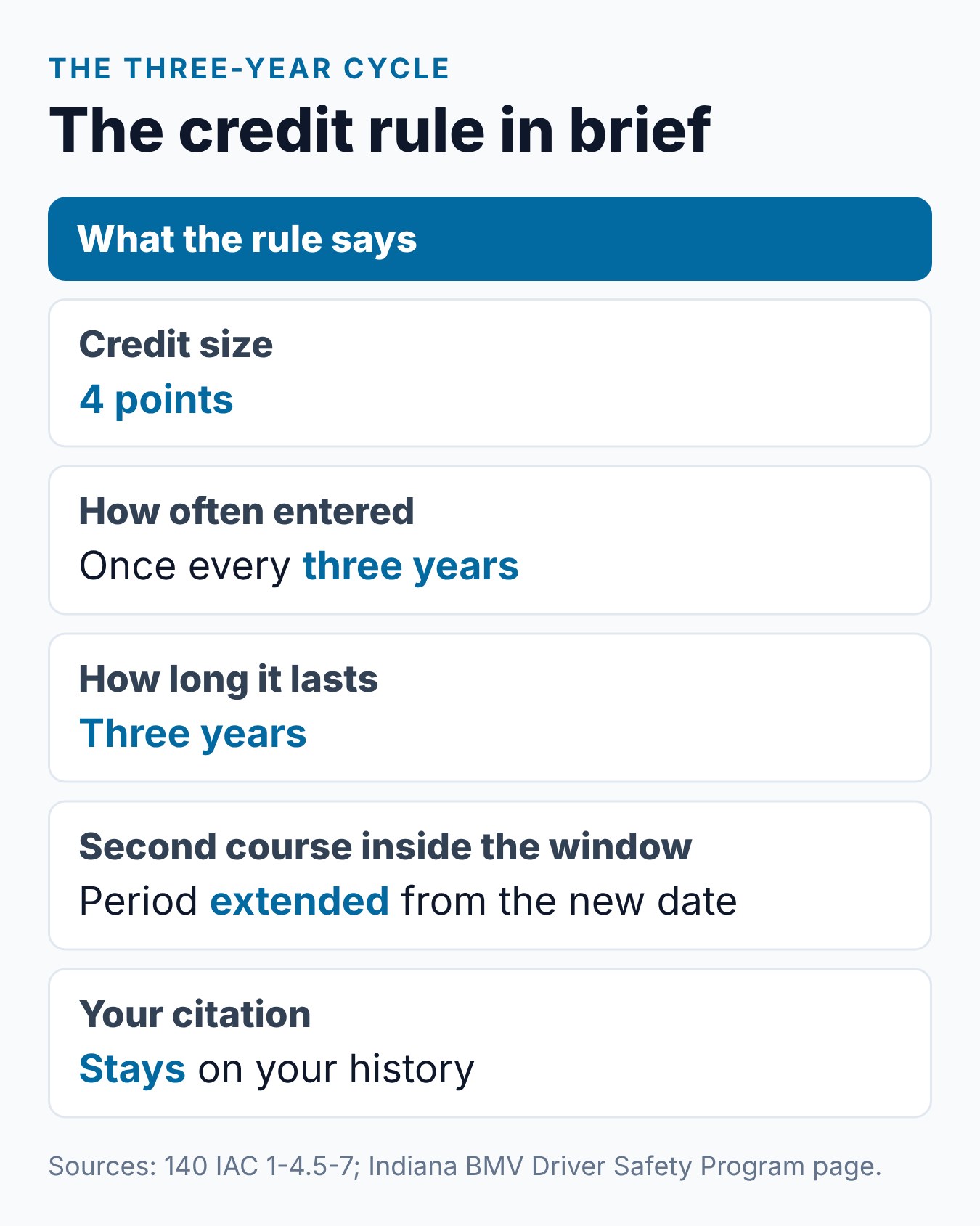
If you are asking how often can you take the Indiana Driver Safety Program, the answer is as often as you need to, but the 4-point credit can be entered on your record only once every three years. A second course inside that window does not add a second credit. Instead, the BMV extends the credit period three years from the new completion date.
Key Facts
- Taking the course: any Indiana driver can take a Driver Safety Program (DSP), and the BMV or a court can require it again. See course versus credit.
- The credit limit: the 4-point credit “may only be applied once every three years.” See the three-year rule.
- A second course early: no new credit; the credit period is extended three years from the new date. See taking it again early.
- Orders still count: a BMV notice still allows only 90 days, even when no new credit is possible. See when you must take it again.
- Check first: find your last completion date on your Official Driver Record. See checking your last course.
How Often Can You Take the Indiana Driver Safety Program?
Two separate questions hide inside “how often.” One is how often you may sit through a DSP. The other is how often the BMV will give you its 4-point credit for one.
The first answer is open. The BMV’s Driver Safety Program page says, “Any Indiana driver can take a DSP course.” It sets no limit on how many times a driver may take one.
The second answer has a firm limit. The credit is tied to a three-year cycle, and the rest of this article explains how that cycle works.
The Three-Year Rule
Two official sources set the rule, and they agree. The BMV says, “The credit may only be applied once every three years.”
The BMV’s point rule, 140 IAC 1-4.5-7, gives the details. It says a person who has “successfully completed and paid for” a BMV-approved program gets a four-point credit on the record. It adds that the credit “shall remain in effect for a three (3) year period” and “may only be entered on the record once every three (3) years.”
So the rule has two parts:
- How long the credit lasts: three years from the course.
- How often a new one can be entered: once in each three-year period.
Only a course from a provider on the BMV’s approved list counts. The BMV says credit can be applied “only if the course was completed by a BMV-approved” provider.
Taking It Again Early
Here is the part of the rule to read closely. If you finish another course before your three years run out, you do not get a second 4-point credit.
The BMV explains what happens instead: “if an additional course is completed, the time period of the credit will be extended for three years from the new course completion date.” The clock restarts from the newer course.
That pushes the next possible credit further out. In plain terms, a repeat course inside the window adds time to the old credit period, not points to your credit.
A Simple Timeline
Here is how the BMV’s wording plays out over time, using course dates only:
| What happens | What the BMV says follows |
|---|---|
| First BMV-approved course is finished | A 4-point credit is entered on the record |
| The credit’s period begins | It stays in effect for three years |
| A second course is finished inside those three years | No second credit is entered |
| That second course date | The credit period is extended three years from it |
| A BMV notice arrives during the period | The course is still due within 90 days of the notice |
The table uses only what the BMV and its rule say. The official pages do not walk through every case, such as how the credit lines up with points from later tickets. For your own record, ask the BMV.
When You Must Take It Again
The three-year rule limits the credit, not your duty to follow an order. Two kinds of orders can send you back to a DSP.
A BMV Order
IC 9-30-3-12 sends a driver back to class when any 12-month span holds two moving-violation results of these kinds: traffic misdemeanor convictions, traffic judgments, or one of each. A driver under 21 must also take one after twice being the driver in an incident that can carry points while under 21, with no 12-month limit.
The BMV mails the notice. The course must be done within 90 days of the notice date, or the BMV suspends driving privileges until the course is done and the BMV has processed it.
That is true even if your last course was recent and no new credit is possible. See BMV-ordered DSP.
A Court Order
A court may also require a DSP. The court’s order sets the deadline and the proof steps, and the BMV says the order may not require a BMV-approved course. A completed DSP also lets a court, if it chooses, suspend half the court costs owed on that traffic case.
Points alone never trigger a BMV order. Convictions or judgments do.
Taking It Again by Choice
You may take a DSP by choice at any time. Before you do, check whether a credit is possible.
If your last course was more than three years ago, a new BMV-approved course can earn a new 4-point credit. If it was less than three years ago, the new course will not add points to your credit. It will only extend the credit period from the new date.
Every approved course runs at least 4 hours, in English or Spanish, and costs no more than $55. The driver pays the course fee.
Repeat Course Cases
These short cases apply the BMV’s wording to a few timing questions. Each one assumes the course comes from a BMV-approved provider:
- Your last course was four years ago. The three-year period has run, so a new course can earn a new 4-point credit.
- Your last course was last year, and a BMV notice arrives. You must still finish within 90 days of the notice. No second credit is entered, and the credit period is extended from the new date.
- A court orders a course one year after your last one. Follow the order’s deadline and proof steps. The credit is not entered a second time inside the window.
- You want a course “just in case.” You may take one, but inside the window it only extends the period.
If your facts do not fit these cases, ask the BMV or your court. Neither the BMV page nor the rule covers every timing question.
Questions to Answer Before You Retake
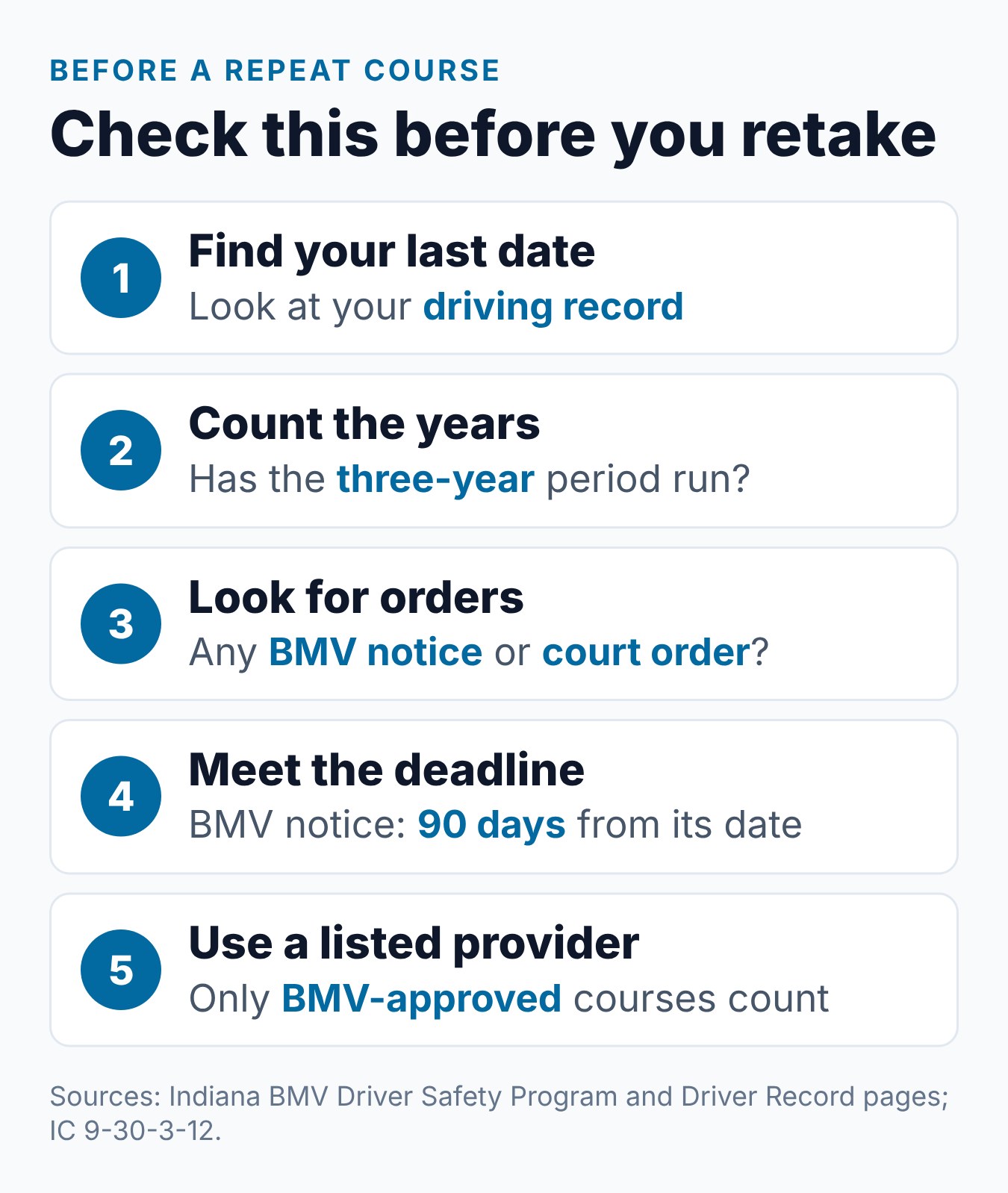
A few quick checks will tell you whether a repeat course will help:
- Do I have a BMV notice, and what date is on it?
- Does a court order name a course, a format or a deadline?
- When did I last finish a BMV-approved DSP?
- Has my three-year credit period run since then?
- Is the provider I picked on the BMV’s approved list?
If the answer to the first or second question is yes, the order comes first. The credit question comes second.
Checking Your Last Course
Your driving record is the place to start. The BMV’s Driver Record page offers two versions:
- Viewable Driver Record: a free online look through myBMV.
- Official Driver Record: the $4 certified version, which you can also order by mail on State Form 53789.
Look for your most recent DSP completion and its credit. Count three years from that course date before you take another one for credit. Our guide to checking your points covers the record in more detail.
How Points and the Credit Interact
The credit works against active points. Points become inactive 24 months after the conviction date, while the credit stays in effect for three years.
A simple example: a driver with 18 active points who completes a BMV-approved DSP has 14 after the credit. The BMV’s suspension levels count active points after any DSP credit, so the credit can matter near those levels. See how the 4-point credit works for more math.
The credit never removes a ticket. The BMV says completion “will not remove a citation from your driver history.”
What We Found on the Official Pages
Our check of the BMV’s Driver Safety Program page on October 26, 2026 found that it said the credit “may only be applied once every three years.” The same page said another course extends the credit period three years from the new completion date.
The rule text in 140 IAC 1-4.5-7 matched that. We found no BMV page that limits how many times a driver may take the course itself.
Common Mistakes to Avoid
Each item comes from a BMV page or an Indiana rule:
- Expecting two credits in three years. The credit is entered only once every three years.
- Retaking early “to reset” for points. A second course inside the window extends the period; it does not add a credit.
- Skipping an ordered course. A BMV notice still allows 90 days, credit or not.
- Using a provider that is not listed. Only BMV-approved courses earn the credit.
- Thinking the ticket is gone. Completion does not remove a citation from your driver history.
- Guessing your last course date. Check your driving record before you enroll for credit.
How Requirements Can Vary
Indiana’s point rules, the 4-point credit and the BMV’s Driver Safety Program order come from state law and BMV rules, and they apply statewide. What you must do still depends on whether you take the course by choice, because of a BMV notice, or under a court order. A court order sets its own deadline and proof steps.
Laws, fees and court practice can change. Check your BMV notice, your court order and the Indiana BMV website for current rules before you enroll or file anything.
Frequently Asked Questions
Can I take the Indiana DSP twice in one year?
Yes, you may take it. But only one 4-point credit can be entered every three years, so the second course will not add a credit. The BMV says it extends the credit period from the new date instead.
How long does the 4-point credit last?
Indiana’s rule says the credit “shall remain in effect for a three (3) year period.” It can be entered only once in that period.
What if the BMV orders a DSP while my credit is still active?
You still must finish the course within 90 days of the BMV’s notice. Missing that date means a suspension that lasts until the course is finished and processed.
Does a court-ordered course count toward the three-year limit?
The rule ties the credit to finishing a BMV-approved course, without limiting it to courses taken by choice. The BMV says a court order may not require a BMV-approved course, and only an approved one earns the credit.
How do I find my last DSP date?
Check your Indiana driving record. The Viewable Driver Record is free on myBMV, and the certified Official Driver Record costs $4.
Will a repeat course help if I am close to a suspension?
Only if a new credit can be entered. The BMV counts active points after any DSP credit, and 20 or more active points within 24 months brings a suspension. A course inside your three-year window extends the period but adds no new credit.
When can I earn a new credit?
A new credit can be entered once your three-year period has run. Remember that any course finished inside the period extends it three years from that course date.
Conclusion
You can take the Indiana Driver Safety Program as often as you need, but the 4-point credit counts only once every three years. A course inside that window extends the credit period instead of adding points to it.
When you are ready, see Driving Logic’s online Indiana Driver Safety Program. If a court ordered your course, check that the order allows an online course.
Related Articles
- Indiana Driver Safety Program: The Complete Guide
- Indiana DSP 4 Point Credit: How It Works
- BMV Ordered Driver Safety Program Indiana: Who Gets One
- How to Check Points on License Indiana: myBMV Steps
Sources
- Indiana BMV — Citation Points & Driver Safety Program
- 140 IAC 1-4.5 — BMV point system rules
- Indiana Code § 9-30-3-12 — Driver safety program
- Indiana BMV — Driver Record
- Indiana BMV — myBMV
Billy Forte is the owner of Driving Logic, a state-approved driver improvement course provider serving Indiana and other U.S. states.
This article is general information, not legal advice. Indiana BMV rules, court orders, fines and penalties depend on your notice, citation, court and case facts, and they can change. Use official Indiana BMV and court sources, and consult a qualified Indiana attorney for advice about your own case.