
Updated October 2026 · Reviewed by Billy Forte
The Florida traffic violation points chart comes from s. 322.27(3)(d), which gives each moving violation 3, 4 or 6 points when you are convicted. Illegal phone use in a school safety zone adds 2 more, and camera tickets carry none. FLHSMV may suspend a license when the total reaches 12, 18 or 24 points within set time windows.
Key Facts
- Where the values come from: s. 322.27(3)(d), plus the FLHSMV points table. See the points chart.
- 3 points: speeding 15 mph over or less, careless driving and other moving violations. See 3-point violations.
- 4 points: speeding more than 15 over, red light, reckless driving and more. See 4-point violations.
- 6 points: crash-linked speeding or phone use, leaving the scene and railroad crossings. See 6-point violations.
- No points: camera tickets; seat belt is a nonmoving violation. See tickets with no points.
The Florida Traffic Violation Points Chart
Florida sets point values in s. 322.27(3)(d), Florida Statutes. The FLHSMV Points and Point Suspensions page shows most of the same rules in table form.
Where they differ, the statute controls. A few values, such as careless driving and child restraint, come from that FLHSMV table.
| Offense (if convicted) | Points | Source |
|---|---|---|
| Speeding, not more than 15 mph over the limit | 3 | s. 322.27(3)(d) |
| Speeding, more than 15 mph over the limit | 4 | s. 322.27(3)(d) |
| Failing to stop at a traffic signal (officer-issued red light) | 4 | s. 322.27(3)(d) |
| Reckless driving | 4 | s. 322.27(3)(d) |
| Passing a stopped school bus | 4 | s. 322.27(3)(d) |
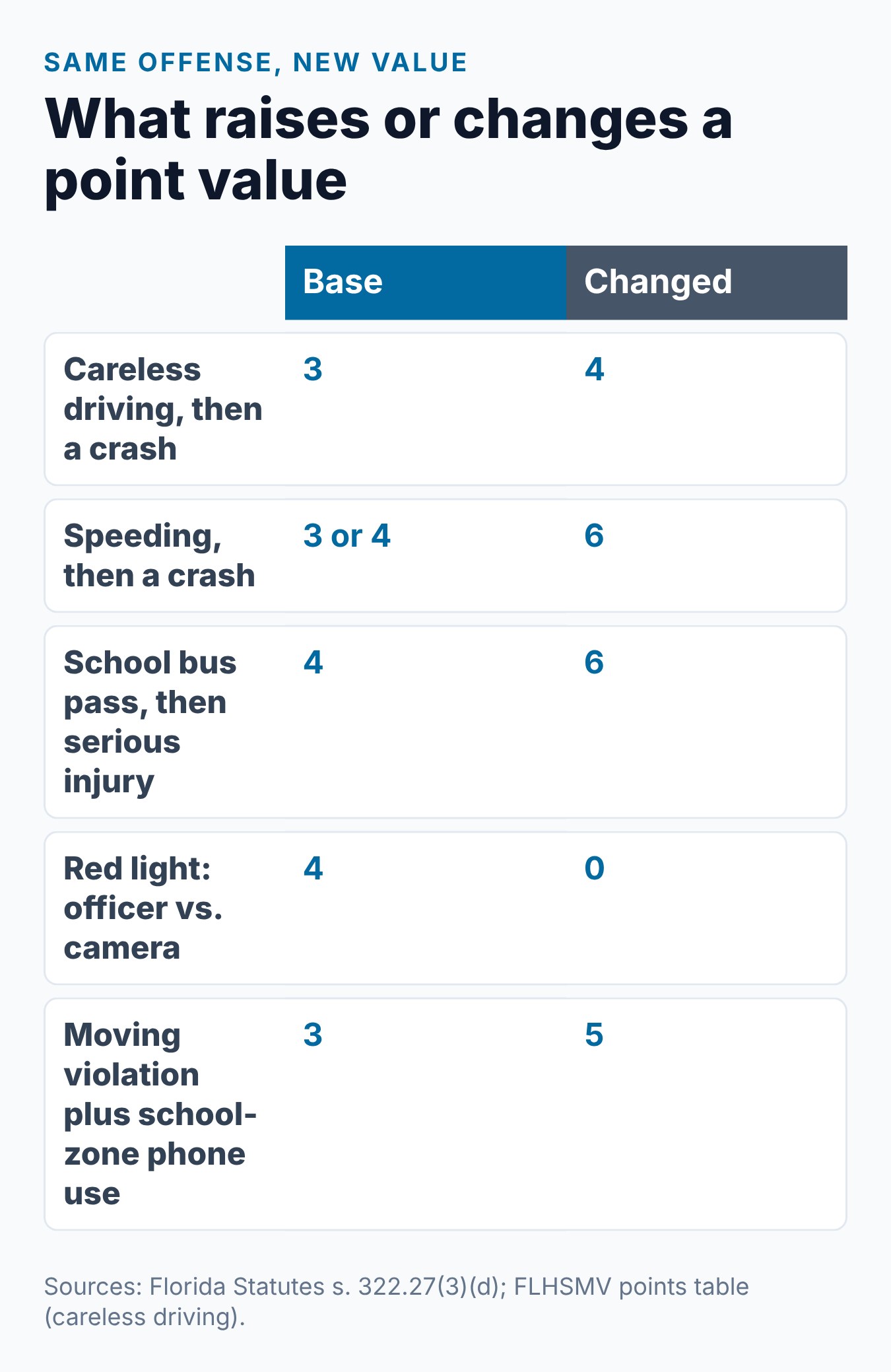
| Passing a stopped school bus, with serious injury or death | 6 | s. 322.27(3)(d) |
| Careless driving | 3 | FLHSMV points table |
| Child restraint violation | 3 | FLHSMV points table |
| All other moving violations | 3 | s. 322.27(3)(d) |
| A moving violation that causes a crash (not speeding or phone use) | 4 | s. 322.27(3)(d) |
| Speeding or phone use that causes a crash | 6 | s. 322.27(3)(d) |
| Leaving the scene of a crash, more than $50 in damage | 6 | s. 322.27(3)(d) |
| Railroad crossing violation | 6 | s. 322.27(3)(d) |
| Illegal phone use in a school safety zone, with a moving violation | +2 | s. 322.27(3)(d) |
| Red light or school zone speed camera ticket | 0 | s. 322.27(3)(d) |
Points come with a conviction. Paying the civil penalty without electing a course counts as one under s. 322.01(11).
How to Read the Chart
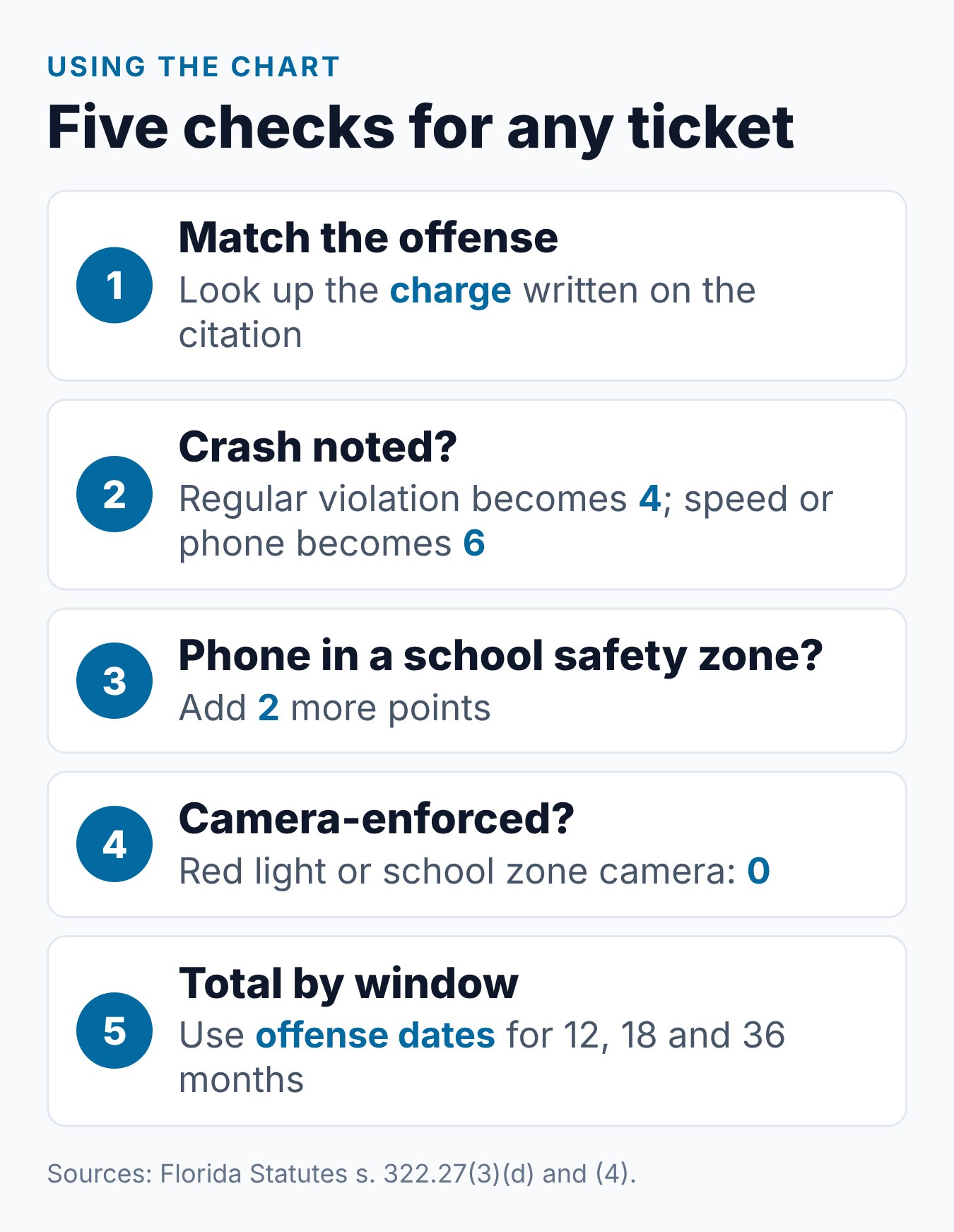
Start with the offense on your ticket. Then check two things.
First, check whether the ticket says the violation caused a crash. A crash raises the value: to 4 points for a regular moving violation, or 6 for speeding or phone use.
Second, check whether the ticket adds unlawful phone use in a school safety zone. That adds 2 points on top of the moving violation.
3-Point Violations
Three points is the base value. Section 322.27(3)(d) gives 3 points to “All other moving violations,” including parking on a highway outside city limits.
These carry 3 points:
- Speeding that is not more than 15 mph over the limit.
- Careless driving, under the FLHSMV table.
- Child restraint violations, under the FLHSMV table.
- Other moving violations the law does not list with a higher value.
Our careless driving guide explains that offense and how it compares with reckless driving.
4-Point Violations
Four points cover more serious conduct and crashes that are not linked to speed or a phone:
- Speeding more than 15 mph over the limit.
- Failing to stop at a traffic signal, when an officer writes the ticket.
- Reckless driving, which is also a crime under s. 316.192.
- Passing a stopped school bus, with no serious injury.
- A moving violation that results in a crash, other than speeding or phone use.
For speeding in detail, see how many points a speeding ticket adds.
6-Point Violations
Six points is the top value in s. 322.27(3)(d). It applies to:
- Speeding that results in a crash.
- Unlawful phone use that results in a crash.
- Leaving the scene of a crash with property damage of more than $50.
- Passing a stopped school bus when it causes serious bodily injury or death.
- A railroad crossing violation.
Leaving the scene of a property-damage crash is also a crime. Under s. 316.061, it is a misdemeanor of the second degree.
The School Safety Zone Phone Add-On
One rule adds points instead of setting a total. Section 322.27(3)(d) assigns 2 points for unlawful use of a wireless device in a school safety zone. Those points are “in addition to the points assigned for the moving violation.”
So a 3-point moving violation with illegal phone use in a school safety zone totals 5 points. A 4-point violation with the same add-on totals 6.
School and work zones do not add points for speeding. Only the phone rule adds points for the zone.
Tickets With No Points
A few tickets should not appear with points:
- Red light camera tickets. No points under s. 322.27(3)(d)6 when the case is enforced by a traffic infraction enforcement officer.
- School zone speed camera tickets. Section 322.27(3)(d)5.c says the same.
- Seat belt tickets. Section 316.614(8) makes a seat belt violation a nonmoving violation. The chart does not list it with points.
Camera violations also may not be used to set insurance rates. An officer-issued red light ticket is different. It carries 4 points.
Using the Chart to Watch Your Total
The chart tells you what each conviction adds. Section 322.27(3) then lets FLHSMV suspend at three levels:
- 12 points from offenses within 12 months: up to 30 days.
- 18 points from offenses within 18 months: up to 3 months.
- 24 points from offenses within 36 months: up to 1 year.
FLHSMV counts the windows from offense dates, under s. 322.27(4). Here is the math with chart values. A 6-point crash ticket plus two 3-point tickets inside 12 months reach 12.
Our license suspension guide covers what happens next. A points suspension calls for Advanced Driver Improvement (ADI) under s. 322.291.
Where BDI Fits With the Chart
The chart shows points for a conviction. A valid Basic Driver Improvement (BDI) election means the chart value is never assessed for that ticket. FLHSMV and clerks also call this course “traffic school.”
Under s. 318.14(9), a valid election means:
- The court withholds adjudication, so no points are assessed.
- The civil penalty is lowered 18 percent but still owed.
- The driver must notify the Clerk of Court within 30 days of the citation and pay the election fee.
Some offenses on the chart cannot be elected. They include speeding 30 mph or more over, and crimes such as reckless driving or leaving the scene.
Tickets that need a hearing under s. 318.19 are also excluded, such as passing a school bus on the side children enter and exit. CDL and CLP holders cannot elect at all, and the limits are one election in 12 months and eight in a lifetime.
Teen Drivers and Out-of-State Tickets
The chart values are the same for every age. Drivers aged 15 through 17 also face a 6-point rule under s. 322.161. Six or more points in 12 months limits the license to “business purposes only.”
Tickets from other states can count too. Under s. 322.27(3)(e), an out-of-state conviction may be recorded with the same points as the Florida offense.
How Long Chart Points Stay
FLHSMV says points stay on the record at least 5 years from the disposition date. That rule is the same for 3, 4 and 6-point offenses.
The only deduction in the law is 3 points after a first points suspension and reinstatement, under s. 322.27(3)(h). Our points system guide explains how these rules fit together.
Matching the Chart to Your Record
Your driving record lists each conviction with its points. FLHSMV says you can buy a 3-year, 7-year or complete record, and the record “will indicate the number of points.” A free online status check exists, but it does not show points.
Compare each entry with the chart. An entry marked “adjudication withheld” after a valid election should carry no points. Our guide on checking points on your license lists the record fees.
Chart Points and Insurance
Point values and insurance rules are separate, but one speed line matters for both. Under s. 626.9541(1)(o)4, an insurer may not surcharge or non-renew solely for one noncriminal infraction. The exceptions include speeding more than 15 mph over, a second infraction in 18 months and a third in 36 months.
What We Found on the Official Pages
On the statute and FLHSMV pages we checked on October 27, 2026, the values in s. 322.27(3)(d) matched this chart. The FLHSMV table listed careless driving and child restraint at 3 points.
The FLHSMV table also listed “SPEEDING” at 3 points in one row. The statute is more exact and gives 4 points above 15 mph over. Where the two differ, the statute controls.
Common Mistakes
Each mistake below is checked against Florida law or the FLHSMV table:
- Listing careless driving at 4 points. It is 3, or 4 if it causes a crash.
- Giving 4 points at exactly 15 mph over. The 4 points start above 15.
- Adding points for a school zone. Only illegal phone use in a school safety zone adds points.
- Counting a camera ticket. Camera tickets carry no points.
- Putting seat belts on the chart. A seat belt ticket is a nonmoving violation.
- Calling reckless driving 6 points. It is 4 points, and it is a crime.
How Requirements Can Vary
Florida’s election rules, point values and suspension levels come from Florida Statutes and FLHSMV, and they apply statewide. The election fee, the date to finish the course and how proof is filed are set by the Clerk of Court in the county on your ticket, or by the court. A court order sets its own deadline and proof steps.
Laws, fees and clerk practice can change. Check your citation, your clerk’s instructions, any court order and the FLHSMV website before you enroll or file anything.
Frequently Asked Questions
What is the highest point value for one Florida ticket?
Six points is the highest single value in s. 322.27(3)(d). It covers speeding or phone use that causes a crash, leaving the scene with more than $50 in damage, a railroad crossing violation and passing a school bus with serious injury or death.
How many points is running a red light?
An officer-issued red light ticket is 4 points. A red light camera ticket enforced by a traffic infraction enforcement officer carries no points.
Is careless driving 3 or 4 points?
Careless driving is 3 points on the FLHSMV table. It is 4 points if it results in a crash, under the crash rule in s. 322.27(3)(d).
Does a seat belt ticket add points in Florida?
No. A seat belt violation is a nonmoving violation under s. 316.614(8), and the chart does not list it with points.
Do school zone tickets add extra points?
No, unless the ticket includes illegal phone use in a school safety zone. That adds 2 points to the moving violation.
Can a BDI election stop chart points?
Yes, for one eligible ticket. A valid election within 30 days means no points are assessed for it. It does not remove points from earlier convictions.
Conclusion
The Florida points chart gives 3, 4 or 6 points per conviction, adds 2 for illegal phone use in a school safety zone, and gives no points for camera tickets. Find your offense, check for a crash, and add your total by offense date. If you are eligible, you have 30 days from the citation date to elect the course. Take the Florida BDI course online if you elect.
Related Articles
- Florida Driver License Points System: Suspensions, Point Values, and BDI Options
- How Many Points Is a Speeding Ticket in Florida?
- Careless Driving in Florida: How Many Points and What Happens?
- Florida License Suspension for Points: What Happens and Reinstatement Options
Sources
- Florida Statutes s. 626.9541 — Unfair insurance trade practices
- Florida Statutes s. 322.27 — Authority to suspend or revoke a license (point system)
- FLHSMV — Points and Point Suspensions
- Florida Statutes s. 322.01 — Definitions
- Florida Statutes s. 316.614 — Safety belt usage
- Florida Statutes s. 318.14 — Noncriminal traffic infractions; procedures
- Florida Statutes s. 318.19 — Infractions requiring a mandatory hearing
- Florida Statutes s. 316.192 — Reckless driving
- Florida Statutes s. 316.061 — Crashes involving damage to vehicle or property
- Florida Statutes s. 322.161 — High-risk drivers; restricted licenses
- Florida Statutes s. 322.291 — Driver improvement schools required in certain suspension cases
Billy Forte is the owner of Driving Logic, a driver improvement course provider serving Florida and other U.S. states.
This article is general information, not legal advice. Election rules, deadlines, fines and penalties depend on your citation, county, court and case facts, and they can change. Use official FLHSMV, Florida Statutes and Clerk of Court sources, and consult a qualified Florida attorney for advice about your own case.