
Updated October 2026 · Reviewed by Billy Forte
A Virginia DMV advisory letter is a warning, not a penalty: DMV may mail it to a driver age 18 or older who has 8 demerit points in 12 months or 12 points in 24 months. The letter lists your convictions and points, and it does not order you to take a class. Read it, check your point balance, and decide whether a voluntary Driver Improvement Clinic makes sense for you.
Key Facts
- What it is: a warning letter under Code § 46.2-495, for drivers 18 and older. See what the letter is.
- When it may come: at 8 demerit points in 12 months or 12 in 24 months. See when DMV may send it.
- What it is not: a clinic order. That comes at 12 points in 12 months or 18 in 24. See letter vs. order.
- No letter, no excuse: not getting the letter does not waive any later step. See if no letter arrives.
- Your option: a voluntary clinic can subtract 5 points from your total, once in 2 years. See the voluntary clinic.
What a Virginia DMV Advisory Letter Is
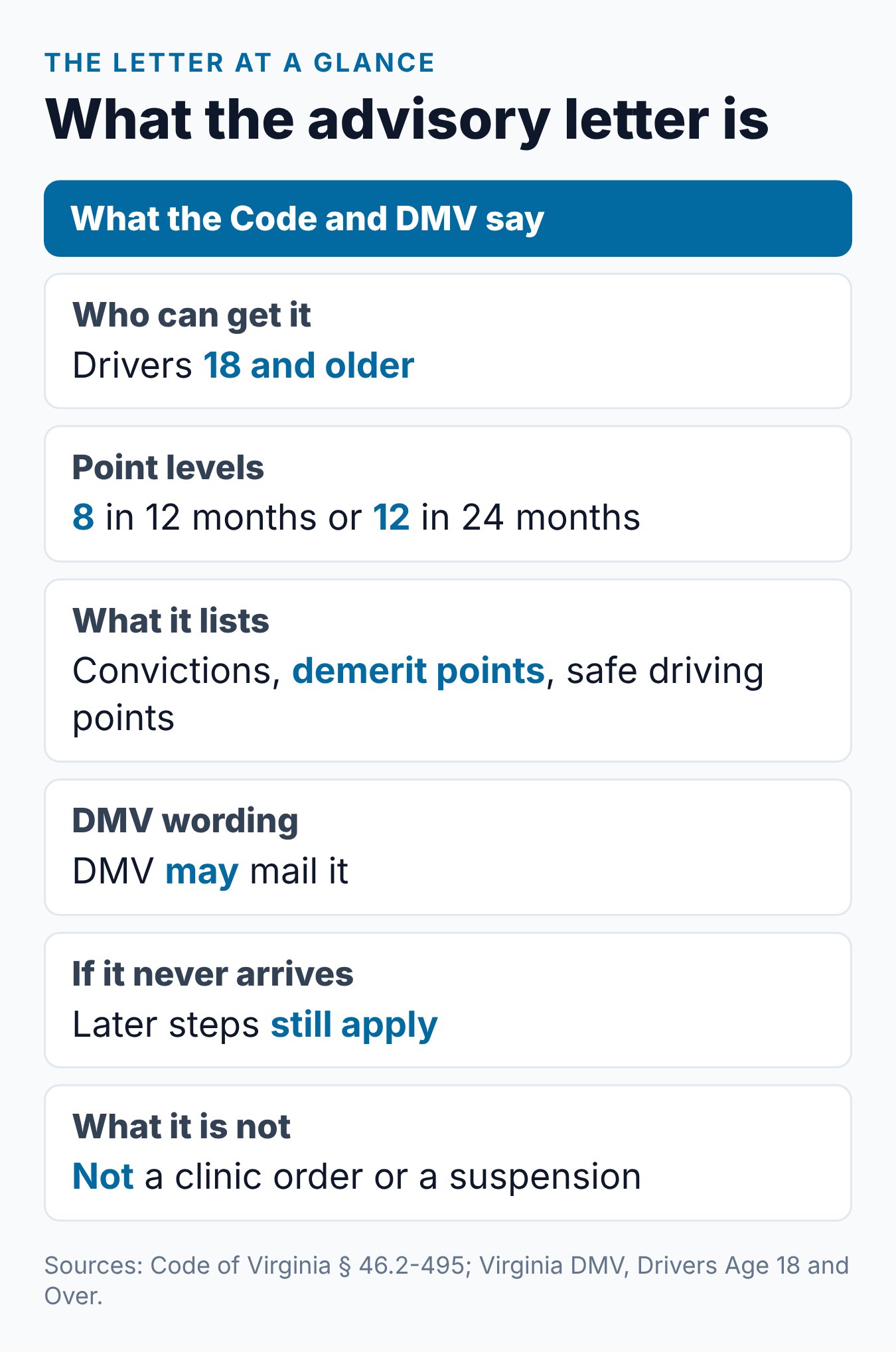
The advisory letter is the first warning in Virginia’s Driver Improvement Program. The rule is in Code § 46.2-495. It lets the DMV Commissioner mail a letter when your record shows a set number of demerit points.
DMV’s page for drivers age 18 and over explains its purpose. It says you “will receive an advisory letter that cautions you about the consequences of violating the law.”
So the letter is a caution. It does not suspend your license, and it does not set a deadline. It tells you where your record stands before stronger steps apply.
When DMV May Send It
The letter is tied to points from convictions. Under § 46.2-495, DMV may mail it when a driver age 18 or older has:
- at least 8 demerit points from offenses committed within 12 consecutive months, or
- at least 12 demerit points from offenses committed within 24 consecutive months.
Note the word “may.” The law lets DMV send the letter, but it does not say DMV must. The letter goes by first-class mail to your last known address.
Each conviction carries 3, 4 or 6 demerit points. For example, speeding 1 to 9 mph over is 3 points, 10 to 19 over is 4, and 20 or more over is 6. Points count for 2 years from the offense date, not the court date.
Tickets from other states count too. DMV says demerit points are assigned for traffic convictions in other states. For the full system, see the Virginia DMV points system guide.
What the Letter Lists
The Code says what the letter covers. It lists your convictions and “the demerit points assigned thereto, including his safe driving points, if any.”
That gives you a snapshot of three things:
- Your convictions that carry points.
- The demerit points for each one.
- Your safe driving points, if you have any.
Safe driving points work against demerit points. DMV gives 1 safe point for each full calendar year with a valid Virginia license and no violations or suspensions.
Those points are added in early April for the year before. The balance can never go above +5.
A Warning, Not a Clinic Order
An advisory letter and a clinic order are two different steps. The letter asks you to pay attention. The order requires action by a deadline.
| Advisory letter | DMV clinic order | |
|---|---|---|
| Point level (age 18+) | 8 in 12 months or 12 in 24 | 12 in 12 months or 18 in 24 |
| Code section | § 46.2-495 | § 46.2-498 |
| DMV wording | DMV “may” mail it | DMV “shall” direct you to a clinic |
| Deadline | None | 90 days to finish the clinic |
| If you do nothing | No penalty from the letter | License suspended until you finish |
Under Code § 46.2-498, the order is required at the higher level. DMV’s Driver Improvement page says that if you do not finish in 90 days, “your driving privilege will be suspended” until you do.
The DMV-ordered clinic guide explains the order notice and the 90 days.
If No Letter Arrives
Some drivers never get the letter. The law plans for that. Section 46.2-495 says DMV’s “failure to mail, or the citizen’s nonreceipt of the advisory letter” is not grounds for waiving any other rule.
In plain words, the later steps still apply. If your points reach the clinic-order level, DMV can still order the clinic. A missing letter does not pause the count.
That is why your own record matters more than your mailbox. Keep your address current with DMV so notices reach you. Check your balance yourself as well.
What Comes After the Letter
The letter is the lowest step. Here is what the Code sets out if more points follow, for drivers 18 and older:
- Clinic order. At 12 points in 12 months or 18 in 24, DMV directs you to a clinic. You have 90 days to finish.
- Probation. A driver directed to a clinic is placed on 6 months of probation. A point violation during probation brings a 45-, 60- or 90-day suspension, for 3, 4 or 6 points.
- Control period. After probation comes an 18-month control period under Code § 46.2-500. A point violation in it means 6 more months of probation.
- Higher totals. At 18 points in 12 months or 24 in 24, Code § 46.2-506 (amended in 2025) sets a 90-day suspension plus the clinic. The other choice is 9 months in the Intelligent Speed Assistance Program plus the clinic.
The control period comes only after probation. The letter has no link to it. See the control period guide for how that period works, and the program explained for every step in order.
Drivers Under 20 Follow Different Rules
The advisory letter rule in § 46.2-495 covers drivers 18 and older. Young drivers face extra rules.
- Ages 18 and 19. Any demerit-point offense, or a seat belt or child restraint violation, means a required clinic under Code § 46.2-334.02.
- Under 18. DMV acts by the number of convictions, not point totals. The first conviction means a clinic within 90 days. The second means a 90-day suspension. The third means revocation for 1 year or until age 18, whichever is longer.
DMV’s page for drivers under 18 lists these steps. For a parent’s view, see the teen clinic guide.
What You Can Do After an Advisory Letter
The letter sets no deadline. Still, a few steps can help you plan:
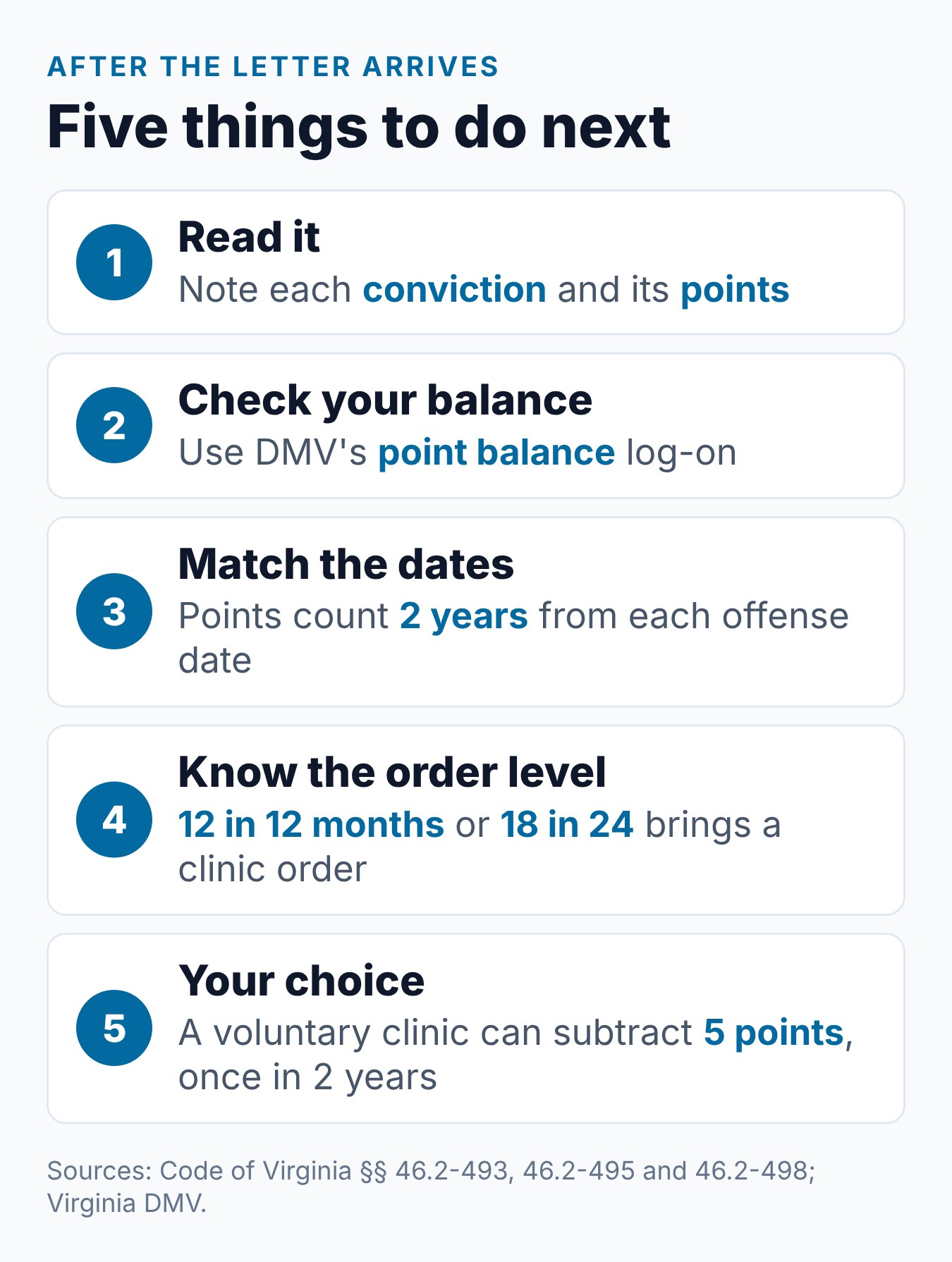
- Read the whole letter. Note each conviction and its points.
- Check your point balance. DMV’s Points System page links to “Log on to See Your Point Balance.”
- Match the offense dates. Points count for 2 years from each offense date.
- Compare with the order level. Count how close you are to 12 in 12 months or 18 in 24.
- Decide on a voluntary clinic. It is your choice, since the letter does not require one.
Questions about a pending ticket or court case belong with the court or a Virginia attorney. DMV can answer questions about your record.
How a Voluntary Clinic Affects Your Total
Any Virginia driver may take the Driver Improvement Clinic (DIC) by choice. Section 46.2-498 says a person who completes it shall have “five demerit points subtracted” from the point total. DMV describes the same benefit as 5 safe driving points.
The limits matter:
- Once in 2 years. The point benefit comes once every 24 months.
- A +5 cap. Your safe driving point balance never goes above +5.
- Points or insurance, not both. You choose the point benefit or an insurance discount, not both, in a 2-year period.
- Tell the provider your reason. DMV’s Reasons for Attending page says to state why you are attending and show a government-issued photo ID.
- Insurance-only completions earn no points.
Here is the math. A driver with 10 demerit points who completes an eligible clinic has 5 subtracted from the total. The convictions themselves stay on the driving record.
Choosing a Clinic
Some people search for a “defensive driving” class after a letter. In Virginia, the official course is the Driver Improvement Clinic. DMV says the Driver Improvement Clinic teaches defensive driving techniques.
DMV’s clinics page and online clinic page set the shared rules:
- Length. The clinic is 8 hours. Online, the 8 hours include the final test.
- Price. A clinic may charge no more than $100.
- Online. You must use a DMV-licensed online provider. The final test is taken with the same provider, once per business day.
- Identity. Your ID is checked during the course and before the test.
- Reporting. The online provider reports your completion to DMV within 24 hours.
To check a provider, use DMV’s “Driver Training Schools and Clinics” search with the Online Clinic filter.
What We Found on the Official Pages
On the DMV and Code pages we checked on October 27, 2026, the wording matched the rules above. The over-18 page said an advisory letter “cautions you about the consequences of violating the law.”
The Code page for § 46.2-495 still said DMV “may mail” the letter. Its history line showed no 2025 or 2026 change.
The over-18 page also described only the 90-day suspension at the highest point level. It did not yet mention the Intelligent Speed Assistance choice added to § 46.2-506 in 2025.
Common Mistakes After an Advisory Letter
Each item below comes from the Code or a DMV page:
- Treating the letter as a clinic order. The letter sets no deadline. An order comes at 12 points in 12 months or 18 in 24.
- Thinking no letter means no problem. Nonreceipt does not waive later steps.
- Counting from the court date. Points count for 2 years from the offense date.
- Linking the letter to the control period. The 18-month control period follows probation.
- Taking the clinic only for insurance and expecting points. Insurance-only completions earn no points.
- Expecting a ticket to leave the record. The clinic changes your point total, not your list of convictions.
How Requirements Can Vary
Virginia’s point rules, safe driving points and DMV clinic orders come from the Code of Virginia and DMV rules, and they apply statewide. What you must do still depends on whether you take the clinic by choice, because of a DMV notice, or under a court order. A court order sets its own deadline and proof steps.
Laws, fees and court practice can change. Check your DMV notice, your court order and the Virginia DMV website for current rules before you enroll or file anything.
Frequently Asked Questions
What does a Virginia DMV advisory letter mean?
It means your record has reached at least 8 demerit points in 12 months or 12 in 24 months. DMV sends it as a warning. It does not suspend your license or order a clinic.
Do I have to take a clinic after an advisory letter?
No. The letter does not require a clinic. DMV orders one only at 12 points in 12 months or 18 in 24, or under the separate rules for drivers under 20.
Do I need to reply to the letter?
The letter is a caution, and § 46.2-495 sets no deadline for it. Read it closely. Then check your point balance with DMV.
Will I always get an advisory letter before a clinic order?
Not always. The Code says DMV “may” mail it. If no letter arrives, the later steps still apply.
Is the control period tied to the advisory letter?
No. The 18-month control period begins after probation, and probation follows a clinic order. The letter is a separate, earlier step.
Can a voluntary clinic help after a letter?
It can lower your total. Code § 46.2-498 subtracts 5 demerit points for an eligible completion, once in 2 years. Your safe point balance never goes above +5.
Do points from other states count?
Yes. DMV assigns demerit points for traffic convictions from other states. Those points go on your Virginia record like any others.
Conclusion
A Virginia DMV advisory letter is an early warning, not a penalty or an order. Check your balance, note your offense dates, and watch the clinic-order level of 12 points in 12 months or 18 in 24.
If you choose a voluntary clinic, you can take the Virginia Driver Improvement Course online. If a court is also involved in your case, ask the court whether it accepts an online course.
Related Articles
- Court-Ordered Driver Improvement Clinic in Virginia: What to Do
- DMV-Ordered Driver Improvement Clinic in Virginia: Points, Notices, and Deadlines
- Virginia Driver Improvement Program: Points, Orders, and Clinics Explained
- What Is the Virginia DMV Control Period and How Does It Work?
Sources
- Virginia DMV — Traffic Violations, Drivers Age 18 and Over
- Code of Virginia § 46.2-495 — Advisory letters
- Code of Virginia § 46.2-498 — Driver improvement clinics; voluntary attendance
- Code of Virginia § 46.2-500 — Driver control period
- Virginia DMV — Driver Improvement
- Virginia DMV — The Points System
- Virginia DMV — Reasons for Attending a Driver Improvement Course
- Virginia DMV — Traffic Violations, Drivers Under Age 18
- Virginia DMV — Driver Improvement Clinics
- Virginia DMV — Complete an Online Driving Improvement Clinic
Billy Forte is the owner of Driving Logic, a state-approved driver improvement course provider serving Virginia and other U.S. states.
This article is general information, not legal advice. Virginia DMV rules, court orders, fines and penalties depend on your notice, summons, court and case facts, and they can change. Use official Virginia DMV and court sources, and consult a qualified Virginia attorney for advice about your own case.