
Updated October 2026 · Reviewed by Billy Forte
Here is how to get learners permit Texas teens need at 15: finish the first part of a licensed driver education course, get the DE-964 and book a DPS visit with the right papers. At the office, the teen passes a vision exam and, if needed, a knowledge exam, then pays the $16 fee. The nine steps below follow the DPS and TDLR pages in order.
Key Facts
- Age: classroom can start at 14, and the application can start at 15. See step 1.
- Classroom first: 6 hours on the concurrent method or 24 on the block method. See step 2.
- Adult at the visit: a parent or guardian, or a notarized application. See step 5.
- Exams: vision at the office, and knowledge unless it was passed in the course. See step 8.
- Fee: $16 for applicants under 18. See step 9.
Before You Start
Two choices shape your timeline. The first is where the classroom hours come from. The second is the method.
Choosing Where the Classroom Hours Come From
DPS lists four teen options: a traditional driving school course, an online course from a driving school, a parent-taught course and public school driver education. Some public schools offer it, so check with yours.
For a parent-taught course, the family buys the curriculum from a TDLR-licensed provider with the parent-taught endorsement. First, the parent applies to TDLR for the instructor designation, which costs $20. Our Program Guide article explains that application.
TDLR’s classroom page says course prices vary. It does not recommend specific courses, but it says all courses have been reviewed for educational standards.
How the Method Changes the Steps
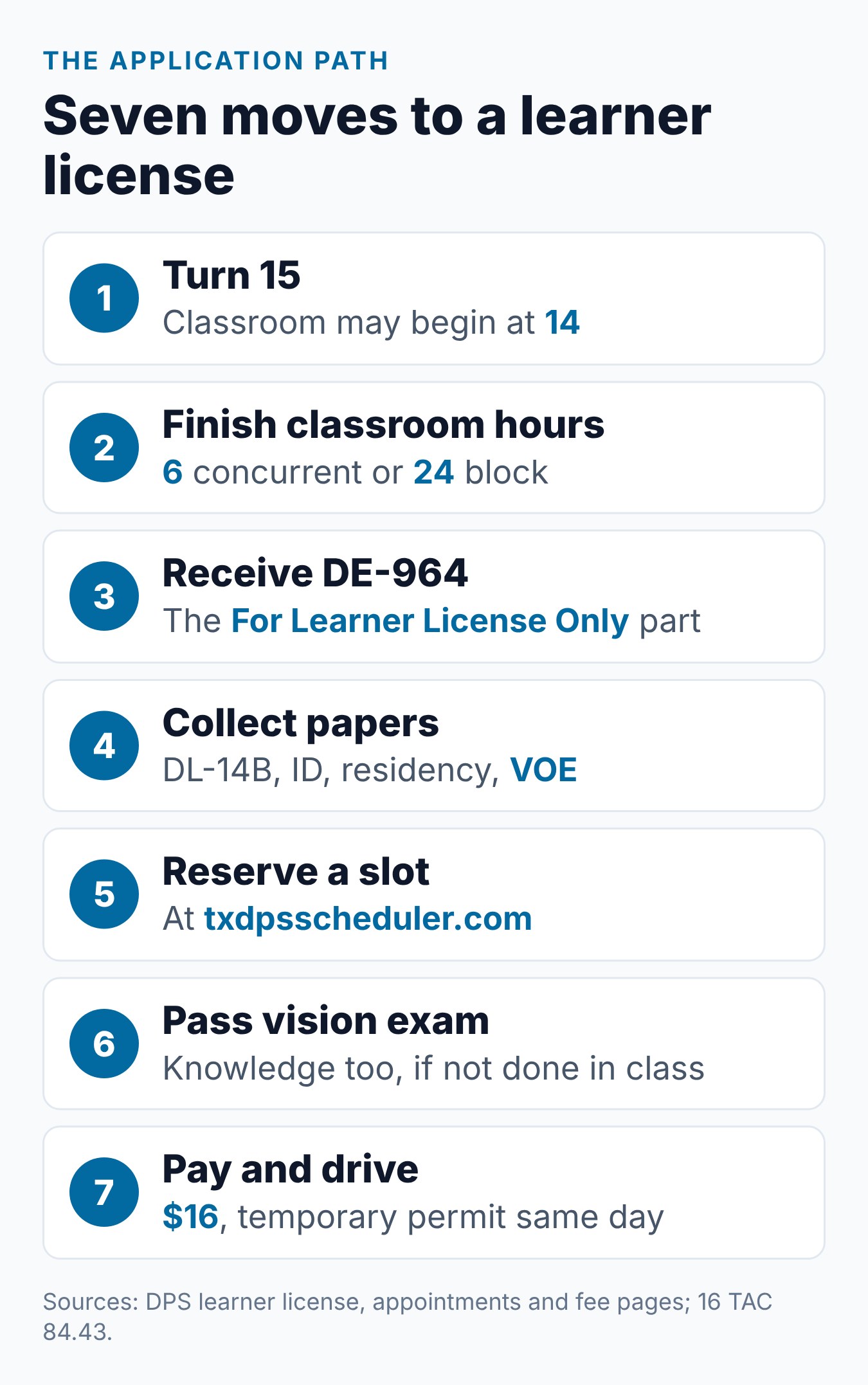
The method decides how many classroom hours come before the application. The concurrent method needs 6 hours first. The block method needs all 24.
DPS says the concurrent method lets the teen get behind the wheel sooner. The trade-off is that the last 18 classroom hours happen during the practice months.
The written exam timing follows the method. DPS places it after the first 6 hours on the concurrent method, or after all 24 on the block method. Our method comparison can help you pick.
How to Get Learners Permit Texas Teens Need, Step by Step
Each step below names the official page it comes from. Do them in this order to avoid a second trip.
Step 1: Confirm the Age Rules
DPS says a teen can begin classroom driver education at 14. The learner license application waits until the teen is at least 15.
So a 14-year-old can get a head start on the course. The DPS visit is booked for a date on or after the 15th birthday.
Step 2: Finish the Required Classroom Hours
The minimum classroom total for minors is 24 hours under 16 TAC 84.500. The DPS page Choosing a Driver Education Course explains how much comes before the application:
- Concurrent: take the first 6 hours, apply, and finish the last 18 while practicing.
- Block: finish all 24 hours, then apply.
TDLR’s classroom page limits instruction to six hours per day. Every student also needs the Texas Driver Handbook, which is online only.
Step 3: Get the DE-964 Learner License Portion
The course provider issues a certificate when the classroom step is done. Under 16 TAC 84.43, this is the “For Learner License Only” portion of the DE-964.
Driving schools and parent-taught courses use the DE-964 or DEE-964. Public school programs use the DE-964E.
What if the provider will not send it? TDLR says to contact its customer service with the student’s full name and the course name.
Step 4: Gather the Documents
DPS asks for the DL-14B application and proof of citizenship or lawful presence. It also asks for Texas residency, identity and a Social Security number.
Add the DE-964, school proof, and evidence of passing the knowledge exam if the course gave it. Parent-taught families bring a few more items. Our document checklist lists every item with notes.
Step 5: Plan Who Goes to the Office
The DPS learner license page gives three options for the adult side:
- A parent or guardian goes to the office with the teen.
- The teen brings a notarized application signed by a parent or guardian.
- The teen brings evidence that waives parental authorization, such as emancipation.
Parent-taught rules are stricter. The TDLR learner license page says the parent instructor on record must go with the student. If that parent is also the legal guardian, bring a certified court order showing guardianship.
Step 6: Book the DPS Appointment
Book at txdpsscheduler.com. The DPS appointments page says you can book up to six months ahead.
Think about the VOE when you pick a date. A VOE is valid 30 days, or 90 days if issued June through August. Our appointment guide covers arrival times and kiosks.
Step 7: Complete the Office Steps and Vision Exam
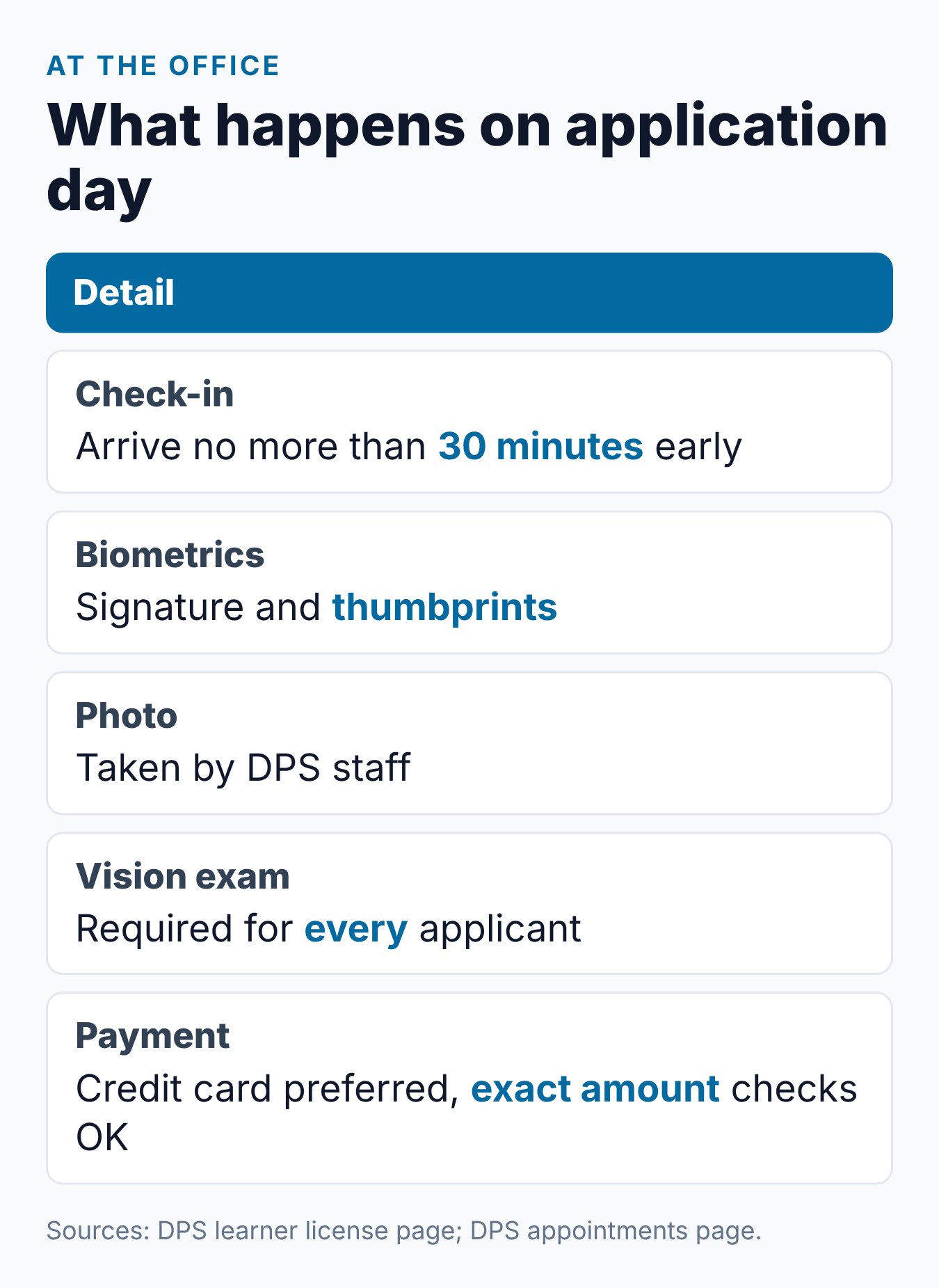
At the office, DPS collects biometric information, which means a signature and thumbprints. Staff take a photo.
The teen then takes a vision exam. DPS lists it for every learner license applicant.
Step 8: Pass the Knowledge Exam if Needed
TDLR says the course provider may include the written exam. If it does, bring the evidence of passing.
If the course did not include it, the teen takes the exam at the DPS office. Our knowledge test guide explains what it covers.
Step 9: Pay the Fee and Get the Temporary Permit
The DPS fee page lists $16 for a learner license under 18. The appointments page says credit cards are preferred. Money orders, cashier’s checks and personal checks are accepted for the exact amount.
Once approved, the teen gets a temporary permit to drive right away. Check it for mistakes before you leave. DPS says the card should arrive by mail in about 2 to 3 weeks.
Where Each Step Happens
This table shows where each step takes place and who handles it:
| Step | Where it happens | Who handles it |
|---|---|---|
| 1. Age check | At home | Family |
| 2. Classroom hours | In the course | Teen and course provider |
| 3. DE-964 portion | From the course | Course provider |
| 4. Documents | At home and school | Family and school |
| 5. Adult plan | Before the visit | Parent or guardian |
| 6. Appointment | txdpsscheduler.com | Family |
| 7. Vision exam | DPS office | DPS |
| 8. Knowledge exam | Course or DPS office | Provider or DPS |
| 9. Fee | DPS office | Family |
Timing the VOE and the Visit
The VOE has a shelf life, so line it up with the appointment. Here is simple date math. The dates are examples only:
- School year: a VOE issued October 1 is valid 30 days. Book a visit on or before October 31.
- Summer: a VOE issued July 1 is valid 90 days. That covers a visit through September 29.
- Late booking: if the only open slot is after the VOE lapses, ask the school for a new form closer to the date.
The DPS page states this window for the VOE form. DPS does not post a set wait for appointments, so check the scheduler for your area.
If the Visit Does Not Go to Plan
Things can still go wrong on the day. The DPS appointments page explains what to do in a few cases:
- Running late. DPS cancels an appointment once you are more than 30 minutes late. Book a new one in the scheduler.
- Missing a requirement. The page says you may have to reschedule if you do not meet the requirements.
- Changing the date. Rebook in the scheduler. Your old slot is cancelled once you confirm the new one.
- No slot at your office. If your office does not show up, it has no open slots. Pick the next closest office.
If the teen does not pass the knowledge exam, ask the DPS office or the course provider about the next try. Our knowledge test guide covers study tips.
After a good visit, the card comes by mail. The DPS pages say you can track the mailing status online.
Extra Steps on the Parent-Taught Route
A parent-taught application has a few more moving parts. The TDLR learner license page adds these to the DPS list:
- Proof of Texas vehicle registration.
- Proof of vehicle insurance, or a signed statement if you do not own a vehicle.
- The receipt for the parent-taught instructor designation.
- The parent instructor on record, in person, at the driver license office.
TDLR also sets a timing rule. No in-car instruction or practice may start until the learner license is issued. So the first lesson behind the wheel comes after step 9, not before.
The instructor designation is a separate TDLR step that comes much earlier. It is done online, one application per child.
What Happens Next
The learner license starts the practice stage. A licensed adult 21 or older rides in the front passenger seat on every drive. Phone use is banned, even hands-free, except in an emergency.
Parent-taught in-car lessons can begin only after the license is issued. Concurrent students also finish the last 18 classroom hours.
The teen holds the license at least six months before a provisional license. Our learner’s permit guide shows the full picture.
Common Mistakes on the Application
Each item below comes from a DPS or TDLR rule:
- Applying before 15. DPS will not issue the learner license until the teen is 15.
- Skipping the certificate. The DE-964 learner license portion is required.
- Bringing the wrong parent. For parent-taught, the instructor on record must attend.
- Using an old VOE. It lapses after 30 days, or 90 days if issued in summer months.
- Forgetting guardianship papers. A guardian who is the parent instructor brings a certified court order.
- Missing the exam proof. If the course gave the knowledge exam, bring evidence of passing.
How Requirements Can Vary
Texas driver education rules come from TDLR, and driver license rules come from Texas DPS. They apply statewide, but what you need depends on the student’s age, the course method, and whether the classroom part comes from a parent-taught course, a driving school, or a public school.
Fees, forms, and office procedures can change. Check the TDLR parent-taught pages and the DPS driver license pages before each step, and follow the instructions from your course provider.
Frequently Asked Questions
Can you get a learner’s permit at 14 in Texas?
No. A teen can start classroom driver education at 14, but DPS issues the learner license at 15 or older.
How many classroom hours come before the application?
Six hours on the concurrent method, or all 24 hours on the block method. The provider then issues the DE-964 learner license portion.
Does a parent have to go to the DPS office?
A parent or guardian must attend, or the teen brings a notarized application. For a parent-taught course, the parent instructor on record must attend.
Where does the teen take the knowledge exam?
In the course, if the provider includes it. If not, the teen takes it at the DPS driver license office.
How much is the Texas learner license fee?
$16 for applicants under 18, per the DPS fee page. It expires on the 18th birthday.
What extra items does a parent-taught family bring?
TDLR adds proof of Texas vehicle registration, proof of insurance or a signed statement, and the instructor designation receipt. The parent instructor on record must also attend.
When does the learner license card arrive?
The teen gets a temporary permit at the office. DPS says the card should arrive by mail in about 2 to 3 weeks.
Conclusion
Getting a Texas learner license at 15 takes nine steps, from the classroom hours to the $16 fee. Bring the DE-964, the right adult and the full set of documents to finish in one visit. Driving Logic’s Texas Parent Taught Drivers Ed course is coming soon, and TDLR lists licensed providers now.
Related Articles
- Texas Learner’s Permit: How to Get It, What You Need, and What It Allows
- Texas Learners Permit Checklist: What to Bring to DPS
- How to Book a Texas DPS Appointment for Your Learner’s Permit
- Texas Learner’s Permit Knowledge Test: What’s on It and How to Prepare
Sources
- Texas DPS — Texas Learner License as a Teen
- TDLR — Parent-Taught Learner License
- TDLR — Become a Parent-Taught Instructor
- Texas DPS — Choosing a Driver Education Course
- 16 Tex. Admin. Code § 84.500 — Courses of instruction (24 classroom hours)
- 16 Tex. Admin. Code § 84.43 — Driver education certificates
- TDLR — Parent-Taught Classroom Instruction
- Texas DPS — Driver License Services Appointments
- Texas DPS — Driver License Fees
Billy Forte is the owner of Driving Logic, a state-approved driver improvement course provider serving Texas and other U.S. states.
This article is general information, not legal advice. Texas driver education and licensing rules are set by TDLR, Texas DPS, and Texas law, and can change. Check the official TDLR and DPS websites for current requirements.