
Updated October 2026 · Reviewed by Billy Forte
Is a speeding ticket a misdemeanor in Florida? No, a regular speeding ticket is a noncriminal traffic infraction, handled as a moving violation under chapter 318 of the Florida Statutes. A few driving acts are crimes instead, such as reckless driving, leaving the scene of a crash and, since July 1, 2025, dangerous excessive speeding.
Key Facts
- Regular speeding: a noncriminal traffic infraction, punished as a moving violation. See the short answer.
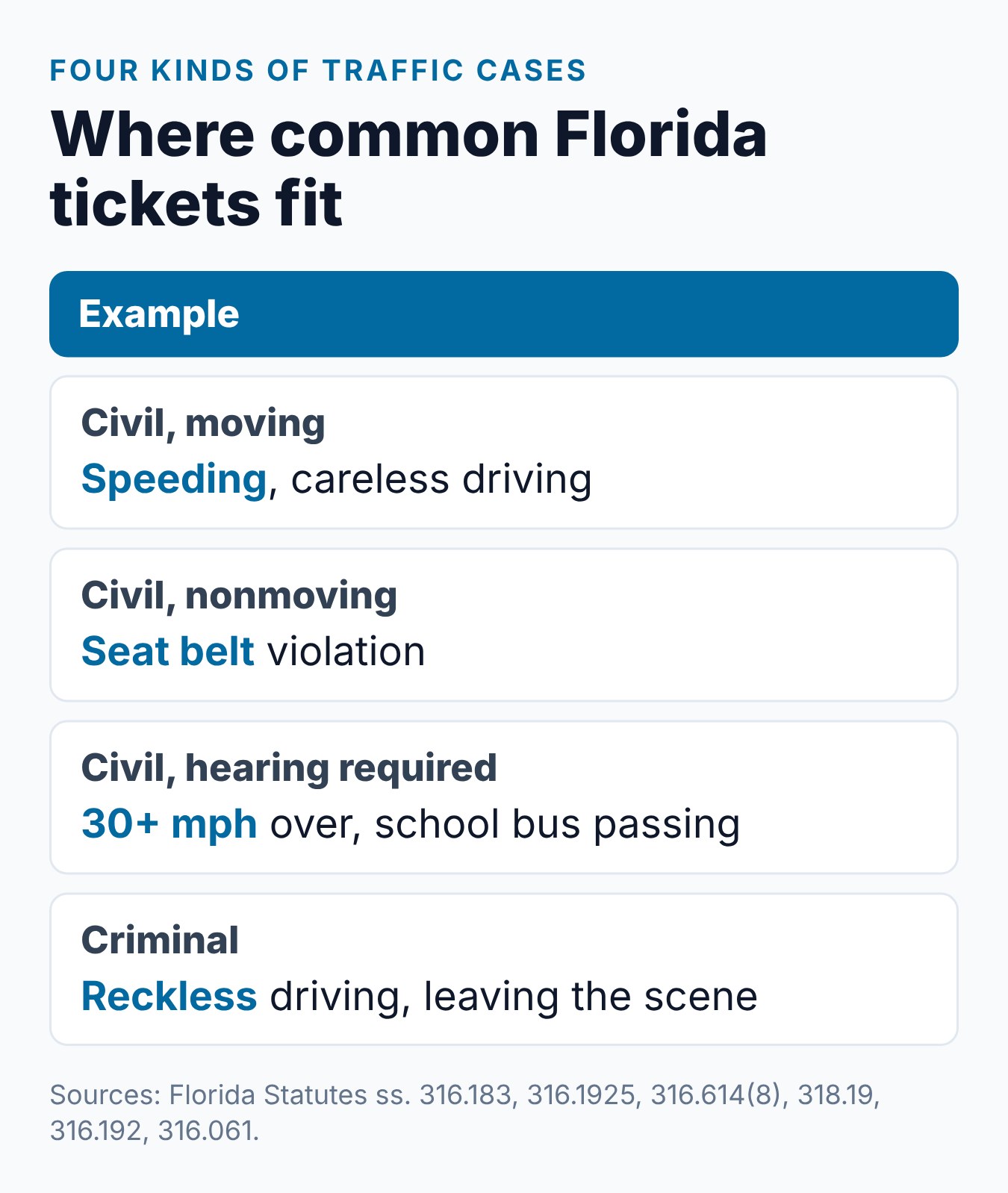
- Civil examples: speeding and careless driving are moving violations; a seat belt ticket is nonmoving. See civil infraction examples.
- Crimes: reckless driving, leaving the scene and dangerous excessive speeding are criminal. See driving crimes.
- Hearing tickets: some noncriminal tickets still require you to appear. See hearing tickets.
- BDI: the election is only for eligible noncriminal infractions. See BDI and ticket type.
Is a Speeding Ticket a Misdemeanor in Florida?
A regular speeding ticket is not a crime in Florida. The speed law, s. 316.183, says a violation is “a noncriminal traffic infraction, punishable as a moving violation as provided in chapter 318.”
Chapter 318 handles these tickets with civil penalties. The base fines are set in s. 318.18, and court costs set by law are added.
The answer changes at very high speeds. Since July 1, 2025, going 50 mph or more over the limit can be a criminal offense. The section on dangerous excessive speeding explains it.
What “Noncriminal Infraction” Means
A noncriminal infraction is a civil traffic violation. It is handled by the Clerk of Court and, if you ask for one, a hearing. You have options under s. 318.14, such as paying, electing a course if eligible, or asking for a hearing.
Florida sorts these infractions into two groups:
- Moving violations, such as speeding. These can bring points under s. 322.27.
- Nonmoving violations, such as a seat belt violation. Section 316.614(8) calls it “a nonmoving violation, punishable as provided in chapter 318.”
A noncriminal infraction can still cost you money and points. It just does not carry criminal penalties.
Florida Traffic Ticket Civil Infraction Examples
These tickets are noncriminal under the statutes we reviewed:
- Speeding under s. 316.183. Speeding not more than 15 mph over is 3 points, and more than 15 mph over is 4 points.
- Careless driving under s. 316.1925. The driver “shall be cited for a moving violation, punishable as provided in chapter 318.” FLHSMV lists it at 3 points.
- School zone speeding under s. 316.1895, which “must be cited as a moving violation.”
- Seat belt violations, which are nonmoving.
Careless driving and reckless driving are not the same offense. Our guide to careless driving points covers the difference in depth.
Driving Acts That Are Crimes
Some driving acts fall outside the civil system. The statutes below call them crimes or set jail terms.
| Offense | Statute | What the statute says |
|---|---|---|
| Reckless driving | s. 316.192 | First conviction: up to 90 days in jail, or a fine of $25 to $500 |
| Reckless driving with property damage | s. 316.192 | A misdemeanor of the first degree |
| Leaving the scene, property damage | s. 316.061 | A misdemeanor of the second degree |
| Dangerous excessive speeding | s. 316.1922 | First conviction: up to 30 days in jail or a $500 fine |
Section 316.192 defines reckless driving as driving with “willful or wanton disregard for the safety of persons or property.” Section 316.061 covers a driver who leaves a crash that damaged a vehicle or property.
Section 318.17 lists offenses for which no part of chapter 318 is available. They include:
- fleeing or attempting to elude an officer;
- leaving the scene of a crash;
- driving under the influence;
- reckless driving; and
- any other offense in chapter 316 classified as a criminal violation.
Dangerous Excessive Speeding
Section 316.1922 took effect on July 1, 2025. It covers a driver who goes:
- 50 mph or more over the speed limit; or
- 100 mph or more in a way that threatens the safety of other people or property.
A first conviction can mean up to 30 days in jail or a $500 fine. A second or later conviction can mean up to 90 days or a $1,000 fine. A second conviction within 5 years also brings a license revocation of at least 180 days, up to 1 year.
The statute sets jail time and fines. It does not use the word “misdemeanor” for this offense, so we do not either.
Where the Line Falls for Speeding
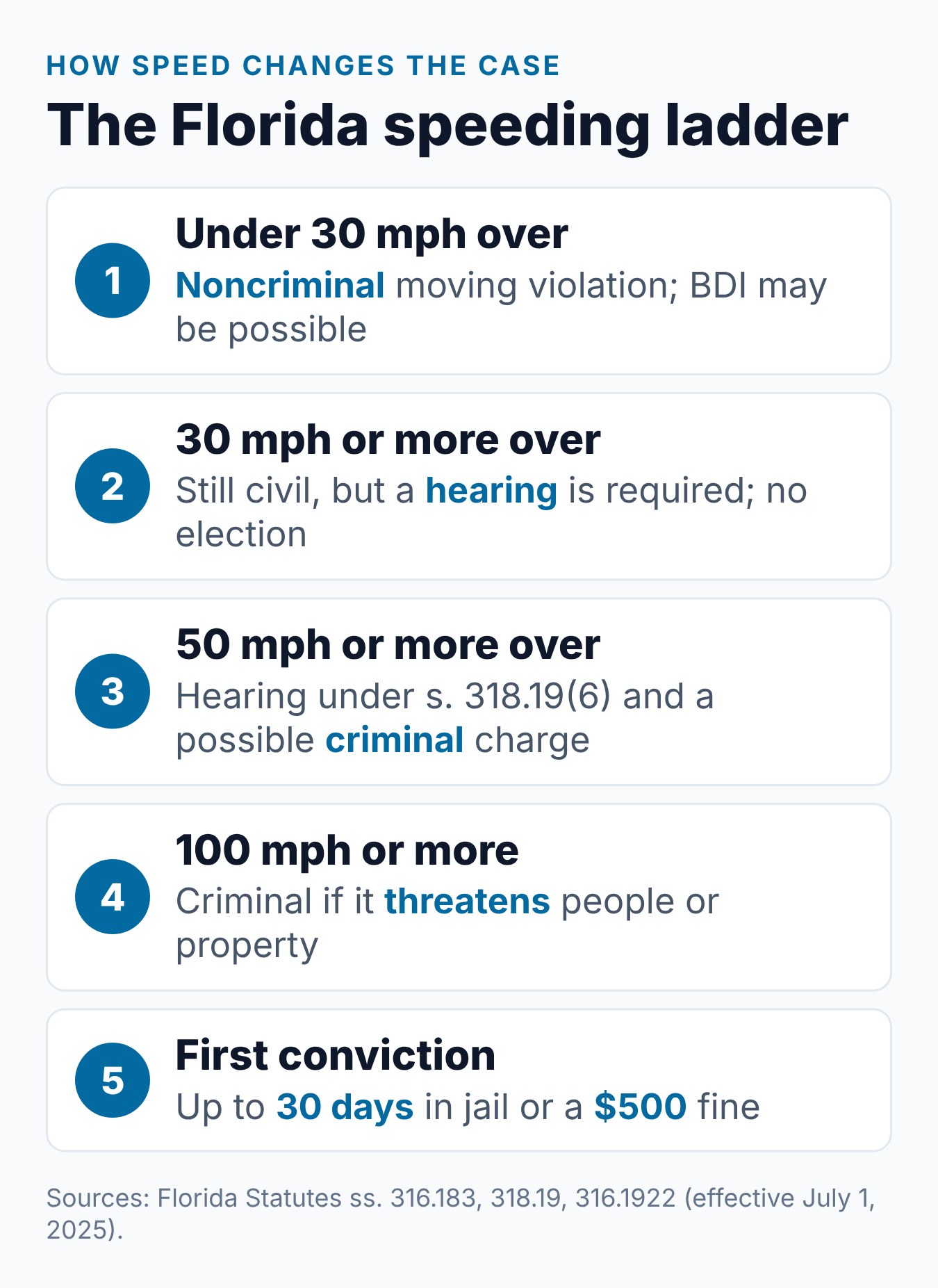
The same speeding stop can land in different places, based on how fast you were going:
- Under 30 mph over: a noncriminal infraction. You may be able to elect BDI.
- 30 mph or more over: still noncriminal, but s. 318.19 requires a hearing, and you cannot elect BDI. The base fine is $250.
- 50 mph or more over: s. 318.19 also requires a hearing for this, and s. 316.1922 makes it a possible criminal charge.
The second part of s. 316.1922 works differently. It turns on driving 100 mph or more in a way that threatens people or property, not on how far over the limit you were.
Noncriminal Tickets That Still Need a Hearing
Not every civil ticket can be handled by mail. Section 318.19 says these infractions require you to appear:
- a crash that causes a death;
- a crash that causes serious bodily injury;
- passing a stopped school bus on the side children enter and exit;
- certain load violations;
- speeding 30 mph or more over; and
- speeding 50 mph or more over, under s. 316.1926(2).
For these, the s. 318.14(2), (4) and (9) options are not available. That means no paying by mail and no BDI election. Our guide to mandatory court appearance tickets explains these cases.
How a Criminal Citation Differs
A criminal traffic citation follows a different path. Under s. 318.14(2), a person cited for a mandatory-hearing violation or “any other criminal traffic violation listed in chapter 316” must sign and accept a citation showing a promise to appear.
So there is no option to simply pay a criminal charge to the clerk. The court handles it. For your own case, ask the clerk, the court or a Florida attorney.
What Each Kind Means for BDI
The Basic Driver Improvement (BDI) election lives in s. 318.14(9). It is only for eligible noncriminal infractions. Even a civil ticket is blocked when:
- the driver has a CDL or CLP, no matter the vehicle;
- the speed was 30 mph or more over;
- s. 318.19 lists the infraction for a hearing; or
- the driver already elected within the preceding 12 months.
A lifetime cap of eight elections also applies. Before July 1, 2024, the cap was five.
If you elect within 30 days, adjudication is withheld and no points are assessed. The civil penalty is still paid, but cut by 18 percent. Our list of eligible violations shows which tickets qualify.
Conviction, Withhold and Your Record
Two words cause confusion here. A civil ticket is not a crime, but Florida law can still call its result a “conviction.”
Section 322.01(11) defines conviction to include “an admission or determination of a noncriminal traffic infraction pursuant to s. 318.14.” Paying a civil ticket counts as an admission.
A BDI election works differently. Section 318.14(11) says a withheld adjudication “is not a conviction.” It is not a dismissal, and the ticket still shows as adjudication withheld. FLHSMV says points stay on the record for at least 5 years from the disposition date.
A Civil Ticket Still Has Real Effects
Noncriminal does not mean minor. A civil moving violation can still lead to a suspension if you do not deal with it.
Here is what Florida law ties to a civil ticket:
- Points. Points from moving violations add up. FLHSMV may suspend a license at 12 points in 12 months, 18 in 18 months, or 24 in 36 months.
- A hearing penalty. If you ask for a hearing and the official finds you committed the infraction, the official may impose a civil penalty of up to $500 under s. 318.14(5).
- A suspension for no response. Under s. 318.15, if you do not pay, do not appear at a scheduled hearing, or do not attend driver improvement school, the clerk notifies FLHSMV. FLHSMV must then issue an order suspending your license.
So a civil ticket still needs an answer within 30 days. Check the clerk’s instructions for your county.
What We Found on the Official Pages
On the statute pages we checked on October 27, 2026, s. 316.183 still called speeding “a noncriminal traffic infraction.” Section 316.1922 showed its 2025 history and listed jail terms for dangerous excessive speeding.
Section 318.19 included the 50-mph item added in 2025. The FLHSMV points page listed careless driving at 3 points and reckless driving at 4 points.
Common Mistakes
Each item below comes from a Florida statute or an FLHSMV page:
- Calling every ticket a crime. Regular speeding is a noncriminal infraction.
- Calling every ticket civil. Reckless driving and leaving the scene are crimes.
- Mixing up careless and reckless. Careless is a moving violation; reckless is criminal.
- Thinking a hearing ticket is criminal. A 30-mph-over ticket needs a hearing but is still noncriminal.
- Expecting to elect BDI for a crime. Section 318.17 bars chapter 318 options for listed criminal offenses.
- Calling a withhold a dismissal. The record shows adjudication withheld.
How Requirements Can Vary
Florida’s election rules, point values and suspension levels come from Florida Statutes and FLHSMV, and they apply statewide. The election fee, the date to finish the course and how proof is filed are set by the Clerk of Court in the county on your ticket, or by the court. A court order sets its own deadline and proof steps.
Laws, fees and clerk practice can change. Check your citation, your clerk’s instructions, any court order and the FLHSMV website before you enroll or file anything.
Frequently Asked Questions
Can you go to jail for a speeding ticket in Florida?
Not for a regular speeding ticket, which is a noncriminal infraction. Dangerous excessive speeding under s. 316.1922 is different. A first conviction can mean up to 30 days in jail or a $500 fine.
Is careless driving a crime in Florida?
No. Section 316.1925 says a careless driver is cited for a moving violation under chapter 318. It carries 3 points, or 4 if it causes a crash.
Is reckless driving a misdemeanor in Florida?
Reckless driving is a crime under s. 316.192. A first conviction can mean up to 90 days in jail or a fine of $25 to $500. If it causes property damage, the statute calls it a first-degree misdemeanor.
Does a 30 mph over ticket make it criminal?
No. Speeding 30 mph or more over is still noncriminal, but it requires a hearing under s. 318.19. You cannot elect BDI for it.
Can I take traffic school for a criminal traffic charge?
No. Section 318.17 says no part of chapter 318 is available for listed criminal offenses, such as reckless driving and leaving the scene. The BDI election is in chapter 318.
Is paying a speeding ticket a conviction?
Under s. 322.01(11), Florida’s definition of conviction includes an admission of a noncriminal infraction. Paying counts as an admission, but the ticket is still civil, not criminal.
How do I know if my ticket is criminal?
Read the citation and any notice from the clerk. If it says you must appear in court, follow it. For your own case, ask the Clerk of Court or a Florida attorney.
Conclusion
A regular Florida speeding ticket is a noncriminal infraction, not a misdemeanor. The line moves at 30 mph over, when a hearing is required, and at 50 mph over, when a criminal charge becomes possible.
For an eligible civil infraction, the election goes through the clerk within 30 days. When that is done, you can take the Florida BDI course online.
Related Articles
- Florida Traffic Ticket: Costs, Points, and Traffic School Options
- Florida Mandatory Court Appearance Tickets: When You Can’t Elect Traffic School
- Careless Driving in Florida: How Many Points and What Happens?
- What Florida Traffic Violations Qualify for Traffic School Election?
Sources
- Florida Statutes s. 316.183 — Unlawful speed
- Florida Statutes s. 318.15 — Failure to comply with civil penalty or to appear
- Florida Statutes s. 316.1925 — Careless driving
- Florida Statutes s. 316.192 — Reckless driving
- Florida Statutes s. 316.061 — Crashes involving damage to vehicle or property
- Florida Statutes s. 316.1922 — Dangerous excessive speeding
- Florida Statutes s. 318.17 — Offenses excepted
- Florida Statutes s. 318.19 — Infractions requiring a mandatory hearing
- Florida Statutes s. 318.14 — Noncriminal traffic infractions; procedures
- Florida Statutes s. 318.18 — Amount of penalties
- Florida Statutes s. 322.27 — Authority to suspend or revoke a license (point system)
- Florida Statutes s. 322.01 — Definitions
- Florida Statutes s. 316.614 — Safety belt usage
- FLHSMV — Points and Point Suspensions
Billy Forte is the owner of Driving Logic, a driver improvement course provider serving Florida and other U.S. states.
This article is general information, not legal advice. Election rules, deadlines, fines and penalties depend on your citation, county, court and case facts, and they can change. Use official FLHSMV, Florida Statutes and Clerk of Court sources, and consult a qualified Florida attorney for advice about your own case.