
Updated October 2026 · Reviewed by Billy Forte
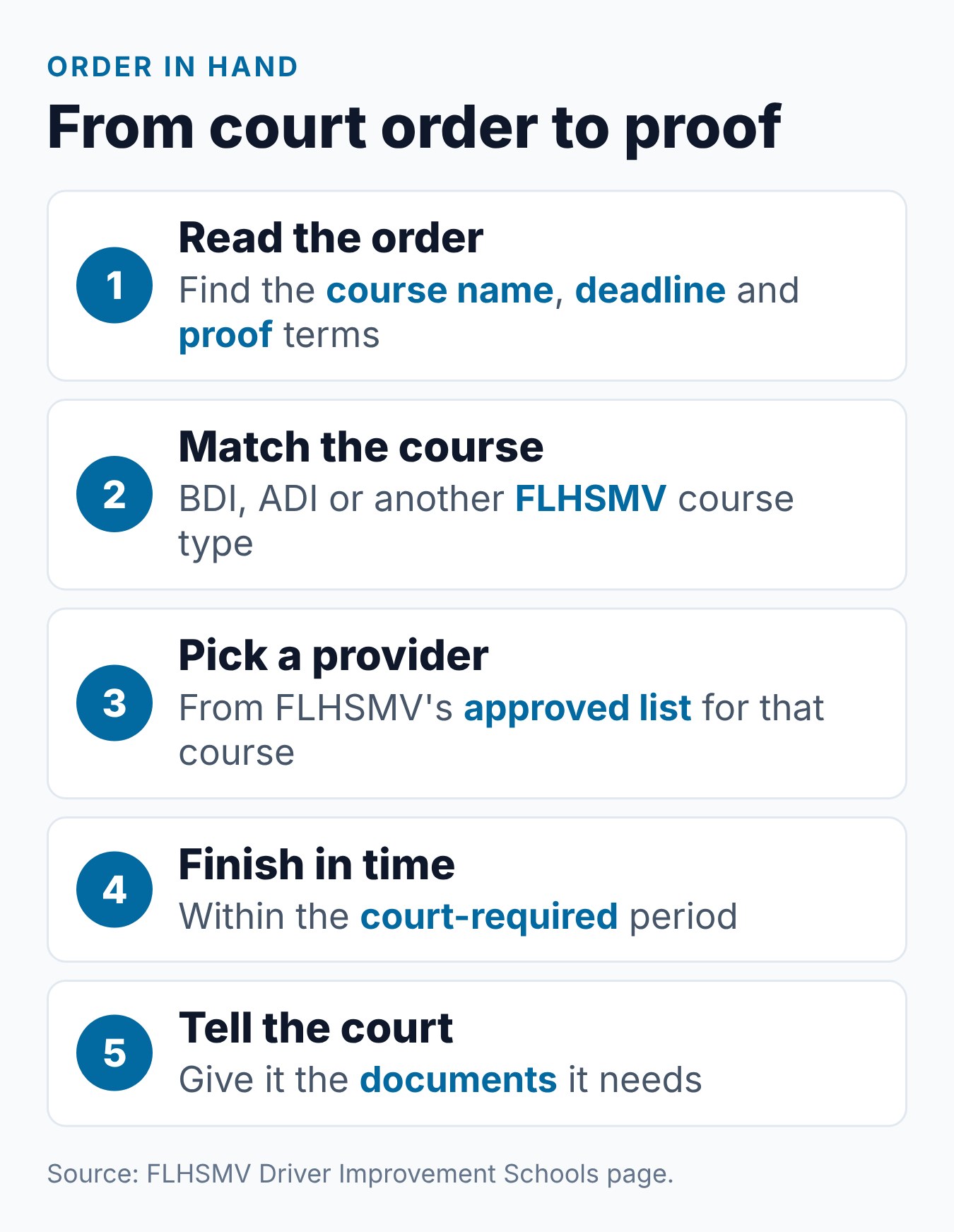
Florida court ordered driver improvement means a judge has required you to finish a driver improvement course, and the court, not a ticket election, sets the course, the deadline and the proof. FLHSMV says you must finish within the court’s time, tell the court when you are done, and give it the documents it needs. Use an FLHSMV-approved course that matches the name in your order, and ask the clerk or court if any term is unclear.
Key Facts
- Not an election: a court order is separate from the s. 318.14(9) ticket election. See order vs. election.
- The court sets the terms: the course, the deadline and how you show proof. See what the court sets.
- Match the course: pick an FLHSMV-approved course with the name your order uses. See matching the course name.
- Different from FLHSMV notices: courses FLHSMV requires after crashes or convictions follow s. 322.0261. See FLHSMV-required courses.
- Not finishing: the clerk must report a failure to attend to FLHSMV. See if the course is not finished.
What Florida Court Ordered Driver Improvement Means
A court order is a judge’s instruction in your case. When it names a driver improvement course, finishing that course becomes part of what the court requires.
The FLHSMV Driver Improvement Schools page puts it this way: “If a driver has been ordered by a court to attend a driver improvement school, they must notify the court once they have completed the school and also provide the necessary documentation to the court.” The same page says drivers “must complete the traffic school course within the court-required time period.”
So your order is the rulebook for your case. This page explains the state rules around it, but your order’s words come first.
How a Court Order Differs From a Ticket Election
A ticket election is a choice the driver makes under s. 318.14(9). An eligible driver tells the clerk within 30 days, pays the clerk’s election fee, and takes the Basic Driver Improvement (BDI) course. The civil penalty drops 18 percent, adjudication is withheld, and no points are assessed for that ticket.
A court order works from the other direction. The court decides that you must take a course.
You do not choose it. The 18 percent cut and the other election terms are written into s. 318.14(9) for elections.
| Question | Ticket election | Court order |
|---|---|---|
| Who starts it | The driver, by telling the clerk | The judge, in the case |
| Where the rule comes from | s. 318.14(9) | The court’s order |
| Which course | BDI | The course the order names |
| Time to finish | Set by the court or clerk | Set by the court |
| How proof reaches the court | Provider files it with the clerk | You tell the court and give it documents |
| What FLHSMV says to do | Elect within 30 days and tell the clerk first | Finish in time, notify the court, give documents |
For the election itself, see how to elect traffic school in Florida.
Three Things the Court Sets
Every court order answers three questions. Read yours for each one before you enroll.
The Course
The order names a course. It may say basic driver improvement, advanced driver improvement or another FLHSMV course type. Take the course the order names, not a similar one.
The Deadline
The court sets the time to finish. FLHSMV says drivers must complete the course “within the court-required time period.” There is no statewide window for court orders.
The Proof
The court also decides how it wants to hear that you finished. FLHSMV says you must notify the court and provide the necessary documents. Keep your certificate and any receipt until the court closes the matter.
Matching the Course Name in Your Order
FLHSMV approves several course types, and each one is tied to its own law:
- Basic Driver Improvement (BDI): s. 318.1451.
- Advanced Driver Improvement (ADI): s. 322.291.
- Traffic Law and Substance Abuse Education (TLSAE): s. 322.095.
FLHSMV says ADI is required after a Florida suspension for points, as a habitual traffic offender (non-DUI), “or by court order.” So a court can order ADI rather than BDI. Our guide to BDI vs. ADI explains the difference.
For BDI, check the FLHSMV Approved BDI Course Providers list. It shows each provider’s delivery method, such as Classroom or Internet.
Some rows limit a provider to one county. Our guide to FLHSMV-approved BDI providers shows how to read it.
If the order names a format or a school, follow it. Whether an online course fits your order is covered in court-ordered BDI online.
Court Orders vs. FLHSMV-Required Courses
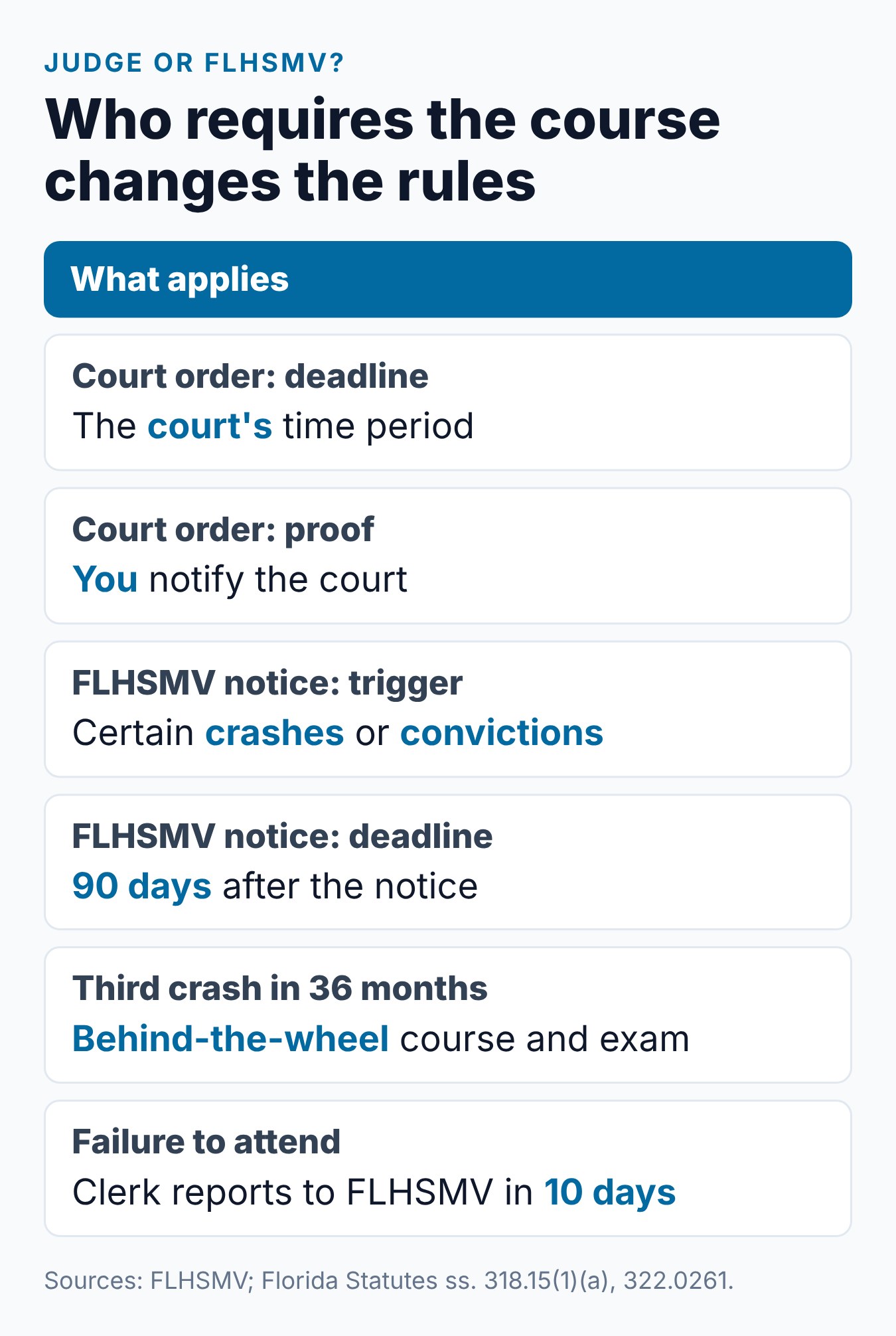
Some drivers get a course notice from FLHSMV, not from a judge. That is a separate rule in s. 322.0261. FLHSMV requires a driver improvement course after:
- a crash involving a death or a bodily injury needing transport to a medical facility,
- a second crash within 2 years with at least $500 in property damage, or
- a conviction for running a red light, passing a school bus, racing or reckless driving.
The driver must finish within 90 days after getting FLHSMV’s notice, or the license is canceled until the course is done.
A third crash within 36 months has its own rule. It needs a course with behind-the-wheel instruction and a behind-the-wheel exam. That is not ADI.
If you have both a court order and an FLHSMV notice, treat them as two separate duties. Ask the court and FLHSMV how each one is met.
Reporting and Proof
Approved BDI providers have reporting duties under s. 318.1451(6)(f). They report completions to FLHSMV within 5 days. For a citation, they also file the completion with the clerk through the Florida Courts E-Filing Portal within 3 days after receiving the certificate number.
The provider must also issue a certificate to each person who completes the course. FLHSMV says to allow 24 to 72 hours for a completion to post. It also says it does not accept paper certificates for any licensing purpose.
None of this replaces your own duty to the court. FLHSMV still says a court-ordered driver must notify the court and provide documents. Ask the clerk what form the court wants.
If the Course Is Not Finished
Section 318.15(1)(a) lists failing to attend driver improvement school among the failures the clerk reports to FLHSMV, which then suspends the license. The clerk must send that notice within 10 days, and the suspension takes effect 20 days after the order is provided.
The court may have other steps of its own. Those depend on your case, so this page does not predict them. A course also does not remove points already on your record.
Points and Your Record
A court-ordered course is about meeting the order. It is not a tool for clearing your record. A course does not remove points already on your record.
Florida law has one point deduction. Under s. 322.27, 3 points are deducted after a first points suspension and reinstatement. Otherwise, an FLHSMV court training document, Reading a Driving Record, says points cannot be removed unless the court tells FLHSMV to remove them.
FLHSMV also says points stay on the record at least 5 years from the disposition date. Ask the court how your order affects your case.
Questions to Ask the Clerk or Court
A short list of questions can settle the details before you start. Each one ties to a term the court sets:
- Which course does the order require? Ask for the exact course name if the order is unclear.
- Does the order name a format or a school? If it does, follow it.
- What is my deadline? Ask for the date in writing if you can.
- What proof does the court want? Ask whether a certificate copy is enough or more is needed.
- Where do I send it? Ask how the court wants to receive your documents.
Write the answers down, with the date and the name of the office you spoke with.
What We Found on the Official Pages
On the FLHSMV pages we checked on October 27, 2026, the court-ordered rule was short: finish in the court’s time, notify the court, and provide documents. The page did not list a statewide deadline for court orders.
We found one mismatch. The same FLHSMV page said drivers in the s. 322.0261 program have “90 days from the citation date.” The statute says 90 days after receiving notice from FLHSMV. The statute is the law, so check your notice and ask FLHSMV if the dates differ.
Common Mistakes
Each item below comes from Florida law or an FLHSMV page:
- Treating the order like an election. The 18 percent cut and the 30-day election window belong to s. 318.14(9), not to a court order.
- Taking the wrong course type. A court can order ADI, and BDI does not replace it.
- Assuming the provider tells the court for you. FLHSMV says you must notify the court and provide documents.
- Mixing up FLHSMV notices and court orders. An s. 322.0261 notice has its own 90-day rule.
- Expecting the 55-and-older discount for an ordered course. The 55-and-older discount law, s. 627.0652, does not apply to a course “taken as punishment specified by a court.”
- Expecting points to come off. A course does not remove points already on the record.
How Requirements Can Vary
Florida’s election rules, point values and suspension levels come from Florida Statutes and FLHSMV, and they apply statewide. The election fee, the date to finish the course and how proof is filed are set by the Clerk of Court in the county on your ticket, or by the court. A court order sets its own deadline and proof steps.
Laws, fees and clerk practice can change. Check your citation, your clerk’s instructions, any court order and the FLHSMV website before you enroll or file anything.
Frequently Asked Questions
What should I do first after a court orders a driver improvement course?
Read the order closely. Note the course name, the deadline and how the court wants proof. Ask the clerk or court about any term you do not understand.
Is court ordered traffic school in Florida the same as electing traffic school?
No. An election is a choice under s. 318.14(9) with set benefits for that ticket. A court order is the judge’s requirement, and the court sets its terms.
Which course should I take?
Take the course your order names. FLHSMV approves BDI, ADI and other course types, and a court can order ADI. Use a provider on FLHSMV’s approved list for that course.
How long do I have to finish?
As long as the court allows. FLHSMV says to complete the course within the court-required time period. There is no statewide window for court orders.
Does the provider send my completion to the court?
Providers report completions to FLHSMV and, for a citation, file them with the clerk. FLHSMV still says you must notify the court and give it the documents it needs.
Is an FLHSMV course notice a court order?
No. FLHSMV requires courses after certain crashes and convictions under s. 322.0261. You must finish within 90 days after the notice, or the license is canceled until you do.
Does a court-ordered course take points off my license?
No. A course does not remove points already on your record. FLHSMV says points cannot be removed unless the court tells FLHSMV to remove them.
What happens if I do not finish?
Section 318.15(1)(a) lists failing to attend driver improvement school among the failures the clerk reports to FLHSMV, which then suspends the license. The court may also act in your case.
Conclusion
Florida court ordered driver improvement follows the order, so the court sets the course, the deadline and the proof. Read your order, pick a matching FLHSMV-approved course, and tell the court when you finish.
Follow the order exactly, and ask the court or clerk if any part is unclear. If your order calls for BDI, you can take the Florida BDI course online once you confirm the format fits.
Related Articles
- How to Elect Traffic School in Florida: The Complete Election Guide
- Can I Take the Florida BDI Course Online If My Court Order Requires It?
- Florida ADI Course vs. BDI: What’s the Difference?
- FLHSMV-Approved BDI Providers: What It Means and How to Verify Your Course
Sources
- FLHSMV — Driver Improvement Schools
- FLHSMV — Basic Driver Improvement (BDI) Approved Course Providers
- FLHSMV — Points and Point Suspensions
- Florida Statutes s. 318.14 — Noncriminal traffic infractions; procedures
- Florida Statutes s. 318.1451 — Driver improvement schools
- Florida Statutes s. 318.15 — Failure to comply with civil penalty or to appear
- Florida Statutes s. 322.0261 — Driver improvement course; requirement to maintain driving privileges
- Florida Statutes s. 322.291 — Driver improvement schools required in certain suspension cases
- Florida Statutes s. 322.27 — Authority to suspend or revoke a license (point system)
- Florida Statutes s. 627.0652 — Insurance discounts for completing a safety course
- FLHSMV — Reading a Driving Record (court training document, 2016, PDF)
Billy Forte is the owner of Driving Logic, a driver improvement course provider serving Florida and other U.S. states.
This article is general information, not legal advice. Election rules, deadlines, fines and penalties depend on your citation, county, court and case facts, and they can change. Use official FLHSMV, Florida Statutes and Clerk of Court sources, and consult a qualified Florida attorney for advice about your own case.