
Updated October 2026 · Reviewed by Billy Forte
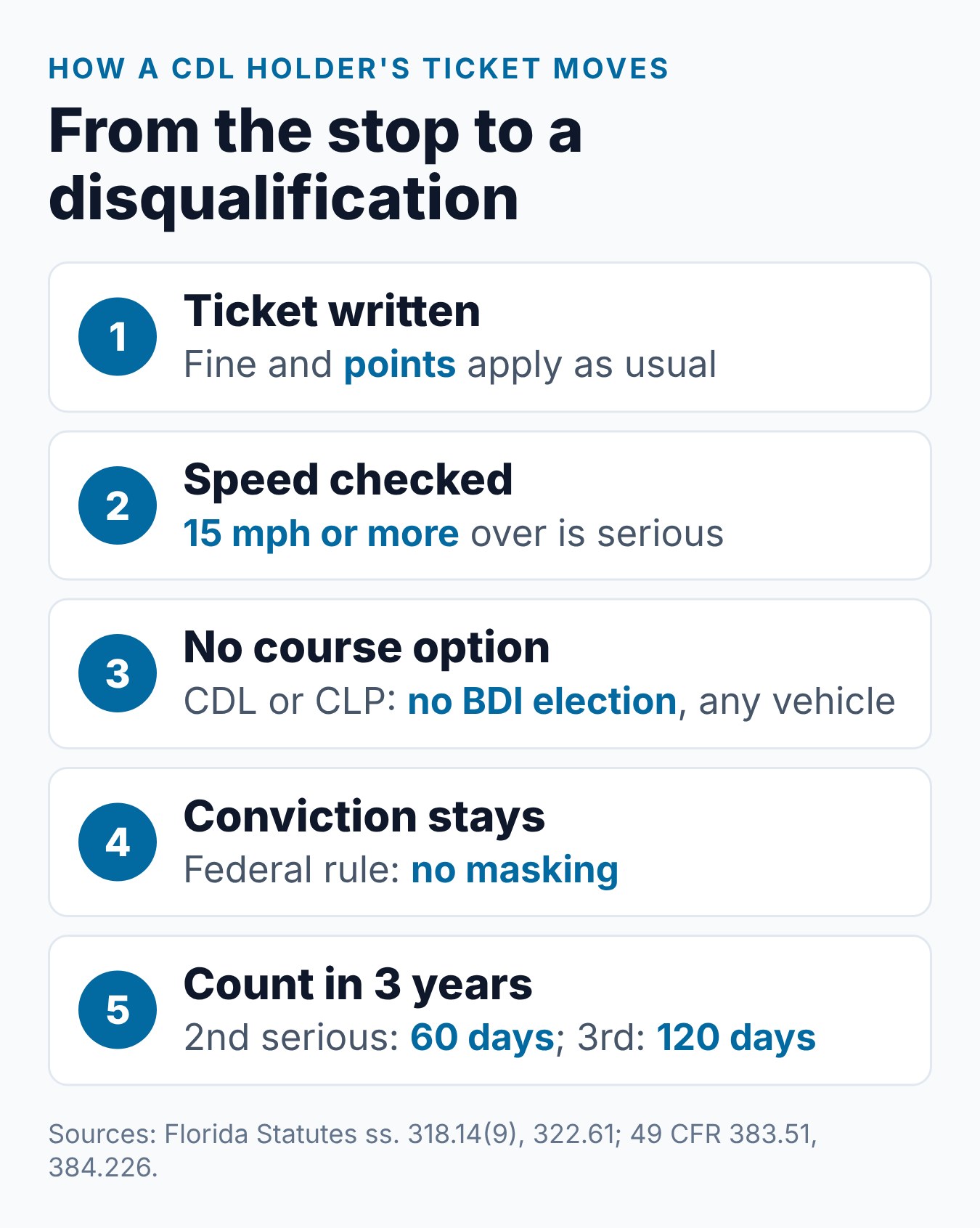
A Florida CDL speeding ticket matters more than a regular ticket because speeding 15 mph or more over the limit is a “serious traffic violation” for a commercial driver. Two of these in 3 years mean 60 days without the right to drive a commercial vehicle, and three mean 120 days. CDL and commercial learner’s permit holders also cannot elect the Basic Driver Improvement (BDI) course for any ticket.
Key Facts
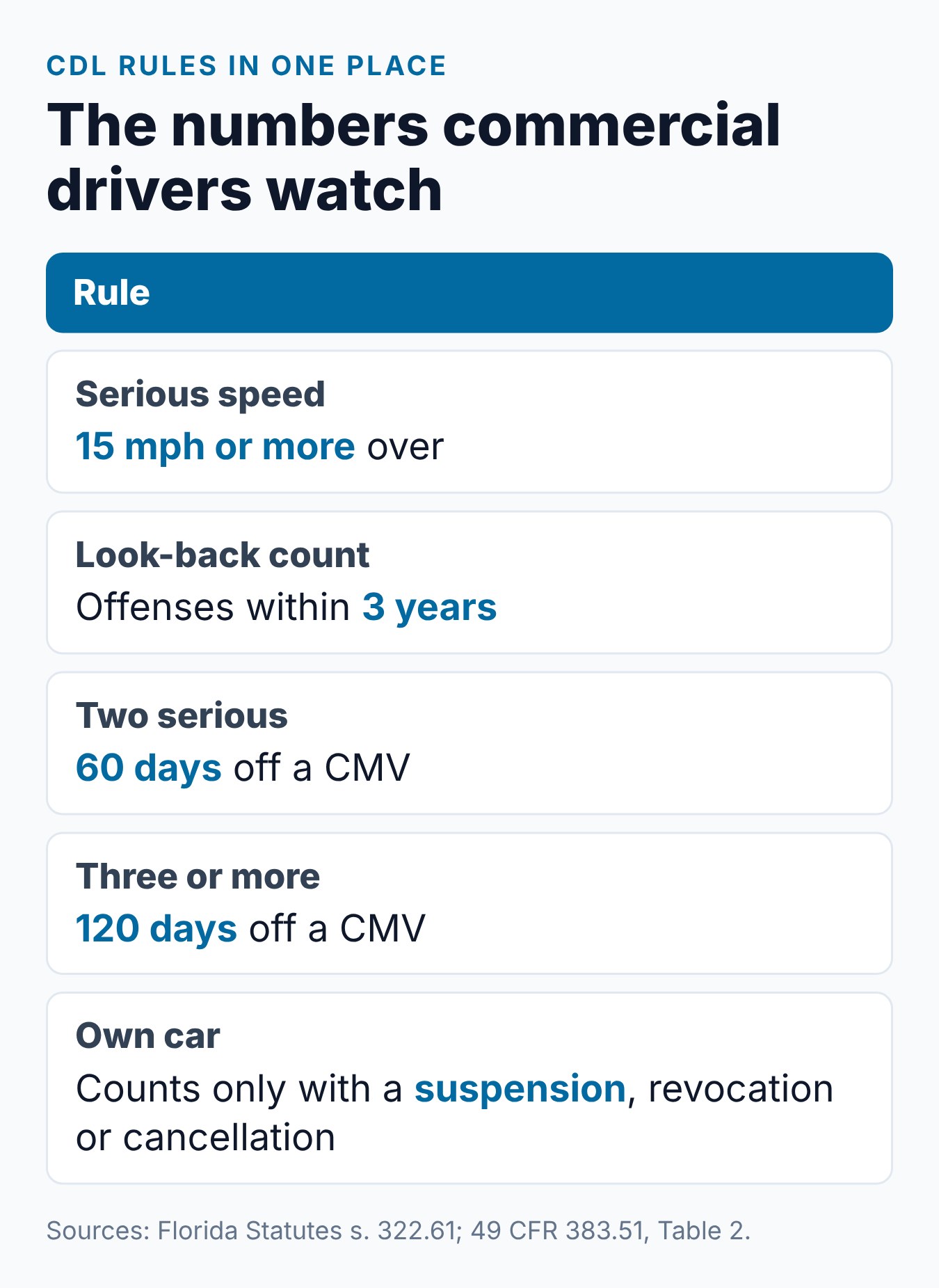
- The 15 mph line: speeding 15 mph or more over is a serious traffic violation. See the 15 mph line.
- Disqualification: 2 serious violations in 3 years means 60 days; 3 means 120 days. See disqualification periods.
- Personal car: these count only if the conviction leads to a suspension, revocation or cancellation. See personal vehicle tickets.
- No BDI election: CDL and CLP holders cannot elect, in any vehicle. See why there is no election.
- No masking: federal rules bar states from hiding a CDL holder’s conviction. See the masking ban.
What a Florida CDL Speeding Ticket Can Lead To
A CDL speeding ticket starts like any other Florida ticket. It still carries a fine under s. 318.18 and points under s. 322.27.
The difference is what happens to your commercial privilege. Two sets of rules apply:
- Florida law in s. 322.61 sets when a CDL holder is disqualified from driving a commercial motor vehicle.
- Federal law in 49 CFR 383.51 lists the same kinds of serious violations and periods.
Disqualification is not the same as losing your regular license. It means you may not drive a commercial motor vehicle for the set time.
The 15 MPH Line
For commercial drivers, the key speed is 15 mph or more over the posted limit. Section 322.61 lists “Unlawful speed of 15 miles per hour or more above the posted speed limit” as a serious violation.
The federal rule uses the same line. It lists “Speeding excessively, involving any speed of 24.1 kmph (15 mph) or more above the regulated or posted speed limit.”
Why Exactly 15 Over Is a Trap
Two Florida rules use 15 mph in slightly different ways:
- Points: speeding “not in excess of 15” mph over is 3 points. Speeding “in excess of 15” mph over is 4 points.
- CDL serious violation: speeding “15 miles per hour or more” over counts.
So a ticket for exactly 15 mph over is a 3-point ticket. Yet it is still a serious traffic violation for a CDL holder. Read the speed on your citation with care.
Other Serious Traffic Violations
Speeding is one item on the list. Section 322.61 and 49 CFR 383.51 also name, among others:
- Reckless driving;
- Improper lane change, which the federal rule calls “improper or erratic traffic lane changes”; and
- Following too closely.
These count together with speeding. For example, one speeding conviction and one following-too-closely conviction in 3 years make two serious violations.
Disqualification Periods
Section 322.61 counts serious violations “for offenses occurring within a 3-year period.” The federal rule counts convictions “in a separate incident within a 3-year period.”
| Serious violations in 3 years | Florida, s. 322.61 | Federal, 49 CFR 383.51 |
|---|---|---|
| One | No disqualification period listed | No disqualification period listed |
| Two | 60 days | 60 days |
| Three or more | 120 days | 120 days |
The periods match under both laws. The disqualification is from operating a commercial motor vehicle.
Personal Vehicle Tickets
A ticket in your own car can count too, but under a narrower test. Section 322.61 includes serious violations “committed in a noncommercial motor vehicle” only “if such convictions result in the suspension, revocation, or cancellation of the licenseholder’s driving privilege.”
The federal rule says the same. A conviction in a non-commercial vehicle counts “if the conviction results in the revocation, cancellation, or suspension of the CLP or CDL holder’s license.”
So a personal-vehicle speeding conviction, by itself, does not add to your serious violation count. It counts only when it leads to one of those license actions.
Points Can Still Lead There
Points from personal-vehicle tickets still add up on your Florida record. Under s. 322.27, FLHSMV may suspend a license at 12 points in 12 months, 18 in 18 months, or 24 in 36 months.
Ask FLHSMV how any suspension on your record affects your CDL. Our guide to speeding ticket points explains the 3-point and 4-point rules.
Why There Is No BDI Election
Eligible Florida drivers can elect a course so no points are assessed for a ticket. CDL holders cannot. Section 318.14(9) opens the election only to a person “who does not hold a commercial driver license or commercial learner’s permit.”
That bar applies in any vehicle. It does not matter whether you were in a truck or your own car. The FLHSMV BDI page lists “A Commercial Driver License (CDL)” as a reason a driver cannot elect.
Clerk pages say the same:
- The Orange County Clerk: “If you hold a Commercial Driver’s license (CDL), you are not eligible for this option.”
- The Hillsborough County Clerk says CDL holders are not eligible for the driving school option.
- The Miami-Dade Clerk says the option “is not available to commercial driver’s license holders.”
Our guide to CDL holders and traffic school explains the election bar in more depth.
Your Choices Without the Election
Losing the election does not remove your deadline. Under s. 318.14(4), a driver who does not elect to appear must act within 30 days after the date the citation was issued.
For a civil speeding ticket, that leaves two main paths for a CDL holder:
- Pay the civil penalty. The Orange County Clerk says “Payment of the civil penalty is considered a conviction.” Points then follow.
- Ask for a hearing. At a hearing, the official may impose a civil penalty of up to $500 under s. 318.14(5).
Doing nothing is not a safe choice either. Under s. 318.15, if a driver does not pay or does not appear at a scheduled hearing, the clerk notifies FLHSMV. FLHSMV must then issue an order suspending the license.
Permit Holders Too
The bar is not limited to full CDL holders. Section 318.14(9) also names the commercial learner’s permit.
The federal masking rule names both a CLP and a CDL holder. So a driver still in training faces the same election bar.
The Federal Masking Ban
Federal law backs up the Florida bar. 49 CFR 384.226 says a state “must not mask, defer imposition of judgment, or allow an individual to enter into a diversion program” that would keep a conviction off the driver’s federal record.
The rule covers a CLP or CDL holder’s conviction “for any violation, in any type of motor vehicle.” It excludes parking, vehicle weight and vehicle defect violations. The goal is to keep the conviction on the CDLIS driver record.
How Florida Defines Conviction for CDL Holders
Florida has a special rule for commercial drivers. Section 322.01(11)(b) says the federal definition of “conviction” in 49 CFR 383.5 applies to offenses committed in a commercial motor vehicle or by a person holding a CDL.
For other drivers, Florida’s general definition includes an admission or determination of a noncriminal infraction under s. 318.14. Either way, paying a speeding ticket is not a neutral act for a CDL holder.
Fines, Points and Higher Speeds
The usual Florida rules still apply on top of the CDL rules:
- Base fines rise with speed under s. 318.18. For example, 15 to 19 mph over is $150, and court costs set by law are added. Our speeding ticket cost guide covers the rest.
- Points are 3 at 15 mph over or less and 4 above that.
- 30 mph or more over requires a court hearing under s. 318.19.
- 50 mph or more over can be dangerous excessive speeding under s. 316.1922, a criminal offense since July 1, 2025.
FLHSMV says points stay on the record for at least 5 years from the disposition date, per its points page.
Talking With a Lawyer
Because a conviction can affect a commercial privilege, some CDL holders choose to talk with a Florida attorney about their ticket. That is a personal choice.
This article explains the rules. It does not tell you what to do in your case. For case questions, ask the Clerk of Court, the court or a Florida attorney.
What We Found on the Official Pages
On the pages we checked on October 27, 2026, the eCFR showed 49 CFR 383.51 as up to date as of October 23, 2026, and 49 CFR 384.226 as up to date as of October 22, 2026. Both still used the 15 mph line and the “any type of motor vehicle” wording.
The FLHSMV BDI page still listed a CDL as a bar to the election. Section 322.61 showed the same 60-day and 120-day periods as the federal rule.
Common Mistakes
Each item below comes from a Florida statute, a federal rule or an official page:
- Thinking the BDI bar only covers trucks. It applies to any CDL or CLP holder, in any vehicle.
- Reading 15 over as safe. Exactly 15 mph over is a serious violation for a CDL holder.
- Counting every car ticket. A personal-vehicle conviction counts only if it leads to a suspension, revocation or cancellation.
- Forgetting other violations. Reckless driving, improper lane changes and following too closely also count.
- Expecting a withhold. Federal rules bar masking a CDL holder’s conviction.
How Requirements Can Vary
Florida’s election rules, point values and suspension levels come from Florida Statutes and FLHSMV, and they apply statewide. The election fee, the date to finish the course and how proof is filed are set by the Clerk of Court in the county on your ticket, or by the court. A court order sets its own deadline and proof steps.
Laws, fees and clerk practice can change. Check your citation, your clerk’s instructions, any court order and the FLHSMV website before you enroll or file anything.
Frequently Asked Questions
Can a CDL holder take traffic school for a speeding ticket in Florida?
No. Section 318.14(9) opens the BDI election only to drivers who do not hold a CDL or a commercial learner’s permit. The bar applies in any vehicle, including your own car.
How fast is a serious speeding violation for a CDL?
Speeding 15 mph or more over the posted limit. Both s. 322.61 and 49 CFR 383.51 use that line.
How long is a CDL disqualification for speeding?
Two serious violations from offenses within 3 years mean 60 days. Three or more mean 120 days. One serious violation alone has no disqualification period on these lists.
Does a speeding ticket in my own car count against my CDL?
Only if the conviction leads to a suspension, revocation or cancellation of your license. That is the test in both s. 322.61 and the federal rule.
Can a Florida court keep a CDL holder’s ticket off the record?
Federal rule 49 CFR 384.226 bars states from masking a CDL or CLP holder’s conviction in any type of vehicle. Parking, weight and defect violations are excluded.
What happens if a CDL holder ignores a Florida ticket?
The clerk notifies FLHSMV, which must issue an order suspending the license. Ask FLHSMV how a suspension affects your CDL.
Does a CDL holder get the same points as other drivers?
Yes. Speeding is 3 points at 15 mph over or less and 4 points above that under s. 322.27. The CDL rules apply on top of the points.
Conclusion
A Florida CDL speeding ticket at 15 mph or more over counts as a serious traffic violation, and a second or third one in 3 years means 60 or 120 days off commercial driving. CDL and CLP holders cannot elect BDI for any ticket, so read your citation and check your options with the clerk.
If you do not hold a CDL or a commercial learner’s permit and your ticket is eligible, you can take the Florida BDI course online after you elect.
Related Articles
- Florida Traffic Ticket: Costs, Points, and Traffic School Options
- Florida CDL Holders and Traffic School: Why the Election Process Doesn’t Apply
- How Many Points Is a Speeding Ticket in Florida?
- How Much Is a Speeding Ticket in Florida? Fines by Speed
Sources
- Florida Statutes s. 322.61 — Disqualification from operating a commercial motor vehicle
- Florida Statutes s. 318.15 — Failure to comply with civil penalty or to appear
- 49 CFR § 383.51 — CDL disqualifications
- 49 CFR § 384.226 — Prohibition on masking convictions
- Florida Statutes s. 318.14 — Noncriminal traffic infractions; procedures
- Florida Statutes s. 322.01 — Definitions
- Florida Statutes s. 322.27 — Authority to suspend or revoke a license (point system)
- Florida Statutes s. 318.18 — Amount of penalties
- Florida Statutes s. 318.19 — Infractions requiring a mandatory hearing
- Florida Statutes s. 316.1922 — Dangerous excessive speeding
- FLHSMV — Basic Driver Improvement (BDI) Approved Course Providers
- FLHSMV — Points and Point Suspensions
- Orange County Clerk — Traffic Ticket Options
- Hillsborough County Clerk — Traffic School
- Miami-Dade Clerk of the Court — Traffic School
Billy Forte is the owner of Driving Logic, a driver improvement course provider serving Florida and other U.S. states.
This article is general information, not legal advice. Election rules, deadlines, fines and penalties depend on your citation, county, court and case facts, and they can change. Use official FLHSMV, Florida Statutes and Clerk of Court sources, and consult a qualified Florida attorney for advice about your own case.