
Updated October 2026 · Reviewed by Billy Forte
The Florida BDI course test is not spelled out in Florida law, and no FLHSMV page we checked lists its format, passing score or retake rules. Those details come from the course rules of the approved provider you choose. The law names safety topics FLHSMV considers when it approves a course, and it says providers must give a certificate to people who successfully complete it.
Key Facts
- Exam details: no statute or FLHSMV page we checked sets a question count, passing score or retake rule. See what the law leaves out.
- Topics: the law names safety topics such as motorcyclist, bicyclist and pedestrian safety, red lights and phones. See topics named in the law.
- Who sets the rules: FLHSMV approves each course and sets how long each course type runs. See FLHSMV’s role.
- The finish line: providers must issue a certificate to people who successfully complete the course. See what finishing leads to.
- Your step: read your provider’s own course rules before you start. See questions to ask.
What Florida Law Says About the Florida BDI Course Test
Florida’s rules for driver improvement schools are in s. 318.1451, Florida Statutes. That section covers who approves courses, what they teach, what providers report and how long they keep records. It does not describe a final exam.
One phrase in that section matters here. Providers must “issue a certificate to persons who successfully complete the course.” So the law sets a finish line, but it does not say how a provider measures it.
The Florida Department of Highway Safety and Motor Vehicles (FLHSMV) runs the program. Its Driver Improvement Schools page explains how completions are reported. We found no test format on that page either.
FLHSMV also has written rules for these schools in the Florida Administrative Code. We could not read the text of those rules, so we do not rely on them here.
What the Law Leaves Out
People who search for the Basic Driver Improvement (BDI) test want numbers. Here is what we could and could not trace to an official source:
| Test detail people ask about | In a Florida source we checked? | Where the answer comes from |
|---|---|---|
| How many questions | No | Your provider’s course rules |
| Score needed to pass | No | Your provider’s course rules |
| Second tries | No | Your provider’s course rules |
| Open or closed book | No | Your provider’s course rules |
| Safety topics covered | Yes, in part | s. 318.1451(2)(a) |
| Certificate after finishing | Yes | s. 318.1451(6)(h) |
If you see a test number online, we could not tie it to Florida law. The rules that apply to you are the ones your own provider posts.
This also means two approved courses may handle quizzes in different ways. Compare the rules before you pay, not after.
Language and Reading Help
Some rows on the FLHSMV provider list say “(Additional Languages Available).” If English is not your first language, look for that note. Then ask the provider which parts of the course, including any quizzes, come in your language.
If reading on a screen is hard for you, ask the provider what help it offers. A classroom course is another option on the same FLHSMV list. Our guide to online and in-person courses compares the two.
Topics Named in the Law
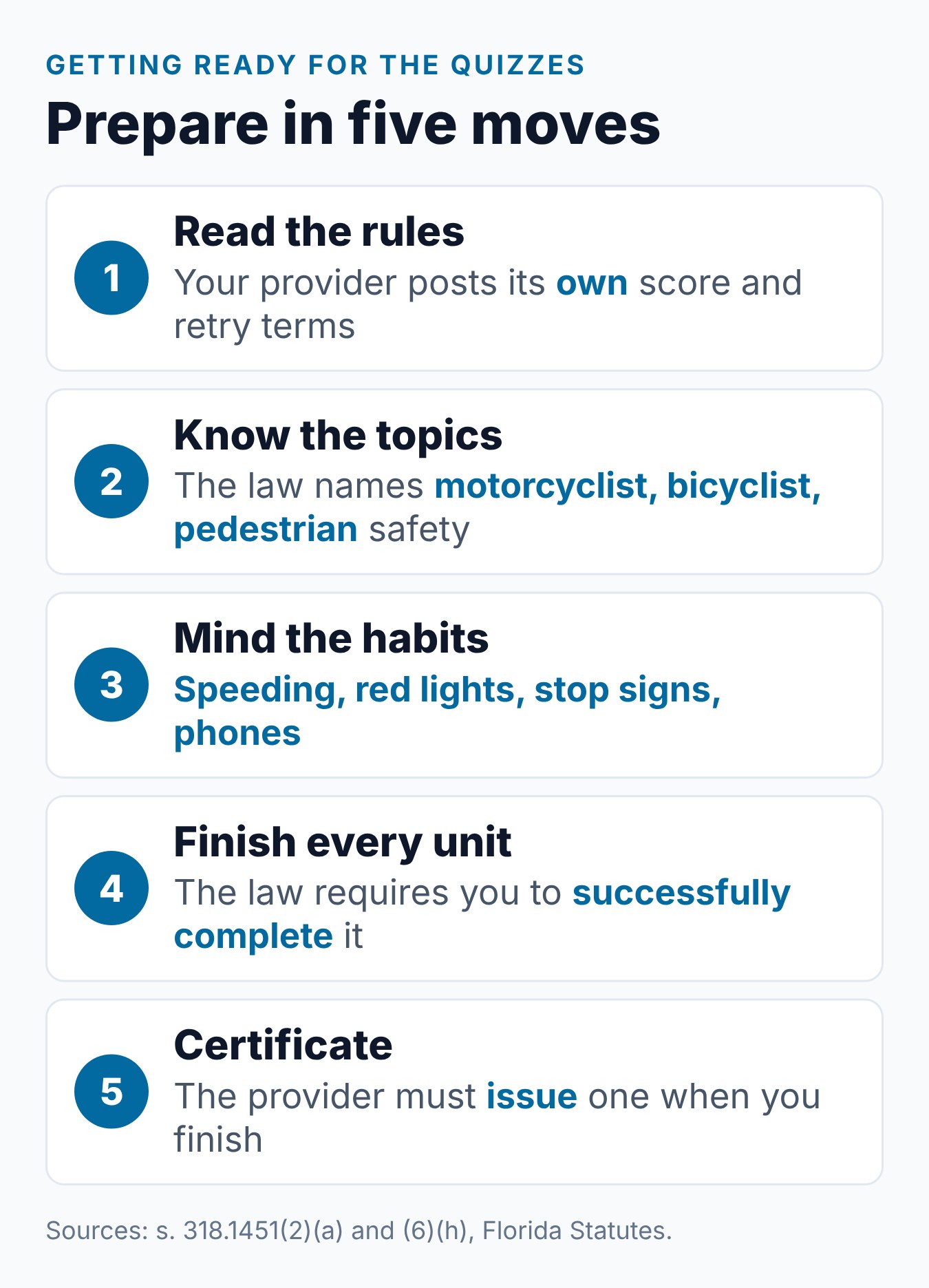
The statute describes what FLHSMV looks at when it approves a course. Section 318.1451(2)(a) names these safety goals:
- People outside cars: “promoting motorcyclist, bicyclist, and pedestrian safety.”
- Risky habits: “speeding, running red lights and stop signs, and using electronic devices while driving.”
A 2024 change added a review duty. Since then, FLHSMV must “annually review changes made to major traffic laws” and keep course content up to date.
If your course has quizzes, these topics are a fair guide to what they may cover. That is our reading of the law. It is not a published exam outline.
How to Study the Named Topics
Florida law sets no study plan. A few habits may help:
- Read each unit to the end. Do not skim the lessons.
- Note the rules for people on foot, on bikes and on motorcycles. The law names motorcyclist, bicyclist and pedestrian safety.
- Watch the parts on phones and red lights. The law names those habits by name.
- Ask your provider if a quiz must be passed before the next unit opens.
FLHSMV’s Role
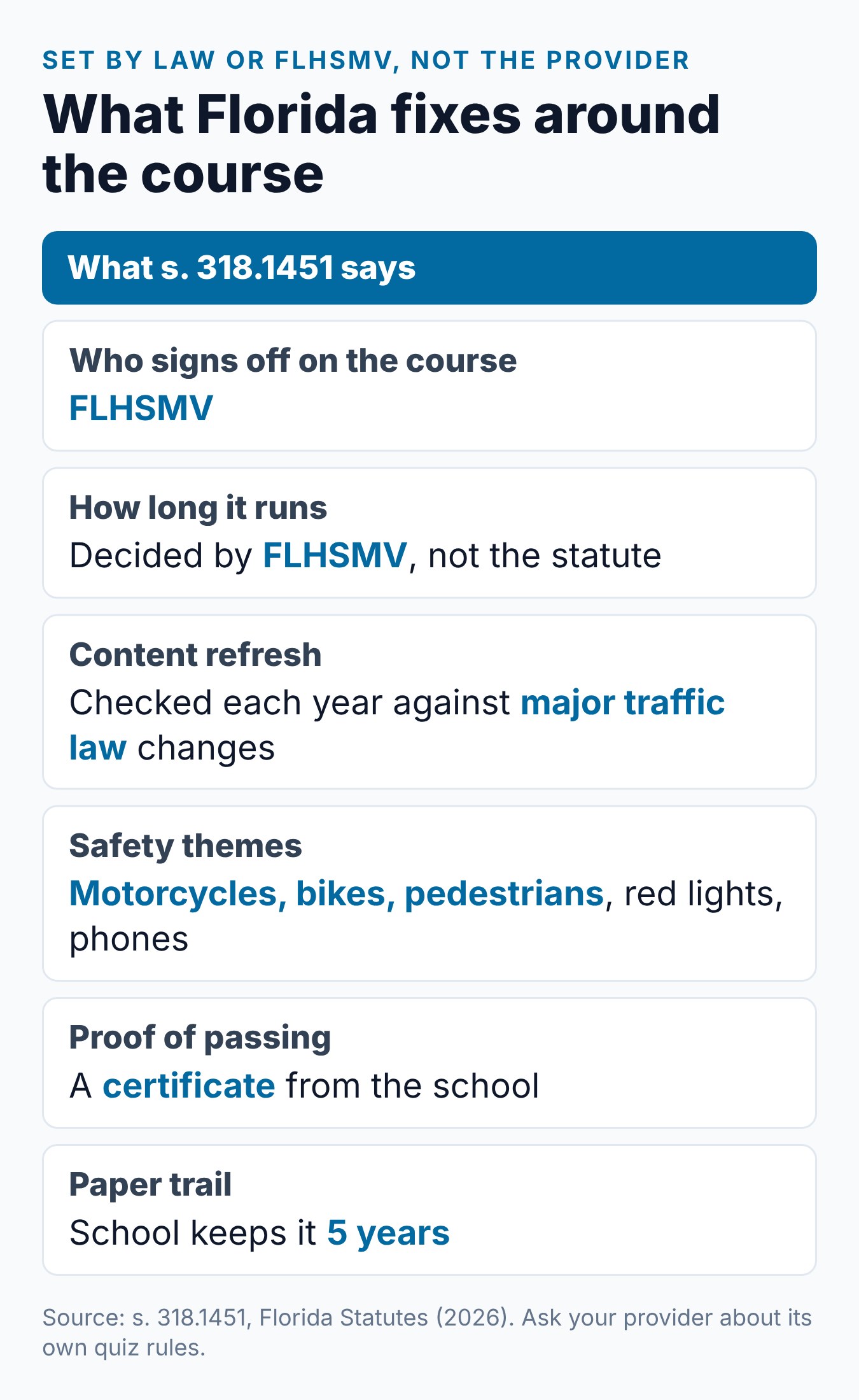
FLHSMV approves and checks every BDI course. Under s. 318.1451, the agency does these jobs:
- Approves courses, including “courses that use technology as a delivery method,” which means online courses.
- Requires statewide approval for online providers, under s. 318.1451(2)(b).
- Sets course length. The law says “The department shall set the duration of all course types.”
- Checks delivery. It makes sure schools teach “the approved course fully and to the required time limit.”
- Reviews content each year against major traffic law changes.
The course is known as the 4-hour BDI course. The Miami-Dade Clerk traffic school page calls it “a 4-hour course.” The length itself is set by FLHSMV. Our guide on how long the Florida BDI course is covers time and finish dates.
You can check a provider on the FLHSMV Approved BDI Course Providers list. Each row shows a delivery method, such as Classroom or Internet.
What Finishing Leads To
Once you successfully complete the course, the provider must issue your certificate. The law then sets two filing duties under s. 318.1451(6)(f):
- To FLHSMV: within 5 days, through the Driver Improvement Certificate Issuance System.
- To the clerk: within 3 days after the provider gets the certificate number, through the Florida Courts E-Filing Portal.
FLHSMV says to allow 24 to 72 hours for a completion to post. It also says it “does not accept paper certificates for any licensing purpose.”
Keep your own copy of the certificate and your citation number. The provider has up to 5 days to report, and posting can take 24 to 72 hours after that. If the report seems late after that time, contact the provider first and then the clerk.
Providers must keep course records for 5 years. Our completion certificate guide explains what to do if a report seems late.
Questions to Ask Your Provider
Since the law leaves test details to providers, ask before you start. Look for clear answers on the course rules page or at checkout:
- Is there a final test, unit quizzes or both?
- What score counts as passing?
- What happens if I miss that score?
- Can I go back to a lesson before I answer?
- What is the total cost? Approved providers must “disclose all fees,” and the law adds a $2.50 state assessment fee to the course fee.
- How is my completion reported and filed?
Save a copy of the rules page when you sign up. If a rule is unclear, ask the provider in writing.
Why Your Deadline Matters More Than the Quiz
A quiz score is between you and your provider. The finish date is set by the court or clerk, and missing it has real effects.
For a ticket election, the steps come from FLHSMV and s. 318.14, Florida Statutes:
- Elect in time. Within 30 days of the citation date, tell the Clerk of Court in the county on the ticket and pay the clerk’s election fee.
- Pay the reduced penalty. The civil penalty is cut by 18 percent.
- Finish by the clerk’s date. There is no statewide window. The Hillsborough County Clerk gives 60 calendar days, and Miami-Dade gives 120 days.
If you elect and do not finish in time, s. 318.15, Florida Statutes applies. Under subsection (1)(b), you are found guilty and points are added. You also pay back the 18 percent plus a processing fee of up to $18.
Separately, s. 318.15(1)(a) lists failing to attend driver improvement school among the failures the clerk reports to FLHSMV, which then suspends the license. Clerk forms say the election still counts toward your lifetime limit.
For a court-ordered course, finish within the court’s time. Then tell the court and give it the documents it needs, as FLHSMV directs. Our ticket election guide covers each election step.
What We Found on the Official Pages
On the FLHSMV pages and statute sections we checked on October 27, 2026, no page gave a BDI exam format. The provider list showed each provider’s name, delivery method and contact details. It showed no test details.
We also saw one mismatch. Some FLHSMV and clerk pages still say drivers can elect five times in a lifetime.
Since July 1, 2024, s. 318.14(9) says eight. The statute controls.
Common Mistakes
Each item below comes from a Florida statute or an FLHSMV page:
- Trusting a test number you cannot trace. No source we checked sets one.
- Picking a course that is not on the FLHSMV list. FLHSMV approves BDI courses and posts the list.
- Starting before you tell the clerk. FLHSMV says to inform the clerk before attending.
- Leaving the course to the last days. The finish date is firm, and late completion has costs.
- Waiting for a paper certificate for licensing. FLHSMV does not accept paper certificates for licensing.
- Studying for the wrong course. BDI is not the 55+ Mature Driver course or the DETS course for new drivers.
- Expecting the course to clear old points. A course does not remove points already on your record.
How Requirements Can Vary
Florida’s election rules, point values and suspension levels come from Florida Statutes and FLHSMV, and they apply statewide. The election fee, the date to finish the course and how proof is filed are set by the Clerk of Court in the county on your ticket, or by the court. A court order sets its own deadline and proof steps.
Laws, fees and clerk practice can change. Check your citation, your clerk’s instructions, any court order and the FLHSMV website before you enroll or file anything.
Frequently Asked Questions
Is there a test in the Florida BDI course?
Florida law does not say. It says providers must issue a certificate to people who successfully complete the course. Your provider’s course rules tell you whether that includes quizzes, a final test or both.
What score do I need to pass?
No Florida statute or FLHSMV page we checked sets a passing score. Each provider’s course rules state its own standard. Read them before you pay.
Can I take the test again if I fail?
We found no state rule on second tries. Ask your provider and check its posted course rules. Do this early, so a retry does not push you past your finish date.
What topics does the course cover?
Section 318.1451(2)(a) names motorcyclist, bicyclist and pedestrian safety. It also names speeding, running red lights and stop signs, and using electronic devices while driving. FLHSMV reviews content each year against major traffic law changes.
Is the test different for a court-ordered course?
Florida law does not set a separate test for court-ordered drivers. The court order controls which course you take and when you must finish. Read the order, and ask the court or clerk if it names a specific course.
Does passing the course keep points off my license?
Passing alone does not. If you made a valid ticket election and finish on time, adjudication is withheld and no points are added for that ticket. A course does not remove points already on your record.
Do I send my test results to the clerk?
For a ticket election, no. The provider reports your completion to FLHSMV and files it with the clerk. For a court-ordered course, you must also tell the court and give it the documents it needs.
How long is the course?
FLHSMV sets the length of each course type. The course is known as the 4-hour BDI course. Your clerk or court sets the date you must finish by.
Conclusion
Florida law names the topics of the BDI course, but it leaves the test format to each approved provider. Read your provider’s course rules, check the FLHSMV list and finish before your clerk’s date.
If a court ordered your course, follow the order and ask the court or clerk if you are unsure. When you are ready, you can take the Florida BDI course online.
Related Articles
- Florida Basic Driver Improvement (BDI) Course: The Complete Guide
- Florida 4 Hour BDI Course: How It Works Online
- Florida BDI Completion Certificate: What It Is and How to Submit It
- Florida 4 Hour Traffic School: How Long Is the BDI Course?
Sources
- Florida Statutes s. 318.1451 — Driver improvement schools
- FLHSMV — Basic Driver Improvement (BDI) Approved Course Providers
- FLHSMV — Driver Improvement Schools
- Florida Statutes s. 318.14 — Noncriminal traffic infractions; procedures
- Florida Statutes s. 318.15 — Failure to comply with civil penalty or to appear
- Miami-Dade Clerk of the Court — Traffic School
- Hillsborough County Clerk — Traffic School
Billy Forte is the owner of Driving Logic, a driver improvement course provider serving Florida and other U.S. states.
This article is general information, not legal advice. Election rules, deadlines, fines and penalties depend on your citation, county, court and case facts, and they can change. Use official FLHSMV, Florida Statutes and Clerk of Court sources, and consult a qualified Florida attorney for advice about your own case.