
Updated October 2026 · Reviewed by Billy Forte
Parents who ask when do Texas teen driving restrictions end get a short answer from the law: on the 18th birthday. The limits in Transportation Code 545.424 cover drivers under 18, and TDLR says the provisional license expires on the 18th birthday. To keep driving, the new adult renews and gets a regular license without the teen limits.
Key Facts
- End date: the under-18 limits stop at 18. See the three limits.
- License expires: the provisional license expires on the 18th birthday. See the expiration.
- Renewal: the driver renews for a regular license. See how to renew.
- What stays: traffic laws for every driver, such as the texting ban, still apply. See what stays.
- No early end: the limits are tied to age. See the timeline.
When Do Texas Teen Driving Restrictions End?
They end at 18. The limits in Transportation Code 545.424 apply to a “person under 18 years of age.” Once the driver is 18, that section no longer applies.
The license has its own end date. The TDLR provisional license page says it expires on the 18th birthday.
So two things happen at once. The teen limits stop, and the teen license runs out. The driver needs a renewal to keep driving.
The Three Limits That Stop at 18
DPS lists three limits for provisional drivers. Each one ends when the driver turns 18:
- Phones. Before 18, no wireless device use while driving, even hands-free, except in an emergency.
- Late nights. Before 18, no driving from midnight to 5 a.m. except for work, school activities or a medical emergency.
- Passengers. Before 18, no more than one passenger under 21 who is not a family member.
For the full rules, see Texas provisional license restrictions.
Graduating from high school does not end the limits early. Neither does moving out or getting a job. The statute looks only at the driver’s age.
What Changes at 18
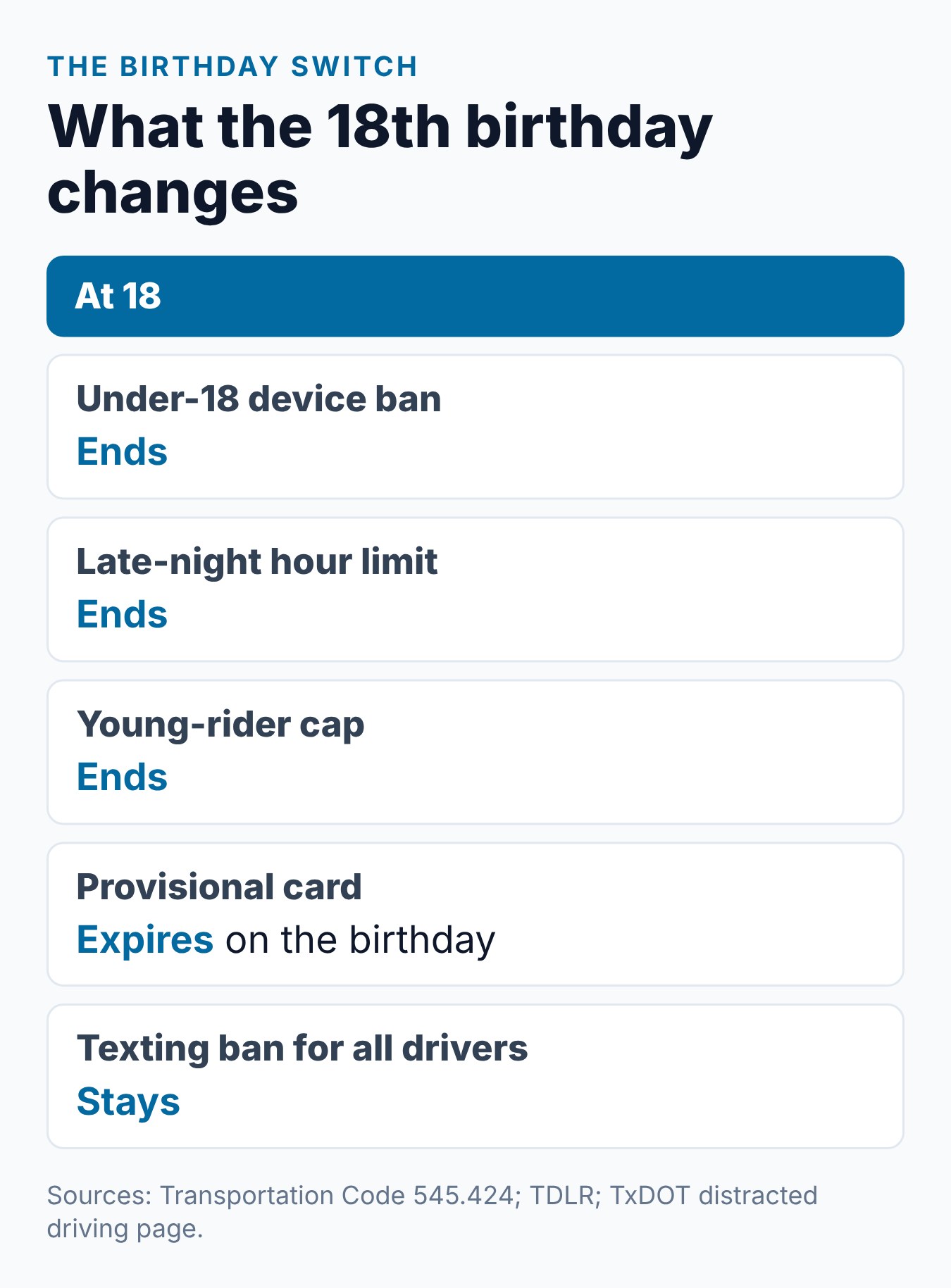
This table shows the change from the last day at 17 to the renewed license at 18:
| Topic | Last day at 17 | After the 18th birthday and renewal |
|---|---|---|
| Device use while driving | Banned, hands-free included, except emergencies | The under-18 ban is gone; the texting ban for all drivers remains |
| Driving from 12 a.m. to 5 a.m. | Only for work, school activities or emergencies | No age-based hour limit |
| Riders under 21 who are not family | One at most | No age-based rider limit |
| License type | Provisional (under-18) license | Regular driver license |
| License status on the birthday | Expires that day | Renewed license in force |
The texting ban comes from TxDOT’s distracted driving page. It says reading, writing or sending a text while driving has been illegal in Texas since Sept. 1, 2017.
Read the table one row at a time. Each teen limit drops away, but the rules for every driver stay in force.
The 18th Birthday Expiration
Both teen licenses share the same end date. DPS says the learner license expires on the 18th birthday. TDLR says the same about the provisional license.
An expired license is a problem. So the renewal is not optional for a driver who wants to keep driving.
Mark the birthday on a calendar months ahead. That gives time to plan the renewal.
The end date is set by the birthday, not by the date the license was issued. A teen licensed at 16 and a teen licensed at 17 both see the license expire on the 18th birthday.
Renewing the License
The TDLR step-by-step guide says it plainly: “After turning 18, the student must renew the license to receive a regular driver license without restrictions.”
TDLR adds two details about renewal:
- Online renewal. The license can be renewed online.
- In person before 18. A teen who renews in person before turning 18 needs a parent or legal guardian.
TDLR calls the result “a regular driver license without restrictions.” The three teen limits are gone from that license. The traffic laws that bind every adult driver still apply.
For current renewal steps and fees, check the DPS driver license pages. The DPS fees page lists every fee in one place. We do not list an adult renewal fee here, since we only verified the under-18 fees.
A Stage-by-Stage Look at the Limits
The limits switch on and off as the teen moves through the license stages:
- Learner, from age 15: the phone ban applies. A licensed adult 21 or older rides in front, which lifts the late-night and passenger limits.
- Provisional, ages 16 and 17: the teen drives alone, so all three limits apply.
- Renewed license, 18 and older: none of the under-18 limits apply.
The middle stage is the only one with all three limits in force. It is also the stage that ends on the 18th birthday.
What Does Not Change at 18
Turning 18 removes the teen limits. It does not remove the rules for every driver.
- The texting ban. It applies to all drivers, at every age.
- Insurance. Texas Department of Insurance guidance on insuring a teen still matters. Talk to your insurer when the license changes.
- Other traffic laws. Every rule for adult drivers still applies.
Our teen driver insurance guide lists questions for your insurer.
How Long a Teen Drives Under the Limits
The span depends on the age at licensing. Simple subtraction gives the answer:
- Provisional license on the 16th birthday: 2 years under the limits.
- Provisional license at 16 and a half: 18 months.
- Provisional license at 17: 1 year.
- Provisional license at 17 and 9 months: 3 months.
The earliest a teen can get a provisional license is 16. So the longest span is two years. A teen licensed at 17 and a half spends six months under the limits, a quarter of that maximum.
What Can and Cannot Change the Timeline
The end date for the teen limits is fixed by age. Section 545.424 ties them to being under 18.
One rule does extend a teen timeline, but it is a different rule. The DPS learner license page says a teen must hold the learner license at least six months. If the learner license is suspended, the six months is extended by the number of days of the suspension.
That extension is about the learner stage only. It moves the earliest date for the provisional license.
It does not move the 18th birthday. Our six-month rule guide explains it.
Turning 18 Before the Six Months Are Up
DPS lists one exception to the six-month hold. A teen who turns 18 does not need to finish it.
Here is a quick example. A teen who gets a learner license at 17 years and 9 months turns 18 three months later. At that point the six-month hold no longer applies.
If Your Teen Is Still a Learner at 18
Some teens reach 18 before they get a provisional license. The learner license expires on the 18th birthday too, per DPS.
At that point, adult rules take over. The DPS apply page for adults sets these steps:
- Ages 18 through 24: complete a six-hour adult driver education course before the driving test.
- Age 25 and older: driver education is not required.
- Impact Texas Drivers: the certificate must be dated within 90 days of the skills test.
DPS’s adult first-license steps do not include a learner license. The six-month learner rule is for applicants under 18.
Using the Last Months Under the Limits
The months before 18 are a chance to practice what opens up later. The statute helps here.
The late-night and passenger limits do not apply while the teen drives with learner-level supervision. That means a licensed adult 21 or older in the front passenger seat.
So a parent can ride along on a late drive or a trip with several friends before the birthday. The phone ban still applies on those drives.
A Countdown Plan for Parents
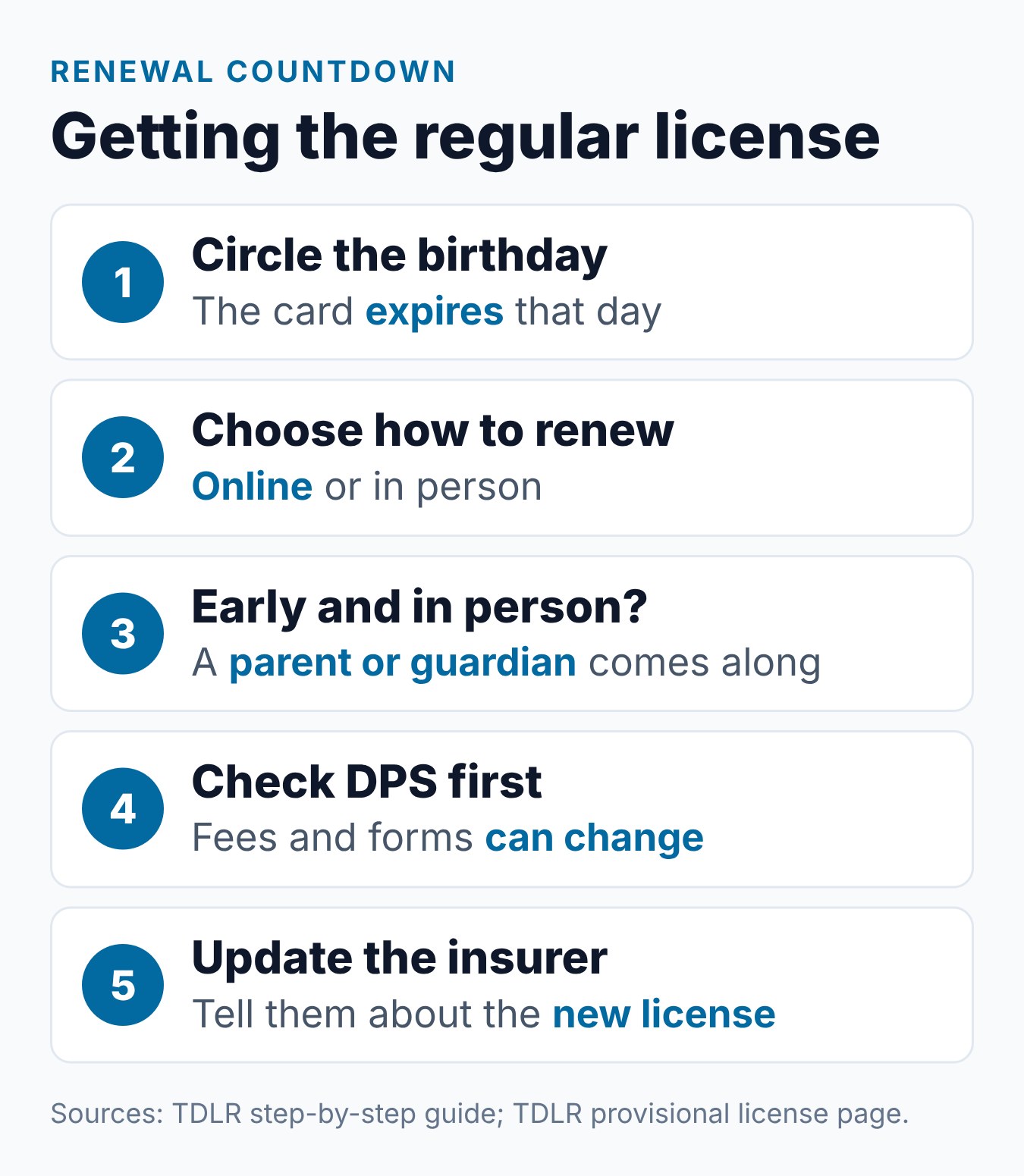
A plan keeps the change smooth. These steps follow TDLR and DPS:
- Note the birthday. The license expires that day.
- Pick a renewal method. Online, or in person.
- Bring a parent if renewing early in person. TDLR requires a parent or legal guardian before 18.
- Check current DPS steps. Fees and forms can change.
- Call the insurer. Update the policy for the new license.
Our Review of the Official Pages
On the TDLR parent-taught pages we checked on October 26, 2026, the 18th birthday was the end date for the provisional license. The step guide said the student “must renew the license” after turning 18.
The DPS provisional page, checked the same day, listed the three limits. Section 545.424 ties all three to drivers under 18. None of the pages we read named a way to end the limits before 18.
Common Mistakes About the End Date
Each of these misreads a TDLR, DPS or statute rule:
- Thinking the limits end at 17. They apply until 18.
- Driving on the expired license. The provisional license expires on the 18th birthday.
- Skipping the parent at an early in-person renewal. TDLR requires a parent or legal guardian before 18.
- Mixing up the six-month extension. A learner suspension extends the learner hold, not the 18th birthday.
- Forgetting the texting ban. It still applies after 18.
- Thinking graduation ends the limits. Only age ends them.
- Expecting a learner license to carry over. It expires on the 18th birthday, and adult rules apply after that.
For the stages before 18, see our graduated driver license guide. For the full licensing path, see our teen driver license guide.
How Requirements Can Vary
Texas driver education rules come from TDLR, and driver license rules come from Texas DPS. They apply statewide, but what you need depends on the student’s age, the course method, and whether the classroom part comes from a parent-taught course, a driving school, or a public school.
Fees, forms, and office procedures can change. Check the TDLR parent-taught pages and the DPS driver license pages before each step, and follow the instructions from your course provider.
Frequently Asked Questions
At what age do Texas teen driving restrictions end?
At 18. Transportation Code 545.424 applies to drivers under 18, so the limits stop on the 18th birthday.
Does the provisional license expire?
Yes. TDLR says it expires on the 18th birthday. The driver must renew to get a regular license without restrictions.
Can my teen renew online?
TDLR says the license can be renewed online. Check the DPS driver license pages for the current steps.
Can my teen renew before turning 18?
TDLR says a teen who renews in person before 18 needs a parent or legal guardian. Check DPS for current timing rules.
Can a ticket extend the restrictions past 18?
The limits in Section 545.424 are tied to being under 18. The extension rule on the DPS teen pages applies to the six-month learner hold, not to the 18th birthday.
What if my teen is still a learner at 18?
The learner license expires on the 18th birthday. From then on, DPS adult rules apply, including a six-hour adult driver education course for ages 18 through 24.
Do the limits end when my teen graduates?
No. Section 545.424 is tied to age, not school status. The limits end at 18.
Does the texting ban end at 18?
No. TxDOT says reading, writing or sending a text while driving is illegal for every Texas driver.
Conclusion
Texas teen driving restrictions end at 18, the same day the provisional license expires. Plan the renewal before that birthday, online or in person, to get a regular license, and remember the texting ban still applies. Driving Logic’s Texas Parent Taught Drivers Ed course is coming soon, and the TDLR step-by-step guide covers the renewal now.
Related Articles
- How to Get a Texas Driver’s License at 16: The Complete Teen Guide
- Texas Graduated Driver License (GDL) System: The Three Stages Explained
- Texas Provisional License Restrictions: Complete Rules for 16-Year-Old Drivers
- How Long Do You Need to Hold a Texas Learner’s Permit Before Getting Your License?
Sources
- Texas Transportation Code § 545.424 — Operation of vehicle by person under 18
- Texas DPS — Texas Provisional License as a Teen
- Texas DPS — Texas Learner License as a Teen
- Texas DPS — Apply for a Texas Driver License
- TDLR — Parent-Taught Provisional License
- TDLR — Parent-Taught Step-by-Step Guide (PDF)
- Texas DPS — Driver License Fees
Billy Forte is the owner of Driving Logic, a state-approved driver improvement course provider serving Texas and other U.S. states.
This article is general information, not legal advice. Texas driver education and licensing rules are set by TDLR, Texas DPS, and Texas law, and can change. Check the official TDLR and DPS websites for current requirements.