
Updated October 2026 · Reviewed by Billy Forte
The Texas PTDE concurrent method lets a teen take the first 6 hours of classroom instruction, get a learner license, and then finish the other 18 hours while practicing driving. The block method finishes all 24 classroom hours before the learner license. Both methods lead to the same 44 in-car hours, the same DE-964 certificate and the same DPS steps.
Key Facts
- Concurrent: 6 classroom hours, then the learner license, then 18 more hours while driving. See the concurrent method.
- Block: all 24 classroom hours come before the learner license. See the block method.
- Same totals: 24 classroom hours and 44 in-car hours either way. See what stays the same.
- Age floor: classroom can start at 14, but the learner license waits until 15 under both methods. See age and timing.
- One program per phase: changing between parent-taught and a school mid-phase means repeating hours. See changing programs.
Two Ways to Order the Classroom Hours
Every Texas teen course has a classroom phase of at least 24 hours. 16 TAC 84.500 sets that minimum, which took effect December 1, 2024. The two methods do not change the total. They change the order.
The DPS Choosing a Driver Education Course page names both methods. One lets classroom and driving overlap. The other keeps them apart.
In parent-taught driver education, the question is simple. Does your teen want the learner license after 6 hours, or after all 24?
How the Texas PTDE Concurrent Method Works
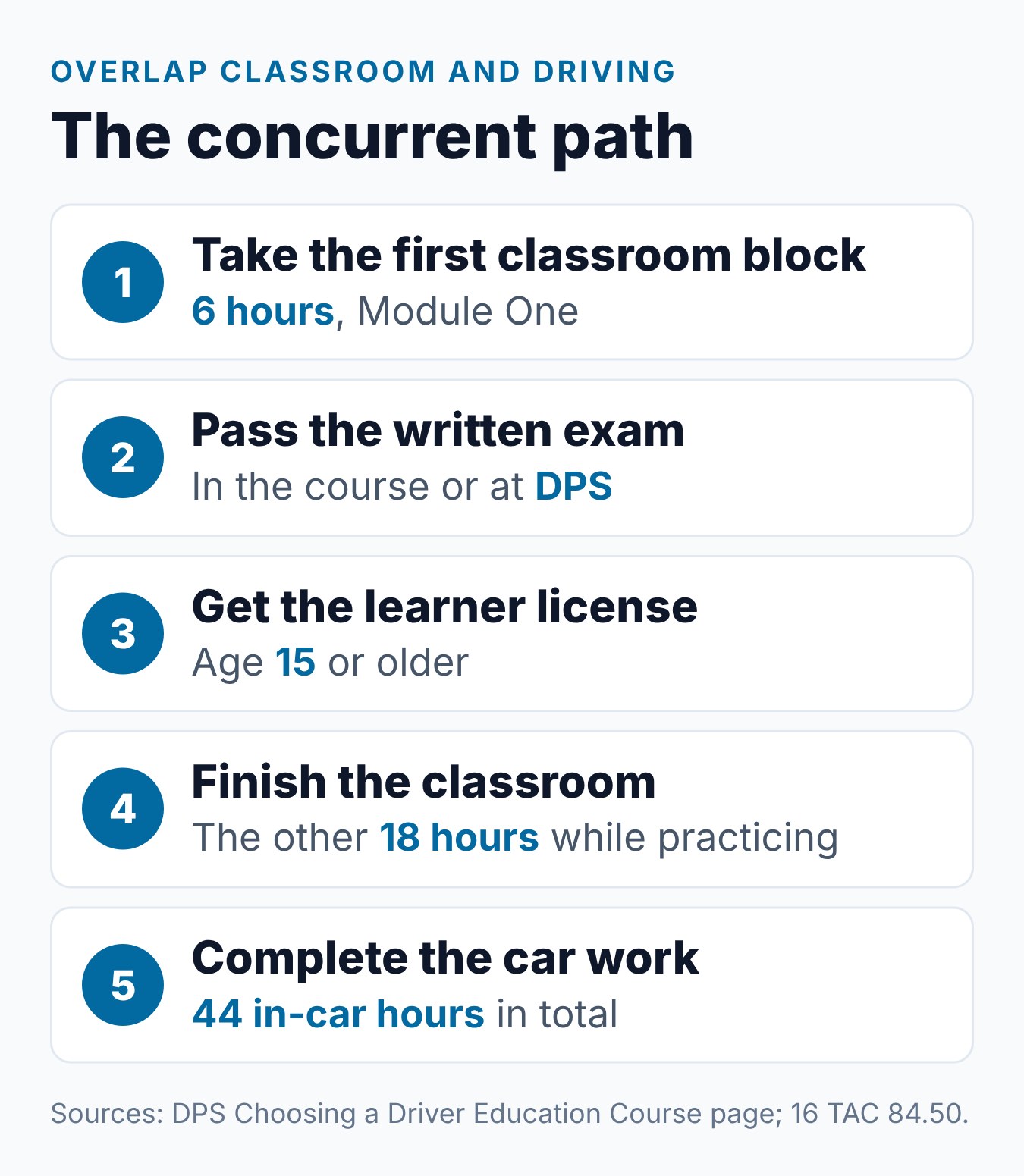
DPS lists four steps for the concurrent method:
- Take the first 6 hours of classroom instruction.
- Pass the learner’s permit written exam.
- Get the learner’s permit to practice driving with a licensed adult.
- Finish the remaining 18 hours of classroom instruction while practicing.
The first 6 hours are Module One. Under 16 TAC 84.43, the provider issues the “For Learner License Only” portion of the DE-964 after Module One. Our guide to Module One covers that first block of lessons.
The written exam can happen in two places. TDLR’s classroom page says the provider may include it. If not, the student takes it at the DPS office.
How the Block Method Works
The block method has three DPS steps:
- Complete all 24 hours of classroom instruction.
- Pass the learner’s permit written exam.
- Get the learner’s permit to practice driving with a licensed adult.
With block, the classroom phase is done before any driving starts. Once the learner license is issued, the in-car phase is the only thing left in the course.
Concurrent vs Block Side by Side
This table puts the two methods next to each other. Every row comes from the DPS course page or the TDLR and TAC rules.
| Question | Concurrent method | Block method |
|---|---|---|
| Classroom hours before the learner license | 6 | 24 |
| Classroom hours left after the learner license | 18 | 0 |
| Do classroom and driving overlap? | Yes | No |
| Earliest learner license age | 15 | 15 |
| When behind-the-wheel hours can start | After the learner license | After the learner license |
| In-car hours in the course | 44 | 44 |
| Final certificate | DE-964 driver license portion | DE-964 driver license portion |
The table shows where the methods split. It is only about timing in the classroom phase. After that, the two paths look the same.
The Tradeoffs
Neither method is required, and DPS lists both. Each one has a clear tradeoff.
What Concurrent Gives You
- Earlier driving. Practice can begin after 6 classroom hours instead of 24.
- An earlier learner license date. The six-month holding period starts when the learner license is issued.
- More to juggle. The teen does classroom lessons and driving practice in the same weeks.
That last point matters because of the daily cap. TDLR’s classroom page limits instruction to six hours a day, with no more than two hours behind the wheel. Classroom and in-car lessons share that cap.
What Block Gives You
- One phase at a time. The classroom work is done before driving starts.
- No sharing of the daily cap. Classroom hours are done before behind-the-wheel lessons need room in the six-hour daily limit.
- A later learner license. The teen waits for all 24 hours before applying.
How the Daily Cap Plays Out
The math is simple. Rule 84.50(d) caps instruction at six hours a day, with no more than two hours behind the wheel.
Under concurrent, a day with 2 hours of behind-the-wheel instruction leaves room for up to 4 more hours of instruction. Under block, the classroom days come first, so the cap only has classroom hours in it.
Practice drives have their own limit. The TDLR behind-the-wheel page allows no more than 2 hours of supervised practice a day.
Age and Timing
Age can shrink the gap between the methods. DPS says classroom can start at 14, but a student cannot apply for a learner license until at least 15.
Simple math shows why. Say a teen starts the classroom phase well before turning 15.
With block, there may be time to finish all 24 hours before the 15th birthday. In that case, the learner license comes at 15 under either method.
The reverse is also true. A teen who is already 15 can reach the learner license sooner with concurrent, since only 6 hours stand in the way. For the full schedule, see our guide on how long PTDE takes.
The Learner License Visit Under Each Method
The DPS visit looks the same with either method. Only the number of classroom hours behind it differs. The DPS learner license page asks for a driver education certificate and evidence of passing the knowledge exam.
For parent-taught students, the TDLR learner license page adds a few items:
- The DE-964 from the course provider.
- The designation receipt from the parent-taught instructor application.
- Vehicle papers: Texas vehicle registration and proof of insurance, or a signed statement if the student does not own a vehicle.
- The parent instructor on record, who must come along.
The learner license fee for a teen is $16 under either method.
Which Method Fits Your Family
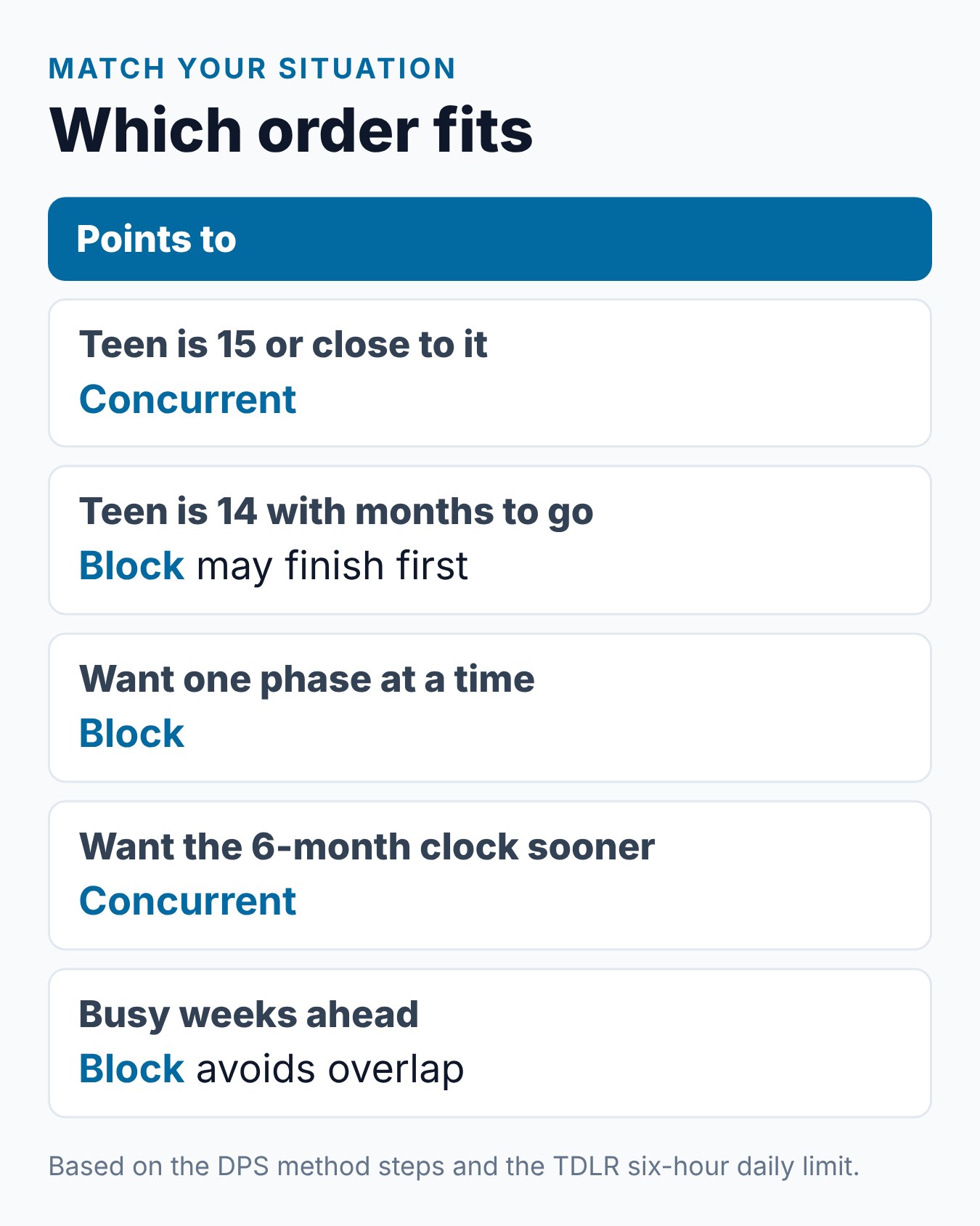
Use your teen’s age and your schedule to choose. These pointers follow from the DPS steps:
- Your teen is 15 or close to it. Concurrent can get the learner license sooner and start the six-month clock.
- Your teen is 14 with months before 15. Block may let the classroom phase finish before the learner license age arrives anyway.
- Your family prefers one thing at a time. Block keeps classroom and driving apart.
- Your weeks are already full. Block avoids fitting classroom and driving into the same days.
Before you buy, ask the provider how its course handles each method. The course must fit the order you plan to follow.
Questions to Ask a Provider About Methods
The method you plan has to match the course you buy. Ask the provider these questions first:
- Does the course support the concurrent method, the block method, or both?
- When does it issue the learner license portion of the DE-964?
- Does it include the knowledge exam, or will the teen take it at DPS?
- How does it track the 18 classroom hours left after the learner license?
What Stays the Same Either Way
The method only reorders the classroom phase. These rules apply to both:
- 24 classroom hours in total.
- 44 in-car hours under 16 TAC 84.50: 7 hours behind the wheel, 7 hours of observation and 30 hours of practice.
- At least 10 practice hours at night.
- No driving lessons before the learner license. Rule 84.50(k) says behind-the-wheel instruction and practice begin after the learner license.
- A 15-day floor. The TDLR behind-the-wheel page says the in-car course cannot be finished in fewer than 15 calendar days.
- Six months with the learner license before the provisional license.
Our guide to how Texas PTDE works online puts these rules in step order.
Changing Programs Mid-Phase
A separate rule covers who teaches each phase. Under 16 TAC 84.50(e), the parent may teach both phases. The family may also use a licensed driver education provider or a public school for either phase.
The catch is in subsections (f) and (g). The 14 hours of in-car instruction must be taught under one program. The classroom hours after Module One must also stay under one program.
The program choices are parent-taught, a licensed provider or a public driver education school. If the program changes before a phase is finished, the rule says all earlier driver education hours must be repeated. Plan who teaches each phase before it starts.
What We Found on the Official Pages
On the DPS course page we checked on October 26, 2026, the concurrent method had four steps and the block method had three. Both used 24 total classroom hours.
The TDLR parent-taught learner license page we checked the same day still showed an older, higher hour count for the block method. The current rule in 16 TAC 84.500 sets 24 hours, so plan around 24.
Common Mistakes
These mix-ups come from the DPS and TDLR rules:
- Driving after Module One but before the learner license. Practice waits until DPS issues the license.
- Expecting concurrent to cut hours. It changes the order, not the 24-hour total.
- Mixing programs mid-phase. Changing between parent-taught and a school before a phase ends means repeating hours.
- Forgetting the daily cap. Classroom and behind-the-wheel lessons share the six-hour daily limit.
- Trusting an old hour count. The classroom minimum is 24 hours since December 1, 2024.
How Requirements Can Vary
Texas driver education rules come from TDLR, and driver license rules come from Texas DPS. They apply statewide, but what you need depends on the student’s age, the course method, and whether the classroom part comes from a parent-taught course, a driving school, or a public school.
Fees, forms, and office procedures can change. Check the TDLR parent-taught pages and the DPS driver license pages before each step, and follow the instructions from your course provider.
Frequently Asked Questions
What is the concurrent method in Texas PTDE?
The teen takes the first 6 classroom hours, passes the written exam and gets a learner license. The other 18 classroom hours are finished while practicing driving.
What is the block method?
The teen completes all 24 classroom hours first. Then the teen passes the written exam and gets the learner license.
Which method gets my teen driving sooner?
The concurrent method, because only 6 classroom hours come before the learner license. The teen must still be at least 15.
Do both methods need the same number of hours?
Yes. Both use 24 classroom hours and 44 in-car hours. Only the order of the classroom hours differs.
Can we use a driving school for one phase and teach the other?
Yes. Under 16 TAC 84.50, the parent may teach both phases or use a licensed provider or public school for either phase. Each phase must stay under one program once it starts.
Does the concurrent method start the six-month clock sooner?
It can. The six-month holding period runs from the day the learner license is issued, and concurrent can bring that day earlier.
Is the written exam the same under both methods?
Yes. DPS lists passing the learner’s permit written exam as a step in both methods. The provider may include it in the course, or the teen takes it at DPS.
Conclusion
The Texas PTDE concurrent method puts the learner license after 6 classroom hours, while the block method waits for all 24. Both end with the same 44 in-car hours, the same DE-964 and the same DPS steps, so pick the order that fits your teen’s age and your weeks. Driving Logic’s Texas Parent Taught Drivers Ed course is coming soon, and TDLR’s provider search lists licensed parent-taught courses today.
Related Articles
- Parent Taught Drivers Ed Texas: The Complete PTDE Guide
- How Texas Parent Taught Drivers Ed Works Online: Step-by-Step
- How Long Does Texas Parent Taught Drivers Ed Take to Complete?
- Texas Learner’s Permit Online Course: What the First 6 Hours Cover
Sources
- Texas DPS — Choosing a Driver Education Course
- 16 Tex. Admin. Code § 84.500 — Courses of instruction (24 classroom hours)
- 16 Tex. Admin. Code § 84.50 — Parent-taught program requirements
- 16 Tex. Admin. Code § 84.43 — Driver education certificates
- TDLR — Parent-Taught Driver Education (Getting Started)
- TDLR — Parent-Taught Classroom Instruction
- TDLR — Parent-Taught Behind-the-Wheel Instruction
- TDLR — Parent-Taught Learner License
- Texas DPS — Texas Learner License as a Teen
Billy Forte is the owner of Driving Logic, a state-approved driver improvement course provider serving Texas and other U.S. states.
This article is general information, not legal advice. Texas driver education and licensing rules are set by TDLR, Texas DPS, and Texas law, and can change. Check the official TDLR and DPS websites for current requirements.