
Updated October 2026 · Reviewed by Billy Forte
The Texas graduated driver license system moves a new driver through three stages: a learner license at 15, a provisional license at 16 or 17, and a license without teen limits after 18. Each stage adds freedom and keeps some limits in place. This guide explains what each stage allows, what it requires, and which papers to bring.
Key Facts
- Stage one: a learner license at 15, with a licensed adult 21 or older in the front seat. See stage one.
- Stage two: a provisional license at 16 or 17, after at least six months as a learner. See stage two.
- Stage three: the under-18 license expires on the 18th birthday, and the driver renews. See stage three.
- Papers: each stage has its own document list. See learner papers and provisional papers.
- Fees: $16 for each license under 18. See fees.
What Graduated Licensing Means in Texas
Graduated licensing is a general name for a step system. A new driver starts with tight limits and earns more freedom over time.
On its teen pages, Texas DPS uses two license names: the learner license and the provisional license. People also call the learner license a learner’s permit.
The rules come from two places. DPS sets the license steps. Transportation Code 545.424 sets the limits for drivers under 18.
The Texas Graduated Driver License in Three Stages
This table compares the stages. It uses the DPS teen pages and the statute.
| Stage | Who it is for | Can drive alone? | Main limits | When it ends |
|---|---|---|---|---|
| 1. Learner license | Age 15 or older, under 18 | No | Adult 21+ in the front seat; no phone use | After at least 6 months, or at 18 |
| 2. Provisional license | Ages 16 and 17 | Yes | Phone ban; midnight to 5 a.m. limit; one young passenger | The 18th birthday |
| 3. Renewed license at 18 | Age 18 and older | Yes | None of the under-18 limits | Normal renewal |
Our learner vs driver license guide goes deeper on stages one and two.
Stage One: The Learner License
The learner license is the first stage. The DPS learner license page sets the minimum age at 15.
A learner never drives alone. A licensed adult 21 or older must sit in the front passenger seat. Cell phone use is banned, including hands-free, except in an emergency.
Before this stage, the teen starts a driver education course. Classroom work can begin at 14, says the DPS course page. The teen needs the first 6 hours (concurrent method) or all 24 hours (block method).
Papers for Stage One
DPS lists these items for a teen learner license:
- Form DL-14B, the application
- A parent or guardian at the office, or a notarized application
- Proof of U.S. citizenship or lawful presence
- Proof of Texas residency and identity
- A Social Security number
- The learner license portion of the DE-964 certificate
- Proof of passing the knowledge exam, if the course gave it
- A VOE form, high school diploma or GED
A VOE form is valid for 30 days. If it was issued June through August, it is valid for 90 days.
Parent-taught students add more, per the TDLR learner license page. They bring Texas vehicle registration, proof of insurance and the parent-taught designation receipt. The parent instructor on record must attend.
Stage Two: The Provisional License
The provisional license lets a teen drive alone. The DPS provisional license page says it “allows you to drive independently with some restrictions.”
To qualify, the teen must:
- Be 16 or 17
- Have held a learner license at least six months
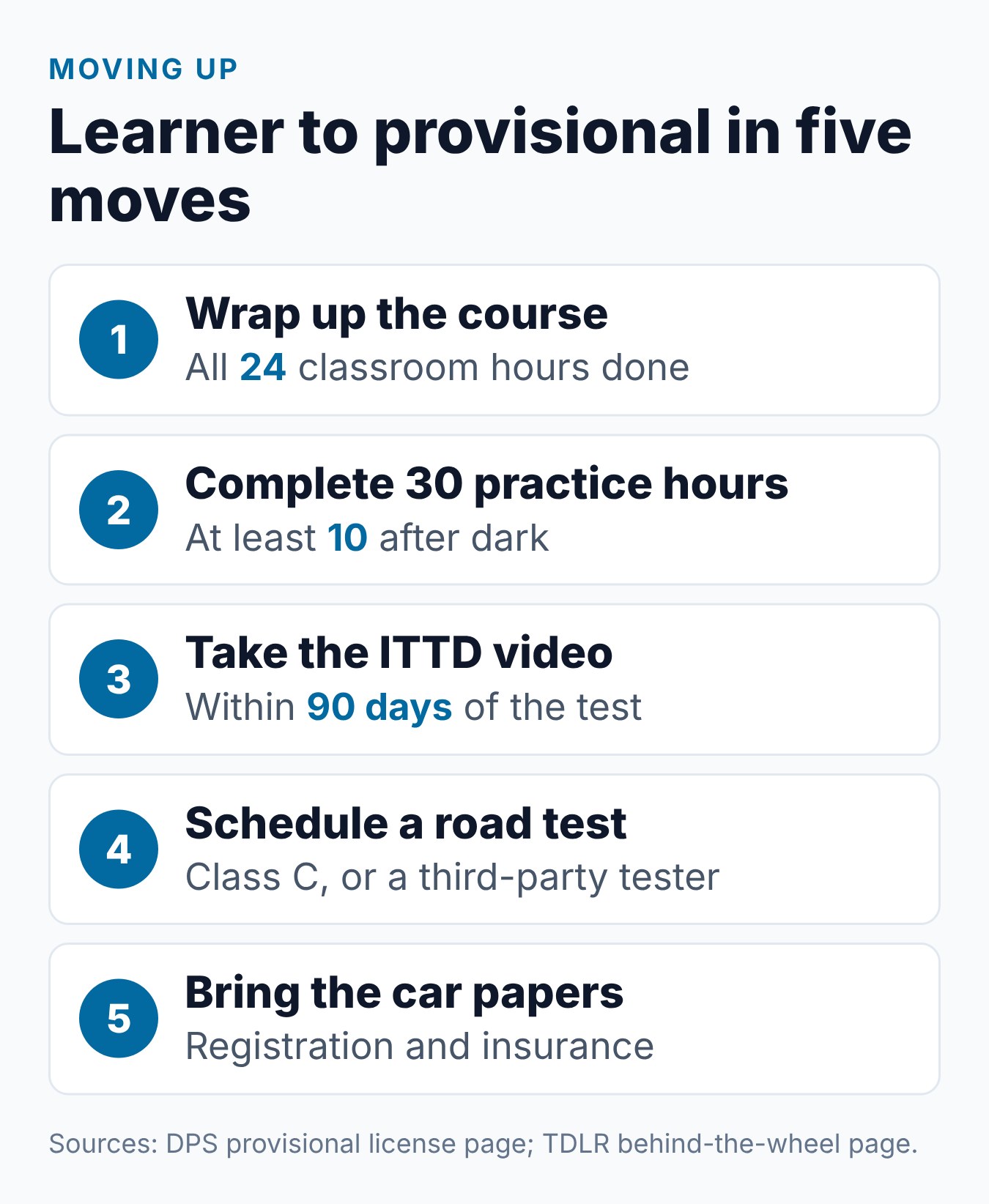
- Finish the full driver education course
- Log 30 hours of practice, with at least 10 at night
- Finish Impact Texas Teen Drivers (ITTD) within 90 days of the driving test
- Pass a vision exam and a driving test
The knowledge test is waived if the teen passed it during the course.
Papers for Stage Two
Bring these on test day:
- The driver license portion of the DE-964
- The printed ITTD certificate
- A VOE form, diploma or GED
- Identity documents
- Current registration and insurance for the test vehicle
For parent-taught students, the TDLR provisional license page says the parent instructor on record must go to the office.
The Limits at Stage Two
Three under-18 limits apply. The teen may not use a phone while driving, even hands-free, except in an emergency.
The teen may not drive from midnight to 5 a.m. unless it is for work, school activities or a medical emergency. And the teen may carry no more than one passenger under 21 who is not a family member.
Our guide to Texas provisional license restrictions covers each limit in detail.
Who Rides Along at Each Stage
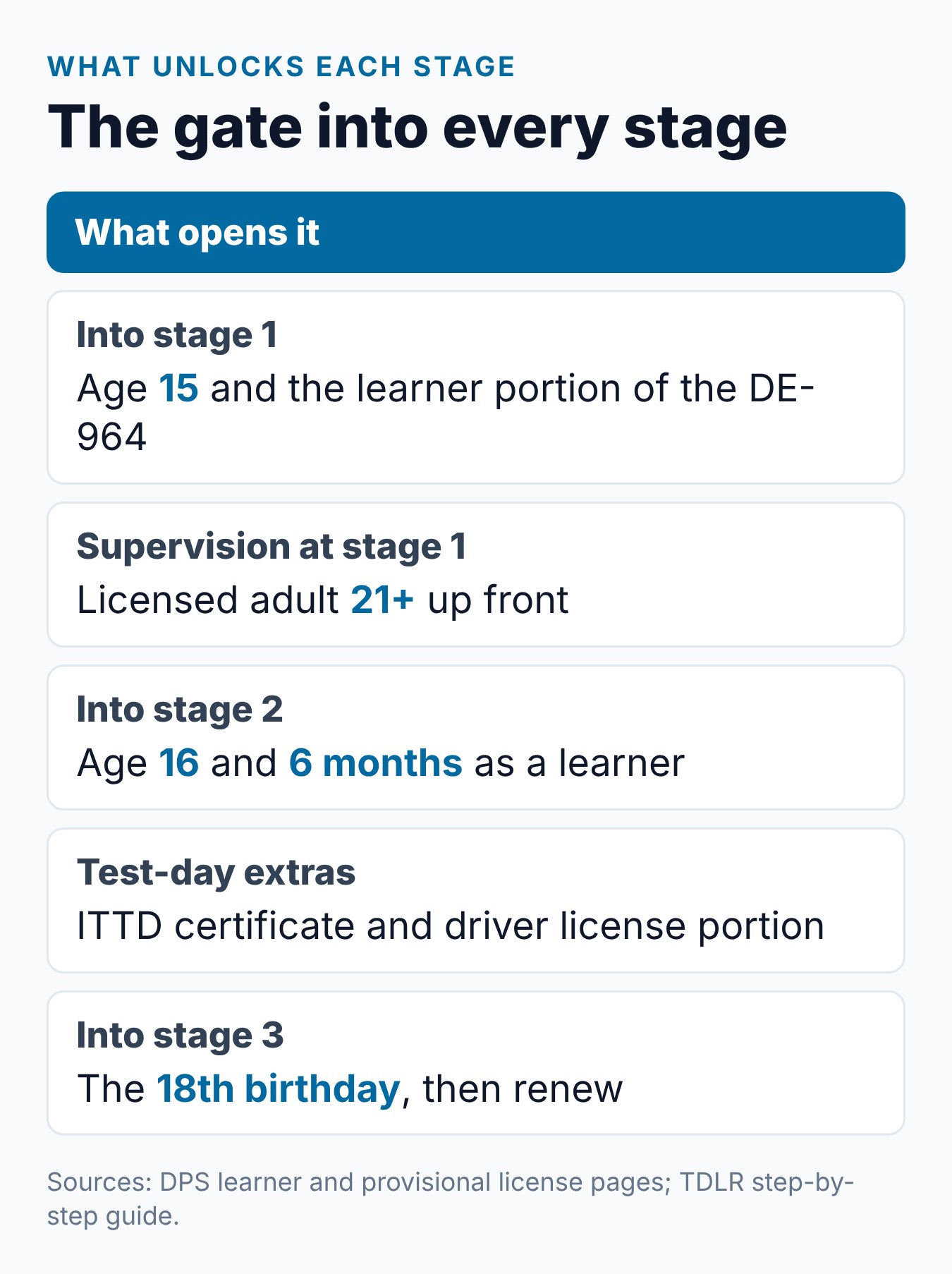
Supervision is the clearest difference between the stages. It shrinks as the teen moves up:
- Stage one: a licensed adult 21 or older sits in the front passenger seat on every drive.
- Stage two: the teen may drive alone, within the under-18 limits.
- Stage three: no under-18 limits remain after the renewal.
The 30 practice hours also have a rule for the adult. The TDLR behind-the-wheel page says the adult must be 21 or older and licensed at least one year. For a minor, a parent or legal guardian certifies the hours.
How the Under-18 Limits Line Up
The statute ties the limits to age, not to the card in the wallet. That changes how each limit fits the stages.
The phone ban reaches every driver under 18. So it covers a learner and a provisional driver alike.
The late-night and passenger limits work a little differently. Section 545.424 says they do not apply while the teen drives with the supervision a learner license requires. In practice, they matter most once the teen drives alone at stage two.
Where Driver Education Fits
The course runs across the first two stages. Its two certificate portions act like tickets:
- Learner license portion of the DE-964: issued after the first 6 classroom hours (concurrent) or all 24 (block). It opens stage one.
- Driver license portion of the DE-964: issued after the full course. It is needed for stage two.
The in-car phase is 44 hours under 16 TAC 84.50. That is 7 hours of observation, 7 hours of behind-the-wheel instruction and 30 hours of practice. None of it can start before the learner license is issued.
The in-car course also cannot be finished in fewer than 15 calendar days. TDLR’s daily limits cap supervised practice at 2 hours per day.
When Each License Expires
Both teen licenses share an end date. DPS says the learner license expires on the 18th birthday, and TDLR says the same for the provisional license.
A teen who turns 18 while still a learner is no longer bound by the six-month wait. DPS lists turning 18 as the exception to that rule.
Stage Three: Turning 18
The under-18 license does not last forever. TDLR says it expires on the 18th birthday.
The driver then renews. The TDLR step-by-step guide says, “After turning 18, the student must renew the license to receive a regular driver license without restrictions.”
TDLR adds two renewal details. The license can be renewed online. A teen who renews in person before 18 needs a parent or legal guardian.
Our guide on when teen driving restrictions end covers this stage.
What Each Stage Costs at DPS
The DPS fees page lists two teen fees:
- Learner license under 18: $16
- Driver license under 18: $16
That is $32 in DPS license fees across stages one and two. Course prices are separate and set by each provider. ITTD is free.
How Long Each Stage Lasts
Age sets the clock, not just time held. Here are three simple examples:
- Learner at 15 years and 0 months. Six months later the teen is 15 and a half. The provisional license still waits until 16.
- Learner at 15 years and 9 months. Six months later the teen is 16 years and 3 months. The six-month hold is what sets the date.
- Learner at 17 years and 8 months. The teen turns 18 four months later. At that point the six-month wait no longer applies.
A suspension during stage one adds time. DPS says the six months is extended by the number of suspension days. See our six-month rule guide.
How a Teen Moves Up a Stage
Moving from learner to provisional is the biggest jump. It takes the full course, the practice hours, ITTD and a road test.
The road test can be at a DPS office or with a third-party skills testing provider. For DPS, book at txdpsscheduler.com and choose “Class C” under Road Skills Test.
Our Review of the DPS Teen Pages
On the DPS learner and provisional license pages we checked on October 26, 2026, the two stages were on separate pages. The learner page listed the front-seat adult rule. The provisional page listed the three limits for drivers under 18.
The provisional page also said the teen must finish ITTD within 90 days of the driving test.
Common Mistakes With the Stages
These come from the DPS and TDLR rules:
- Driving alone as a learner. A licensed adult 21 or older must be in the front seat.
- Counting from the wrong date. The six months starts when the learner license is issued.
- Thinking the limits end at 17. They apply until 18.
- Skipping the renewal. The under-18 license expires on the 18th birthday.
- Using hands-free calls. The phone ban covers hands-free devices at both teen stages.
- Starting in-car hours early. Behind-the-wheel work begins only after the learner license is issued.
- Letting a 19-year-old supervise. The front-seat adult must be 21 or older.
For the full path from course to license, see our teen driver license guide.
How Requirements Can Vary
Texas driver education rules come from TDLR, and driver license rules come from Texas DPS. They apply statewide, but what you need depends on the student’s age, the course method, and whether the classroom part comes from a parent-taught course, a driving school, or a public school.
Fees, forms, and office procedures can change. Check the TDLR parent-taught pages and the DPS driver license pages before each step, and follow the instructions from your course provider.
Frequently Asked Questions
What are the stages of the Texas graduated driver license?
There are three. A learner license at 15, a provisional license at 16 or 17, and a license without the under-18 limits after the driver renews at 18.
Can a learner drive alone in Texas?
No. A licensed adult 21 or older must be in the front passenger seat whenever a learner drives.
How long must a teen stay at stage one?
At least six months, unless the teen turns 18 first. A suspension extends the six months by the number of suspension days.
What can a provisional driver do that a learner cannot?
Drive alone. The provisional driver still follows the under-18 limits on phones, late-night driving and young passengers.
Do adults go through the same stages?
No. The learner license and its six-month rule are for applicants under 18. DPS’s first-license steps for adults do not include a learner license.
Does the phone ban apply to learners?
Yes. The ban covers every driver under 18, including learners. It includes hands-free devices, with an exception only for emergencies.
What happens at 18?
The under-18 license expires on the 18th birthday. The driver renews to get a regular license without the under-18 limits.
Conclusion
The Texas graduated driver license path has three stages, and each one has its own papers and limits. Plan for six months as a learner, a road test at 16 or later, and a renewal at 18. Driving Logic’s Texas Parent Taught Drivers Ed course is coming soon, so check TDLR’s provider search for licensed courses in the meantime.
Related Articles
- How to Get a Texas Driver’s License at 16: The Complete Teen Guide
- Texas Provisional License Restrictions: Complete Rules for 16-Year-Old Drivers
- When Do Texas Teen Driving Restrictions End?
- Texas Learner’s Permit vs Driver’s License: What’s the Difference?
Sources
- Texas DPS — Texas Learner License as a Teen
- Texas DPS — Texas Provisional License as a Teen
- TDLR — Parent-Taught Learner License
- TDLR — Parent-Taught Provisional License
- TDLR — Parent-Taught Behind-the-Wheel Instruction
- TDLR — Parent-Taught Step-by-Step Guide (PDF)
- 16 Tex. Admin. Code § 84.50 — Parent-taught program requirements
- Texas DPS — Choosing a Driver Education Course
- Texas DPS — Driver License Fees
- Texas Transportation Code § 545.424 — Operation of vehicle by person under 18
Billy Forte is the owner of Driving Logic, a state-approved driver improvement course provider serving Texas and other U.S. states.
This article is general information, not legal advice. Texas driver education and licensing rules are set by TDLR, Texas DPS, and Texas law, and can change. Check the official TDLR and DPS websites for current requirements.