
Updated October 2026 · Reviewed by Billy Forte
The best parent taught drivers ed Texas families can choose is the one that fits who has time to teach, because Parent Taught Drivers Ed (PTDE) and a driving school cover the same hours and lead to the same certificate. With PTDE, an eligible parent teaches the in-car lessons at home. With a driving school, the school’s instructors do that teaching, and the family still helps with practice hours.
Key Facts
- Same hours: both routes need 24 classroom hours and 44 in-car hours. See what stays the same.
- Who teaches: the parent instructor in PTDE, the school’s instructors in a driving school. See who teaches what.
- Parent time: TDLR says PTDE takes at least 7 weeks of daily instruction. See the time commitment.
- Fees: the $20 TDLR designation is for PTDE only. DPS license fees apply to both. See official fees.
- Best fit: it depends on your family, not on a ranking. See which families each route fits.
What Stays the Same on Both Routes
PTDE is not a shortcut. The Texas Department of Licensing and Regulation (TDLR) sets the same course hours for every teen course.
Under 16 TAC 84.500, the classroom minimum for minors is 24 hours. That rule took effect on December 1, 2024.
The in-car phase is also the same size. TDLR’s parent-taught overview lists these parts:
- 7 hours of in-car observation
- 7 hours of behind-the-wheel instruction
- 30 hours of behind-the-wheel practice, with at least 10 at night
Both routes end with the same paper. The course provider issues the Texas Driver Education Certificate of Completion, called the DE-964. Our DE-964 guide explains its two portions.
The Department of Public Safety (DPS) steps match too. Your teen gets a learner license at 15 or older and holds it at least six months. Then your teen can test for a provisional license at 16.
Who Teaches What on Each Route
The big difference is the person in the passenger seat during lessons. Here is how the work splits:
| Part of the course | Parent-taught (PTDE) | Driving school |
|---|---|---|
| Classroom lessons | Curriculum from a TDLR-licensed provider with the parent-taught endorsement | The school’s course |
| 7 hours of observation | Guided by the parent instructor | Run by the school |
| 7 hours of in-car lessons | Taught by the parent instructor | Taught by a school instructor |
| 30 hours of practice | A licensed adult 21 or older | A licensed adult 21 or older |
| TDLR instructor designation | Needed, one per child | Not needed |
The practice row is the same on both routes. TDLR’s behind-the-wheel page says the adult must be 21 or older and licensed for at least one year.
So a school takes the 14 in-car lesson hours off your plate. It does not take the 30 practice hours. Someone in your family still rides along for those.
For a closer look at how a school course runs, read our guide to teen driver education vs PTDE.
The Time Commitment for Parents
Time is the first thing to weigh. Look hard at your calendar before you decide.
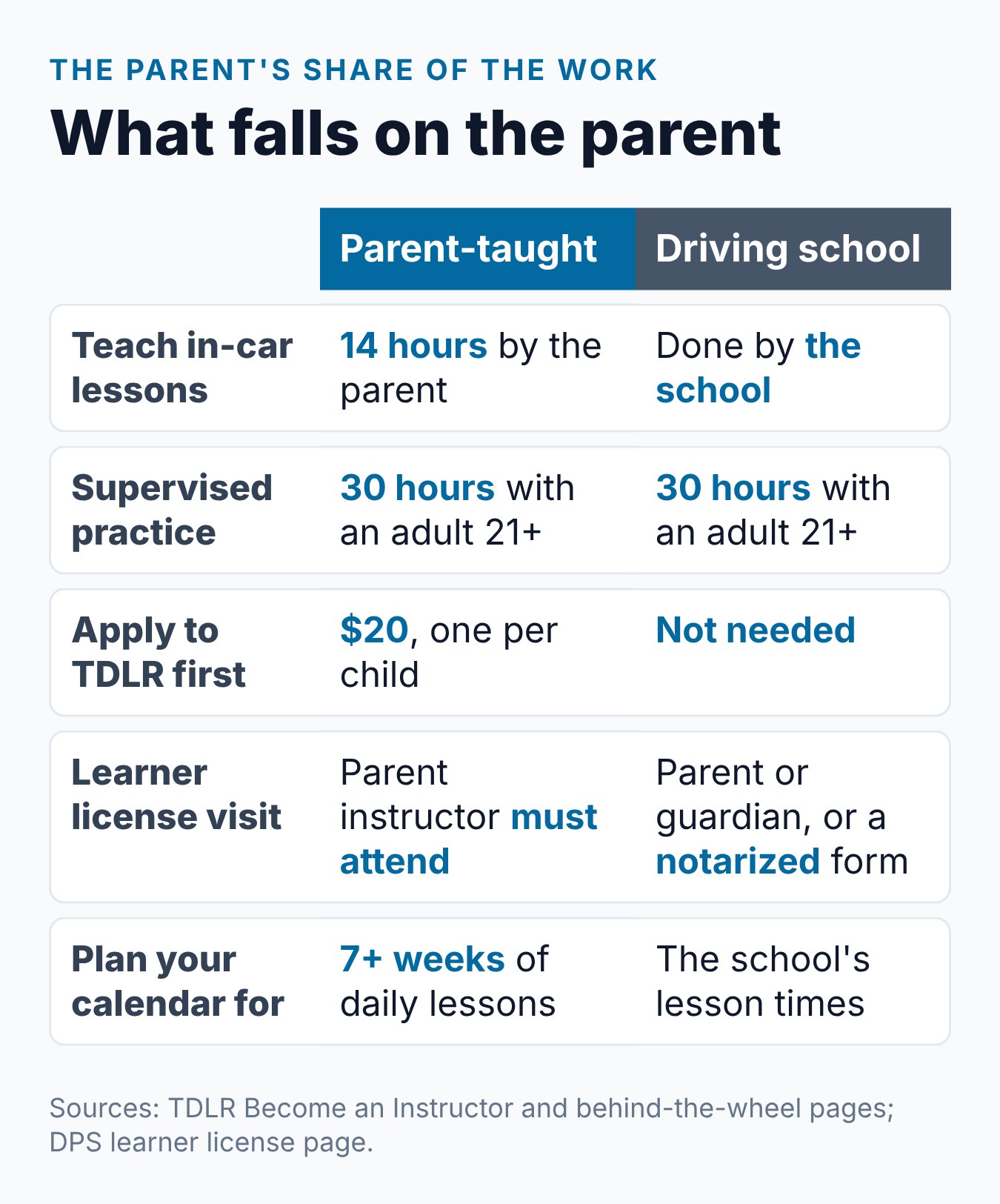
TDLR’s Become an Instructor page says parent-taught driver education requires “at least 7 weeks of daily instruction.” The same page says the instructor must go with the student to the DPS office twice.
Here is what a parent instructor signs up for:
- Teaching 14 hours in the car. That is 7 hours of observation and 7 hours of lessons.
- Guiding the classroom part. The parent works through the course with the teen.
- Keeping the 30-hour practice log. Students and parent instructors complete it together.
- Two DPS visits. The parent instructor on record attends for the learner license and the provisional license.
On the driving school route, the school teaches the 14 in-car hours. A parent or another licensed adult still supervises the 30 practice hours.
Daily Limits Shape the Pace
The rules cap each day, so no family can rush the in-car phase. TDLR’s classroom page limits instruction to six hours a day. No more than two of those hours can be behind-the-wheel.
Supervised practice also tops out at 2 hours a day, per the TDLR behind-the-wheel page. The in-car course cannot be finished in fewer than 15 calendar days.
Here is the math. Fourteen in-car hours at 2 hours a day take at least 7 days of lessons. Thirty practice hours at 2 hours a day take at least 15 days.
Schedule Control
PTDE puts the calendar in your hands. You pick the days and times for lessons, as long as you stay inside the daily limits.
That can help a family with shifting work hours or a teen with a busy sports season. You can also plan night practice when it suits your home.
A driving school runs on its own schedule. Ask the school how lessons are booked and how far ahead you need to plan.
The trade-off is simple. More control means more of the work falls on you.
Official Fees on Both Routes
This guide does not compare course prices. Each provider sets its own, and TDLR’s classroom page says prices vary.
The official fees are short and easy to compare:
- TDLR designation, $20. Only PTDE families pay it. It is non-refundable, and you need one per child.
- DPS learner license, $16. Both routes pay it, per the DPS fees page.
- DPS under-18 driver license, $16. Both routes pay it.
The Impact Texas Teen Drivers program is free on either route. For the full cost breakdown, see our PTDE cost guide.
Can Your Family Use PTDE?
Not every adult can teach. TDLR checks the instructor’s age, license history and driving record.
For example, the instructor must be at least 25 and must have held a license for at least seven years. A license with the B restriction does not qualify.
DPS checks the instructor’s record twice, once for each license. TDLR’s provisional license page warns that DPS may deny the license if the instructor is not eligible. Read the full list in our instructor requirements guide before you pick PTDE.
The Student Has Rules Too
TDLR also sets a school rule for parent-taught students. A student under 18 without a diploma or equivalent must have been in school for at least the past 80 days. A student in a high school equivalency program must have been enrolled for at least the past 45 days.
Before lesson one, wait for TDLR to confirm the designation. TDLR’s classroom page also says to wait for the training materials from your course provider. Every student needs the Texas Driver Handbook, which is online only, in English and Spanish.
Which Families Each Route Fits
There is no single best choice. These lists match each route to a family’s situation, using only what the rules require.
PTDE may fit your family when:
- An adult in the home meets every TDLR instructor rule.
- That adult can teach on a daily basis for at least 7 weeks.
- You want to set lesson times around work and school.
- The parent instructor can go to both DPS visits.
A driving school may fit your family when:
- No adult in your home meets the instructor rules.
- No one can commit to daily lessons for 7 weeks or more.
- You want a trained instructor to teach the 14 in-car hours.
- You still have a licensed adult for the 30 practice hours.
The Best Parent Taught Drivers Ed Texas Option Is the One You Finish
A course only helps once your teen completes it. Pick the plan your family can carry all the way to the DE-964 driver license portion.
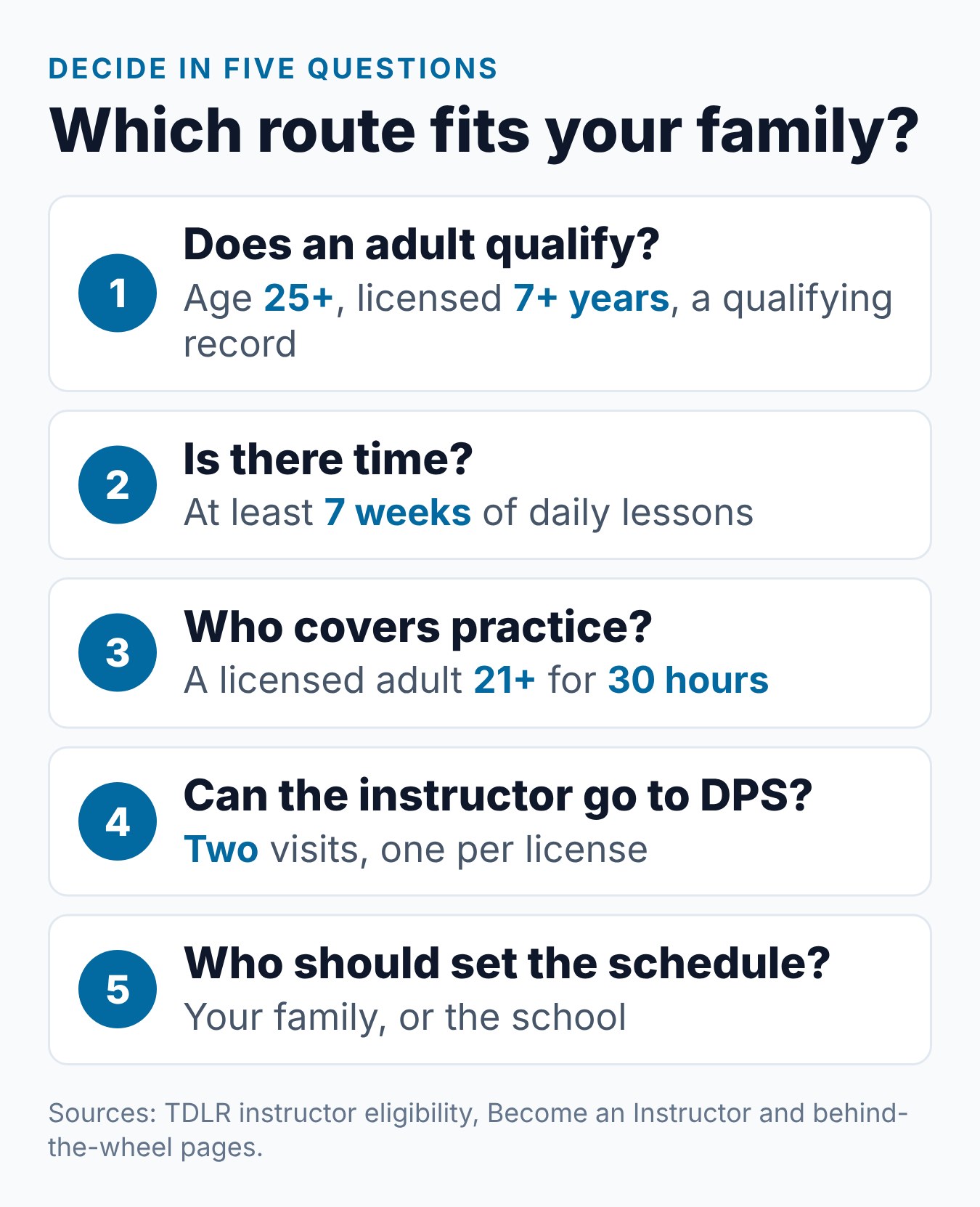
Ask each question below and answer it honestly:
- Does an adult in our home qualify as an instructor?
- Can that adult teach on a daily basis for at least 7 weeks?
- Who will supervise the 30 practice hours, including 10 at night?
- Can the parent instructor attend both DPS visits?
- Do we want to control the schedule, or hand it to a school?
If you answer “no” to the first two questions, a driving school is the clearer fit. If you answer “yes” to all five, PTDE is a real option.
A Mixed Route: Hybrid Classroom
You do not have to pick one source for everything. TDLR’s classroom page says the classroom hours can come from a driver education provider or a public school. The parent can then teach the in-car part.
Plan the switch with care. Under 16 TAC 84.50, hours in one phase must stay in one program. If you change methods before a phase is done, the earlier hours in that phase must be repeated.
So finish a phase before you change routes. Ask both providers how they handle the move.
Concurrent or Block on Either Route
Both routes use the same two classroom methods. The DPS Choosing a Driver Education Course page explains them.
With the concurrent method, the teen takes the first 6 classroom hours, gets the learner license, then finishes the other 18 while practicing. With the block method, the teen finishes all 24 hours first. Our concurrent vs block guide compares them.
Common Mistakes When Choosing
These mistakes come from the official rules. Each one can cost time:
- Assuming PTDE needs fewer hours. Both routes need 24 classroom hours and 44 in-car hours.
- Skipping the instructor check. DPS may deny the license if the instructor is not eligible.
- Starting lessons too early. In-car lessons begin only after the learner license is issued.
- Forgetting the practice hours. A school does not replace the 30 hours with a licensed adult.
- Switching mid-phase. Hours in an unfinished phase must be repeated.
- Applying once for two kids. TDLR needs a separate application for each child.
How Requirements Can Vary
Texas driver education rules come from TDLR, and driver license rules come from Texas DPS. They apply statewide, but what you need depends on the student’s age, the course method, and whether the classroom part comes from a parent-taught course, a driving school, or a public school.
Fees, forms, and office procedures can change. Check the TDLR parent-taught pages and the DPS driver license pages before each step, and follow the instructions from your course provider.
Frequently Asked Questions
Is parent-taught or a driving school better in Texas?
Neither is better by rule. Both cover the same hours and lead to the DE-964. The right choice depends on who can teach and how much time your family has.
Do both routes need the same number of hours?
Yes. Each route needs 24 classroom hours and 44 in-car hours. The in-car hours include 7 of observation, 7 of lessons and 30 of practice.
Does a driving school handle the 30 practice hours?
No. The practice hours are done with a licensed adult 21 or older who has been licensed at least one year. A family member can be that adult.
What fees apply only to PTDE?
The $20 TDLR instructor designation applies only to PTDE. The $16 DPS learner license fee and the $16 under-18 license fee apply on both routes.
How much time does PTDE take a parent?
TDLR says to plan for at least 7 weeks of daily instruction. The parent instructor also goes to the DPS office twice.
Can we switch from PTDE to a driving school?
You can, but timing matters. Hours in one phase must stay in one program, so hours in an unfinished phase must be repeated after a switch.
What if no parent qualifies as an instructor?
A parent, legal guardian or judge can name a designee who meets the same rules. If no one qualifies, a driving school is the other route.
Conclusion
The best route is the one your family can finish, since PTDE and a driving school cover the same hours and lead to the same DE-964. Pick PTDE when an eligible adult has the time and wants schedule control, and pick a school when that time or eligibility is missing. Driving Logic’s Texas Parent Taught Drivers Ed course is coming soon, and until then you can check any provider with TDLR’s license search.
Related Articles
- Parent Taught Drivers Ed Texas: The Complete PTDE Guide
- Texas Teen Driver Education (TDE): What It Is and How It Compares to PTDE
- Who Can Teach Parent Taught Drivers Ed in Texas? Parent Eligibility Requirements
- Texas Parent Taught Drivers Ed Cost: What to Expect
Sources
- TDLR — Parent-Taught Driver Education (Getting Started)
- TDLR — Become a Parent-Taught Instructor
- TDLR — Parent-Taught Instructor Eligibility
- TDLR — Parent-Taught Classroom Instruction
- TDLR — Parent-Taught Behind-the-Wheel Instruction
- TDLR — Parent-Taught Provisional License
- 16 Tex. Admin. Code § 84.50 — Parent-taught program requirements
- 16 Tex. Admin. Code § 84.500 — Courses of instruction (24 classroom hours)
- Texas DPS — Choosing a Driver Education Course
- Texas DPS — Texas Learner License as a Teen
- Texas DPS — Driver License Fees
Billy Forte is the owner of Driving Logic, a state-approved driver improvement course provider serving Texas and other U.S. states.
This article is general information, not legal advice. Texas driver education and licensing rules are set by TDLR, Texas DPS, and Texas law, and can change. Check the official TDLR and DPS websites for current requirements.