
Updated October 2026 · Reviewed by Billy Forte
The road part of the Texas drivers license test grades four skills on every drive: control, observation, positioning and signaling. The Texas Driver Handbook also lists maneuvers you may be graded on, such as parallel parking, a quick stop at about 20 mph and backing about 60 feet. Losing more than 30 points, breaking a law, refusing instructions or driving dangerously means your application is not approved.
Key Facts
- Four skills: control, observation, positioning and signaling are graded on every drive. See the four skills.
- Maneuvers: parallel parking, a quick stop, backing, stop signs, signals, turns and more. See the maneuver list.
- Parking aids: a back-up camera is allowed, but automated parking is not. See parallel parking.
- Points limit: more than 30 points deducted means the application is not approved. See how scoring works.
- No set length: the handbook and DL-60 give no length for the drive. See length and route rules.
Where the Skills List Comes From
Texas DPS sets the road test. Its rules for the test are in the Texas Driver Handbook, form DL-7. Chapter 1 has a part called “The Driving Exam.” It names the skills and maneuvers the examiner may grade.
DPS also has a short form called DL-60, “How to Prepare for a Drive Test”. The DPS road test FAQ points to it. DL-60 repeats the same skills in plain words.
The person who grades you is a License and Permit Specialist, or LPS. You can test at a DPS office or with a driving school that DPS has certified. DPS says it audits and approves each school’s drive route.
The Four Skills on the Texas Drivers License Test
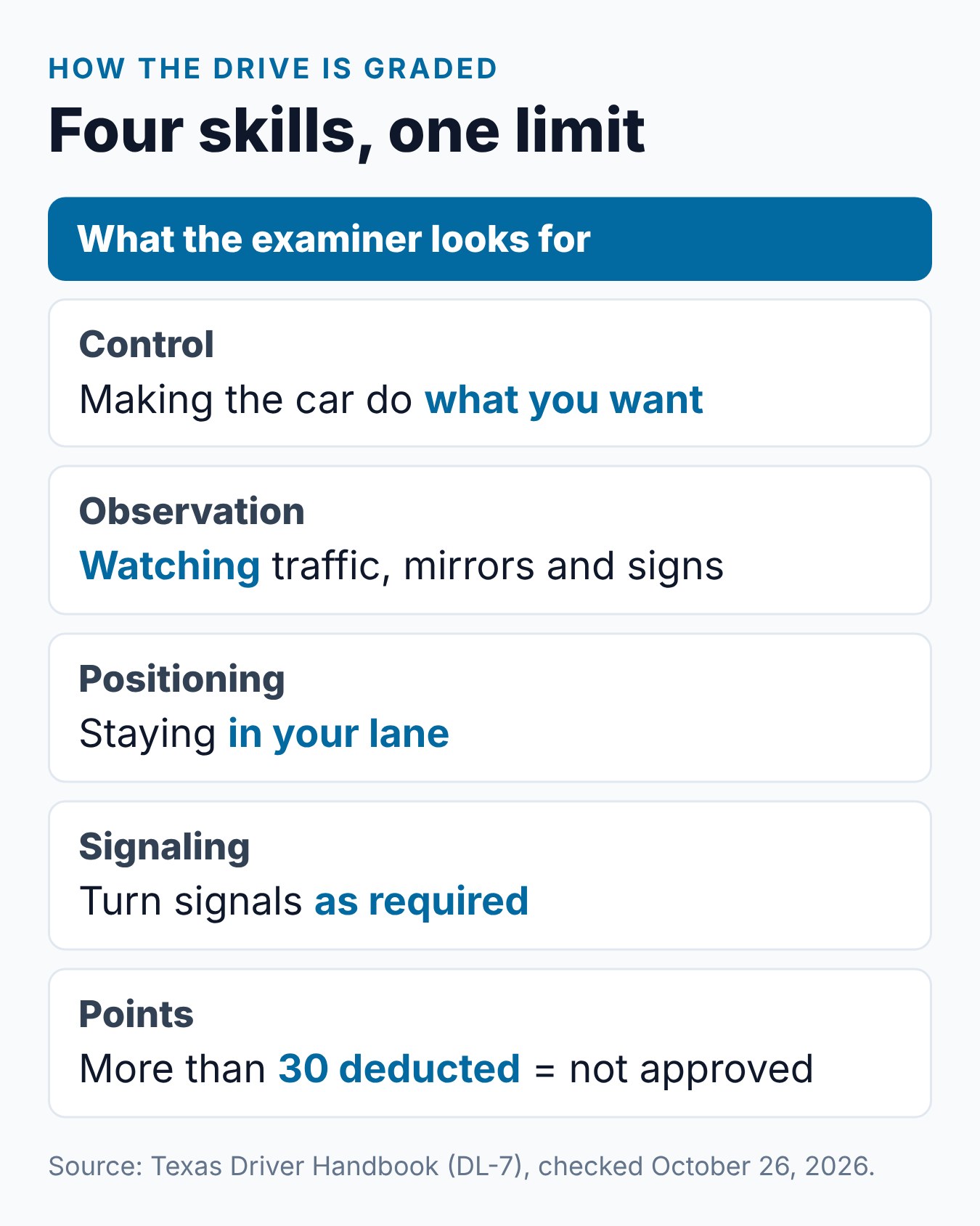
Every road test grades four skills. They run through the whole drive, not just one maneuver.
- Control. The handbook calls this “Your ability to make your car do what you want it to do.” It covers smooth steering, speed and braking.
- Observation. This is how you watch the road. DL-60 calls it “observing traffic.” It includes checking mirrors, looking at intersections and noticing signs.
- Positioning. The handbook says this is “Your ability to drive in your lane.” It also covers where the car sits at stops and in turns.
- Signaling. The handbook says this is “Your ability to use turn signals as required.” Signal before every turn and lane change.
These four skills matter on each item below. A clean parallel park can still lose points if you forget to look behind you first.
The Maneuvers DPS Lists
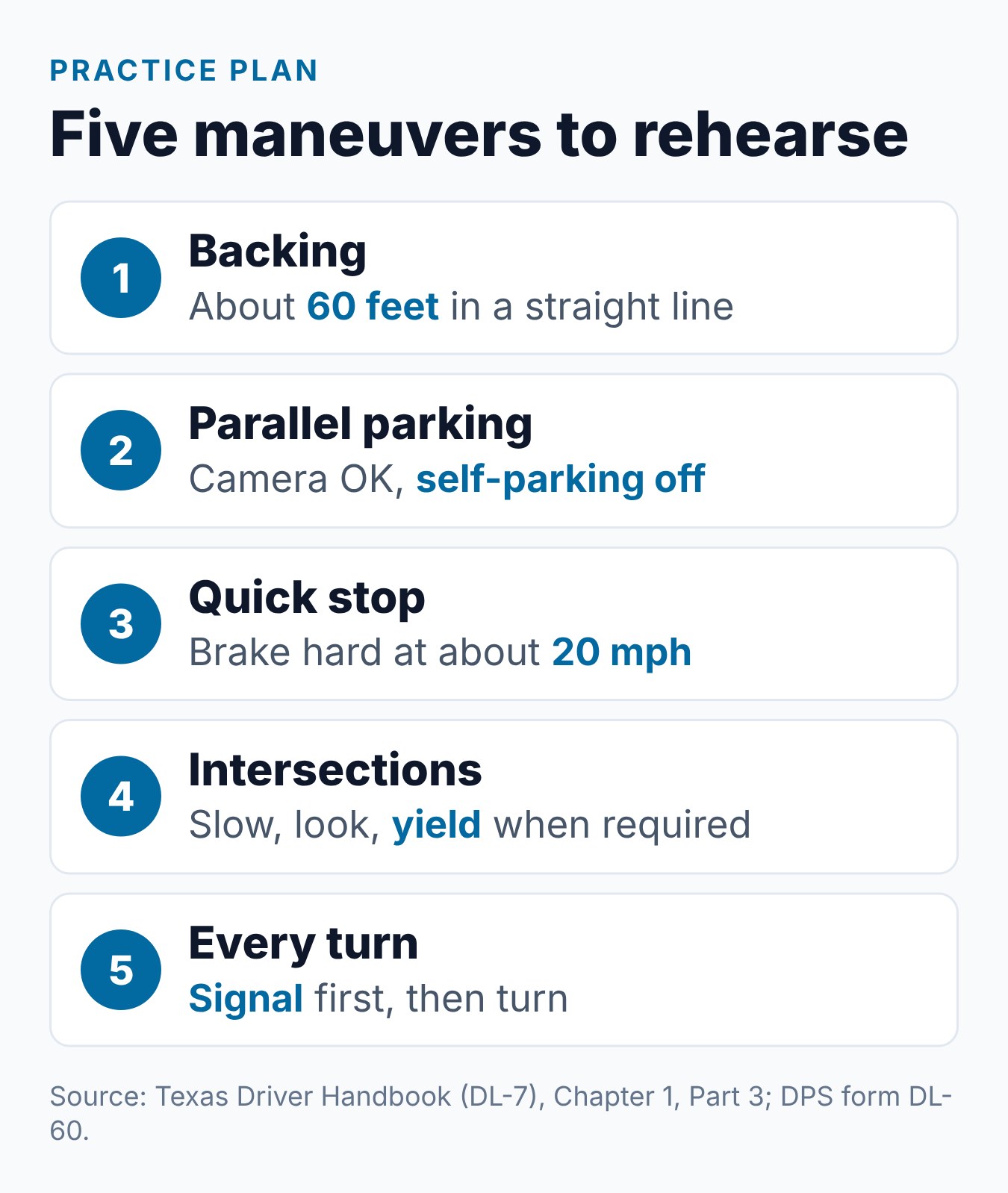
The handbook lists items you “may be graded on.” Here they are, with what DPS says about each one:
| Item on the list | What it means in practice |
|---|---|
| Parallel parking | Back-up camera allowed; automated parking not allowed |
| Quick stop | Stop “as quickly as possible” at about 20 mph |
| Backing | About 60 feet; DL-60 says “in a straight line” |
| Stop signs and traffic signals | Obey each sign and light on the route |
| Clutch use | Applies when the car has a manual transmission |
| Intersections and turns | Approach, look and turn from the right lane position |
| Right-of-way | Yield when the law says to |
| Following, passing and lanes | Keep space, pass legally and stay in your lane |
| Posture | How you sit and hold the wheel |
The word “may” matters. The examiner picks what fits the route. You might not do every item on one drive.
Parallel Parking
Parallel parking is on the list by name. The handbook allows a back-up camera to help you. It also says the automated vehicle parking function “will not be allowed.”
So if your car can park itself, turn that feature off. Use your mirrors, the camera if you have one, and a look over your shoulder.
Signal before you pull in. Check traffic behind you before you back up. Those two steps tie the maneuver to the observation and signaling skills.
The Quick Stop
The handbook asks you to “stop your car as quickly as possible at about 20 mph.” The examiner tells you when. This shows you can control the car in a sudden stop.
Keep both hands on the wheel and press the brake firmly. Keep the car straight in its lane. Then wait for the next instruction before you move.
Backing in a Straight Line
The handbook lists backing for about 60 feet. DL-60 calls it “backing in a straight line.” The goal is a slow, steady path without drifting.
Turn to look back, and use your mirrors too. Go slowly, and keep the car close to the curb or the line without touching it.
Intersections, Turns and Right-of-Way
Three list items cover intersections. They are intersection observance, turns and right-of-way. DL-60 adds “approaching intersections” and “turning.”
At each intersection, slow down and look both ways. Watch for people walking and riding bikes. Signal early and turn into the correct lane.
Right-of-way rules are in Chapter 4 of the handbook. Stop fully at stop signs. Yield when a sign or the law tells you to.
Following, Passing and Lane Use
The handbook lists following, passing and lane observance as one item. Keep a safe space behind the car ahead. Pass only where it is legal and safe.
Stay centered in your lane. Lane use also ties to the positioning skill, so drifting can cost points in more than one way.
Clutch Use and Posture
Clutch use only applies if your test car has a manual transmission. The examiner watches for stalls and rough starts.
Posture is how you sit. Sit upright with both hands on the wheel and your seat set so you can reach the pedals.
How Scoring Works
The examiner deducts points for errors. The handbook gives one clear number: your application “will not be approved” if you have more than 30 points deducted. It also lists three other conditions that stop an approval:
- You break a traffic law.
- You refuse to follow instructions.
- You drive dangerously or have a crash.
DL-60 adds one more detail. If you make a dangerous or illegal maneuver, the test stops right away, and the result is an automatic fail.
DPS does not publish a point value for each error. If a website shows a chart of points per mistake, DPS did not post it. Use the handbook list and the four skills to guide your practice instead.
Length and Route Rules
The handbook and DL-60 list only the items above. Some tips online name other maneuvers, but the handbook names the items you may be graded on.
Traffic laws still apply on the route. The handbook says your application will not be approved if you violate the law, refuse to follow instructions, drive dangerously or have a crash, or have more than 30 points deducted.
After the drive, the handbook says the examiner will explain all driving errors and let you know how to correct them. Use that feedback to plan your practice.
The handbook and DL-60 also give no length for the drive. Plan your day around your appointment, not a set test time.
Your Car and Its Features
You bring the car for the road test. The handbook says it must match the class of license you are applying for. For a first car license, that is Class C.
Some features help, and some are not allowed. Here is what DPS says:
- Back-up camera. Allowed for parallel parking.
- Automated parking. Not allowed.
- Manual transmission. Allowed; clutch use is then graded.
- Dealer cardboard tags. The handbook says they “may not be used” for driving exams.
The vehicle also needs valid registration and insurance. Our Texas driving test guide covers the full vehicle check and what to bring.
Who Takes the Road Test
DL-60 says a drive test is needed if any of these apply:
- You have never been licensed.
- Your license has been expired for more than two years.
- You have a medical condition that calls for a test.
- A restriction on your license requires one.
- A court ordered it.
The handbook adds that no one younger than 18 is exempt. For a first license, adults must pass all other exams first. That includes the vision test and the knowledge test.
New residents can be different. The DPS Moving to Texas page says adults 18 and older with a valid out-of-state license are exempt from the knowledge and skills exams. DPS also accepts a license not expired over two years.
Practicing the List
DL-60 gives simple advice. It says to practice every maneuver on the Driver Safety Checklist before you schedule. It also says to have someone instruct you and point out mistakes.
Turn the handbook list into a plan. Practice each item slowly at first. Then add the four skills to each one: look, signal, stay in position and keep control.
The handbook also says a licensed driver must drive the car to the office and test area if you are not licensed. Plan for that person on test day.
What We Found on the Official Pages
On the DPS pages we checked on October 26, 2026, the handbook was revision January 2026. Its driving exam part listed the graded items and the four skills. It did not give a point value for each error.
DL-60 listed the same core skills in plain words, including backing in a straight line and stopping in regular traffic. It said no pets or unauthorized passengers may ride during the test.
Common Mistakes to Avoid
Each of these comes from the DPS handbook or DL-60:
- Letting the car park itself. Automated parking is not allowed.
- Skipping a signal. Signaling is one of the four graded skills.
- Rolling through a stop sign. Breaking a law means the application is not approved.
- Arguing with an instruction. Refusing instructions also ends approval.
- Using dealer cardboard tags. The handbook says they may not be used.
- Bringing a pet or a friend along. DL-60 says no pets or unauthorized passengers.
If the test does not go well, see what to do if you fail the Texas driving test. To test outside a DPS office, read about third-party driver license testing.
How Requirements Can Vary
Texas driver license rules come from state law, Texas DPS rules and TDLR rules, and they apply statewide. What you need still depends on your age, whether you hold a license from another state, and which tests you have already passed.
Laws, fees and office procedures can change. Check the Texas DPS and TDLR websites for current rules before you book an appointment or enroll in a course.
Frequently Asked Questions
Is parallel parking on the Texas driving test?
Yes. Parallel parking is on the handbook list of items you may be graded on. You may use a back-up camera, but not an automated parking feature.
What are the four skills on the Texas road test?
They are control, observation, positioning and signaling. The examiner grades them across the whole drive.
How many points can I lose and still pass?
The handbook says your application will not be approved if more than 30 points are deducted. DPS does not publish how many points each error costs.
Can I use my back-up camera?
Yes. The handbook allows a back-up camera for parallel parking. Self-parking features are not allowed.
Does a third-party school test different skills?
DPS says certified schools give “the driving test” for Class C applicants, and it audits and approves each school’s route. Ask the school to explain its route and process before test day.
What happens right after the drive?
The handbook says the LPS “will explain all driving errors and let you know how to correct those errors.” You learn your result before you leave.
Conclusion
The Texas road test grades four skills and a short list of maneuvers from the DPS handbook. Practice each item with the handbook and DL-60, and keep your points well under the 30-point limit. Adults 18 to 24 also need the six-hour course before testing, and you can start with Driving Logic’s online Texas adult driver education course.
Related Articles
- Texas Driving Test: What to Expect and How to Prepare
- Failed Texas Driving Test? What to Do Next
- Texas Third-Party Driver’s License Testing: What It Is and Where to Go
Sources
- Texas DPS — Texas Driver Handbook (DL-7, PDF)
- Texas DPS — FAQ: Scheduling a Road Test
- Texas DPS — Apply for a Texas Driver License
- Texas DPS — Third Party Skills Testing Program
- Texas DPS — Moving to Texas
- 37 Tex. Admin. Code § 15.55 — Examination requirements
Billy Forte is the owner of Driving Logic, a state-approved driver improvement course provider serving Texas and other U.S. states.
This article is general information, not legal advice. Texas driver license and driver education rules are set by Texas law, Texas DPS and TDLR, and they can change. Check the official DPS and TDLR websites for current requirements before you apply.